
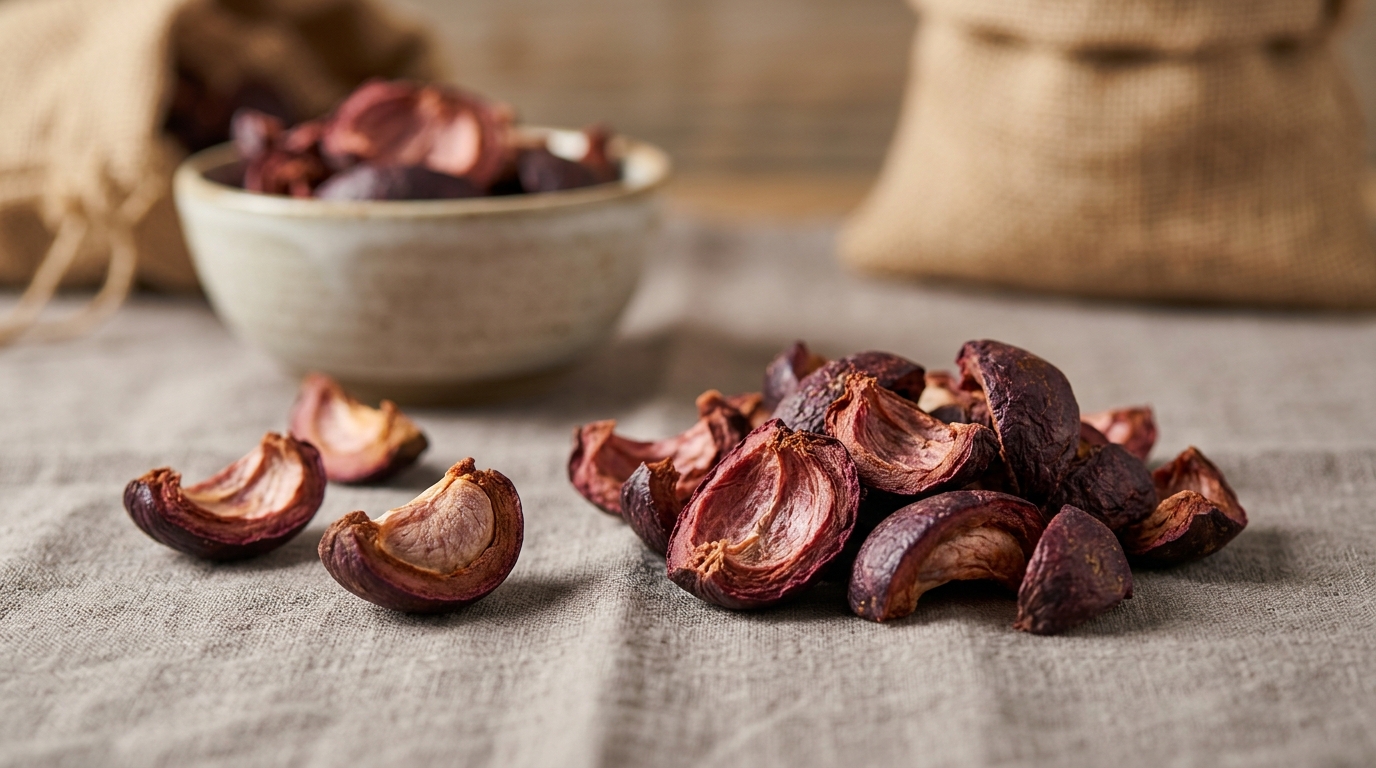
Dehydrated mangosteen looks like a simple ingredient, but procurement outcomes (cost, continuity, and claims risk) are largely determined by a few upstream “lock-in” points: aril recovery yield, drying endpoint control (moisture and water activity), and the ability of packaging + logistics to keep the product dry through ocean transit. This guide maps the physical chain and translates it into contractable specs and supplier governance levers.
Dehydrated mangosteen is physically constructed around one constraint: fresh fruit is highly perishable and bulky, while the usable edible portion (aril) is a small fraction of the whole fruit. That forces value creation (and cost) to concentrate near origin, where peeling/seed removal and drying must happen quickly and under tight hygiene control.
The chain is short in number of steps but dense in irreversible transformations—once fruit is peeled, trimmed, and dried, most downstream cost is about protecting that achieved dryness and preventing defects (moisture pickup, browning, foreign matter).
Orchard/collection → sorting for “processor-grade” fruit → manual peel/segment/de-seed → pre-treatment (anti-browning; optional sugar infusion) → drying (hot-air/vacuum/freeze-dry) → post-dry sorting + foreign matter controls → moisture-barrier packaging → ambient export with humidity management → destination QA hold + distribution.

Your supply continuity and spec consistency are structurally determined upstream (fruit maturity, labor throughput, drying method). Downstream nodes can’t “fix” a bad dry; they can only detect defects, rework at high cost, or reject.
Dehydrated mangosteen’s cost stack is dominated by (1) raw fruit economics and yield loss, (2) manual labor for aril recovery, and (3) energy/time in drying—while packaging and logistics act as “insurance” against humidity-driven quality loss.
If you want predictable specs, you are effectively paying for process control (labor discipline + validated drying + sorting + packaging integrity), not just fruit.
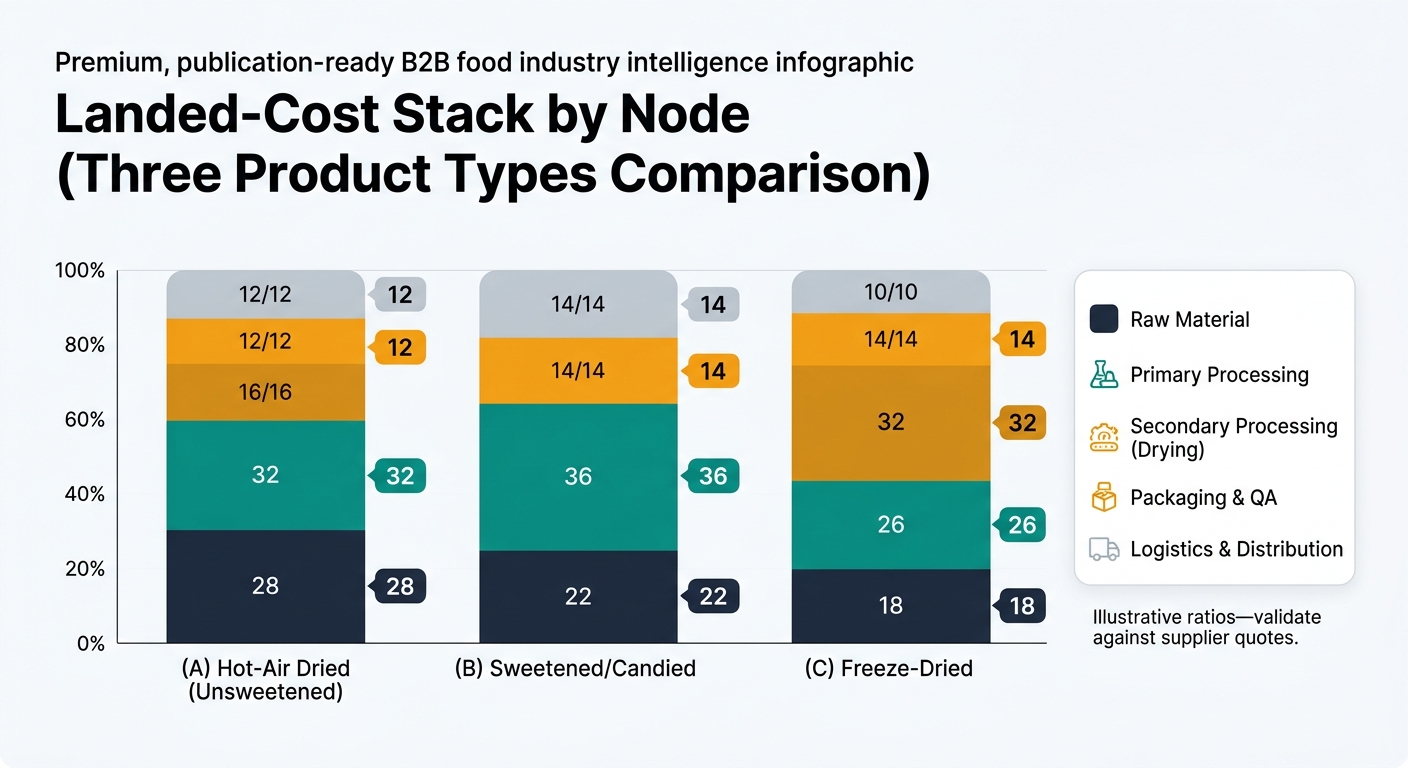
The ratios below are plausible for specialty dried-fruit ingredients and sum to 100%, but they are not “industry published standards” for mangosteen specifically. Use them as a negotiation framework to ask better questions (yield, labor minutes/kg, kWh/kg, packaging spec) and to sanity-check supplier explanations.
| Supply Chain Node | Cost Ratio (% of Final Cost) | Notes |
|---|---|---|
| Raw Material (fresh fruit) | 28% | Driven by seasonality, maturity, defect profile, and competition with fresh channels. |
| Primary Processing (peel/segment/de-seed + pre-treatment) | 32% | Labor + yield loss are structural; also where foreign matter risk is introduced/controlled. |
| Secondary Processing (hot-air drying) | 16% | Energy + time; tighter moisture/aw targets increase cost via longer cycles and more rejects. |
| Packaging & QA | 12% | Barrier film, desiccants/absorbers, lab tests, and inspection/sorting. |
| Logistics & Distribution | 12% | Inland to port + ocean freight + destination handling/QA holds. |
| Supply Chain Node | Cost Ratio (% of Final Cost) | Notes |
|---|---|---|
| Raw Material (fresh fruit) | 22% | Fruit cost share drops because added solids contribute to final weight. |
| Primary Processing + Sugar Infusion | 36% | Additional ingredients + process time + sanitation controls; stickiness increases handling losses. |
| Secondary Processing (drying/setting) | 14% | Lower water removal per unit weight than unsweetened, but tighter control needed to avoid tackiness. |
| Packaging & QA | 14% | Higher need for barrier packaging to prevent moisture-driven stickiness and clumping. |
| Logistics & Distribution | 14% | Similar freight profile; higher risk of quality drift if humidity managed poorly. |
| Supply Chain Node | Cost Ratio (% of Final Cost) | Notes |
|---|---|---|
| Raw Material (fresh fruit) | 18% | Often requires better fruit quality for premium sensory outcomes. |
| Primary Processing | 26% | Still labor-dominant; cut uniformity matters for even sublimation. |
| Secondary Processing (freeze-drying) | 32% | Capex + energy + long cycle times; throughput is the limiting factor [5]. |
| Packaging & QA | 14% | Very moisture-sensitive; strong barriers essential to protect crispness. |
| Logistics & Distribution | 10% | Lower spoilage risk if packaged well; damage/crushing risk can rise due to brittleness. |
Three structural realities shape supply, quality, and landed-cost reliability regardless of short-term price moves.
Understanding these constants helps you interpret supplier claims and predict where failures will occur.
Most quality disputes in dehydrated mangosteen trace back to a small set of measurable physical specs that map directly to specific nodes.
The highest-leverage spec anchors are moisture (%), water activity (aw), foreign matter limits (seed/peel/metal), cut-size distribution, color/browning tolerance, and (where applicable) added sugar solids and sulfite declaration.
If you tighten these specs without aligning them to the right process controls (primary trimming discipline, drying validation, post-dry sorting, barrier packaging), you increase rejection risk and lot-to-lot variability.
(Analyzed at: Sep, 2026)
Write your next dehydrated-mangosteen contract as if humidity exposure is guaranteed, not hypothetical: lock in a two-part dryness spec (moisture and aw) and a named “sorbent + high‑barrier” packaging requirement (film structure, seal integrity, desiccant/absorber use, and container humidity SOP). This works because aw is the stability control that correlates with mold risk, while freight volatility and disruption-driven dwell time make moisture pickup more likely in real lanes today [1]. What’s at stake is not a minor sensory issue: one wet-leaning lot can flip into holds, rework, or rejection—costing you the product value plus expedited replacement freight and lost production time, which can easily dwarf any single-digit unit-price “win.”


