
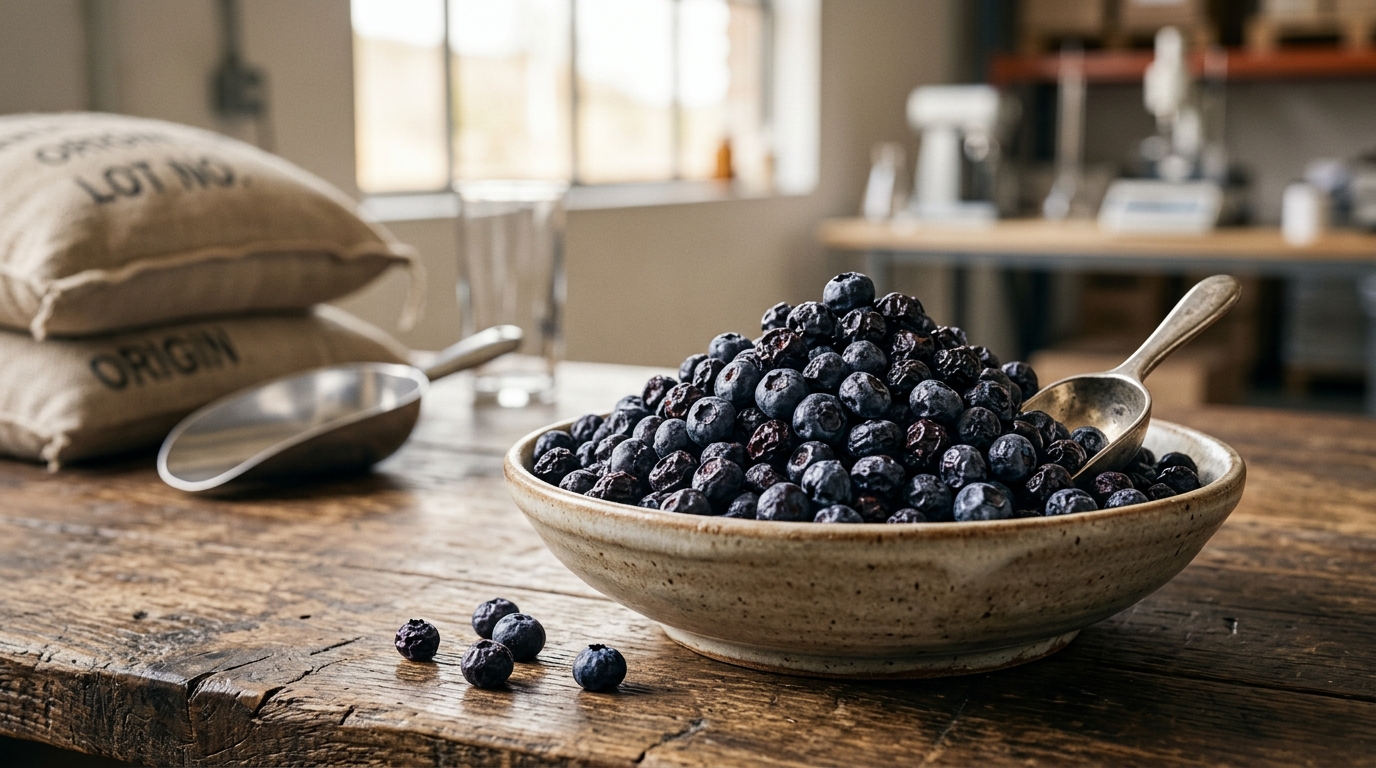
You can buy “dried blueberries” as if they’re a single ingredient, but operational outcomes (holds, rejects, audit findings, and disruption exposure) are driven by the physical pathway: what feedstock was used, how drying/infusion was run, and where the final lot was handled and packed.

Dehydrated blueberries are not a single commodity flow; they are a set of physical pathways that start with a short harvest window and then “stabilize” supply through freezing (IQF) and dehydration. The biggest fixed cost-drivers are (1) raw berry quality/yield at harvest, (2) energy and throughput in drying, and (3) post-process handling that protects water activity, color, and lot integrity.
Most industrial dried formats are produced either from fresh berries routed quickly into processing or from berries held frozen (commonly IQF) to extend the processing season. Commercial “dried blueberries” used as inclusions are frequently infused/sweetened before or during dehydration (an osmotic infusion step followed by drying) to hit texture targets and reduce brittleness; freeze-dried formats sit in a different cost/quality tier due to equipment intensity and longer cycle times.
When you see variability in moisture/aw, stickiness, piece integrity, or COA completeness, it usually traces back to one of three physical constraints: feedstock condition (fresh vs frozen), drying method/controls, or repacking/handling steps. Mapping which pathway your supplier is actually using is the foundation for consistent specs and fewer holds.
Cost accumulates in predictable places: farming sets the yield and defect baseline; freezing and dehydration convert seasonality into inventory (and financing); and packaging/QA protects a moisture-sensitive ingredient that can fail late (caking, oxidation, micro, foreign material) if controls are weak.
Dehydration is energy-intensive and yield-dilutive (you are paying to remove water and then protect the product from reabsorbing it). Infusion lines add ingredient inputs (sugars/juices), thermal steps, and cleaning/changeover complexity. Repacking introduces additional handling steps that can increase foreign material exposure and blur chain-of-custody unless lot coding and documented controls are strong.
For a buyer responsible for Quality/Safety/Compliance, the “cost story” is inseparable from control points: the same steps that add cost (sorting, metal detection, barrier packaging, hold-and-release testing) are also the steps that prevent rejects and recalls.
Farm economics are dominated by yield per acre, harvest labor, and the share of berries that meet processing grade; these determine how much usable fruit enters the dehydration pathway.
Blueberries are highly seasonal and weather-sensitive; softness, skin damage, and variable soluble solids at harvest affect downstream drying efficiency, piece integrity, and defect rates (stems, underripe berries, decay). U.S. processing-grade standards explicitly call out tolerances for stems/leaves/foreign material and decay/mold-type defects—useful anchors for upstream defect expectations.
Even though you buy “dried,” the physical quality ceiling is set here. If your application needs intact pieces (inclusions), upstream softness/skin damage shows up later as fines, smear, and higher foreign material sorting burden.
This node converts field variability into a more uniform feedstock and often uses IQF as the buffering mechanism that makes year-round dehydration possible.
Costs concentrate in high-capex sorting (optical/manual), wash systems, sanitation, and—if IQF is used—freezing energy plus cold storage and inventory carry. Sorting losses (reject streams) are a structural feature, not an exception.
If a supplier relies heavily on IQF feedstock, expect additional embedded costs from cold chain and financing—but typically better continuity and more consistent input specs. For compliance, this is where you want clarity on incoming inspection, sanitation, and how rejects are segregated.
Drying method and pre-treatments are the biggest determinants of texture, color retention, and shelf stability—and are also the largest controllable cost drivers (energy + throughput).
Hot-air/tunnel drying is generally the volume workhorse; vacuum drying can reduce thermal damage but adds equipment complexity; freeze-drying produces premium porous pieces/powders but is capex- and energy-intensive with longer cycle times. Infused/sweetened styles add syrup inputs and extra thermal steps, increasing cleaning/changeover load and variability in sugar pickup.
Your spec must match the physics: moisture % alone is not enough—water activity (aw) governs microbial growth potential and moisture migration behavior. Two products can share moisture content yet have different aw, and FDA guidance explicitly treats aw as a key stability/safety control for dried foods.
Dried blueberries are hygroscopic enough that packaging is a functional control, not a commodity input; repacking is also a common point where traceability and foreign material risk can increase.
Costs concentrate in barrier films/liners, cartonization, potential nitrogen flush (more common for premium/oxidation-sensitive formats), and in-line detection (sieves, magnets, metal detection/X-ray, optical sorting). QA costs include COA testing (moisture/aw; micro and chemistry as required), retention samples, and certification overhead (GFSI schemes where applicable). In trade, repacking also creates regulatory labeling/marking obligations (e.g., country-of-origin marking rules when repacked in the U.S.), which is a practical reason chain-of-custody documentation is often messy.
This node determines hold/release speed and nonconformance rates. If a supplier is a repacker/trader, you need explicit documentation of where detection steps occur (processor vs repacker) and whether COAs represent the final packed lot (not just the upstream processor lot or a blended lot).
Dried blueberries ship ambient, but temperature and humidity exposure still drive quality loss (caking, color fade/oxidation, package condensation risk).
Cost drivers include inland freight, container availability, insurance, and variability in port dwell time. Physical risk is driven by humidity cycling and long transit times; powders are especially sensitive due to high surface area and rapid moisture pickup. 2026 ocean freight outlooks still emphasize volatility (congestion/routing risk), so “ambient” does not mean low-risk for schedule or condition.
If you experience late-stage failures (clumping, off-notes, color loss), logistics conditions and packaging specs are prime suspects. This is where you align storage instructions, pallet configuration, and barrier requirements to your shelf-life expectation.

| Supply Chain Node | Cost Ratio (% of Final Cost) | Notes |
|---|---|---|
| Raw Material (berries) | 30% | Yield/grade at harvest sets usable input volume. |
| Primary Processing (sort/wash/IQF) | 12% | Sorting losses + freezing/cold storage if used. |
| Secondary Processing (infusion + drying) | 26% | Energy + syrup inputs + throughput constraints. |
| Packaging & QA (incl. detection) | 10% | Barrier packaging + metal detection/optical + COA. |
| Logistics & Distribution | 10% | Ocean/inland freight + variability in dwell time. |
| Manufacturer/Distributor Margin | 12% | Working capital + risk + service level. |
| Supply Chain Node | Cost Ratio (% of Final Cost) | Notes |
|---|---|---|
| Raw Material (berries) | 38% | Higher sensitivity to berry integrity and defects. |
| Primary Processing (sort/wash/IQF) | 12% | Uniformity work; IQF buffer may still apply. |
| Secondary Processing (drying) | 22% | Energy-driven; quality depends on control precision. |
| Packaging & QA (incl. detection) | 10% | Barrier packaging needed to prevent moisture pickup. |
| Logistics & Distribution | 8% | Ambient, but humidity/heat exposure matters. |
| Manufacturer/Distributor Margin | 10% | Capacity utilization and inventory carry. |
| Supply Chain Node | Cost Ratio (% of Final Cost) | Notes |
|---|---|---|
| Raw Material (berries) | 25% | Often higher-grade inputs to protect final appearance. |
| Primary Processing (sort/wash/IQF) | 10% | Tight sorting to reduce defects visible in final. |
| Secondary Processing (freeze-dry) | 38% | High capex + energy + longer cycle times. |
| Packaging & QA (high barrier) | 12% | Moisture/oxygen barrier critical; powder is sensitive. |
| Logistics & Distribution | 6% | Lower weight, but protection from humidity is key. |
| Manufacturer/Distributor Margin | 9% | Capacity and yield risk priced into margin. |
Three structural constraints shape dehydrated-blueberry availability, quality consistency, and compliance workload: seasonality at origin, the central role of frozen inventory, and the multi-tier nature of trade (processor vs repacker vs trader).
Blueberry supply begins with short, origin-specific harvest windows; processors often buy heavily during harvest and sell across many months, which makes inventory carry and storage conditions a built-in part of the product’s physical economics. Many commercial dried blueberries are infused/sweetened, which structurally changes ingredient declarations and can drive different process controls (syrup handling, sanitation, stickiness control). Multi-tier chains are common, especially when repacking is used to meet pack-size, labeling, or regional distribution needs.
These realities explain why two suppliers can “meet the same moisture spec” yet behave differently in your plant. They also explain why documentation can be inconsistent: COAs may reflect the processor’s lot, the repacker’s lot, or a blended lot unless chain-of-custody is explicit.
If your supplier uses frozen feedstock, cold storage and financing are embedded costs—and controls. That can improve continuity but adds quality dependencies (freeze/thaw handling, drip loss affecting drying behavior).
Moisture % is not interchangeable with aw. Two lots can share moisture but differ in microbial stability and caking behavior depending on sugar infusion, particle size distribution, and packaging barrier.
Every additional handling step increases exposure to foreign material and traceability ambiguity unless detection, segregation, and lot coding are robust.
The most reliable way to reduce downstream nonconformances is to align specs and documentation to the actual physical pathway (feedstock → drying method → handling/packing).
The chain’s fixed cost-drivers cluster around (1) sorting losses and raw yield, (2) energy/throughput in drying (especially freeze-dry), and (3) barrier packaging + detection controls that prevent moisture pickup and foreign material incidents.
If you standardize a small set of “physics-first” spec fields—feedstock (fresh/frozen), drying method, infusion status, moisture and aw, piece size distribution, and packing barrier requirements—you reduce the number of suppliers that look equivalent on paper but perform differently in production.
(Analyzed at: Aug, 2026)
In the current environment—where weather shocks can tighten berry availability (including documented 2026 freeze impacts in parts of the U.S. Southeast) and ocean freight remains volatile—your highest-leverage contract move is to tie price and service levels to a mandatory “pathway declaration” plus lot-level chain-of-custody: feedstock (fresh vs frozen), infusion status, drying method, and whether any repacking occurs after the validated lethality/kill step.
It works because most expensive failures (holds, sticky/caked product, foreign material incidents, COA disputes) originate exactly at those nodes, not in the PO. What’s at stake is rarely just a small ingredient delta—one avoidable hold/reject cycle can burn weeks of production time and force spot buys at materially higher delivered cost when the market is tight.


