

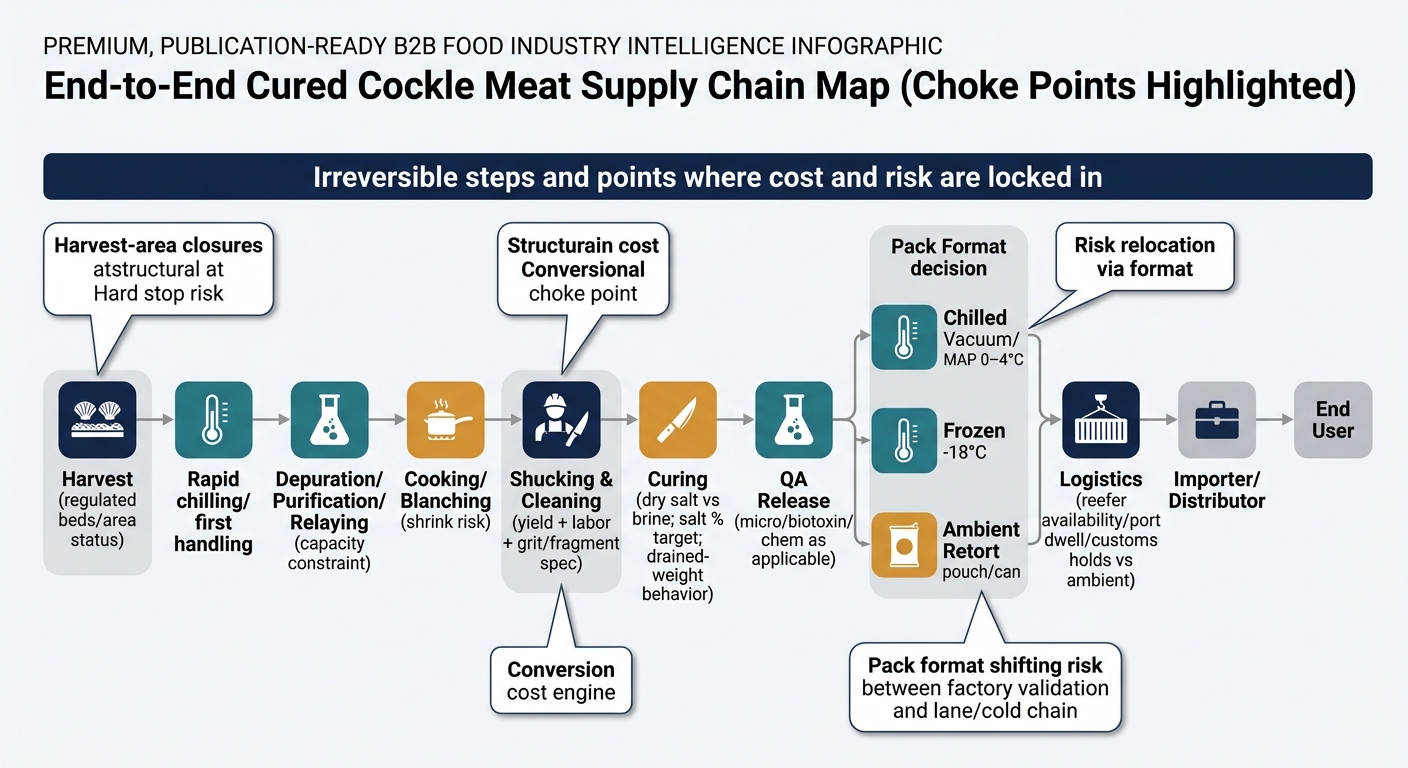
Procurement teams often treat cured cockle meat like a simple “processed seafood SKU.” In practice, you’re buying into a tightly regulated bivalve shellfish system where harvest-area controls, depuration/purification capacity, labor-heavy shucking yield, and pack-format choices lock in both cost and risk early—then amplify them in logistics and border holds.
Cured cockle meat is not a single “commodity lane”—it’s a chain of irreversible physical steps where cost and risk get locked in early (harvest handling, depuration/purification capacity, cooking + shucking yield), then compounded later (curing targets, packaging format, and cold-chain execution). The biggest structural constraint is that cockles are typically harvested from regulated beds/production areas: when areas close (biotoxins, pollution, stock rules), supply stops regardless of downstream demand [1].
Insight: The cured product’s landed cost is largely predetermined by three physical choke points: harvest window variability, labor-heavy shucking/cleaning, and the chosen preservation/pack format (chilled/frozen vs. ambient-retorted).
Data: Shellfish chains routinely carry mandatory monitoring/testing and may require depuration/purification/relaying steps depending on area classification and local rules; both add time and capacity constraints that cannot be “turned on” instantly during a tight season [5].
Procurement Impact: Your spec choices (salt %, drained weight, grit/sand tolerance, pack style) are not cosmetic—they decide which nodes dominate cost (labor vs. energy vs. packaging) and which failure modes dominate risk (border holds/detentions, temperature excursions, texture breakdown).
Insight: In cured cockle meat, “value add” is mostly conversion (yield loss + labor) and assurance (monitoring/testing/traceability/cold chain), not branding.
Data: The same raw cockle can produce materially different unit economics depending on: (a) cook shrink + shuck yield, (b) rework needed to hit low grit/shell-fragment specs, and (c) whether the format is ambient-stable (retorted) or cold-chain dependent. (Yield ranges for bivalves vary widely by species and raw condition; published processing references show broad yield bands and highlight overcooking shrink as a real loss mechanism.) [2]
Procurement Impact: Understanding which node is driving cost lets you interpret quotes correctly (e.g., a low unit price can hide higher defect risk or weaker drained-weight control; an ambient pack can rationally price higher because it substitutes processing/packaging cost for logistics risk).
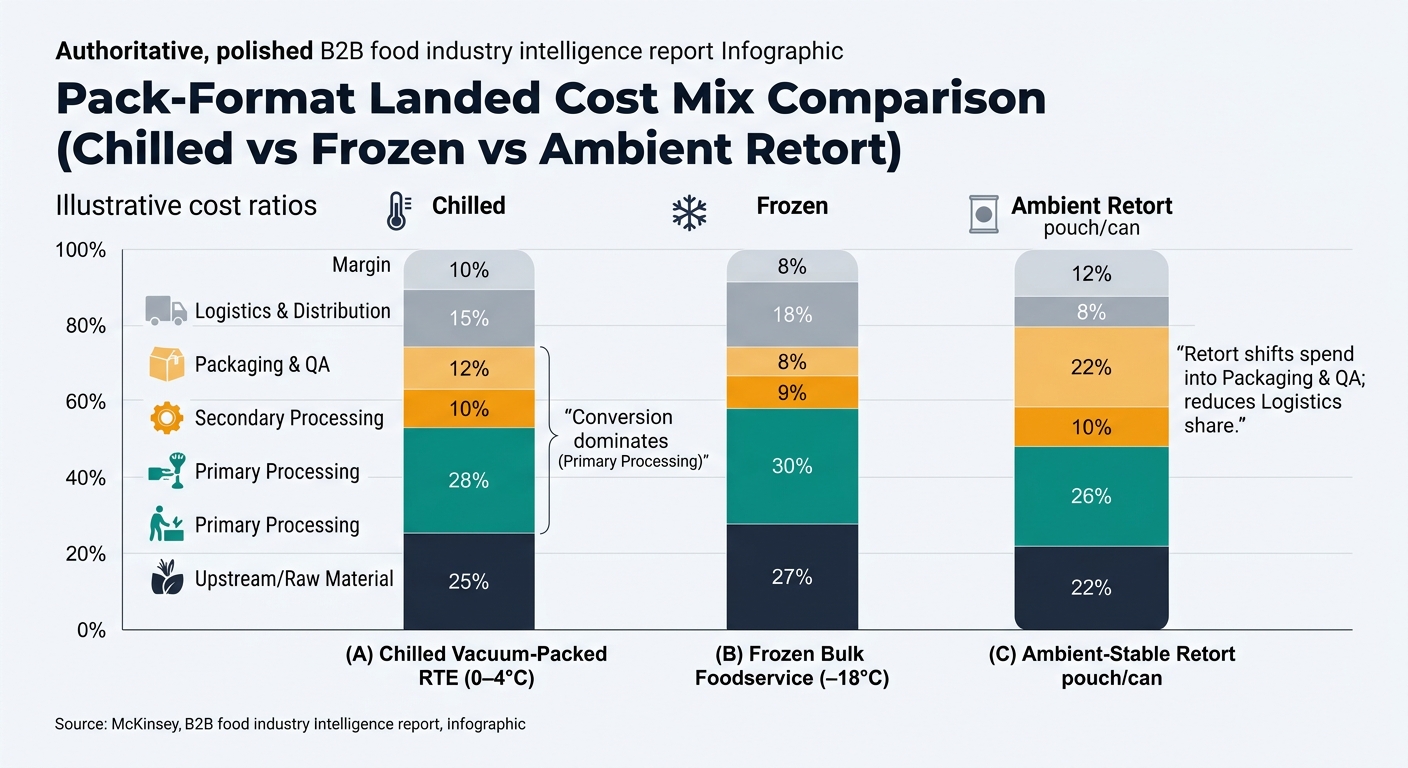
| Supply Chain Node | Cost Ratio (% of Final Cost) | Notes |
|---|---|---|
| Upstream / Raw Material | 25% | Seasonality and bed/area closures drive raw scarcity premiums. |
| Primary Processing | 28% | Labor + yield loss dominate (cook + shuck + cleaning). |
| Secondary Processing | 10% | Cure control + hold space + rework risk. |
| Packaging & QA | 12% | Seal integrity, testing, traceability, labeling. |
| Logistics & Distribution | 15% | Cold chain + inspection/hold exposure. |
| Wholesale/Retail Margin | 10% | Lower than premium retail SKUs; higher in specialty channels. |
| Supply Chain Node | Cost Ratio (% of Final Cost) | Notes |
|---|---|---|
| Upstream / Raw Material | 27% | Raw still drives base cost; freezing doesn’t fix scarcity. |
| Primary Processing | 30% | Conversion remains the main cost engine. |
| Secondary Processing | 9% | Similar cure inputs; slightly less rework pressure vs. chilled. |
| Packaging & QA | 8% | Simpler bulk packs; QA still material. |
| Logistics & Distribution | 18% | Frozen storage and reefer energy/storage time add up. |
| Wholesale/Foodservice Margin | 8% | Often tighter margins in bulk ingredient channels. |
| Supply Chain Node | Cost Ratio (% of Final Cost) | Notes |
|---|---|---|
| Upstream / Raw Material | 22% | Raw cost share drops because downstream conversion increases. |
| Primary Processing | 26% | Still heavy conversion + cleaning. |
| Secondary Processing | 10% | Cure + formulation consistency matters for thermal outcome. |
| Packaging & QA | 22% | Retort packaging, thermal processing, validation, higher material cost. |
| Logistics & Distribution | 8% | No cold chain; lower spoilage/shrink in transit. |
| Wholesale/Retail Margin | 12% | Often higher due to shelf-stable convenience positioning. |
Insight: Most “surprises” in cured cockle meat are not market mysteries—they’re structural constraints that show up repeatedly.
Data: The chain is built on regulated shellfish areas, labor-intensive conversion, and compliance/monitoring holds; these constraints exist in every cycle regardless of price level [1].
Procurement Impact: If your internal planning assumes smooth, continuous output like farmed aquaculture or mechanically processed proteins, you will under-budget lead time, QA release time, and yield-driven cost.
The Bottom Line for Your Next Contract (Analyzed at: Jul, 2026): If you’re still buying cured cockle meat on “unit price + vague spec,” change the contract architecture now: lock a single, auditable measurement method for drained weight and salt % basis, and tie it to a pack-format decision that matches your lane reality (chilled/frozen vs. retort). This works because it attacks the two biggest repeatable leak points—conversion rework/disputes in the plant and variance from congestion-driven dwell time in transit—both of which are amplified in 2026’s still-volatile ocean environment. With transpacific and other lanes showing sharp peak-season spikes and congestion effects, teams that align format + spec methods typically avoid the quiet 5–10% landed-cost bleed that comes from claims, write-offs, and expedite moves when the lane doesn’t behave [4].


