
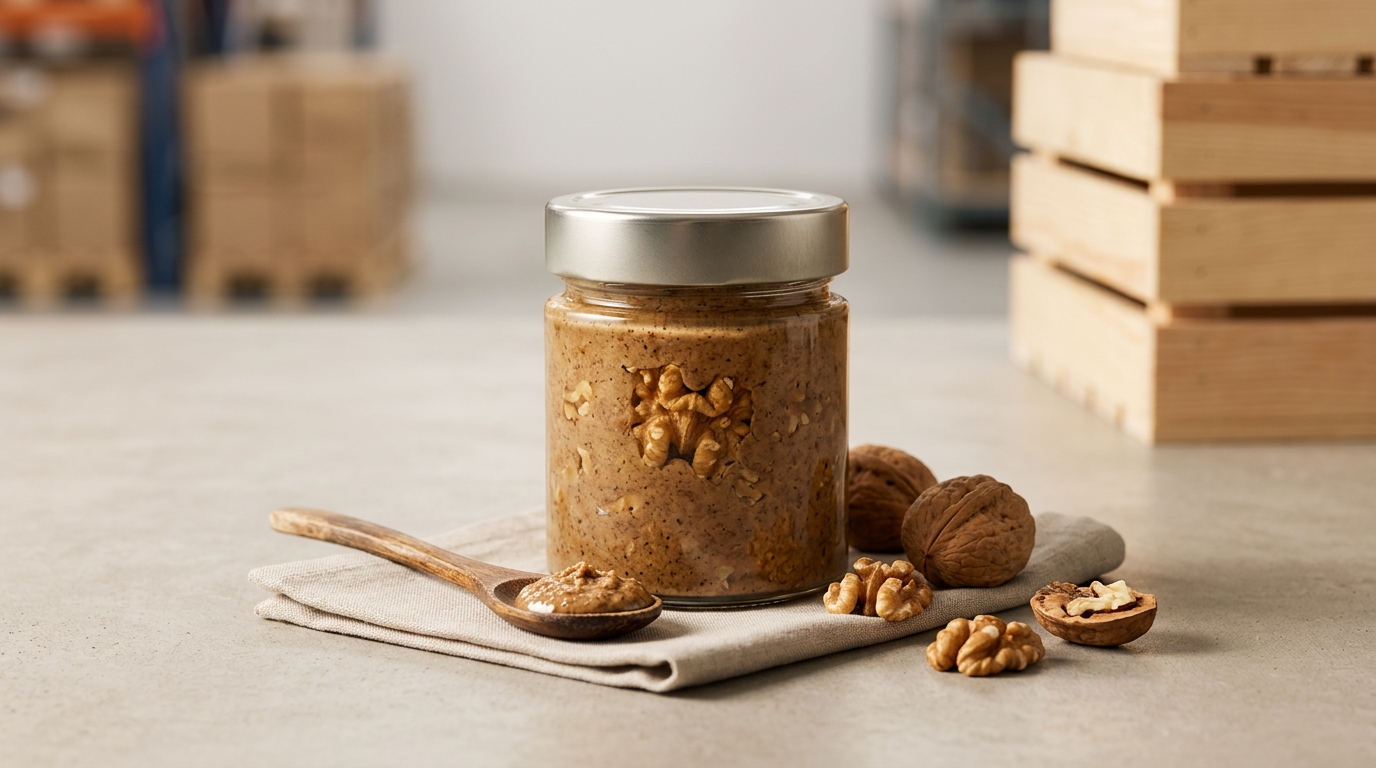
Crunchy walnut butter looks like a simple product, but procurement outcomes are largely determined by upstream biology (one harvest per year), midstream physics (sorting limits and foreign material removal), and downstream oxidation control (packaging + time/temperature). This guide maps where cost and risk truly get “locked in,” so Purchase–Quality/Safety/Compliance teams can write specs and verification scopes that hold up in audits and prevent avoidable quality escapes.
Crunchy walnut butter is a low-moisture, high-fat spread where most downstream outcomes are physically determined upstream: kernel grade and age drive flavor/rancidity; shelling and sorting set defect/foreign-material baselines; heat treatment (if used) sets microbial risk-control strength; and packaging oxygen/light exposure governs shelf-life stability. The chain is short on paper, but every handoff adds yield loss (sorting rejects, breakage, oil loss), QA burden (COAs, pathogen/mycotoxin/pesticide screens where applicable), and packaging-driven cost.
Insight: The fixed cost-drivers concentrate in three places: (1) kernel grade/yield at origin, (2) sorting/foreign-material control during shelling and inclusion prep, and (3) packaging + QA for oxidation control and allergen/label governance.
Data: Walnuts are harvested seasonally and then marketed year-round from storage; “time/temperature/oxygen” exposure accumulates across months, not days. [1]
Procurement Impact: Your spec and audit scope should mirror the physical map: upstream storage/age controls, midstream sorting & detection capability, and downstream oxygen/light management.

Insight: In crunchy walnut butter, cost is not only “walnuts + labor.” Yield loss, testing/holds, and packaging components routinely become the most rigid cost blocks once you move from bulk kernels to a branded/retail-ready spread.
Data: Typical conversion losses stack: sorting rejects (defects/foreign material), breakage downgrades, and rework constraints in allergen-controlled plants.
Procurement Impact: When comparing suppliers, map their cost structure by node (not just delivered price) to understand what can’t be “engineered out” later.
Fixed cost drivers:
Fixed cost drivers:
Fixed cost drivers:
Fixed cost drivers:
Fixed cost drivers:
Fixed cost drivers:

| Supply Chain Node | Cost Ratio (% of Final Cost) | Notes |
|---|---|---|
| Upstream / Raw Material | 60% | Orchard inputs + harvest + drying; grade mix drives value. |
| Primary Processing | 25% | Shelling/sorting, yield loss, foreign-material controls. |
| Food Safety Conditioning | 5% | If pasteurized/steam treated; includes verification overhead. |
| Logistics & Distribution | 10% | Inbound freight, warehousing, shrink/damage. |
| Supply Chain Node | Cost Ratio (% of Final Cost) | Notes |
|---|---|---|
| Upstream + Primary Processing (Kernels) | 55% | Kernel cost remains dominant; reject rate matters. |
| Secondary Manufacturing | 18% | Grinding energy, wear parts, yield loss, formulation inputs. |
| Packaging & QA | 12% | Lined pails/drums, seals, COA/testing, traceability docs. |
| Logistics & Distribution | 15% | Heavier shipments, warehousing time, handling. |
| Supply Chain Node | Cost Ratio (% of Final Cost) | Notes |
|---|---|---|
| Upstream + Primary Processing (Kernels) | 40% | Includes both paste base and inclusion-grade pieces. |
| Food Safety Conditioning | 5% | Validation/verification + hold/release where used. |
| Secondary Manufacturing | 15% | Roast/grind/mix; inclusion sizing and extra sorting add cost. |
| Packaging & QA | 20% | Jar/lid/label/carton, seal integrity, label governance. |
| Logistics & Distribution | 10% | Glass weight, damage risk, returns. |
| Wholesale/Retail Margin | 10% | Channel margin varies by brand and route-to-market. |
Insight: Three structural constraints shape availability, specs, and risk in crunchy walnut butter regardless of supplier or brand.
Data: These are rooted in biology (harvest cycles), physics (oxidation), and process reality (sorting and detection limits).
Procurement Impact: Build specs and supplier documentation requirements around these constants to reduce surprises in audits and customer complaints.
(Analyzed at: Aug, 2026) Write your next crunchy walnut butter contract so it forces crop-year traceability + storage-condition disclosure on every lot of kernels and separately on the crunch inclusions, then require those identifiers to carry through to finished-jar lot coding. It works because the category’s biggest “mystery failures” (rancidity drift, inconsistent crunch texture, and hard foreign material complaints) are usually traceable to stored inventory age and sorting limits—not the filling line.
With packaging inputs still volatile enough to show up in macro pricing indices (notably glass containers), teams that also lock in approved alternates for jar/lid/liner avoid the quiet 2–5% COGS creep that hits when a component substitution forces line slowdowns, relabeling, or re-validation mid-year. [4]


