
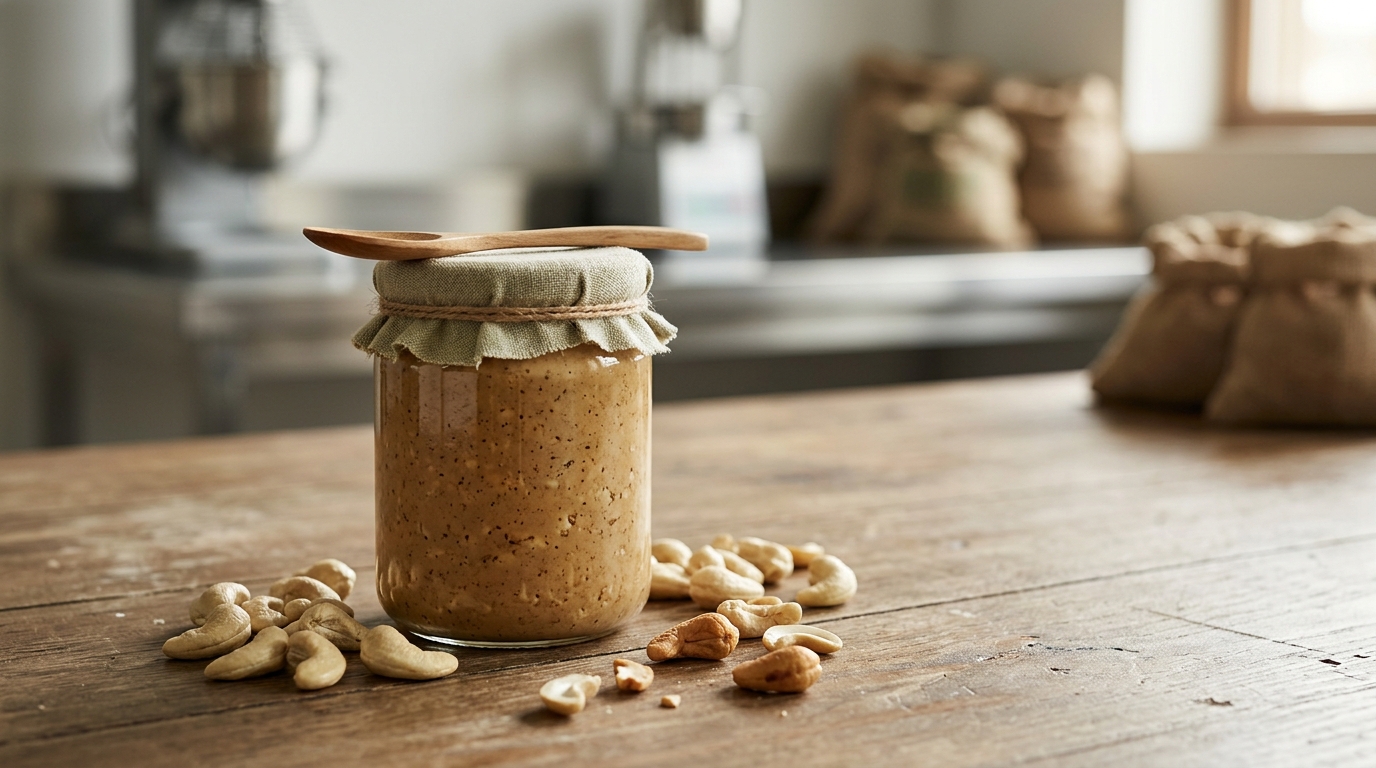
Crunchy cashew butter looks simple (roast, grind, add pieces, fill), but most of your quality risk and “unplanned cost” is structurally set upstream—by kernel conversion yield, low‑moisture Salmonella controls, and how heat exposure is managed from ocean container to customer shelf. This guide maps the physical lane so Purchasing—Quality/Safety/Compliance can make faster, more defensible approve/monitor/switch decisions.
Crunchy cashew butter is a low-moisture, shelf-stable product whose cost and risk profile is set upstream—first by how raw cashew nuts are dried, stored, and converted into export kernels, then by how roasting (kill step), grinding, and inclusion handling are controlled in a nut-butter plant.
The cashew kernel chain is a multi-step conversion process (cleaning/calibration → heat treatment/steaming → shelling → drying/conditioning → peeling → grading → QC/metal detection → vacuum packing) designed to maximize whole-kernel yield and minimize defects and foreign material. [6]
For Quality/Safety/Compliance buyers, the “map” matters because each node creates fixed cost drivers (yield loss, energy, labor, testing, packaging weight) and fixed technical constraints (moisture targets, kill-step validation expectations, foreign material detection capability) that don’t disappear downstream—your finished butter inherits them.

Most downstream variability (texture drift, oil separation complaints, micro holds, foreign material incidents) traces back to a small set of physical cost drivers: moisture control, yield loss/breakage, kill-step design, inclusion handling, and packaging weight.
Primary processing is explicitly structured around steps that manage moisture, enable peeling, and separate grades—each step adds labor/energy cost and introduces yield loss (whole → broken → rejects). [2]
When you compare suppliers, you’re often comparing where they spend money (sorting vs. automation vs. validation vs. packaging) rather than whether they spend money—those choices show up as defect rates, COA completeness, and stability in your finished crunchy product.
RCN is a smallholder-heavy crop where post-harvest drying and storage conditions are the earliest “quality gate”—they set mold/defect risk and the baseline for downstream yield.
Processing references emphasize that early steps (cleaning/calibration and conditioning) assume incoming RCN is reasonably controlled; poor upstream handling increases sorting load and defect removal later. [6]
Even if you buy kernels or finished butter (not RCN), upstream handling drives (a) kernel defect rates that change roast consistency and flavor, and (b) the probability of tight-lot acceptance criteria triggering holds.
This is the highest “conversion complexity” node: heat treatment enables shelling, drying targets low kernel moisture for stability, and conditioning/humidification is used to support peeling while managing breakage.
Multiple processing references describe a standard sequence including drying to roughly the ~3–4% range and then moisture adjustment for peeling/handling, followed by grading, QC/metal detection, and vacuum packing/cartoning. [2]
For crunchy cashew butter, this node determines the feasible input “basket” (whole vs. pieces/brokens), baseline foreign material risk (shell fragments), and how much incoming inspection/testing you need to prevent downstream rework.
Nut-butter plants convert kernel variability into a consistent paste by controlling roast profile, grind energy/heat, and inclusion size distribution—crunchy format adds an extra failure mode: inclusions create extra handling steps and can introduce post-roast recontamination risk if controls are weaker than for the base paste.
FDA guidance and related materials treat Salmonella as a significant hazard in foods where its presence can render food injurious; for low-moisture foods, the control strategy relies on validated processes and prevention of recontamination (environmental control, hygienic design, and disciplined handling). [3]
This node drives fixed operating costs (roaster energy, line changeover sanitation time, metal detection/X-ray capability, environmental monitoring expectations) and fixed quality costs (hold-and-release time, lot testing cadence, sensory rework when roast/grind drifts).
Packaging is both a cost sink (materials + freight cube/weight) and a compliance gate (allergen statements, net weight, coding/traceability, tamper evidence). In nut butters, “release” is frequently a documentation-and-testing workflow, not just a production step.
Processing references explicitly include QC/foreign material controls (e.g., metal detection) before dispatch, and FDA guidance reinforces why buyers rely on testing/COA interpretation as part of a preventive approach where Salmonella presence is a serious concern. [3]
Packaging format decisions (glass vs. plastic; retail jars vs. foodservice tubs) set fixed landed-cost structure and constrain co-man options (filler capability, capper/induction seal, label control sophistication).
Cashew butter doesn’t need cold chain, but it is heat-sensitive: high temperatures accelerate oxidation/rancidity perception and can worsen oil separation—so logistics is a quality preservation cost, not only a freight cost.
Cashew kernel trade is built around long-haul logistics with controlled packing (often vacuum-packed) and attention to storage/handling as part of maintaining quality through transit and warehousing. [7]
Hot-lane exposure (containers, warehouses, last-mile) can convert “in-spec at ship” into “consumer complaint at shelf,” driving hidden costs in credits/returns and forcing tighter shelf-life and storage specs.

| Supply Chain Node | Cost Ratio (% of Final Cost) | Notes |
|---|---|---|
| Upstream RCN + aggregation | 45–60% | Farmgate + drying/handling losses dominate the base cost before conversion. |
| Primary processing (shelling → grading) | 25–35% | Labor/energy + yield loss + sorting/grading + QC/metal detection. |
| Packaging & QA (bulk) | 3–6% | Vacuum bags/cartons, inspection/documentation. |
| Logistics & distribution | 7–12% | Ocean + inland freight; heat/humidity protection reduces quality loss. |
| Processor/trader margin | 5–10% | Working capital and shrink risk priced into the chain. |
| Supply Chain Node | Cost Ratio (% of Final Cost) | Notes |
|---|---|---|
| Kernel input (incl. pieces/brokens) | 35–55% | Still the anchor cost; input grade affects roast consistency and defect sorting. |
| Secondary manufacturing | 12–20% | Roasting energy, grinding, inclusion handling, sanitation/changeovers, yield. |
| Packaging & QA release | 15–25% | Jar/lid/label/carton, coding, COA management, hold-and-release time. |
| Logistics & distribution | 8–15% | Weight/cube (especially glass) + heat-managed warehousing to protect shelf life. |
| Brand/wholesale/retail margin | 10–20% | Channel structure varies widely by private label vs. branded. |
| Supply Chain Node | Cost Ratio (% of Final Cost) | Notes |
|---|---|---|
| Kernel input | 40–60% | Higher nut-content economics; fewer label/retail presentation costs. |
| Secondary manufacturing | 12–22% | Similar process costs; larger batch sizes can reduce changeover burden. |
| Packaging & QA release | 8–15% | Lower packaging cost per kg vs. retail jars; still needs coding/traceability. |
| Logistics & distribution | 8–14% | Better freight efficiency than glass jars; heat exposure still matters. |
| Distributor margin | 8–15% | Foodservice distribution economics. |
Three constants shape quality outcomes and total cost in crunchy cashew butter: conversion yield economics, low-moisture pathogen control, and lane-dependent quality preservation.
(1) Cashew processing is explicitly multi-stage and yield-sensitive, with a structurally limited kernel outturn from RCN that makes yield and grade mix unavoidable economics. [1] (2) FDA guidance underscores the seriousness of Salmonella in foods and the importance of sound testing/interpretation within preventive systems—relevant to low-moisture nut operations where recontamination control is critical. [3] (3) EU contaminant regulation sets maximum levels for aflatoxins for tree nuts and processed products thereof, making upstream lot quality and documentation a structural compliance constraint for EU-bound programs. [4]
The fastest way to understand a crunchy-cashew-butter supplier is to map their lane to five physical questions: kernel conversion path, kill-step control, inclusion handling, foreign material detection, and packaging format capability.
The kernel chain is standardized and stepwise (including QC/metal detection and vacuum packing), and FDA guidance underscores why Salmonella control thinking (process + prevention of recontamination + testing/interpretation) is central in nut-adjacent, low-moisture contexts. [8]
(Analyzed at: Aug, 2026)
Given the 2026 cashew-sector volatility signals (geopolitical/shipping uncertainty and raw material buying behavior), stop treating “approved supplier” as a single site and start contracting to an approved lane: name the origin/primary processor, the roast/grind/fill site, and the packaging format as a controlled bundle, with pre-defined triggers to shift 20–30% of volume to a qualified alternate lane when transit times or risk signals spike. This works because your biggest lock-ins are conversion yield and post‑roast recontamination control—switching suppliers without switching lanes is where holds and surprises come from. The stake is rarely the unit price; it’s the avoidable 5–15% total-cost hit from emergency testing, long holds, rework, and expedited freight when a disruption forces an unqualified change. I can outline practical governance and intelligence workflows, but you should validate final requirements with your internal QA/regulatory experts and your supplier approval program. [5]


