
INDUSTRY TRENDS

Cowpea Protein Isolate: How to Time Buys When Input Signals and Isolate Quotes Don’t Move Together

Author
Team Tridge
DATE
October 6, 2026
9 min read
cowpea-protein-isolate Cover
Unlock Full Data
Cowpea Protein Isolate Market Intelligence
Prices · Trends · Origins · Forecasts

Cowpea protein isolate (CPI) behaves less like a simple “commodity ingredient” and more like a conversion-constrained category where inventory cycles, drying capacity, and seasonal quality risk can dominate what you pay and when. This guide translates those dynamics into procurement actions—timing triggers, contract mechanics, and governance moves—so you can reduce budget surprises without gambling on perfect forecasts.

Executive Summary

  • CPI quotes often lag raw cowpea (or pulse) input signals because processors sell through prior-bean inventory and because wet extraction + spray drying creates a real conversion cost floor. [1]
  • The biggest “savings trap” is switching for a lower $/kg and paying it back in holds, rework, or expedite freight—so negotiate cost-in-use protections, not just price.
  • Use two-part pricing (conversion fee + indexed input with an explicit lag) to avoid being last to benefit when inputs soften.
  • Build repeatable triggers around spread, lead-time drift, and quality signals; don’t wait for a supplier to “volunteer” pass-through.

1) The Market Signal You’re Missing: Why Bean Costs and Isolate Quotes Rarely Move Together

  • Insight: Cowpea-protein-isolate (CPI) pricing often “disconnects” from raw cowpea grain moves for ~6–16 weeks—long enough to create repeatable buying windows where disciplined teams beat the index while reactive teams overpay.
  • Data: Three structural lags drive the disconnect: (1) inventory lag (processors are quoting against beans or protein-rich flour bought weeks to months earlier), (2) capacity floor (wet extraction + drying sets a minimum conversion cost that doesn’t fall just because beans get cheaper), and (3) spec-risk premium (when off-flavor or micro risk rises seasonally, suppliers widen their “quality spread” even if beans are flat). Wet fractionation is typically more energy-intensive and requires a drying step, which is one reason conversion economics can stay “sticky.” [1]
  • Procurement Impact: If you negotiate only off “today’s bean market” or only off “today’s isolate quote,” you miss the real lever: when conversion capacity and quality risk are tight vs. loose.
A clean dual-line time series chart comparing raw cowpea input signal vs. CPI isolate quoted price over time, with a shaded band labeled “Typical lag window: ~6–16 weeks” and callouts for inventory sell-through, conversion cost floor (wet extraction + drying), and spec-risk premium, illustrating inputs falling ~10% over ~8 weeks while isolate moves only ~2% to ~5%.

The three most exploitable CPI pricing anomalies (with realistic numbers)

  • Insight: The best negotiating leverage shows up when raw material softens but conversion stays tight—because suppliers will resist list-price drops, yet will trade value in terms (rebates, freight, MOQs, reopeners) to defend share.
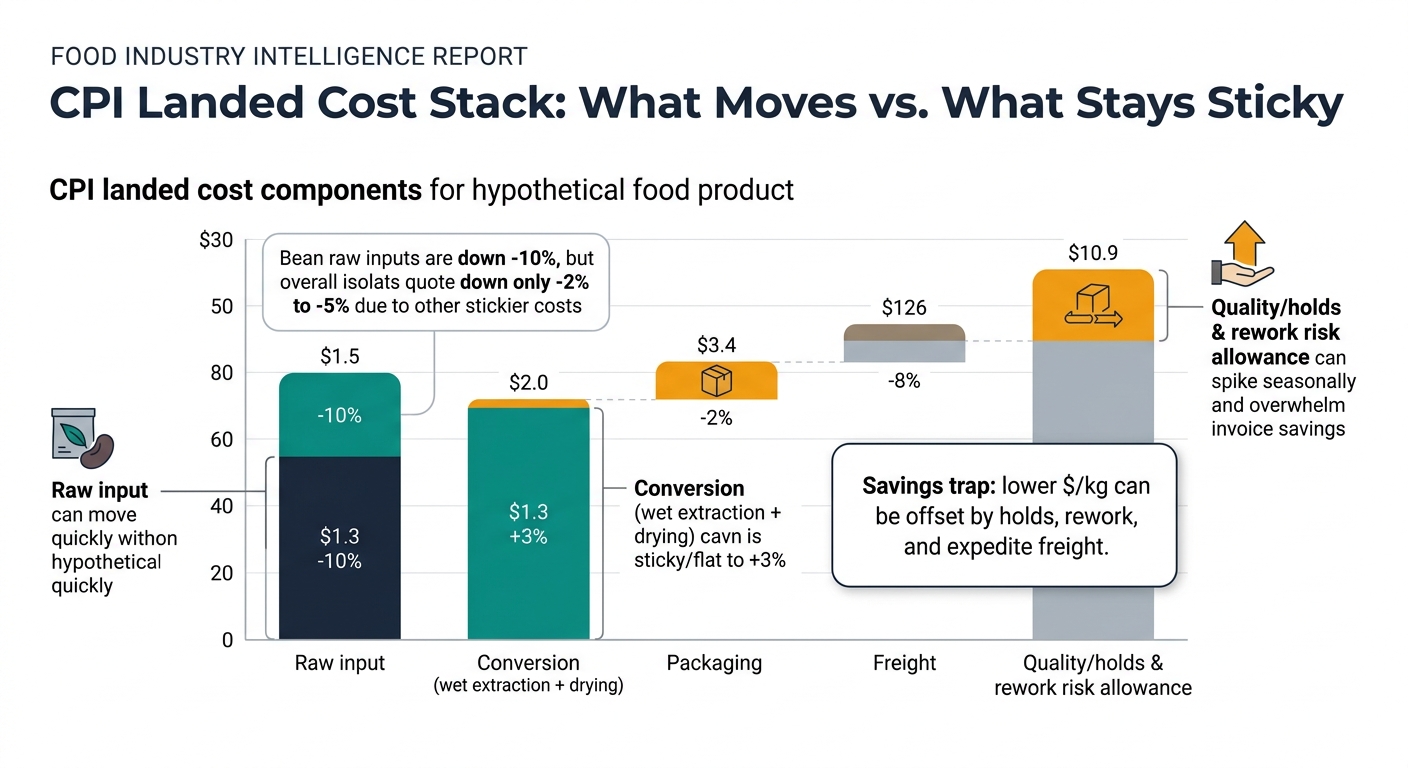
  • Data: A typical CPI cost stack for a buyer can behave like this (illustrative ranges; your exact stack depends on protein %, functionality, and certification set):
  • Raw cowpea input signal: -10% over ~8 weeks (e.g., beans move from ~$650/MT to ~$585/MT at an origin-equivalent).
  • Conversion cost floor: flat to +3% (utilities/energy + labor + wastewater load + membrane consumables + drying).
  • Net isolate quote movement: only -2% to -5% in the same window because suppliers are still selling inventory produced from earlier, higher-cost beans and protecting margin while capacity is booked.
  • Procurement Impact: Don’t demand a full pass-through immediately; instead, trade the partial pass-through for contract mechanics that force future alignment (index triggers, step-downs, or retroactive true-ups once the supplier’s input inventory turns).
A stacked bar chart breaking CPI landed cost into raw input, conversion (wet extraction + drying), packaging, freight, and quality/holds & rework risk allowance, with annotations showing raw input moves quickly, conversion is sticky/flat to +3%, and quality/holds can spike seasonally; includes a callout warning that a lower $/kg can be offset by holds, rework, and expedite freight.
  • Insight: The opposite anomaly—beans spike but isolate quotes lag—is your chance to lock coverage before the next quote reset.
  • Data: In tight capacity periods, suppliers often honor existing quote validity for a short window (commonly 2–4 weeks) even if inputs move quickly, because they’re selling from lower-cost stocks and don’t want to disrupt customer schedules. That window closes once they re-cost the next production run.
  • Procurement Impact: If you have forecast confidence, you can pull-forward 30–60 days of volume at the old conversion economics (or secure a short-term fixed price) before the reprice hits.
  • Insight: The most expensive CPI you’ll ever buy is “cheap CPI that fails in use.” Quality-driven cost inflation often shows up as a hidden premium after receipt.
  • Data: When seasonal quality risk rises, effective cost can jump even if invoice price doesn’t:
  • Rejection/hold rates: moving from ~1–2% to ~6–10% during higher-risk lots (buyer-specific; depends on your micro/spec tightness).
  • Downgrade/blending: extra 0.5–1.5% inclusion to hit texture/solubility targets can add the equivalent of +3–7% to protein cost-in-use.
  • Expedites: one airfreight or hot-shot truck event can erase a quarter’s “savings.”
  • Procurement Impact: Negotiate CPI on cost-in-use protection, not just $/kg: tighter COA commitments, retain samples, lot traceability, and pre-shipment release options reduce the probability of paying twice.

Quick Win (use this in your next negotiation): Ask for a two-part quote: (1) a conversion fee component (more stable) and (2) an input-linked component with a clearly defined lag (e.g., 60-day trailing average). You’re not asking for a lower number—you’re asking for a pricing mechanism that prevents you from being last to benefit when inputs fall.

2) The 3 Mistakes That Quietly Inflate Your CPI Landed Cost

Mistake #1: Treating CPI like a commodity and running quarterly supplier “beauty contests”

  • What happens: The team re-bids every quarter and reallocates volume to the lowest quote, assuming CPI is interchangeable.
  • Why it fails: CPI switching friction is real: qualification, sensory/functionality re-validation, packaging/label updates, and lane setup routinely add ~2–6% to effective landed cost in the first two shipments (typical range; varies by application criticality).
  • The hidden cost: A mid-sized North American nutrition brand rotated between three pulse-protein suppliers to save $0.20/kg on paper; they later absorbed $0.28/kg equivalent in rework (solubility failures), extra QA holds, and one expedited replenishment. (Note: treat as a composite example based on common failure modes; not a named public case.)

Mistake #2: Negotiating only on $/kg and ignoring “capacity priority” economics

  • What happens: Procurement pushes for the lowest unit price but accepts vague lead times and no allocation language.
  • Why it fails: In CPI, the real constraint is often the isolation/drying schedule. Wet fractionation is energy- and process-intensive and culminates in drying; when those assets run hot, suppliers protect their best customers with allocation priority and push others into longer lead times or partial shipments. [1]
  • The hidden cost: A single missed production slot can force a buyer into spot buys at ~+8–15% premiums or into formulation workarounds that raise cost-in-use.

Mistake #3: Over-specifying early (and then paying a permanent premium for optionality you don’t use)

  • What happens: Specs are written to “cover every future application,” so procurement locks in tight functionality and documentation requirements for all volume.
  • Why it fails: Tight specs shrink the qualified supplier pool and increase the supplier’s risk premium. In CPI, that premium persists even when the market loosens.
  • The hidden cost: Teams commonly pay ~+4–9% vs. a fit-for-purpose spec for the majority of volume that goes into applications that don’t need the tightest functionality band.

Quick Win: Split your demand into two lanes: a “performance-critical” spec for the subset of SKUs that truly need it, and a “baseline” spec for the rest. You’re not lowering standards—you’re buying precision where it pays back.

Unlock Full Data
Cowpea Protein Isolate Market Intelligence
Prices · Trends · Origins · Forecasts

3) What Changes When You Run CPI Like an Intelligence-Led Category

  • Insight: CPI outcomes improve when you manage it as a risk-and-conversion constrained category, not a simple ingredient line.
  • Data: The shift is operationally small but financially meaningful.
Operating Element Before (Traditional) After (Intelligence-led) Measurable Outcome You Can Expect
Market view 2–3 incumbent quotes Broader benchmark across comparable suppliers + lanes Reduce overpay risk by ~5–10% on re-contracting cycles
Timing Buy when contracts expire Buy when input-vs-isolate spread is favorable Cut “wrong-week buys” by ~1–2 events/year
Risk control Supplier reputation-based Exposure-based (facility, lane, seasonal quality risk) Fewer expedites; target ~30–50% reduction in premium freight events
Governance Ad hoc documentation Decision log + thresholds for concentration/coverage Faster exec reviews; clearer audit trail
  • Procurement Impact: You don’t need perfect forecasts; you need repeatable triggers: when spreads widen, when lead times drift, when quality claims rise, and when capacity signals tighten.

Quick Win: Track a simple internal KPI: “invoice price vs. last 60-day input signal.” When the gap widens beyond your historical norm, you have a negotiation moment—even if the supplier says “market is firm.”

4) Three Scenarios Where Better Intelligence Pays Back Immediately

  • Insight: CPI decisions are won in the 2–8 weeks before a disruption or reprice—not during it.
  • Data: These are the moments where teams either preserve leverage or lose it.
  • Procurement Impact: Use scenario playbooks so you’re not improvising under time pressure.

Scenario A: Contract renewal in 60 days, but input signals are falling

  • Insight: Falling inputs don’t guarantee falling CPI quotes on your timeline.
  • Data: Suppliers may still be selling higher-cost inventory for 4–10 weeks; conversion costs don’t fall proportionally.
  • Procurement Impact: Negotiate a step-down schedule (e.g., price review at day 45 and day 90) instead of a single fixed annual number.

Scenario B: Your lead times extend by 2–3 weeks with no price change

  • Insight: Lead-time drift is often the earliest sign of capacity tightening.
  • Data: Suppliers typically ration capacity before they reprice; the first symptom is “later ship dates,” not higher quotes.
  • Procurement Impact: Pay for reliability with terms, not price: allocation language, ship-window penalties/credits, and safety stock positioning.

Scenario C: QA flags a small uptick in off-notes or micro holds

  • Insight: Quality issues are often origin/season-patterned—not random—and they can precede broader market tightening.
  • Data: A move from 1–2% to ~5% holds can cascade into schedule misses and spot buys.
  • Procurement Impact: Trigger a lot-level containment approach: pre-shipment COA release, retain samples, and a temporary shift of volume to your most consistent supplier even if it’s +2–3% on invoice price.

Quick Win: Pre-define your “switch threshold” (e.g., two consecutive late shipments or one critical QA hold). Without a threshold, teams wait too long and end up buying the market top.

5) How This Same Playbook Protects You in Adjacent Plant-Protein Buys

  • Insight: CPI’s price disconnects mirror what you see in other conversion-constrained ingredients.
  • Data: The pattern repeats:
  • Pea/fava protein isolates: wet processing + drying capacity creates a conversion floor; input moves pass through with lag. [1]
  • Specialty starches/fibers: functional specs create a “quality spread” that widens in tighter seasons.
  • Texturized vegetable proteins (TVP): extrusion capacity and energy costs can dominate even when base meal prices soften.
  • Procurement Impact: If your organization already sources pea or fava, you can reuse the same governance: spread tracking, lag assumptions, and capacity-risk triggers—reducing category management overhead.

6) Why CPI Is a Useful Test Case for Smarter Procurement (Without Adding Complexity)

  • Insight: CPI forces clarity on what procurement can control: timing, terms, qualification readiness, and concentration exposure.
  • Data: The category is small enough to pilot discipline (benchmarks, triggers, decision logs) but volatile enough that small improvements show up quickly in budget variance and service levels.
  • Procurement Impact: If you can run CPI with fewer surprise reprices and fewer expedites, you can replicate the same operating model across higher-spend ingredients—without relying on “heroics” from buyers.

7) The Bottom Line for Your Next Move

When you see raw cowpea inputs softening but CPI quotes staying stubborn, don’t wait for a full pass-through that may not arrive on your renewal date. Use that disconnect to negotiate a short initial term (or a stepped reprice) that forces alignment once the supplier’s input inventory turns, while trading them volume visibility in return. That window exists because conversion capacity and inventory cycles create predictable lags—and teams that capture those lags typically avoid the 5–10% overpay that shows up when you lock a long fixed price at the wrong point in the spread.

Key Insights

  • Insight: CPI pricing is governed by lags and conversion constraints, not just bean markets.
    Data: Inventory cycles (often measured in weeks to a few months), conversion cost floors (utilities + drying), and spec-risk premiums explain why CPI can move -3% when beans move -10%—or not move at all until the next production turn. Wet extraction plus drying is a structural reason conversion costs can remain sticky. [1]
    Procurement Impact: Build buying triggers around spreads, lead-time drift, and quality signals—not just supplier quotes.
  • Insight: The most common CPI “savings” trap is switching for price and paying it back in cost-in-use.
    Data: Switching friction and quality holds routinely create 2–6% hidden cost, with occasional +8–15% premiums via expedites.
    Procurement Impact: Protect continuity with allocation terms and pre-qualified alternates; reserve aggressive price plays for volume you can truly flex.
  • Insight: The simplest upgrade is contractual: separate conversion economics from input economics.
    Data: Two-part pricing (conversion + indexed input with defined lag) prevents you from being last to benefit when inputs fall.
    Procurement Impact: You gain budget control, negotiation leverage, and an audit-ready rationale for why your CPI performance beat the market—even when the market was noisy.

The Bottom Line for Your Next Contract

(Analyzed at: Oct, 2026)

Given the 2026 Sahel/West Africa weather uncertainty and El Niño risk signals, assume higher variance in cowpea-origin quality and logistics timing than a “normal” year—and contract accordingly. [2] The highest-conviction move is to convert your next CPI renewal to a two-part mechanism (conversion fee + input index with an explicit 45–75 day lag) and pair it with allocation/ship-window language, because conversion and capacity—not just beans—are what stay sticky when conditions tighten. If you don’t, the cost of being wrong shows up fast as premium freight, QA holds, and short-notice spot buys that can easily wipe out a mid-single-digit “win” on invoice price.

Cowpea Protein IsolateSupply Chain Intelligence
134 countries tracked
10
Exporters
10
Importers
$781M
Top Export Value
Top Exporters (2024)
🇺🇸
United States
$781M
🇳🇱
Netherlands
$316M
🇩🇪
Germany
$192M
🇬🇧
United Kingdom
$165M
🇪🇸
Spain
$107M
+129 more
Top Buyers
🇨🇦 Canada $195M🇩🇪 Germany $178M🇳🇱 Netherlands $170M🇺🇸 United States $138M🇨🇱 Chile $137M

References

  1. pmc.ncbi.nlm.nih.gov
  2. agrhymet.cilss.int

Related Contents

Subscribe
→
By subscribing you agree to with our Privacy Policy and provide consent to receive updates from our company.
Thank you! Your submission has been received!
Oops! Something went wrong while submitting the form.
Subscribe to receive the latest blog posts, updates, promotions, and announcements from Tridge.
