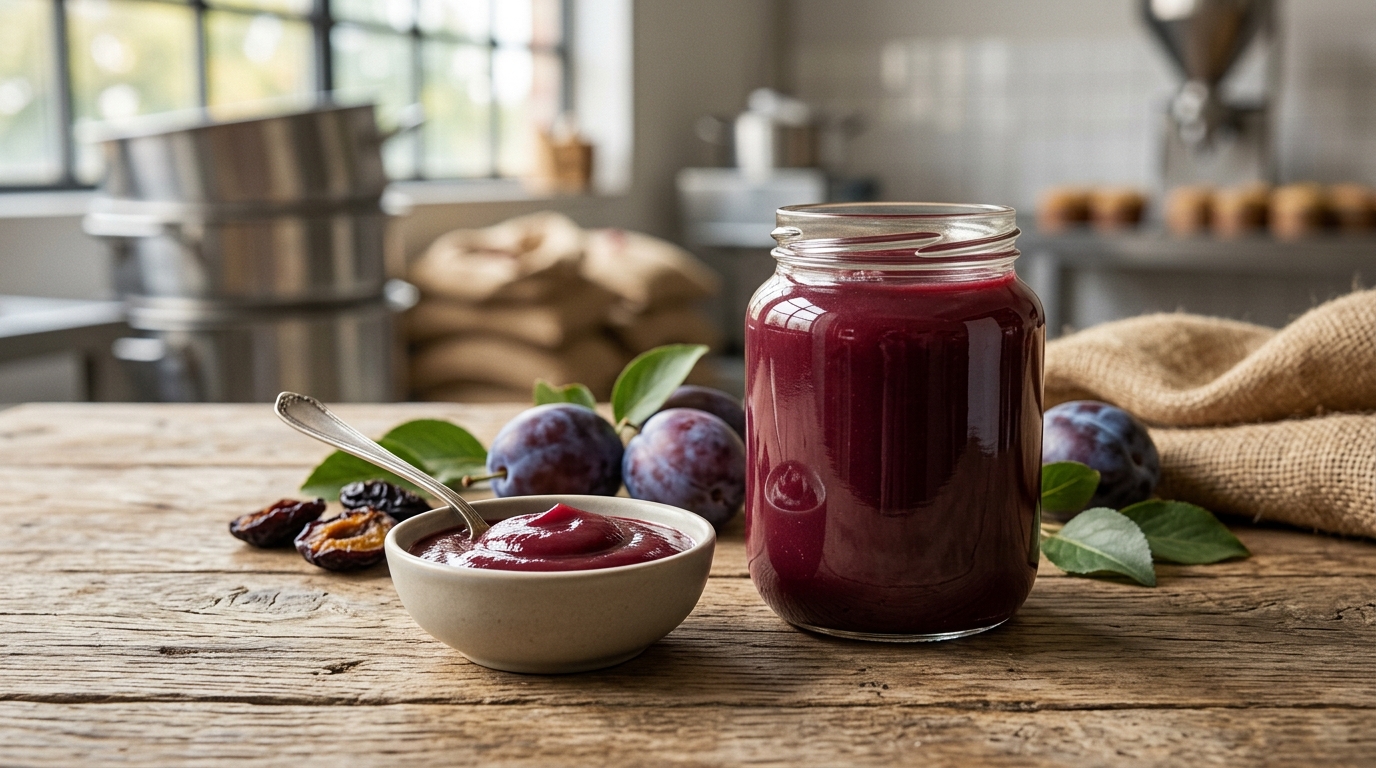
This guide maps how conventional plum puree is physically produced, stabilized, packaged, and moved—so Purchasing owners for Quality/Safety/Compliance can separate negotiable commercial terms from non-negotiable process constraints. It’s written to help you set specs, documentation bundles, and supplier approval gates that reduce holds/rejections without over-constraining supply.
Conventional plum puree is a harvest-driven ingredient where the largest fixed constraints are (1) orchard yield and maturity timing, (2) destoning/pulping and (often) evaporation capacity during a short intake window, and (3) aseptic packaging availability and execution quality. The product typically moves as single-strength puree for nearby users or as puree concentrate (commonly ~28–32°Bx) for export efficiency, then gets reconstituted/standardized near end use.
Insight: The chain’s economics are set early: fruit maturity and intake throughput determine yield, while thermal/concentration choices determine energy load and freight efficiency.
Data (validated): Commercial plum puree concentrate specifications commonly show 30/32°Bx offerings (a practical subset of the broader ~28–32°Bx band often used for puree concentrates) [1].
Procurement Impact: Even before “supplier performance” enters the picture, physical bottlenecks (harvest window, evaporator/aseptic line capacity, packaging) shape availability, lead times, and the quality-consistency you can realistically expect lot-to-lot.

Insight: Plum puree cost is a “stack” of yield loss + energy + packaging + logistics; margins typically accrue at nodes that control standardization, documentation, and pack integrity.
Data (validated): Plum puree concentrate specs commonly appear as 30–32°Bx in supplier technical sheets, consistent with a broader industry “standard concentrate” band often cited around 28–32°Bx for many fruit purees [1].
Procurement Impact: Understanding which node creates which cost lets you interpret supplier quotes and COA packs as reflections of real process choices (not just “overhead”).
| Supply Chain Node | Cost Ratio (% of Final Cost) | Notes |
|---|---|---|
| Raw Material (fruit) | 45% | Yield and maturity (°Bx/acid) dominate usable solids cost. |
| Primary Processing | 12% | Destoning/finishing + yield loss + sanitation/CIP. |
| Thermal Processing | 8% | Pasteurization/hot-fill energy + process controls. |
| Packaging & QA | 15% | Drums/liners or pails + lab testing + COA pack assembly. |
| Logistics & Storage | 20% | Higher freight per solids vs concentrate; cold chain if frozen. |
| Supply Chain Node | Cost Ratio (% of Final Cost) | Notes |
|---|---|---|
| Raw Material (fruit) | 35% | Concentrate spreads fruit cost over more solids per kg shipped. |
| Primary Processing | 10% | Destoning/finishing remains critical for pit fragment control. |
| Thermal + Concentration | 20% | Evaporation energy is a major fixed driver; cleaning downtime matters. |
| Packaging & QA | 15% | Often aseptic bag-in-drum/IBC; component quality is critical. |
| Logistics & Storage | 20% | Lower freight per solids; ambient possible if aseptic integrity holds. |
| Supply Chain Node | Cost Ratio (% of Final Cost) | Notes |
|---|---|---|
| Raw Material (fruit) | 30% | Juice yield differs from puree; solids concentration is high. |
| Extraction/Clarification | 15% | Filtration/enzymatic steps can add cost vs puree lines. |
| Thermal + Concentration | 25% | Higher concentration typically increases energy intensity. |
| Packaging & QA | 10% | Often drums/IBC; QA focuses on °Bx, acidity, micro, etc. |
| Logistics & Storage | 20% | Very freight-efficient per solids; used as a benchmark in fruit ingredients. |
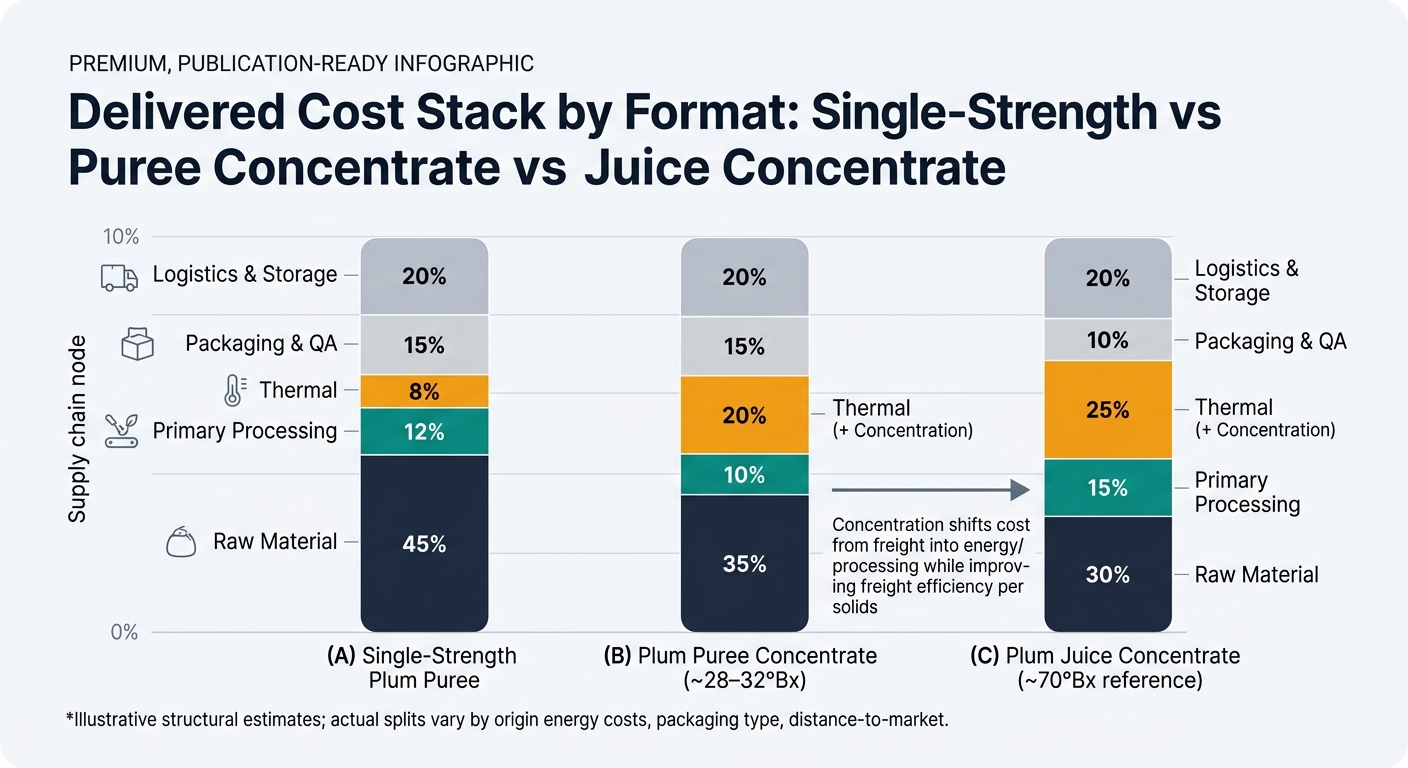
(Note: Ratios are structural estimates to illustrate where costs typically sit; actual splits vary by origin energy costs, packaging type, and distance-to-market.)
Insight: Three constants shape this category regardless of supplier: harvest compression, intrinsic foreign material risk, and spec normalization around solids.
Data (validated): Commercial specs commonly cluster around defined °Bx bands for plum puree concentrate (e.g., 30/32°Bx offerings), and aseptic control is treated as a validated process with records—not something “proven” by finished-product testing alone [1][2].
Procurement Impact: These realities explain why documentation, process capability, and format selection matter as much as “origin” in determining consistent receiving outcomes.
(Analyzed at: Sep, 2026)
Write your next plum puree/puree concentrate award so every bid is solids-normalized (°Bx), process-defined (aseptic vs non-aseptic), and packaging-specified down to bag/fitment/liner configuration, and make those fields non-optional on the COA and lot documentation. This works because the market really does cluster around 30/32°Bx concentrate specs and because aseptic control is fundamentally a documented, validated process—not something you can “test into compliance” after the fact [1][2]. The stakes are practical: one poorly controlled packaging/aseptic interface or a false comparison between single-strength and concentrate can turn into holds, rework, and expedited replacement volume that quietly adds up to a mid-single-digit delivered-cost hit over a season.