
INDUSTRY TRENDS

Concentrated Chicken Stock Sourcing: A Practical Decision Tree for Cost Volatility and Continuity Risk

Author
Team Tridge
DATE
July 21, 2026
10 min read
concentrated-chicken-stock Cover
Unlock Full Data
Concentrated Chicken Stock Market Intelligence
Prices · Trends · Origins · Forecasts

Concentrated chicken stock sourcing looks simple until you’re forced to choose between cost, label/spec integrity, and “can we actually keep the line running.” This decision tree is designed for procurement and customer-facing teams to use in real conversations: it starts with the operational constraints (format, shelf life, spec tightness, lead time) and only then lands on the right commercial structure.

Executive Summary

  • Decision anchor: In chicken stock concentrate, the “best” supplier is the one that can meet your format + spec + change-control requirements with realistic lead times—not just the lowest unit price.
  • Cost drivers that matter: Pricing pressure commonly traces to poultry byproduct availability, energy for cook/evaporation/spray-drying, and packaging constraints (especially aseptic components).
  • Use real triggers: Run this tree at 120–180 days pre-renewal, after 2 months of OTIF degradation, or when label/spec posture changes.
  • Governance is leverage: Put index/lag/cap rules and change-control notice into the RFQ/contract to prevent surprise surcharges.

1) What decision you’re actually making (and why it’s easy to get wrong)

Insight

Concentrated chicken stock procurement is rarely a single “pick a supplier” decision—it’s a linked set of choices about format (liquid/paste/powder), shelf-life model (aseptic vs chilled/frozen), and contract structure (spot vs indexed vs fixed) that determines both cost volatility and continuity risk.

Data

In this category, cost and availability are structurally tied to (1) poultry processing byproduct flows (bones/frames/skin), (2) energy intensity of cooking/evaporation (and sometimes spray-drying), and (3) packaging constraints—especially aseptic filling capacity and availability of bags/fitments for bag-in-box or similar systems.
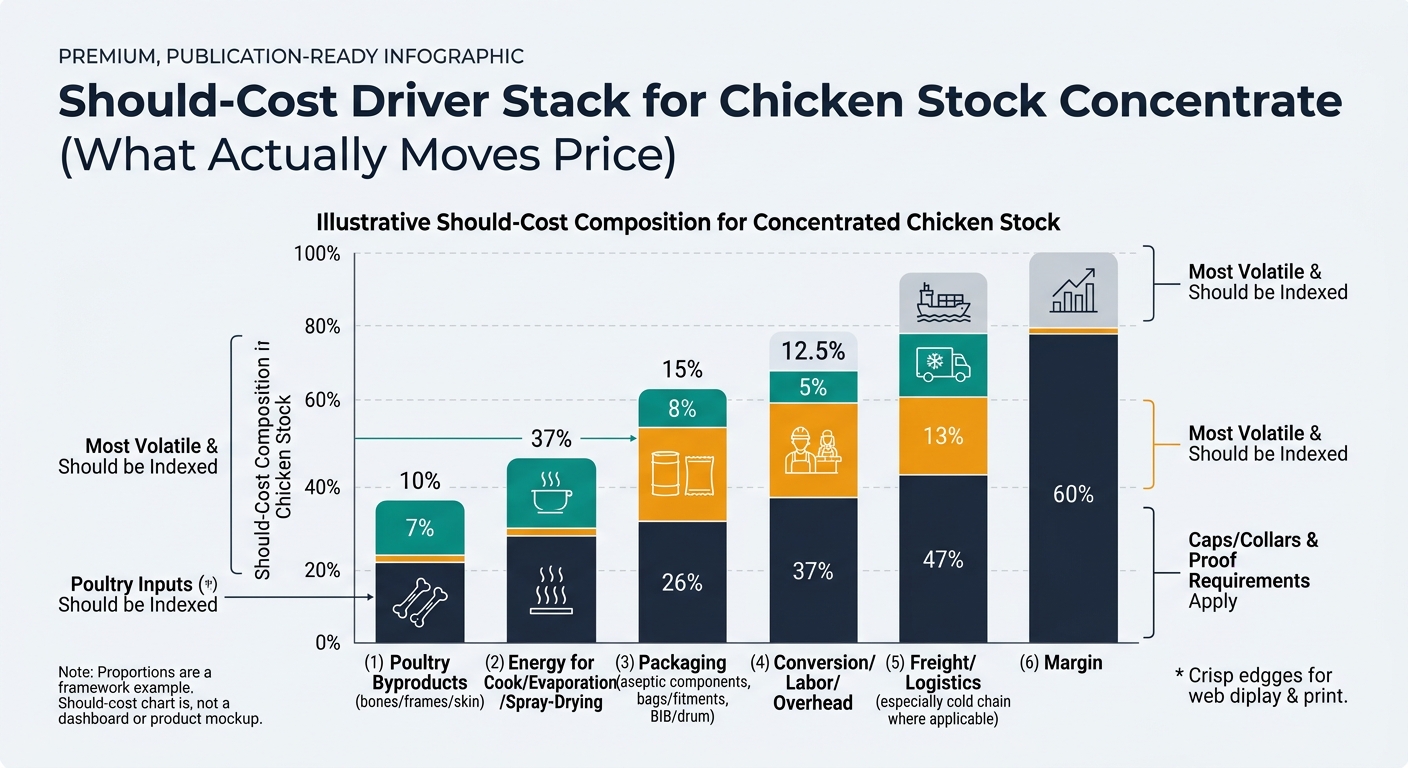
A stacked bar chart showing an illustrative should-cost composition for concentrated chicken stock across key drivers: poultry byproducts, energy for cook/evaporation/spray-drying, packaging (aseptic components, bags/fitments, BIB/drum), conversion/labor/overhead, freight/logistics (especially cold chain where applicable), and margin, with callouts noting which components are most volatile and should be indexed and where caps/collars and proof requirements apply.

Procurement Impact

A structured framework prevents two common failure modes: (a) locking in a “cheap” source that later adds surcharges via energy/packaging clauses, or (b) over-specifying (tight sodium, “clean label,” micro limits) until you have no realistic alternates.

Quick Win (use next week)

Before you run an RFQ, confirm your “must-have” spec items vs “preference” items and quantify how each one reduces the eligible supplier pool (format + certifications + labeling posture + micro limits).

2) When to use this framework and what you need before you start

Insight

You should run this decision tree at specific trigger moments—because concentrated chicken stock risk shows up as lead time slippage and quality holds before it shows up as a headline.

Data

Typical triggers include: (1) contract renewal inside 120–180 days, (2) OTIF degradation for 2 consecutive months, (3) any spec change request (sodium, allergen statement, “no added MSG,” “natural flavors” posture), (4) a shift to aseptic/ambient distribution, or (5) upstream shocks like avian influenza disruptions (CDC maintains an A(H5) bird flu “Current Situation” summary and related updates). [1]

Procurement Impact

Running the framework early gives you time for qualification sequencing (paper review → samples → pilot → approval), rather than emergency substitutions that increase finished-product risk.

Inputs you’ll need (minimum viable)

  • Demand: Annual volume (MT), monthly run-rate, peak months, and tolerance for allocation.
  • Format & logistics: Liquid/paste/powder; ambient aseptic vs chilled/frozen; receiving constraints (drum/tote/BIB).
  • Spec boundaries: Solids/Brix (if liquid), sodium target & allowed variability, fat %, viscosity/gel strength (paste), micro limits, allergen/cross-contact statement, clean-label constraints.
  • Commercials: Current price structure, surcharge history, freight terms, MOQ, lead times, and change-control terms.
  • Risk posture: Single-site tolerance, required certifications (GFSI-benchmarked schemes such as BRCGS/FSSC 22000/SQF/IFS), country-of-origin constraints. [2]

Quick Win

If you can’t write your “spec guardrails” in one page, your RFQ will produce incomparable bids and you’ll lose negotiation leverage.
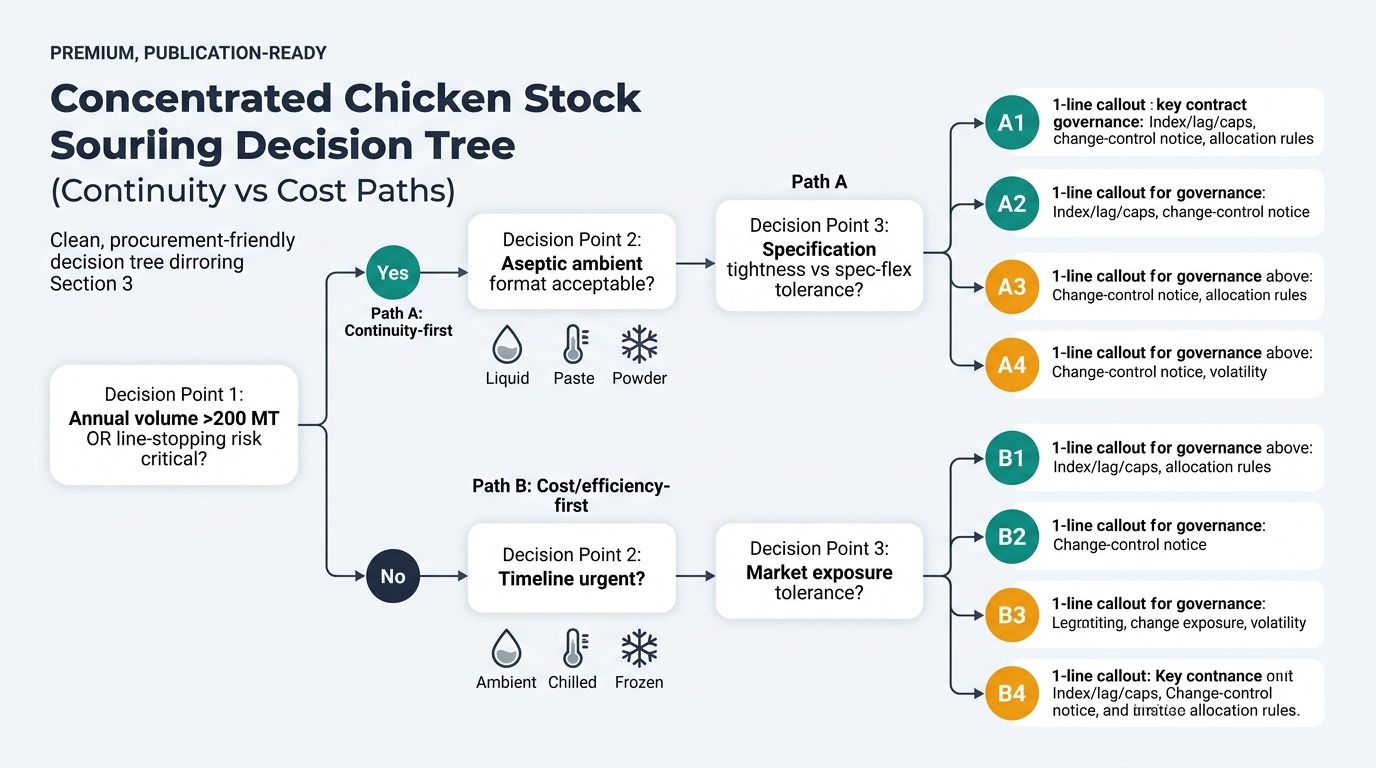
3) The decision tree: choose the sourcing strategy that fits your constraints

200 MT or line-stopping), branching to Path A (continuity-first) vs Path B (cost/efficiency-first), including Decision Points 2 and 3 for each path, and ending with recommendations A1–A4 and B1–B4 plus 1-line contract governance callouts (index/lag/caps, change-control notice, allocation rules), with icons for format, temperature, and risk." />

Insight

The “right” strategy depends less on unit price and more on (a) how tight your spec is, (b) how fast you need to switch, and (c) whether you can run aseptic ambient.

Data

Energy is a meaningful cost driver for evaporation/spray-drying. EIA’s Henry Hub series is a transparent U.S. benchmark; as of mid-July 2026, it shows meaningful month-to-month movement across 2025 and 2026 (not a flat input). [3]

Procurement Impact

If you don’t align contract structure to the true cost drivers (poultry inputs + energy + packaging), you’ll either overpay for risk transfer or get surprised by “unavoidable” surcharges.

Decision Point 1: What’s your annual demand and supply criticality?

  • Decision Point 1: Is annual volume > 200 MTor is this ingredient line-stopping (no finished goods without it)?
  • If YES → follow Path A (Continuity-first, dual-source design)
  • If NO → follow Path B (Cost/efficiency-first, simplify the supply model)

Path A (Continuity-first): you need redundancy that can actually run

Decision Point 2 (Path A)

Can you accept ambient aseptic product (shelf life ≥ 6–12 months) without changing finished-product performance?

  • If YES → Recommendation A1: Dual-source aseptic with capacity protection
  • What it looks like: 70/30 or 80/20 split across two qualified producers; both approved for the same packaging format (e.g., drums or aseptic BIB).
  • Contract structure: Mix of indexed components (energy/packaging) + fixed conversion margin windows; define allocation rules during disruptions.
  • If NO (must be chilled/frozen) → Recommendation A2: Dual-source with inventory + logistics redundancy
  • What it looks like: Primary chilled/frozen supplier + secondary supplier validated for emergency supply; pre-book cold storage and define expedite lanes.
  • Contract structure: Stronger service-level terms (lead time, OTIF, penalties/credits) because logistics is the constraint.

Decision Point 3 (Path A)

How tight is your spec relative to market reality?

  • If sodium target is narrow (e.g., ±0.2% absolute) OR “no yeast extract / no natural flavors” is mandatory → Recommendation A3: Keep spec tight but fund qualification time
  • Trade-off: Fewer alternates; you pay via longer lead times, higher change-control overhead, and higher risk of allocation.
  • If you can widen one constraint (e.g., sodium band, allowable processing aids, packaging flexibility) → Recommendation A4: Spec-flex to expand supplier pool
  • Trade-off: Requires controlled sensory and label review; reduces single-supplier dependence.

Path B (Cost/efficiency-first): you can optimize without overbuilding redundancy

Decision Point 2 (Path B)

Is your timeline urgent?

  • If you must award in ≤ 45 days → Recommendation B1: Renegotiate + add alternates-on-paper
  • What it looks like: Extend incumbent with a short bridge term, but complete paper qualification for 2–3 alternates to create credible leverage.
  • If you have ≥ 90–120 days → Recommendation B2: Competitive RFQ with should-cost guardrails
  • What it looks like: RFQ structured around comparable specs + explicit surcharge rules; require disclosure of packaging format and lead time by lane.

Decision Point 3 (Path B)

What market exposure can you tolerate?

  • If finance requires budget certainty → Recommendation B3: Fixed-price windows + re-openers
  • What it looks like: Fix price for 90–180 days; include re-opener triggers tied to energy or packaging indices.
  • If you can tolerate volatility to capture downside → Recommendation B4: Indexed pricing with caps/collars
  • What it looks like: Index the most volatile components; cap the upside to avoid runaway surcharges.

Quick Win

Put “surcharge governance” in the RFQ (what indices, what lag, what proof) or you’ll negotiate it under duress later.

4) Scenario walkthroughs (how real buyers land on different answers)

Insight

The framework is most useful when you trace the operational constraint first (format + spec + lead time), then choose the commercial model.

Data

Upstream volatility signals often arrive via energy and animal-health channels; EIA’s Henry Hub series provides a transparent energy indicator, and CDC publishes ongoing A(H5) situation summaries relevant to poultry operations risk. [1][3]

Procurement Impact

These walkthroughs show how to avoid “false savings” that disappear after freight, yield loss, or emergency substitutions.

Scenario A: High-volume prepared meals producer (line-stopping risk)

  • Profile: 600 MT/year; liquid concentrate; current single-source; two plants; any outage stops production.
  • Path through tree:
  • Decision Point 1: >200 MT and line-stopping → Path A
  • Decision Point 2 (Path A): Can accept aseptic ambient → YES
  • Decision Point 3 (Path A): Spec moderately tight (sodium band flexible) → Spec-flex possible
  • Final strategy:Recommendation A1 + A4 (dual-source aseptic, widen one constraint to expand alternates)
  • Why it lands here: Aseptic reduces cold-chain failure points; spec-flex increases the number of viable backup plants without changing the finished product—assuming controlled sensory validation.

Scenario B: CPG sauce brand (tight label posture, moderate volume)

  • Profile: 120 MT/year; paste/base; “no added MSG,” tight allergen statement; marketing-driven label constraints.
  • Path through tree:
  • Decision Point 1: <200 MT and not line-stopping → Path B
  • Decision Point 2 (Path B): Has 120 days before renewal → B2
  • Decision Point 3 (Path B): Budget certainty required → B3
  • Final strategy:Recommendation B2 + B3 (structured RFQ + fixed windows with re-openers)
  • Why it lands here: Tight label posture limits alternates; the best leverage comes from comparable bids and disciplined surcharge terms, not from threatening an unrealistic switch.

Scenario C: Foodservice manufacturer hit by recurring quality holds (edge case)

  • Profile: 250 MT/year; chilled liquid; two recent micro-related holds; OTIF slipping; switching risk high.
  • Path through tree:
  • Decision Point 1: >200 MT and effectively line-stopping → Path A
  • Decision Point 2 (Path A): Aseptic acceptable? → NO (process requires chilled functionality)
  • Decision Point 3 (Path A): Spec is tight + micro limits strict → A3
  • Final strategy:Recommendation A2 + A3 (dual-source with inventory/logistics redundancy + fund qualification time)
  • Why it lands here: You can’t “negotiate away” micro holds; you need redundancy and governance (change control, lot release discipline) while you qualify a true alternate.

5) Action matrix (match buyer type to the playbook)

Insight

Different operational realities require different sourcing designs; the same contract template should not be reused across all stock formats.

Data

Aseptic systems can become a bottleneck because they rely on specialized filling equipment and specific packaging components (e.g., bags/fitments). Treat that as a capacity constraint in your continuity plan—not just a packaging detail.

Procurement Impact

Use this table to align internal stakeholders quickly: procurement (commercial), QA (risk), ops (format/handling), finance (volatility).

Buyer Profile Key Factors Recommended Strategy Expected Outcome
High-volume, line-stopping (≥200 MT/year) Needs redundancy; can run ambient Dual-source aseptic (70/30) + capacity protection terms Lower disruption downtime; fewer expedites
High-volume but must be chilled/frozen Cold-chain constraint; tight lead times Dual-source + pre-book cold storage + stronger SLAs Better service continuity; higher logistics cost control
Moderate volume, tight clean-label posture Limited alternates; long qualification Structured RFQ + fixed windows + re-openers Budget stability; fewer surprise surcharges
Low volume, many SKUs Admin burden; MOQs matter Consolidate SKUs/specs + negotiate MOQ/lead-time tiers Lower total admin cost; fewer stockouts
Quality drift / sensory complaints Lot variability; change control gaps Tighten release specs + supplier scorecard + alternates-on-paper Reduced incident rate; clearer accountability

Quick Win

If you can’t explain your strategy in one sentence (“dual-source aseptic with indexed energy and capped packaging pass-through”), you probably haven’t aligned stakeholders.

6) Risk mitigation: what to monitor, when to re-open, and what buyers miss

Insight

The biggest failures in this category come from unmanaged change: raw material shifts, process tweaks, packaging substitutions, or silent spec drift.

Data

Two external indicators are consistently useful as early signals: (1) energy pricing (EIA Henry Hub) and (2) animal-health disruption updates (CDC A(H5) situation reporting). [1][3]

Procurement Impact

Build “review triggers” into governance so you adjust before allocation, not after.

For Recommendation A1 (Dual-source aseptic)

What to watch for

  • Aseptic constraint signals: Extended lead times on bags/fitments; filler maintenance downtime; sudden MOQ increases.
  • Quality drift signals: Brix/solids variability trend; viscosity shifts; sensory deviation tickets.

Contingencies

  • Inventory action: Increase safety stock when lead time extends by > 2 weeks.
  • Commercial action: Activate allocation clauses; shift volume split temporarily if one plant is constrained.

Monitoring metrics & triggers

  • OTIF trigger: < 95% OTIF for 2 months → executive supplier review (95% is a commonly used service-level threshold in supply programs). [4]
  • Spec drift trigger: Brix or sodium trending toward limits for 3 consecutive lots → corrective action + tighter COA review.

Common mistakes

  • Mistake: Dual-source “on paper” without packaging equivalency.
  • Mistake: No defined rules for who gets volume during allocation.

For Recommendation A2 (Dual-source chilled/frozen)

What to watch for

  • Cold-chain fragility: Carrier failures, dock delays, temperature excursions.
  • Shelf-life compression: Receiving delays that reduce usable days-on-hand.

Contingencies

  • Lane redundancy: Pre-qualify at least 2 carriers per lane.
  • Receiving SOP: Tighten appointment windows; add temperature logging requirements.

Monitoring metrics & triggers

  • Temperature excursion trigger: ≥ 2 excursions/quarter → switch lanes or packaging.

Common mistakes

  • Mistake: Negotiating price while ignoring the total landed cost of cold-chain failures.

For Recommendation B2/B3 (RFQ + fixed windows)

What to watch for

  • Surcharge creep: New “packaging” or “energy” adders outside contract terms.
  • Index mismatch: Supplier references an index that doesn’t reflect your geography or actual cost driver.

Contingencies

  • Re-opener discipline: Re-open only when indices move beyond a pre-set band (e.g., ±15% vs baseline).
  • Bid timing: Avoid awarding during peak disruption windows if you can extend a bridge.

Monitoring metrics & triggers

  • Cost driver trigger: Henry Hub sustained move for 30+ days → review energy pass-through exposure. [3]

Common mistakes

  • Mistake: Accepting “market conditions” language instead of explicit index/lag/cap rules.

Quick Win

Add a “change-control clause” that requires written notice for any raw material/process/packaging change that could affect label, allergens, or sensory.

7) Key insights you can use as a sourcing stance (not a promise)

Insight

The best near-term posture is usually to protect continuity while keeping optionality—because qualification cycles are long and disruptions tend to show up as lead-time and quality variance first.

Data

Energy and animal-health indicators remain live volatility inputs (EIA Henry Hub series; CDC A(H5) updates). [1][3]

Procurement Impact

Treat this as a governance stance for the next contracting cycle, not a guaranteed savings claim.

Strategy stance

  • Strategy: Hold
  • Reliability: Medium
  • Potential Saving: 2%–6%
  • Insight: Hold the spec steady while you (1) pre-qualify at least one near-spec alternate and (2) renegotiate surcharge governance (explicit indices, lag, caps/collars). This typically improves negotiation leverage and reduces surprise increases without forcing a rushed supplier switch.

Logical Next Step (analysis, not promotion)

The hardest procurement problem in concentrated chicken stock is separating a legitimate cost-driver move (poultry inputs, energy, packaging) from supplier margin expansion early enough to time bids and re-openers. Teams that can continuously benchmark supplier pricing position, track lead-time shifts, and tie surcharge claims to transparent indices make better contract decisions—especially when specs are tight and switching is slow.

Sourcing Window Radar
Concentrated Chicken Stock — Global Harvest Calendar
MALAYSIA SEASON ACTIVE
🇲🇾 Malaysia
JUL — DEC
🇺🇸 United St.
JAN — NOV
🇨🇷 Costa Rica
JAN — DEC
🇬🇹 Guatemala
SEP — DEC
🇨🇳 China
SEP — NOV
JanFebMarAprMayJunJulAugSepOctNovDec

The Bottom Line for Your Next Contract

(Analyzed at: Jul, 2026) EIA’s latest published Henry Hub data (release dated July 15, 2026) shows 2026 has not been a “set-and-forget” energy year, and EIA’s STEO narrative still frames gas pricing as sensitive to storage and seasonal demand—exactly the kind of input volatility that turns into mid-contract surcharge fights if you leave terms vague. [3] The move that consistently holds up is to renew (or bid) with explicit index/lag/cap language on energy and packaging, while you paper-qualify at least one alternate that can run your exact format. If you don’t, a few points of ungoverned pass-through can quietly erase the margin you thought you negotiated—especially once expediting, downtime, or rework enters the picture.

Concentrated Chicken StockSupply Chain Intelligence
134 countries tracked
10
Exporters
10
Importers
$913M
Top Export Value
Top Exporters (2024)
🇺🇸
United States
$913M
🇨🇦
Canada
$243M
🇪🇸
Spain
$200M
🇳🇱
Netherlands
$120M
🇩🇪
Germany
$112M
+129 more
Top Buyers
🇺🇸 United States $627M🇲🇽 Mexico $563M🇨🇦 Canada $332M🇳🇱 Netherlands $183M🇩🇪 Germany $182M

References

  1. cdc.gov
  2. nsf.org
  3. eia.gov
  4. usersolutions.com

Related Contents

Subscribe
→
By subscribing you agree to with our Privacy Policy and provide consent to receive updates from our company.
Thank you! Your submission has been received!
Oops! Something went wrong while submitting the form.
Subscribe to receive the latest blog posts, updates, promotions, and announcements from Tridge.
