

This guide maps the cold-pressed krill oil supply chain from harvest to finished goods, with a Quality/Safety/Compliance procurement lens. The goal is to show where quality is truly “made,” where costs become irreversible, and which documentation and controls create an audit-ready, defensible supplier decision—without assuming you’re a krill-oil domain expert.
Cold-pressed krill oil is structurally different from most nutraceutical oils because the upstream is geographically concentrated (Southern Ocean), operationally constrained (short fishing windows, harsh weather), and chemically fragile (rapid enzymatic breakdown and oxidation risk without immediate stabilization). The supply chain is best understood as a race against time/temperature/oxygen from net-to-oil, then a documentation-heavy conversion into standardized, audit-ready lots.
Insight: The dominant “fixed” cost-drivers are vessel economics (days at sea, fuel, onboard processing) and oxidation-control infrastructure (inerting, cold/controlled storage, high-frequency QC).
Data (validated): CCAMLR’s management in Area 48 includes a “trigger level” of 620,000 tonnes; when the combined catch reaches that level, the fishery can be closed and/or additional spatial rules apply. [1]
Procurement Impact: Downstream costs and lot consistency are largely predetermined before the oil ever reaches a refinery/encapsulator—because handling and stabilization decisions upstream determine oxidation headroom and rework/reject risk.
Physical flow (simplified):
Antarctic harvest (factory trawlers) → immediate stabilization & primary separation (onboard or coastal) → bulk crude oil storage (inerted, light/oxygen controlled) → secondary refining/standardization → bulk packaging (drums/totes, nitrogen headspace) → encapsulation/finished goods packaging → distribution.
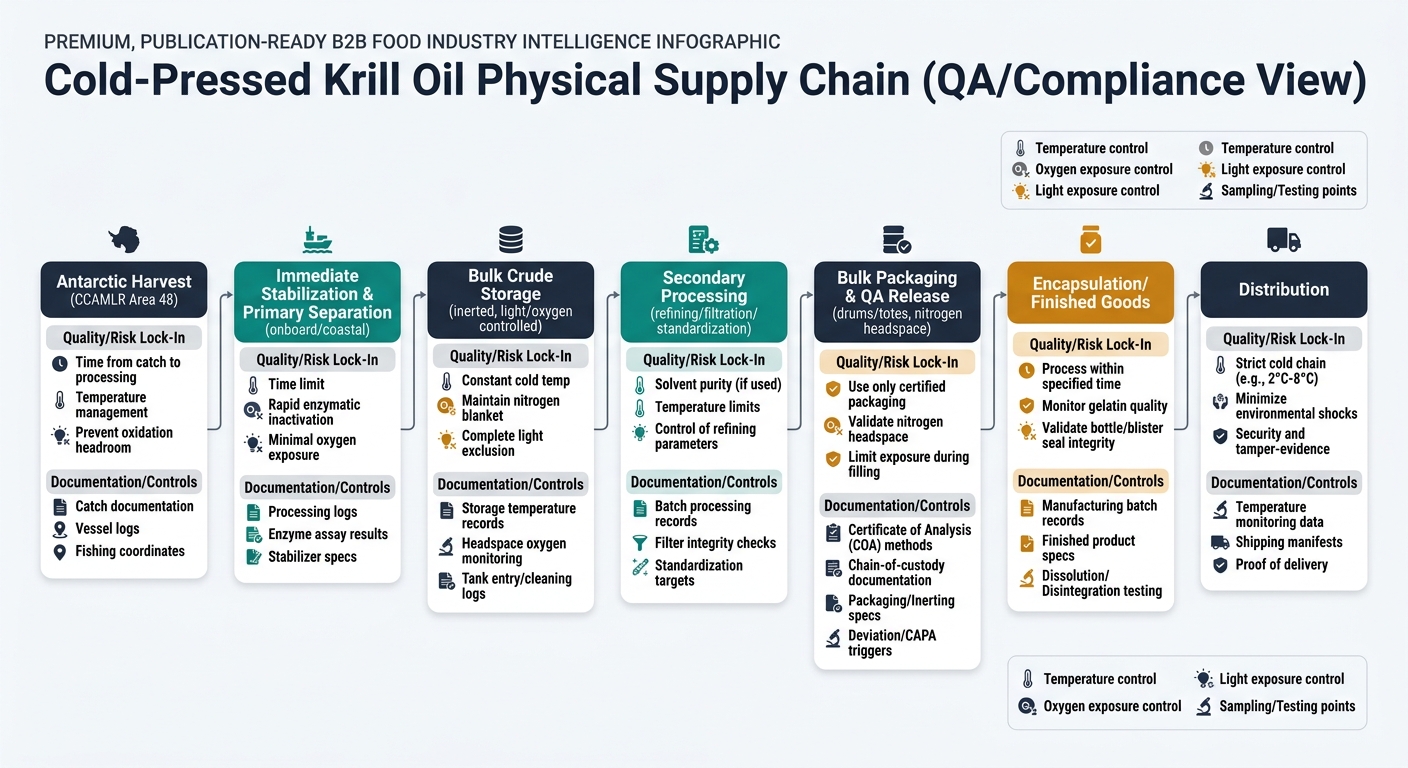
Insight: Krill oil cost is not “one big raw material cost.” It is a stacked system where each node adds irreversible cost through yield loss, quality protection, and compliance-grade QA.
Data (validated): CCAMLR’s krill management includes the trigger-level mechanism (620,000 tonnes in Area 48) and spatial controls, and the fishery’s operational concentration increases the impact of downtime or quality excursions. [1]
Procurement Impact: The most expensive failures are physical (oxidation, temperature excursions, yield loss) and happen early; later nodes mostly convert and document quality rather than “fix” it.
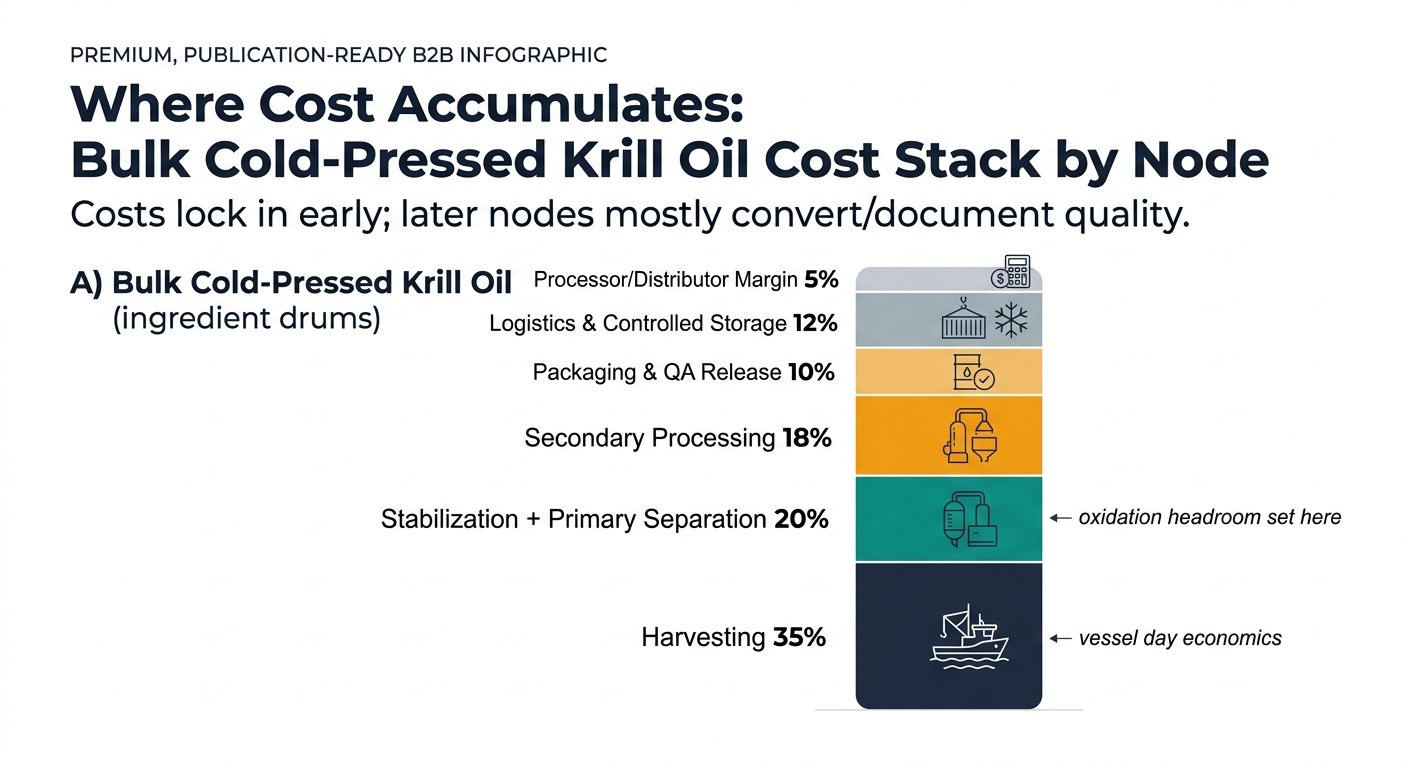
| Supply Chain Node | Cost Ratio (% of Final Cost) | Notes |
|---|---|---|
| Harvesting (vessel operations) | 35% | Day-rate/capex, fuel, crew, CCAMLR compliance overhead; highly sensitive to fishing days. |
| Stabilization + Primary Separation | 20% | Immediate handling, inerting/cold control, yield loss prevention; determines oxidation headroom. |
| Secondary Processing (standardize/refine) | 18% | Filtration, polishing, potential deodorization constraints, high-frequency QC and rework risk. |
| Packaging & QA Release | 10% | Nitrogen headspace, oxygen/light barrier, COA/testing, retains, batch documentation. |
| Logistics & Controlled Storage | 12% | Long routes, insurance, temperature management, working capital tied up in campaign supply. |
| Processor/Distributor Margin | 5% | Margin is often constrained by upstream allocation and quality rejects. |
| Supply Chain Node | Cost Ratio (% of Final Cost) | Notes |
|---|---|---|
| Bulk Krill Oil Input | 30% | Ingredient cost plus any overage for yield/QA holds. |
| Encapsulation Conversion | 22% | Softgel materials, line time, yields, in-process controls, cleaning/changeovers. |
| Packaging (bottles/blisters) | 18% | Oxygen/light management, desiccants, labels, tamper evidence, serialization (as applicable). |
| QA/QC & Release Testing | 10% | Finished-goods COA, stability program costs, retains, complaint investigation readiness. |
| Logistics & Distribution | 10% | Warehousing, temperature exposure risk, returns handling. |
| Brand/Wholesale Margin | 10% | Commercial margin after conversion and channel costs. |
| Supply Chain Node | Cost Ratio (% of Final Cost) | Notes |
|---|---|---|
| Harvesting | 32% | Same physical constraints; premium grades still start with the same fishery reality. |
| Stabilization + Primary Separation | 22% | Tighter oxidation control and segregation practices increase cost intensity. |
| Secondary Processing + Standardization | 22% | More testing, tighter in/out specs, higher yield loss risk to hit premium PV/p-AV/TOTOX. |
| Packaging & QA Release | 10% | More stringent documentation, tighter oxygen specifications. |
| Logistics & Controlled Storage | 10% | Often stricter storage expectations and shorter allowable dwell times. |
| Margin | 4% | Premium is frequently absorbed by higher reject/rework and documentation burden. |
Insight: Three structural constraints shape availability, quality outcomes, and cost—regardless of supplier or brand.
Data (validated): CCAMLR’s trigger-level approach (620,000 tonnes in Area 48) is a hard structural constraint, and oxidation metrics (PV/p-AV/TOTOX) are embedded in widely used standards frameworks (Codex) and industry benchmarks (GOED). [1] [2] [3]
Procurement Impact: These constraints explain why krill oil behaves more like a campaign-based, high-spec ingredient than a continuously produced commodity oil.
(Analyzed at: Aug, 2026)
Write your next krill oil contract as if the fishery can close early, because it already has: CCAMLR’s own reporting indicates the Area 48 catch hit the 620,000-tonne trigger level and the fishery was closed on 1 August 2026—a real-world stress test that tends to cascade into allocations, longer lanes, and higher oxidation risk. [4]
The highest-leverage move is to lock in a lane-specific “evidence pack” (packaging/inerting spec, max time/temperature exposure, COA methods/limits for PV-AV-TOTOX, and deviation/CAPA triggers) and pre-approve one backup source under change control. If you don’t, the cost shows up quietly as rework, holds, and late-life complaints—often enough to erase several points of negotiated savings on the ingredient when supply tightens and handling gets rushed.


