
This report is powered by Tridge market intelligence.
Every data point, price signal, and supply chain insight in this analysis is drawn from the same engine that procurement teams worldwide rely on daily. As you read, consider what this level of visibility could do for your category.
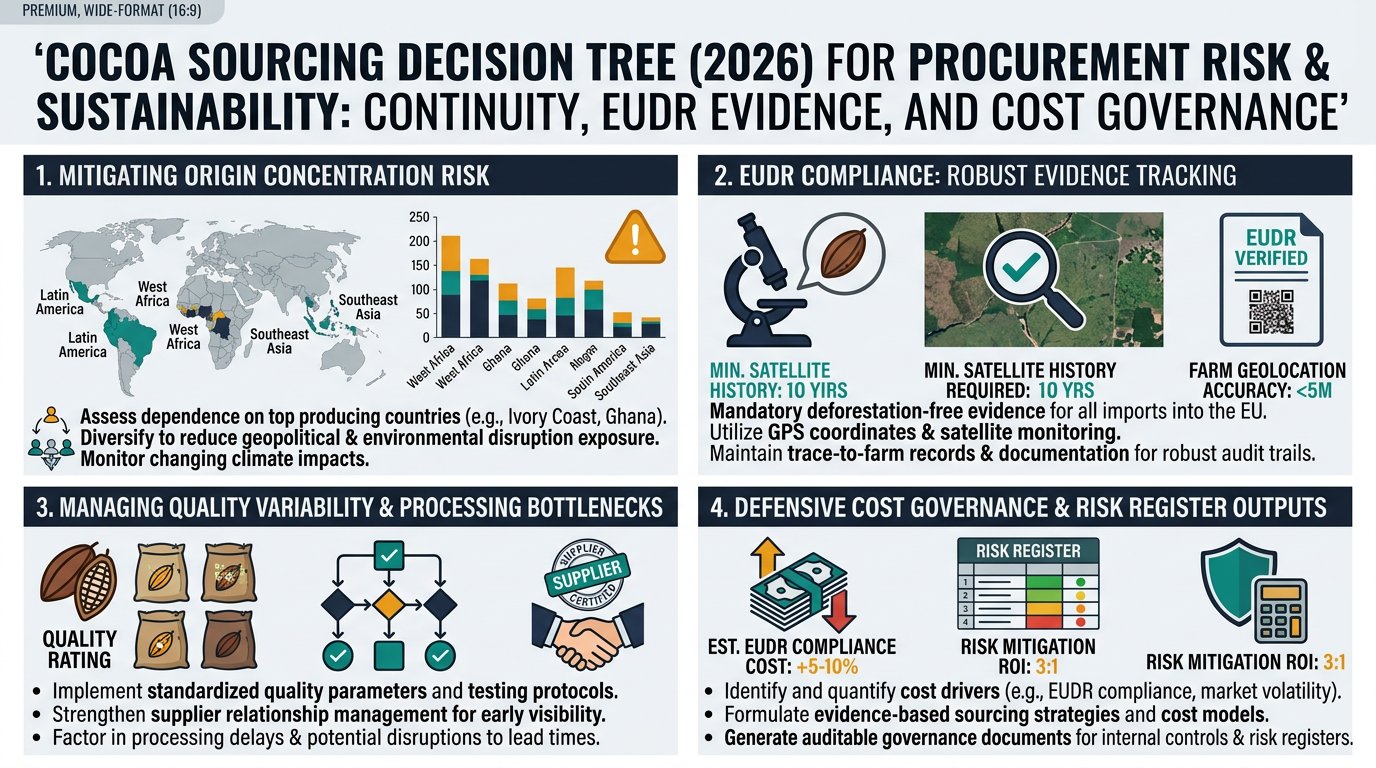
This guide is a practical decision tree for procurement risk & sustainability stakeholders who don’t live in cocoa every day, but need to make defensible decisions quickly. It translates cocoa’s real constraints—origin concentration, quality variability, processing bottlenecks, and rising evidence requirements (notably the EU Deforestation Regulation)—into measurable decision points, clear sourcing paths, and governance outputs you can use in risk registers, supplier approvals, and audit preparation.
Analyzed at: Mar, 2026
Insight: As of March 2026, cocoa procurement risk is still dominated by (1) high origin concentration (Côte d’Ivoire often cited ~40% of global output) and (2) tightening evidence expectations driven by EUDR implementation timelines. The most defensible near-term action is to lock in resilience and evidence readiness in parallel: (a) ensure ≥2 qualified suppliers per critical spec (with at least one alternative processing footprint or route-to-market), and (b) implement an “EUDR evidence gate” for any EU-bound (or EU-customer) volumes requiring plot geolocation linkage and due diligence statement readiness. This typically reduces costly expedited buys, quality-related yield losses, and last-minute documentation remediation more reliably than attempting to time price moves.
This decision framework helps you choose a cocoa sourcing strategy across four procurement levers that drive both supply continuity and sustainability defensibility:
Cocoa is unusually sensitive to correlated shocks and evidence risk:
Use this if you’re a Purchase – Risk & Sustainability stakeholder (or a sourcing manager partnering with sustainability/legal/quality) and you are:
I can outline practical risk and sustainability decision frameworks and the types of intelligence that support them, but I can’t guarantee compliance outcomes or replace your legal/audit functions.
You will end up in one of these practical strategies:

Output of Path A: a documented tiered supply plan (Primary / Secondary / Contingency), with qualification timelines and trigger points.
Output of Path B: a supplier governance model (scorecards + evidence pack) and a contracting policy aligned to volatility tolerance.
Note: season calendars can shift. For example, Côte d’Ivoire reported an adjustment to its cocoa crop calendar in late February 2026 (main crop and mid-crop windows). Treat harvest timing as a monitored assumption rather than a static fact.
Profile: 800 MT/year cocoa liquor; < 25 days safety stock; EU customer questionnaires require plot-level traceability.
Why this works: you reduce correlated origin shock exposure while ensuring backups don’t fail at the border/customer audit due to missing geolocation/due diligence documentation.
Profile: 300 MT/year natural cocoa powder; US-only sales; moderate sustainability requirements; demand fluctuates.
Why this works: you avoid over-committing volume while still controlling the big cost drivers you can influence (service, differentials, freight lanes, quality rejects).
Profile: 60 MT/year cocoa butter; sudden supplier failure; production needs material in 4 weeks; tight fat profile.
Why this works: you protect product performance first, then build resilience by adding a second processing route once the immediate gap is closed.
| Buyer Profile | Key Factors | Recommended Strategy | Expected Outcome |
|---|---|---|---|
| High-volume (≥ 500 MT), line-stopper, low safety stock | < 30 days stock; high disruption cost | Resilience-first portfolio (A1/A2 + A4) | Fewer emergency buys; faster switching; reduced downtime risk |
| EU-exposed or audit-heavy customer base | Plot-level evidence needed; deforestation cut-off risk | Evidence-first sourcing (A3/B3) | Higher audit readiness; fewer shipment/customer rejections due to missing evidence |
| Cost-driven industrial buyer (200–600 MT) | Budget variance; uncertain demand | Flexible coverage + differential governance (B2) | Lower total landed cost volatility; improved forecast-to-actual performance |
| Origin-sensitive premium chocolate | Tight sensory profile; limited blending | Same-origin multi-supplier + quality governance (A2 + B4) | Maintains flavor consistency while reducing single-supplier risk |
| Small buyer (< 100 MT) with urgent gap | < 6 weeks; limited leverage | Urgent continuity plan (A4 + Decision Point 5 fast-track) | Supply restored quickly; formal plan to qualify backups post-crisis |

Regulatory note: EUDR covers cocoa and sets the deforestation-free cut-off after 31 Dec 2020. Commonly communicated application milestones include 30 Dec 2025 (large/medium) and 30 Jun 2026 (micro/small), but confirm your exact obligations with counsel based on your entity type and role (operator vs trader; importer vs exporter; downstream manufacturer vs first placer).
Market context reminder: recent years have seen extreme cocoa price moves linked to West African weather/disease impacts and supply tightness, increasing downstream price pressure for chocolate makers. Plan governance assuming volatility is not “rare.”
Insight: If your cocoa is a line-stopper or EU-exposed, prioritize a two-layer resilience move over chasing marginal unit price: (1) ensure you have ≥ 2 qualified suppliers per critical spec and (2) implement a simple evidence completeness score (geolocation/traceability pack readiness) that gates any new supplier onboarding. This typically reduces emergency buys, quality rejects, and audit firefighting—often worth more than negotiating a small differential improvement.
Take Your Sourcing Intelligence to the Next Level
The insights in this report are just the starting point. Tridge Eye gives you real-time market signals, origin risk alerts, and price benchmarks — so you can act before the market moves.
No external links were provided in the source content, so no references were generated.