INDUSTRY TRENDS

Cocoa Procurement Reality Check (2026): How Cost Builds Up, Where Risk Hides, and Why Your Physical Price Won’t Follow Futures

Author
Team Tridge
DATE
March 17, 2026
10 min read
Cocoa Cover
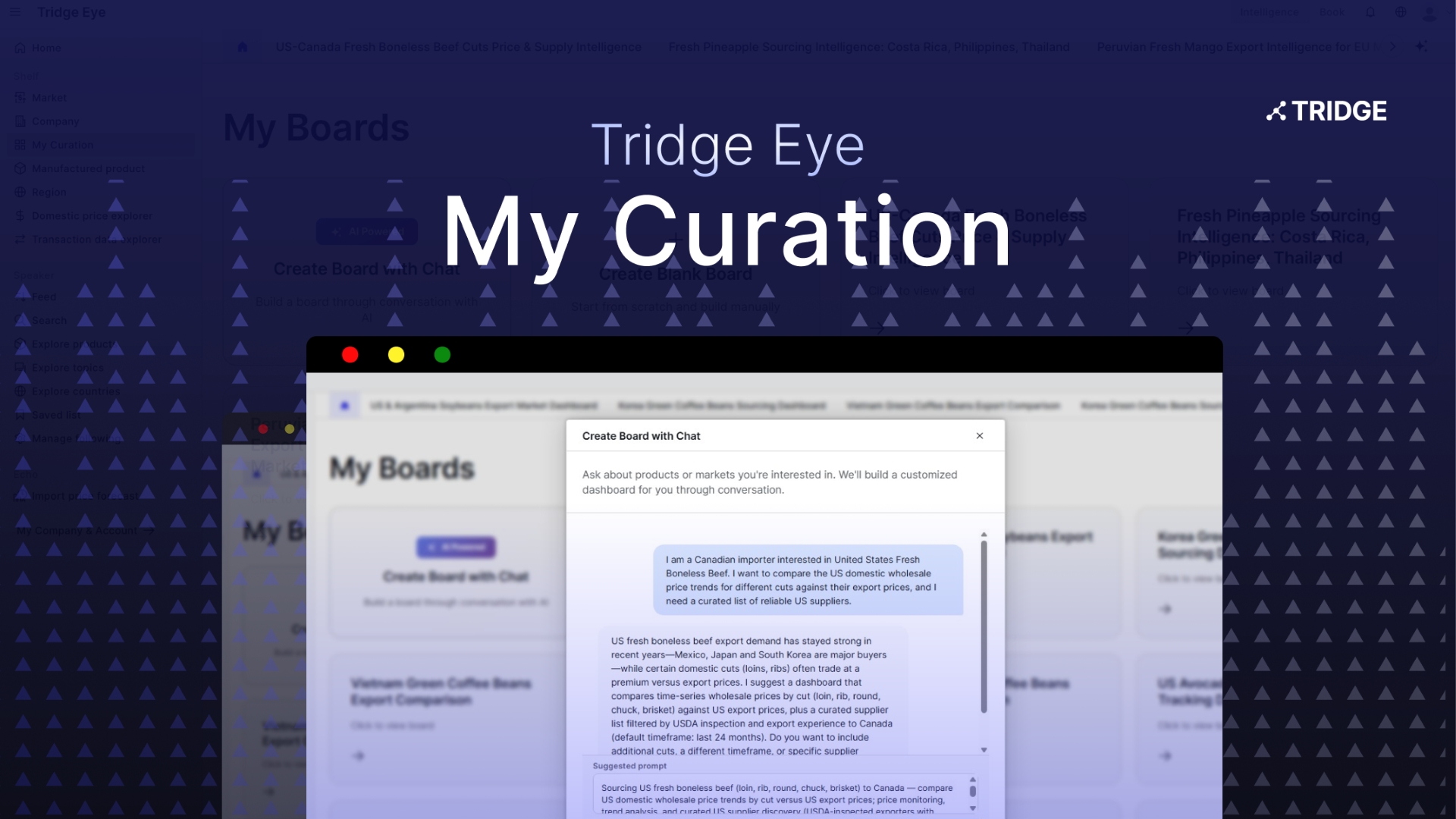
Tridge Eye Data Intelligence Solution

This report is powered by Tridge Eye Data Intelligence.

Every data point, price signal, and supply risk insight in this analysis comes from the same platform that procurement and sourcing leaders worldwide rely on daily. As you read, consider what this level of market intelligence could do for your sourcing decisions.

Explore Tridge Eye →

Cocoa sourcing is often treated like a straightforward ingredient purchase, but it behaves more like a risk-managed supply system: agricultural variability upstream, processing bottlenecks midstream, and tightening compliance/traceability requirements downstream. This guide is written for procurement and sourcing managers who are experienced buyers in other categories but need a practical, cocoa-specific mental model to make defensible allocation and contracting decisions—without assuming perfect price forecasts.

Executive Summary

  • What you’re buying is a chain, not a SKU: Beans → liquor → butter + cake → powder; each node adds cost, lead time, and compliance obligations.
  • Concentration creates correlated shocks: Côte d’Ivoire + Ghana account for roughly ~60–70% of global cocoa supply; broader West Africa is commonly cited around ~70–75% depending on season and definitions [1].
  • Physical costs don’t track futures cleanly: basis/differentials, quality spreads, coverage (forward sales), and logistics/capacity constraints can dominate your invoice timing.
  • Grinding hubs are real leverage points: ICCO data consistently shows Netherlands and Germany among the largest grinders, with Indonesia and Malaysia also major hubs—important for lead-time and conversion-cost risk [2].
  • Quality is economics: moisture and defects drive yield, claims, and food-safety holds; industrial buyers commonly target bean moisture around ~7% (with many commercial specs using max values around 7–7.5%) [3].
  • EUDR timing remains a moving target: market sources describe a shift toward later application dates (commonly discussed as Dec 30, 2026 for large/medium and Jun 30, 2027 for small/micro), but you should validate your exact applicability and customer commitments [4].

Key Insights

Analyzed at: Mar, 2026

  • Strategy: Hold
  • Reliability: Medium
  • Potential Saving: 4% ~ 10%

Insight: Treat 2026 contracting as a variance-reduction exercise rather than a “beat the market” exercise: (1) split awards by route + grinding hub (not just supplier names) to reduce correlated disruption exposure; (2) renegotiate contracts to separate index vs basis/differentials vs compliance premiums with explicit caps/tiers; and (3) accelerate pre-qualification of at least one alternate for each critical spec (butter deodorization profile; powder pH/color; micro limits). This typically reduces total landed cost variance (claims, expediting, downtime risk) more reliably than chasing unit price in a volatile market.

1) What You’re Actually Buying: The Ground Truth Cocoa Flow (Beans → Ingredients)

Cocoa procurement looks like an “ingredient buy,” but operationally it’s a multi-node agricultural + processing system where value, risk, and compliance obligations accumulate at each handoff.
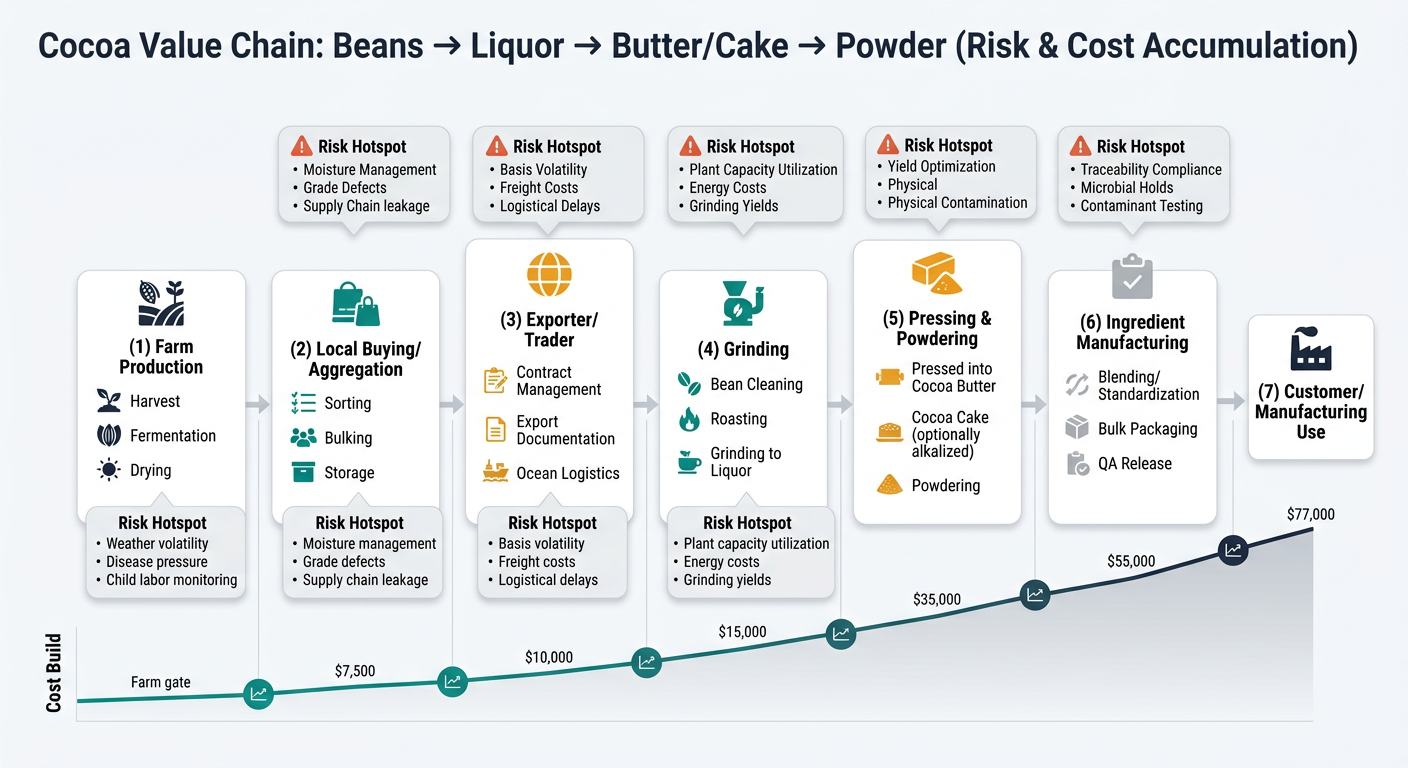
End-to-end flow (simplified)

  1. Farm-level production (smallholders) → harvest pods, ferment & dry beans
  2. Local buying / aggregation → quality sorting, bulking, financing, internal transport
  3. Exporter / trader → contracts, documentation, logistics to grinding hubs
  4. Grinding / primary processing → beans → nibs → liquor (mass)
  5. Pressing / secondary processing → liquor → butter + press cake → powder (natural or alkalized)
  6. Manufacturing → chocolate, compounds, fillings, bakery and beverage ingredients
  7. Distribution / end markets

Why this matters to a sourcing manager

  • Most volatility originates upstream (crop size, disease, weather), but your delivered cost and service risk often materialize midstream/downstream (port delays, grinding capacity, QA holds, segregation for compliance).
  • Your “supplier” might be a trader, a grinder, or an ingredient manufacturer—each has different cost drivers and different levers for mitigation.
A process flow showing the end-to-end cocoa transformation from farm production through aggregation, exporter/trader logistics, grinding, pressing and powdering, ingredient manufacturing, and customer use, with overlays indicating stepwise cost build and risk hotspot callouts at farm, aggregation, trading/logistics, grinding/pressing, and QA/compliance.

2) Where the Money Goes: Cost & Margin Build-Up by Supply-Chain Node

2.1 Upstream Farming (Pods → Fermented/Dried Beans)

Key insight: Cocoa is an agricultural commodity with high yield uncertainty and quality variability driven by fermentation/drying discipline. That variability directly affects grinder yield and therefore the price you see for liquor/butter/powder.

What drives cost here

  • Labor-intensive harvesting + post-harvest handling (fermentation/drying)
  • Weather sensitivity (rainfall distribution, heat stress)
  • Disease pressure (e.g., black pod; swollen shoot in West Africa)
  • Farmgate pricing systems (notably in Côte d’Ivoire and Ghana) can create timing effects between futures prices and physical availability

Procurement implication

  • If you buy processed products (butter/powder), you still inherit farm-level risk via raw bean tightness and quality spreads.

2.2 Local Buying & Aggregation (Quality Sorting + Bulking + Financing)

Key insight: Aggregation is where “hidden” cost shows up as losses and claims: moisture out-of-spec, mold risk, foreign matter, infestation, and inconsistent bean counts.

What drives cost here

  • Collection networks + inland transport (often poor roads)
  • Working capital / pre-financing to secure volumes
  • Sorting losses and re-bagging
  • Storage conditions (humidity/odor taint risk)

Procurement implication

  • A supplier with strong origin controls often has lower downstream variability (fewer QA holds, fewer weight/quality disputes).

2.3 Exporter/Trader Layer (Contracts + Logistics + Risk Transfer)

Key insight: Traders monetize their ability to assemble compliant lots, manage documentation, and carry logistics risk. In tight markets, differentials widen because “deliverable” cocoa becomes scarce.

What drives cost here

  • Contracting against futures (basis/differentials)
  • Freight, insurance, demurrage
  • Documentation + compliance (increasingly traceability/geo-data)

Procurement implication

  • Your negotiation is rarely just “price/mt.” It’s price + basis + Incoterms + payment terms + quality tolerances + claims protocol.

2.4 Grinding (Beans → Nibs → Liquor)

Key insight: Grinding converts agricultural variability into industrial consistency—but at a cost: energy, maintenance, QA, and yield management.

What drives cost here

  • Cleaning/sorting losses
  • Roasting energy and process control
  • Capacity utilization (tight capacity amplifies lead-time risk)

Reference reality: ICCO grindings data consistently shows the Netherlands and Germany as top grinding locations, with Indonesia and Malaysia also among major grinders. Use this to think about your exposure to specific processing hubs (energy, capacity, congestion) rather than treating “processing” as generic [2].

2.5 Pressing & Powdering (Liquor → Butter + Cake → Powder; optional alkalization)

Key insight: Butter and powder economics are coupled by the butter-to-powder output ratio. If your demand skews heavily to one side (e.g., butter tightness), costs can spike even if beans are stable.

What drives cost here

  • Pressing yields and mechanical efficiency
  • Optional alkalization (chemicals + energy; color/pH targets)
  • QA and micro controls (powders are sensitive to contamination risk)

Process reality: Cocoa liquor is pressed to remove butter; powders are produced by pulverizing press cake; alkalization can be applied at different steps depending on the product and plant configuration.

2.6 Ingredient Manufacturing & Brand Layer (Formulation, Packaging, Route-to-Market)

Key insight: Downstream price to your business may not track futures quickly because brands and ingredient manufacturers reprice on cycles, carry inventory, and embed hedging/coverage positions.

What drives cost here

  • Formulation, standardization, blending
  • Packaging, labeling, QA release
  • Customer-specific specs and service levels

Observed market behavior: Multiple reports in 2024–2025 highlighted that cocoa futures spikes did not immediately translate into lower shelf prices when futures later softened (pricing lag and coverage effects).

Product-level cost breakdown (illustrative, % of delivered cost to an industrial buyer)

These are modeled ratios to show where cost concentrates by product form. Actual splits vary by origin, certification/segregation, plant utilization, energy, Incoterms, and market tightness. Use them as a “where to look” guide, not a should-cost guarantee.

Four side-by-side 100% stacked bars comparing delivered cost build-up by product form (beans, liquor, butter, powder), segmented into consistent cost components such as bean/farm input value, aggregation/origin handling, trader/services, conversion costs, QA & food safety, packaging/handling, logistics, processor margin, and alkalization for Dutched powder, with a legend and an illustrative-model note.

A) Fermented & Dried Cocoa Beans (FOB-equivalent landed to buyer’s port)

Supply Chain Node Cost Ratio (% of Delivered Cost) Notes
Farming (incl. fermentation/drying labor) 65% Dominant driver; yield and quality variability matter most.
Local buying/aggregation 10% Sorting losses, storage, internal transport, financing.
Exporter/trader margin & services 8% Assembly, documentation, risk transfer.
Packaging & QA 4% Bagging, sampling, basic tests.
Logistics (freight/insurance/port) 13% Highly variable with lane congestion and Incoterms.

B) Cocoa Liquor (Mass/Paste), industrial blocks

Supply Chain Node Cost Ratio (% of Delivered Cost) Notes
Bean input value 55% Beans still dominate; quality affects yield and flavor.
Grinding conversion cost 18% Energy, labor, maintenance, losses.
QA & food safety release 6% Micro testing and spec conformance.
Packaging 6% Blocks, liners, palletization.
Logistics 7% Often steadier than beans but still lane-dependent.
Processor margin 8% Utilization and demand balance matter.

C) Cocoa Butter (deodorized or natural, blocks/totes)

Supply Chain Node Cost Ratio (% of Delivered Cost) Notes
Bean input value 45% Indirect through liquor; tight bean markets propagate quickly.
Grinding + pressing cost 22% Press efficiency and energy matter.
QA & specification compliance 7% Fat profile, odor, contaminants.
Packaging/handling 8% Blocks/cartons or liquid handling/totes.
Logistics 8% Temperature/handling requirements can raise risk/cost.
Processor margin 10% Strongly affected by butter/powder balance.

D) Cocoa Powder (natural or alkalized/Dutched)

Supply Chain Node Cost Ratio (% of Delivered Cost) Notes
Bean input value 40% Indirect via liquor/cake; still the anchor.
Grinding + pressing + milling 25% Multi-step, energy-intensive.
Alkalization (if Dutched) 6% Chemical + energy + yield impacts.
QA & micro controls 10% Release testing and contamination prevention.
Packaging 9% Multiwall bags, labeling, pallet wrap.
Logistics 5% Bulkier but stable lanes.
Processor margin 5% Often squeezed when demand weakens.

3) The Structural Fact Most Non-Cocoa Buyers Miss: Concentration + Correlated Risk

Cocoa is not just “global.” It is concentrated—and concentration creates correlated shocks.

  • Côte d’Ivoire and Ghana are commonly cited as responsible for roughly ~60–70% of global cocoa supply; broader West Africa is often cited around ~70–75% depending on season and definition [1].
  • When Côte d’Ivoire/Ghana have simultaneous weather/disease issues, you don’t get a gentle price move—you get basis blowouts, quality scarcity, and allocation behavior.

Procurement implication

  • “Multiple suppliers” isn’t diversification if they all source from the same origin corridor and ship through the same ports.

4) The Critical Insight: Why Cocoa Futures and Your Physical Costs Disconnect

Procurement teams often expect cocoa to behave like metals: futures up → physical up immediately; futures down → physical down immediately. Cocoa often does not.

Four reasons the linkage breaks

  1. Quality and deliverability spreads: In tight markets, the premium for spec-compliant lots widens faster than futures move.
  2. Coverage and pricing cycles: Processors/brands sell forward; they reprice on cycles, so your invoices lag the screen.
  3. Origin marketing systems and timing: In key origins, sales programs and farmgate pricing can create mismatches between futures moves and physical flow availability.
  4. Capacity and logistics constraints: Even if beans exist, grinding capacity, port dwell, container availability, and QA release can constrain supply.

Market reality example: The 2024–present volatility is widely linked to West African supply tightness after consecutive seasons affected by weather and disease [5]. Treat this as a reminder that “screen price” is only one input into physical procurement timing.

5) Where Procurement Teams Commonly Misstep (and Pay for It)

  1. Treating cocoa like a single SKU
  2. Buying “powder” without locking: fat %, alkalization level, color/pH, micro specs, cadmium risk (origin-dependent), and acceptable defect tolerances.
  3. Optimizing unit price while ignoring yield and claims
  4. A cheaper bean lot with higher defects/moisture risk can cost more after processing loss, QA holds, rework, and customer complaints.
  5. Assuming compliance is a paperwork exercise
  6. Traceability and deforestation due diligence are increasingly “data requirements,” not just certificates.
  7. Not pre-qualifying alternates
  8. In a shock, you can’t qualify a new powder supplier in two weeks if you need plant trials, allergen validations, micro baselines, and customer approvals.
  9. Under-specifying contracts
  10. Missing: cut-test/defect definitions, moisture limits, claims windows, substitution rules, Incoterms, and contingency allocation language.

Quality reality anchor: Many industrial guidance sources describe buyer requirements for cocoa bean moisture at approximately ~7% (often expressed as a maximum). Exact targets vary by origin and contract, but moisture remains one of the most practical predictors of mold risk and claims exposure [3].

6) How Intelligence-Driven Sourcing Changes the Outcome (Without Pretending to Predict Prices)

The objective isn’t “forecast cocoa.” It’s to make defensible allocation and contracting decisions under uncertainty.

What a procurement team should monitor (signals → decisions)

A) Supply assurance signals (origin + logistics)

  • Weather anomalies and heat stress in core belts (leading indicators for crop quality/size)
  • Port congestion and lane reliability (lead-time risk)
  • Policy actions impacting flow (stock interventions, export rules)

Decision impact:

  • Earlier allocation shifts (e.g., move some volume to alternative origins or different processors)
  • Adjust safety stock and reorder points based on lead-time distribution, not averages

B) Cost-driver signals (beyond futures)

  • Differentials/basis behavior (tightness in deliverable quality)
  • Energy and processing constraints at grinding hubs
  • Butter/powder imbalance (when one co-product tightens)

Decision impact:

  • Choose contract structures that separate what you can control:
  • index-linked + basis caps
  • multi-origin optionality
  • tiered premiums for certified/segregated flows

C) Supplier capability and performance signals

  • Spec fit by product form (beans vs liquor vs butter vs powder)
  • On-time-in-full proxies, complaint patterns, QA release times
  • Certification/traceability coverage by origin and route

Decision impact:

  • Build an approved/conditional/preferred supplier segmentation with clear triggers for movement

D) Governance signals (deforestation due diligence readiness)

  • Ability to provide plot geolocation and due diligence statements for EU-bound volumes
  • Segregation capability (mass balance vs segregated vs identity preserved, where applicable)

Regulatory reality: Many procurement-facing summaries now describe EUDR applicability dates later than the original 2024 expectation, commonly referenced as Dec 30, 2026 for large/medium and Jun 30, 2027 for small/micro enterprises (subject to change; validate against your legal/compliance team and customer requirements) [4].

7) Strategic Use Cases Procurement Leaders Can Operationalize

  1. Disruption-ready dual sourcing (by route, not just supplier name)
  2. Map each supplier’s origin exposure and shipping lanes
  3. Pre-qualify alternates for your exact powder/butter specs
  4. Spec-driven should-cost models for cocoa ingredients
  5. Translate bean quality variability into expected grinding yield and risk premium
  6. Separate: bean value vs conversion cost vs compliance/segregation cost
  7. Contract governance that survives volatility
  8. Define: quality tolerances, claims, substitution rules, force majeure boundaries, allocation logic
  9. Use tiered pricing for certification/traceability levels rather than bundling everything into one opaque premium
  10. Quarterly risk committee reporting (auditable, not anecdotal)
  11. Origin concentration, supplier dependency, on-time performance, compliance coverage
  12. Escalation triggers tied to actions (reallocate, build inventory, expedite qualification)
  13. Supplier development and resilience planning
  14. Identify which upstream interventions (training on fermentation/drying, storage improvements) reduce your downstream QA risk

8) Why This Matters Beyond Cocoa (Examples Your Category Portfolio Likely Shares)

Intelligence-based sourcing is most valuable in categories with (1) agricultural variability, (2) concentrated origins, (3) rising compliance, (4) processing bottlenecks—cocoa just makes these visible.

Comparable categories procurement teams often manage alongside cocoa

  • Coffee: origin/weather sensitivity; quality differentials; compliance and traceability expectations similar to cocoa (and also covered under deforestation-linked rules in many frameworks).
  • Palm oil derivatives (in confectionery/fats): deforestation due diligence, segregation models, and reputational risk management.
  • Spices (e.g., vanilla, pepper): quality volatility, fraud/adulteration risk, and long qualification cycles.
  • Dairy powders (for chocolate and fillings): energy-driven processing costs, tight specs, and demand shocks.

Transferable lesson

  • The winning pattern is not “buy cheap.” It’s reduce variance (cost variance, lead-time variance, compliance variance) with better signals and pre-decisions.

9) Why Cocoa Is the Best Proof-Point for Procurement Intelligence

Cocoa forces procurement teams to confront the full reality of modern sourcing:
  • Volatility is structural, not a one-off event (weather + disease + aging trees + concentrated origins).
  • Quality is economics (defects/moisture translate into yield, claims, and service risk).
  • Compliance is becoming operational (traceability and due diligence expectations reshape who is “qualified”) [4].
  • Your best lever is preparedness: pre-qualified alternates, contract clarity, and risk triggers tied to action—because once a cocoa shock hits, the market moves faster than internal approval cycles.
Tridge Eye Data Intelligence Solution

Make Faster, Data-Driven Sourcing Decisions

The insights in this report are just the starting point. Tridge Eye is the data intelligence solution that gives procurement and sourcing leaders real-time market signals, price benchmarks, and supply risk alerts — so you can act before the market moves.
Explore Tridge Eye →

References

  1. globalforestwatch.org
  2. icco.org
  3. qm.cocoaquality.eu
  4. integritynext.com
  5. wikipedia.org
Subscribe
By subscribing you agree to with our Privacy Policy and provide consent to receive updates from our company.
Thank you! Your submission has been received!
Oops! Something went wrong while submitting the form.
Subscribe to receive the latest blog posts, updates, promotions, and announcements from Tridge.