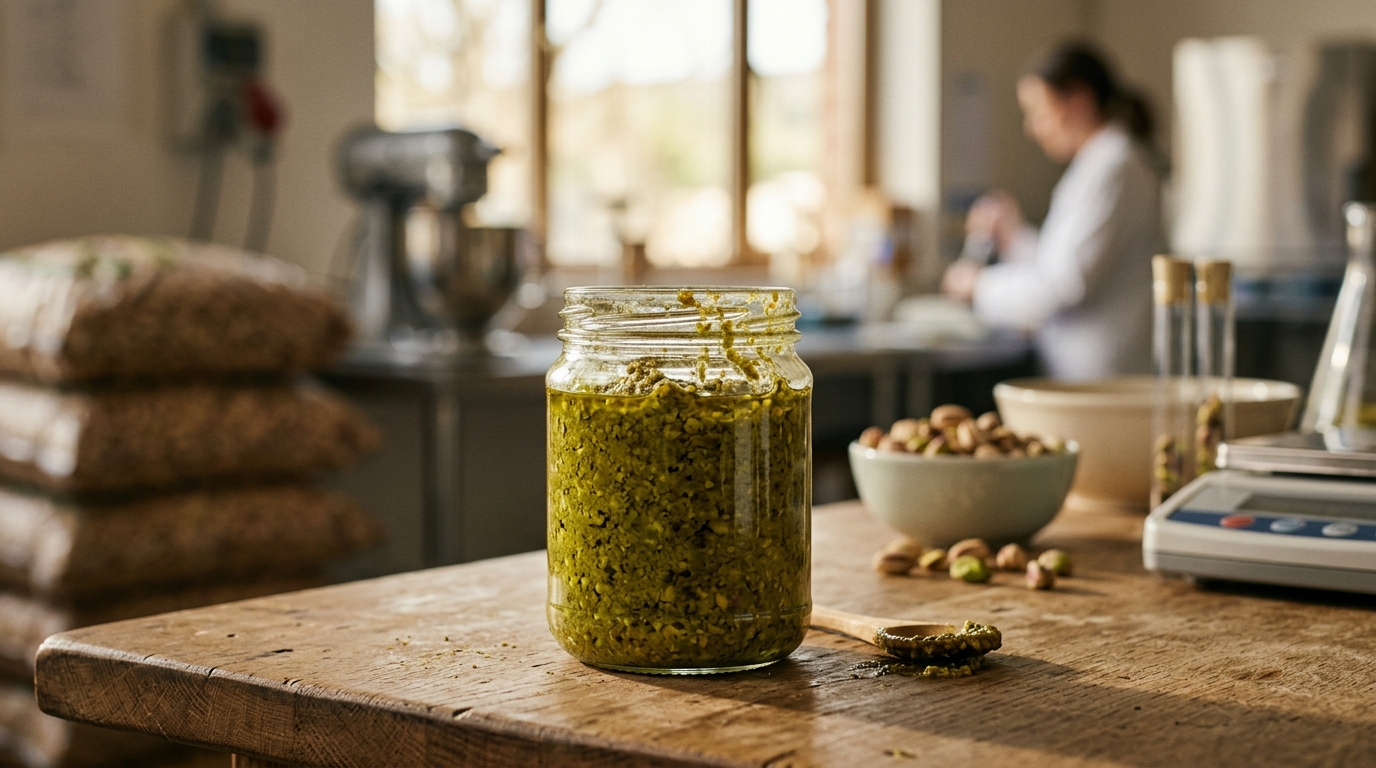
INDUSTRY TRENDS

Coarse-Ground Pistachio Paste: Where Cost Really Gets Locked In (and Where QA Governance Prevents the Next Non‑Conformance)

Author
Team Tridge
DATE
August 14, 2026
7 min read
coarse-ground-pistachio-paste Cover
Unlock Full Data
Coarse Ground Pistachio Paste Market Intelligence
Prices · Trends · Origins · Forecasts

Coarse-ground pistachio paste looks like a simple “roast + grind” ingredient, but most of the cost—and most of the compliance risk—gets set earlier: post-harvest handling, defect removal, and lot governance. This guide maps the physical chain to the cost stack so Purchase (Quality/Safety/Compliance) can write tighter specs, demand the right evidence, and avoid paying for preventable rework, rejects, and recall exposure.

Executive Summary

  • Cost lock-in happens upstream: Defect mix and yield loss at sorting/grading typically matter more than the grinding step for final paste cost.
  • Regulatory anchor (U.S.): FDA action level guidance for total aflatoxins in pistachio nuts is 20 ppb (CPG 570.500 reference). [1]
  • Oxygen control is a quality control step: UC Davis postharvest guidance notes oxygen below 1% is effective in delaying rancidity; vacuum or nitrogen flushing is commonly recommended for tree nuts. [2]
  • 2026 market reality: Buyer scrutiny on pistachio supply chains remains elevated due to ongoing Salmonella risk awareness in low-moisture foods and recent outbreak/recall attention (even when your paste is an ingredient). [3]

1) The Physical Map: Where Cost Gets “Locked In” (Ground Truth)

Coarse-ground pistachio paste is a short, high-value supply chain where kernel quality and defect removal upstream dominate both food safety outcomes and the final cost base. The “manufacturing” step (roast + grind) is comparatively simple; the real complexity is post-harvest handling, sorting, testing, and keeping oxygen/heat away from a high-fat ingredient.

Insight: The chain is physically constructed around two irreversible moments: (1) post-harvest hulling/drying (sets mold/aflatoxin risk trajectory) and (2) grading/sorting (sets yield and the available pool of “paste-grade” kernels).

Data (validated): FDA’s action level guidance for total aflatoxins in pistachio nuts is 20 ppb (commonly referenced as 20 µg/kg). [1]

Procurement Impact: If you only map “paste processor → buyer,” you miss where quality and safety are actually created (and where yield loss is monetized). For QA/compliance roles, the physical map tells you which upstream nodes must be visible in traceability to keep recall scope tight.

Supply chain flow (typical):

Orchard/harvest → hulling & drying → shelling/handling + storage → optical sorting & grading → (optional) blanch/roast → coarse grinding & blending → metal detection/sieving + testing → oxygen-barrier packing (often N2 flush) → distribution.
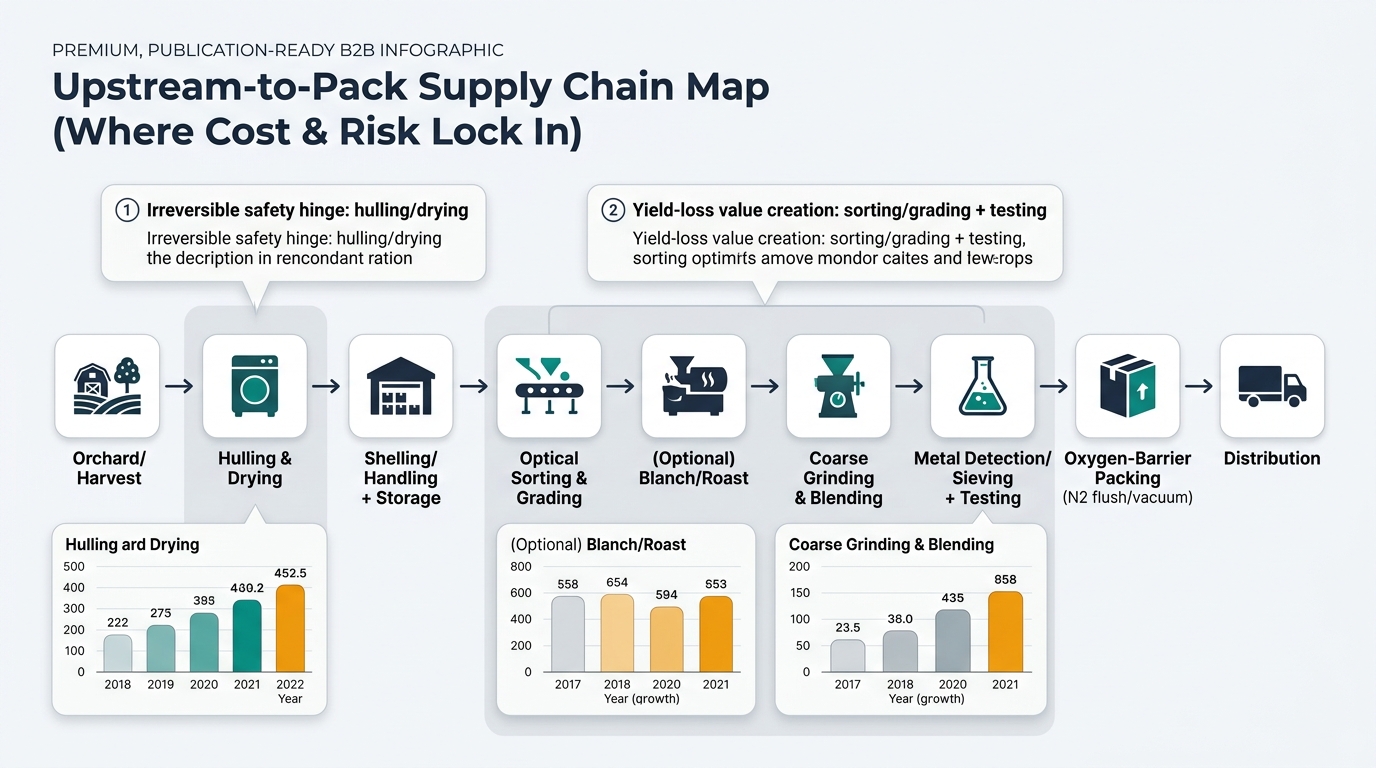
A left-to-right supply chain flow showing: Orchard/Harvest → Hulling & Drying → Shelling/Handling + Storage → Optical Sorting & Grading → (Optional) Blanch/Roast → Coarse Grinding & Blending → Metal Detection/Sieving + Testing → Oxygen-Barrier Packing (N2 flush/vacuum) → Distribution, with callouts for “Irreversible safety hinge: hulling/drying” and “Yield-loss value creation: sorting/grading + testing,” using simple icons and no dashboard visuals.

2) Where the Money Accumulates: Cost & Margin Structure by Node

Insight: Costs accumulate less from “processing complexity” and more from yield loss, testing burden, storage financing, and packaging that protects oxidative stability.

Data (validated): UC Davis Postharvest notes oxygen levels below 1% are very effective for delaying rancidity/staleness in pistachios and other tree nuts; vacuum or nitrogen flushing is recommended to reach low oxygen levels for quality preservation. [2]

Procurement Impact: Your landed cost sensitivity is structurally highest at nodes that (a) scrap defects, (b) carry inventory, and (c) must re-test or rework lots to meet contaminant limits.
1. Upstream / Orchard & Harvest (Origin)

  • Insight: Farming cost is not just “ag inputs”—it’s the starting point for defect rates (insect damage, early split, mold susceptibility) that later turn into sorting losses and higher test frequency.
  • Data (practice-consistent): Pistachios are seasonal; quality is heavily influenced by maturity and how quickly product moves into hulling/drying after harvest (delays increase spoilage/quality risk). [4]
  • Procurement Impact: Even though you don’t buy at this node, your paste cost base is structurally tied to origin yield and defect mix. When premium green kernels are scarce, processors protect their best lots for higher-value applications, tightening paste-grade availability.

2. Primary Processing: Hulling, Drying, Shelling & Handling

  • Insight: This is the food-safety hinge point: rapid hulling/drying reduces the window for fungal growth; shelling/handling introduces the first major opportunity for lot segregation and traceability discipline.
  • Data (validated context): FDA maintains aflatoxin compliance policy guidance for pistachios and broader mycotoxin resources; in the U.S., aflatoxin control is a structural requirement, not an optional “quality add-on.” [5]
  • Procurement Impact: A “paste processor” with weak visibility into handler lots inherits risk they can’t grind away. If traceability stops at “received kernels,” your recall containment and root-cause work become slower and broader.

3. Sorting, Grading, and Food Safety Testing (Value Creation via Yield Loss)

  • Insight: Optical sorting + manual rework is where cost is converted into compliance: removing stained/moldy/damaged kernels is expensive, but it’s also what makes aflatoxin compliance feasible at industrial scale.
  • Data (validated anchor): FDA action level guidance for pistachios is 20 ppb total aflatoxins; lots can fail and be subject to reconditioning/diversion depending on program/market. [1]
  • Procurement Impact: Tight specs (color, defect limits, low aflatoxin targets) structurally increase cost because they require (a) higher sorting intensity and (b) more downgrades/diversions. This is why two “same-origin” pastes can have very different cost bases.

4. Secondary Processing: Roast (Optional) + Coarse Grinding (Paste Manufacture)

  • Insight: Grinding is mechanically straightforward, but temperature control and particle-size distribution are the technical cost drivers: heat accelerates oxidation and can shift flavor/color; coarse grind must be consistent to avoid downstream texture and oil separation issues.
  • Data (credible, but not a spec): Pistachios are lipid-rich and susceptible to rancidity; literature and industry practice commonly monitor oxidation via indicators such as peroxide value and free fatty acids (methods and thresholds vary by buyer/spec). [6]
  • Procurement Impact: Expect the “manufacturing margin” here to be smaller than upstream sorting economics, but this node determines functional performance (viscosity, granularity, oil separation). If your application is gelato/fillings, small PSD drift can create large rework costs.

5. Packaging, QA Release, and Distribution (Protecting a Fragile Fat System)

  • Insight: Packaging is not cosmetic; it’s a control step. Pistachio paste is high-fat and oxygen-sensitive, so oxygen-barrier materials, headspace control (N2/vacuum), and heat management during transit protect shelf life.
  • Data (validated): UC Davis Postharvest explicitly calls out low oxygen atmospheres (<1%) and recommends vacuum packaging or nitrogen flushing to reduce oxygen exposure for pistachios/tree nuts. [2]
  • Procurement Impact: Packaging and logistics choices become “hidden cost drivers” via shelf-life claims, customer complaints, and scrap from rancid/off-flavor lots—especially on warm lanes and long dwell times.

Product-Level Cost Breakdown

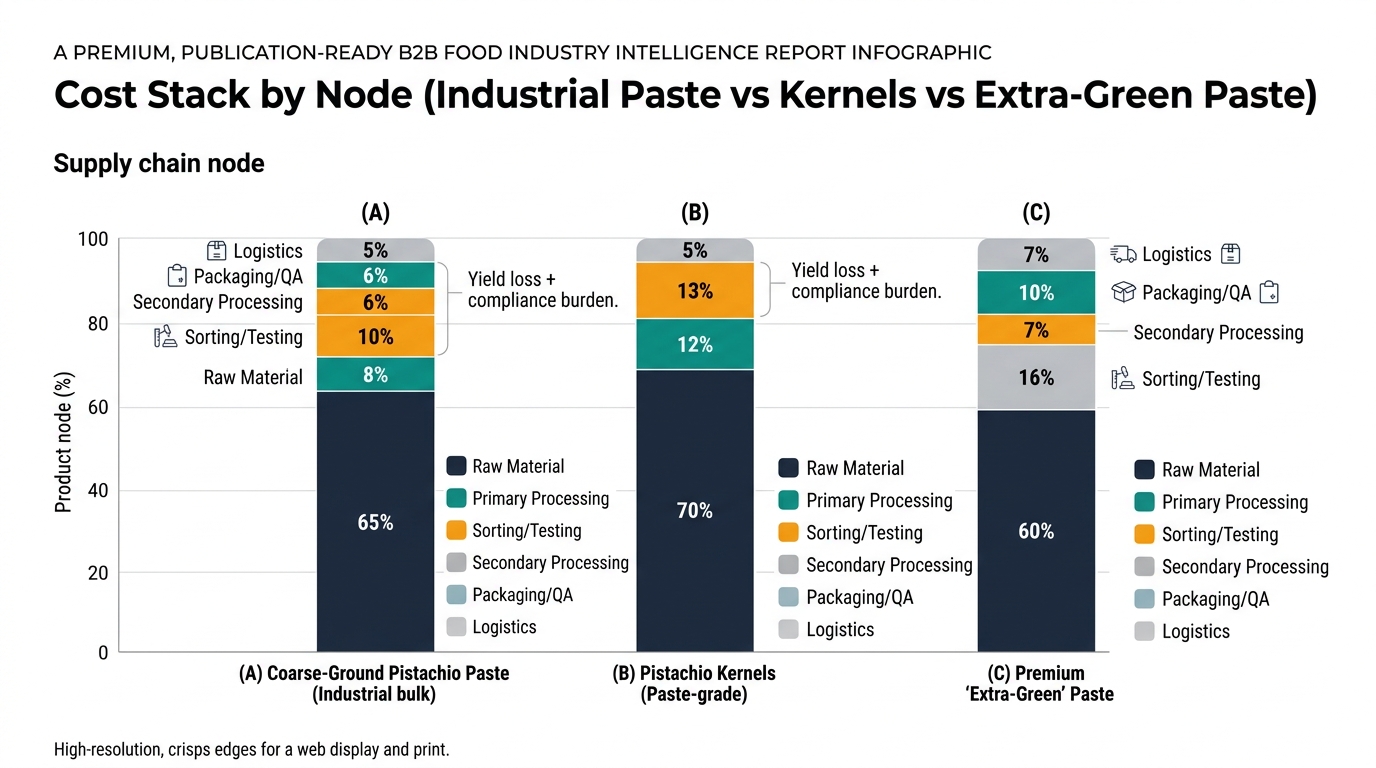
Grouped stacked bar chart with three bars labeled: (A) Coarse-Ground Pistachio Paste (Industrial bulk), (B) Pistachio Kernels (Paste-grade), (C) Premium “Extra-Green” Paste. Each bar is segmented by supply chain node with percentages matching the tables: A = Raw Material 65, Primary Processing 8, Sorting/Testing 10, Secondary Processing 6, Packaging/QA 6, Logistics 5; B = Raw Material 70, Primary Processing 12, Sorting/Testing 13, Packaging/Logistics 5; C = Raw Material 60, Sorting/Testing 16, Secondary Processing 7, Packaging/QA 10, Logistics 7. Includes an annotation above Sorting/Testing segments: “Yield loss + compliance burden,” with a consistent legend across all bars.

A) Coarse-Ground Pistachio Paste (Industrial bulk pails/drums)

Supply Chain Node Cost Ratio (% of Final Cost) Notes
Raw Material (kernel value embedded from origin) 65% Kernel quality/grade dominates; defects and green color premium concentrate value here.
Primary Processing (hull/dry/shell/handle) 8% Energy + throughput + lot segregation discipline; sets safety trajectory.
Sorting/Grading + Food Safety Testing 10% Optical sorting, rework labor, sampling/testing; yield loss monetized.
Secondary Processing (roast/grind/blend) 6% Throughput + temperature control + PSD targets; relatively smaller share.
Packaging & QA Release 6% Oxygen barrier, liners, N2/vacuum options, release testing and documentation.
Logistics & Distribution 5% Freight, temperature exposure risk, insurance, handling of heavy drums/pails.

B) Pistachio Kernels (Paste-grade, sorted/handled)

Supply Chain Node Cost Ratio (% of Final Cost) Notes
Raw Material (orchard/harvest embedded) 70% Yield and defect mix drive the base cost.
Primary Processing 12% Hulling/drying/shelling throughput and storage.
Sorting/Grading + Testing 13% Defect removal intensity + compliance testing burden.
Packaging & Logistics 5% Bulk cartons/bags; less protective than paste packaging.

C) Premium “Extra-Green” Paste (tight color/defect targets)

Supply Chain Node Cost Ratio (% of Final Cost) Notes
Raw Material 60% Higher input grade but also higher diversion pressure.
Sorting/Grading + Testing 16% More aggressive defect/color sorting increases scrap and rework.
Secondary Processing 7% Tighter temperature control and blending discipline to protect color/flavor.
Packaging & QA Release 10% Higher likelihood of N2 flush/oxygen barrier and stricter release checks.
Logistics & Distribution 7% More sensitivity to heat exposure; higher spoilage risk cost.
Unlock Full Data
Coarse Ground Pistachio Paste Market Intelligence
Prices · Trends · Origins · Forecasts

3) Structural Realities You Can’t Negotiate Away (But Must Design Around)

Insight: Three structural constraints shape availability, compliance burden, and downstream variability regardless of market conditions: (1) harvest seasonality + storage drawdown, (2) contaminant risk management via sorting/testing, and (3) oxidation sensitivity driven by oxygen and temperature.

Data (validated): FDA maintains action-level guidance and compliance policy for aflatoxins in pistachios (20 ppb total aflatoxins). [1]

Procurement Impact: Your specification, traceability depth, and packaging/logistics requirements determine whether the chain behaves like a stable ingredient flow or a recurring non-conformance generator.

  • Structural fact #1 (Seasonality + inventory financing): Supply is harvested in a narrow window, then carried as kernels/paste for months. The chain structurally embeds storage cost and quality drift risk (oxidation) into off-season supply.
  • Structural fact #2 (Compliance is achieved by removal, not “treatment”): Aflatoxins are managed by prevention + segregation + defect removal + testing. That means compliant lots often cost more because they include the economics of scrap/diversion.
  • Structural fact #3 (Heat/oxygen exposure is a silent quality destroyer): Even when microbiology is stable, oxidative rancidity and color shift can move faster than teams expect if packaging/headspace and warm-lane transit aren’t controlled. Very low oxygen atmospheres (<1%) are a known lever to delay rancidity. [2]

Key Insights (What to Remember When You Read Any Spec Sheet)

  • Key Takeaways: The paste step is not where most cost is created; sorting yield loss and kernel grade are.
  • Key Takeaways: The “real” safety system spans upstream handling through grading/testing; FDA’s aflatoxin action-level framework makes contaminant control a structural requirement, not a preference. [1]
  • Key Takeaways: Packaging is a functional control: oxygen and heat management protect shelf life; nitrogen flush/vacuum and oxygen barriers directly defend quality. [2]
  • Key Takeaways: Expect lot variability: particle size distribution, oil separation behavior, and sensory profile are outcomes of kernel mix + thermal history + grinding temperature control.

The Bottom Line for Your Next Contract

(Analyzed at: Aug, 2026)

Write your next coarse-ground pistachio paste contract around lot governance, not just a paste SKU: require handler/processor lot linkage, defined aflatoxin testing evidence aligned to the U.S. 20 ppb action level framework, and explicit oxygen-control expectations at pack (e.g., nitrogen flush/vacuum targets and barrier packaging). This works because the biggest preventable failures still come from upstream defect removal economics and downstream oxidation exposure—not the grinder itself. With ongoing 2025–2026 Salmonella/outbreak attention around pistachios and pistachio-containing products, the cost of weak documentation is no longer “paperwork time”—it shows up as holds, expanded tracebacks, and lost production windows. [1]

Unlock Full Data
Coarse Ground Pistachio Paste Market Intelligence
Prices · Trends · Origins · Forecasts

References

  1. fda.gov
  2. postharvest.ucdavis.edu
  3. fda.gov
  4. postharvest.ucdavis.edu
  5. fda.gov
  6. pmc.ncbi.nlm.nih.gov

Related Contents

Subscribe
→
By subscribing you agree to with our Privacy Policy and provide consent to receive updates from our company.
Thank you! Your submission has been received!
Oops! Something went wrong while submitting the form.
Subscribe to receive the latest blog posts, updates, promotions, and announcements from Tridge.
