
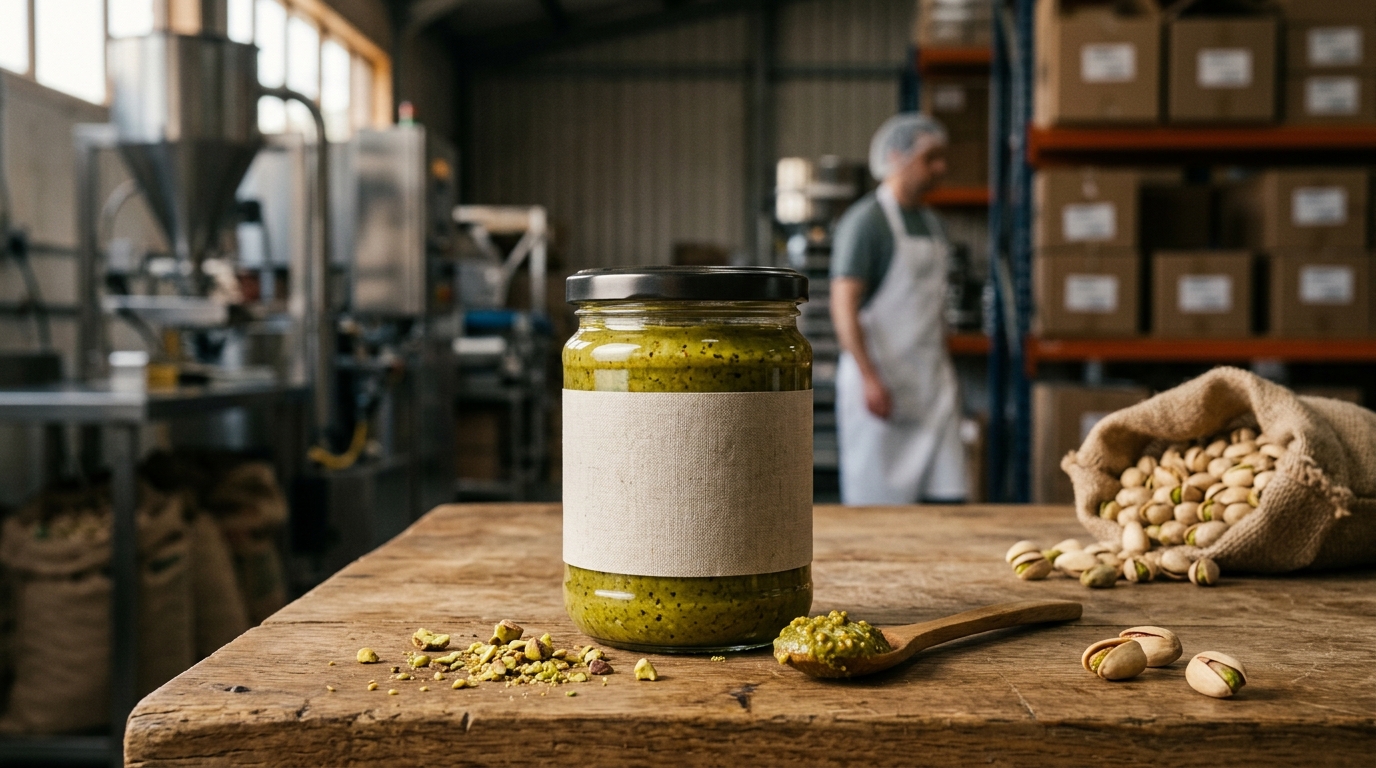
This guide maps the physical supply chain behind chunky pistachio butter and highlights where cost, quality, and compliance risk “lock in.” It is written for Purchase—Quality, Safety, and Compliance teams who need to set evidence-based specs, approve suppliers, and avoid costly holds/complaints without overbuilding controls.
Chunky pistachio butter is structurally a kernel-driven product: most downstream cost and quality outcomes are pre-determined by what happens to pistachios immediately after harvest (hulling/drying, initial sorting) and again at the roast + grind interface where flavor and oxidation stability are set. The “chunky” format adds a second physical dependency—inclusion pieces—which forces tighter handling, segregation, and fill control than smooth pistachio paste.
Insight: The chain is short in number of steps, but long in “value density”—each node amplifies defects (aflatoxin risk, foreign material, oxidation) into expensive downstream loss.
Data (validated): In California, pistachio harvest typically occurs late August through early October (often peaking in September), depending on variety and hull split timing.
Procurement Impact: The physical map tells you where specifications must be technically tight (moisture/defects at origin; roast profile + particle size at manufacturing; oxygen/light barrier at packaging) because these are the nodes where rework is limited and yield loss becomes permanent.
Supply chain flow (typical): Orchard harvest → hulling/drying → shelling + grading/sorting → (optional) roasting + further sorting → grinding to paste → inclusion preparation → mixing/filling → metal detection/QA release → ambient distribution.

Insight: For chunky pistachio butter, raw kernel yield and downgrade rates dominate total cost; processing and packaging add meaningful cost but cannot “fix” bad kernels.
Data (validated/clarified): Aflatoxin thresholds differ materially by market, shaping how much sorting/testing and rejection is economically unavoidable. The U.S. FDA action level lists pistachio nuts at 20 ppb. EU maximum levels for aflatoxins in certain tree nuts intended for final consumers/ingredient use are commonly referenced at AFB1 2 µg/kg; total 4 µg/kg (note: exact applicability depends on product category and whether “further processing” applies).
Procurement Impact: Even before you discuss any commercial structure, the physical cost base is set by (1) kernel quality distribution, (2) sorting intensity required to meet destination limits, and (3) packaging + QA choices needed to protect oxidation-sensitive fats through shelf life.

| Supply Chain Node | Cost Ratio (% of Final Cost) | Notes |
|---|---|---|
| Raw Material (kernels + inclusion pieces) | 55% | Kernel price + sorting shrink dominate; inclusions require tighter grading. |
| Primary Processing (hull/dry + shell/sort) | 12% | Optical sorting, labor/energy, reject handling. |
| Secondary Processing (roast + grind + mixing) | 10% | Energy-intensive roasting/grinding; wear parts; yield loss from fines. |
| Packaging & QA | 13% | Jar/lid/label/case, metal detection, lab testing, coding/traceability. |
| Logistics & Distribution | 10% | Ambient freight; temperature excursions accelerate rancidity/oil separation. |
| Supply Chain Node | Cost Ratio (% of Final Cost) | Notes |
|---|---|---|
| Raw Material (kernels) | 65% | Paste is essentially “kernel concentration”; quality drives usable yield. |
| Primary Processing (shell/sort) | 15% | Higher sorting intensity if destined for strict markets. |
| Secondary Processing (grind) | 8% | High-shear milling; oxidation control during processing. |
| Packaging & QA | 5% | Lined pails/drums; COA + release testing. |
| Logistics & Distribution | 7% | Bulk handling; heat exposure increases oxidation rate. |
| Supply Chain Node | Cost Ratio (% of Final Cost) | Notes |
|---|---|---|
| Raw Material (kernels) | 50% | Size/color/defect distribution drives grade value. |
| Primary Processing (shell/sort/grade) | 25% | Optical sorting + grading premiums; foreign material removal. |
| Secondary Processing (roast + post-roast sort) | 12% | Roast energy + additional sorting for fragments/fines. |
| Packaging & QA | 5% | Foodservice/industrial packs; metal detection common. |
| Logistics & Distribution | 8% | Fragility + oxidation sensitivity in warm storage. |
Insight: The biggest “constants” are harvest seasonality, regulatory asymmetry on aflatoxin, and the physics of oxidation in high-fat spreads.
Data (validated): California pistachio harvest is concentrated in a narrow late-summer/early-fall window. The U.S. FDA action level for pistachio nuts lists 20 ppb aflatoxin. EU maximum levels for aflatoxins in certain tree nuts placed on the market for final consumers/ingredient use are commonly cited at AFB1 2 µg/kg; total 4 µg/kg. Oxidation monitoring in pistachio oil/paste/spread research commonly uses peroxide value and related markers, reflecting inherent sensitivity to oxygen/light/heat.
Procurement Impact: These constants shape the physical map of cost:
Critical Risk Factors (physical, not commercial): aflatoxin susceptibility, foreign material from shelling/roasting, oxidation during grinding and storage, and inclusion PSD drift that destabilizes texture.
(Analyzed at: Aug, 2026)
Lock the contract around lot-level aflatoxin evidence + shrink economics, not just a kernel price. In 2026, credible market research points to a more “price-supported” California pistachio cycle versus the boom/bust years, which means you’re less likely to buy your way out of a quality shortfall later with cheap spot supply.
The practical move is to require destination-aligned limits (U.S. vs EU), specify the COA fields and lab method expectations up front, and negotiate how rejections/downgrades are handled (who owns shrink, retest rules, and diversion channels).
Teams that do this typically avoid the most expensive failure mode—late-cycle holds and emergency substitutions—where the fully loaded cost can easily run several percent of annual volume once freight, rework, and write-offs are counted.


