

Chorizo sourcing decisions tend to get framed as “US vs Mexico vs Spain,” but procurement outcomes are driven by a more practical bundle: product format (fresh vs dry-cured), which inputs dominate your cost (trim/fat vs spices/packaging), and how much cold-chain + compliance friction you can absorb without breaking service levels. This comparison is written for customer-facing teams who need a credible, chorizo-specific talk track without turning it into a feature tour.

Insight: Chorizo sourcing isn’t a simple “country A vs country B” decision—your real procurement choice is a bundled trade-off between pork-trim economics, process type (fresh vs dry-cured), and the cold-chain + compliance burden you’re willing to carry.
Data: In 2026, pork economics are visibly moving: the EU average pig price in week 28, 2026 was €167/100kg cw (about 24% below the same week last year), while US AMS specialty trim reporting shows 72% trim combo at $114.86/100 lb for the week ending May 22, 2026. [1]
Procurement Impact: If your chorizo spec is meat-cost-index-sensitive (trim-heavy, high throughput SKUs), you should treat origin choice as a cost-driver decision first; if your SKU is brand/heritage-led (dry-cured, paprika-forward), treat it as a QA + lead-time + working-capital decision first.
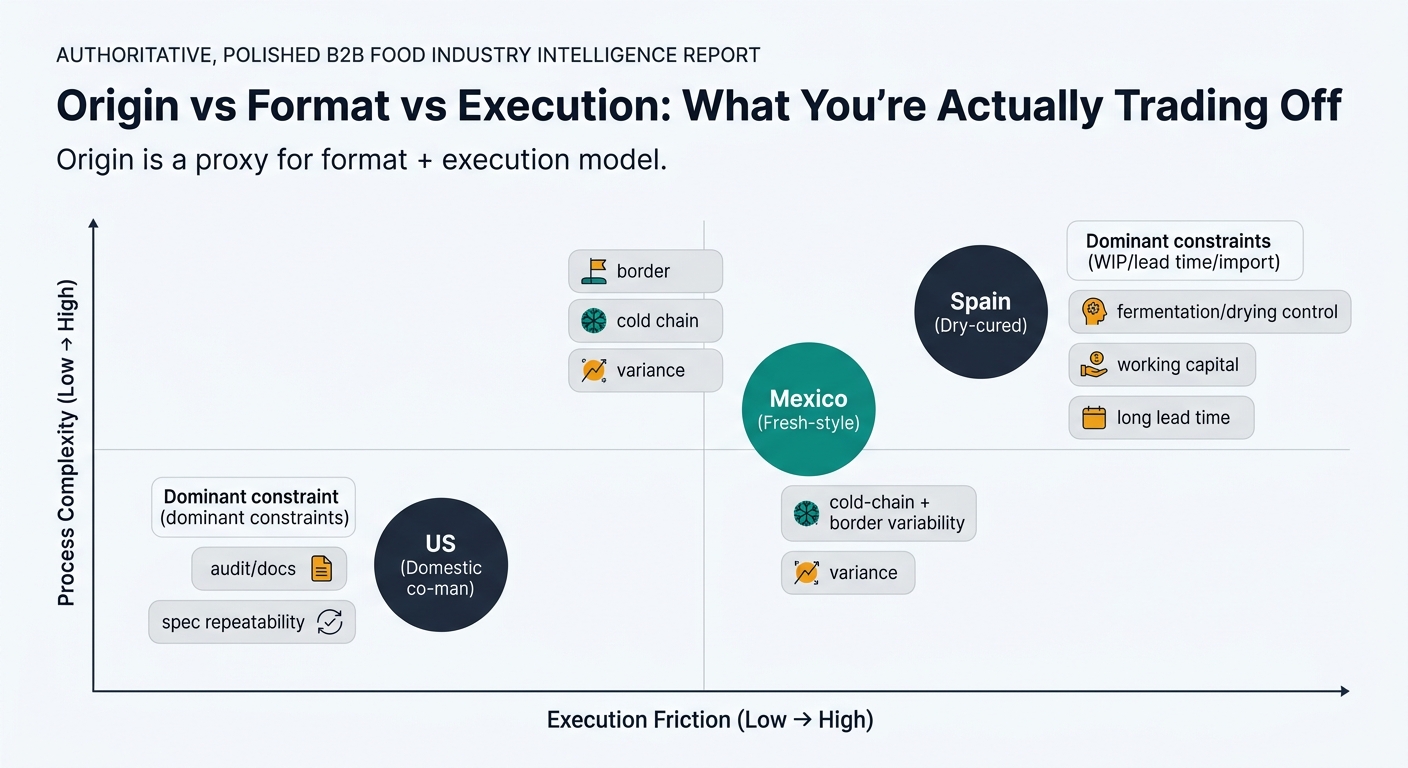
Insight: The best origin depends on whether you’re optimizing for landed cost stability, brand-authentic sensory profile, or speed-to-fill with minimal qualification friction.
Data: EU pig price reporting provides weekly reference points (e.g., DG AGRI weekly pig price reporting), and US AMS publishes weekly pork specialty references used as sausage inputs (including 72% trim combo). [3]
Procurement Impact: Use this table to align sourcing strategy to the decision you’re making this quarter: rebid, dual-source, or lock capacity.
| Option (Typical procurement use) | Cost | Quality | Risk | Lead Time | Availability |
|---|---|---|---|---|---|
| United States (domestic co-man / processor) | Medium | High (spec control) | Low–Med | Short | High |
| Mexico (fresh-style, value + proximity) | Low–Med | Medium–High (varies by supplier tier) | Med | Short–Medium | Medium–High |
| Spain (dry-cured / Spanish-style, heritage-led) | High | Very High (style authenticity) | Med | Long | Medium |
Insight: Chorizo cost is dominated by pork inputs (trim + fat balance), but the “surprise” costs usually come from yield loss (dry-cured), QA/testing cadence, and cold-chain execution.
Data: USDA AMS specialty reporting shows 72% trim combo at $114.86/100 lb for week ending May 22, 2026; EU Commission reporting shows the EU average pig price at €167/100kg cw in week 28, 2026 with large year-on-year decline context. [2]
Procurement Impact: Build negotiation models that separate (a) meat index exposure, (b) conversion cost, and (c) logistics/packaging—otherwise you’ll argue price while the supplier is managing a different cost driver.
Insight: The quality dimension that matters most depends on format: fresh chorizo fails on microbiological control + cold chain; dry-cured fails on process validation (pH/aw), sliceability, and color/flavor stability.
Data: The EU pigmeat data portal and dashboards are designed to support normalized, comparable market context across Member States; AMS specialty reporting explicitly aggregates multiple destinations/packaging styles—so procurement must normalize specs when benchmarking. [4]
Procurement Impact: Tighten the 3–5 specs that protect your brand (fat ratio, grind, paprika/chile profile, casing type, allergen statement) and loosen the rest to widen the supplier pool.
Insight: Chorizo risk is multi-node: upstream animal supply shocks hit everyone; midstream plant capacity and food-safety events hit you via single-supplier dependency; downstream cold chain hits fresh SKUs disproportionately.
Data: EU Commission pigmeat market situation reporting highlights week-by-week price moves and large year-on-year changes—useful context because volatility often triggers allocation behavior by suppliers. [1]
Procurement Impact: Map risk by node (trim supply, casing supply, co-man capacity, cold storage/reefer) and dual-source the tightest bottleneck—not necessarily the finished product.
Insight: For chorizo, lead time is not just transit—it’s production scheduling, QA release, and temperature-controlled logistics capacity.
Data: EU pigmeat data resources and dashboards are updated on a repeatable cadence; USDA AMS weekly reporting provides a cadence procurement teams can align to contracting and index mechanisms. [4]
Procurement Impact: If your service level target is tight, prioritize origins where you can secure (a) predictable production slots and (b) reliable cold-chain execution—not just the shortest distance.
Insight: Scaling chorizo volume is usually constrained by co-man capacity (stuffing/smoking/slicing) and QA release throughput, not by spice cost.
Data: EU pigmeat dashboards provide macro context (production/market signals), while AMS trim reporting provides input-market transparency that helps anticipate rationing behavior when raw material tightens. [5]
Procurement Impact: If you plan to grow volumes, negotiate capacity and allocation rules early (peak weeks, minimum runs, frozen vs chilled flexibility).
Insight: Compliance friction shows up as time-to-qualify: audits, allergen controls, label language, and traceability completeness can delay switching more than price differences justify.
Data: EU Commission pig price reporting is built on standardized reporting frameworks and normalizing structures—mirroring why procurement needs comparable, auditable documentation sets across suppliers. [3]
Procurement Impact: Build a tiered compliance checklist by risk: finished-goods chorizo (highest) vs ingredients/packaging (varies). This reduces “surprise” requalification delays.
Insight: Procurement teams make better decisions when they quantify relative differences (even as ranges) and score risks consistently across options.
Data: Weekly reference reporting exists in both the EU (pig carcass prices) and US (pork specialty/trim references), enabling repeatable benchmarking cadence. [3]
Procurement Impact: Use these tables to drive alignment across procurement, QA, and operations before you issue an RFP or rebid.
| Option | Indicative landed cost vs US (index-driven SKUs) | Where the delta usually comes from |
|---|---|---|
| US | 0% (baseline) | Higher conversion cost offset by lower execution variance |
| Mexico | -5% to -15% | Conversion + labor economics; can be erased by variance/holds |
| Spain (dry-cured) | +10% to +30% | Process time, yield shrink, premium positioning, longer logistics |
Constraint: These are directional ranges; actual deltas depend on format (fresh vs dry-cured), pack format (bulk vs sliced), and your compliance gates.
| Dimension | US | Mexico | Spain |
|---|---|---|---|
| Input price volatility (pork) | Medium | Medium | Medium |
| Cold-chain execution risk (fresh SKUs) | Low | Medium | Medium |
| Border/customs complexity | Low | Medium | High |
| Supplier concentration risk | Medium | Medium | Medium |
| Quality drift risk (spec adherence) | Low | Medium | Low–Medium |
| Lead-time variance | Low | Medium | High |
Insight: “Best origin” changes by scenario: your priority (cost, continuity, authenticity, speed) should dictate the award strategy and the format (fresh/frozen/dry-cured).
Data: EU and US weekly market references support scenario-based contracting tied to market cadence (rather than ad hoc price fights). [1]
Procurement Impact: You can reduce firefighting next week by matching sourcing choice to the operational constraint you’re actually facing (capacity, shelf life, QA bandwidth, or forecast error).
| Buyer priority | Recommended option | Why it fits |
|---|---|---|
| Lowest landed cost (high volume) | Mexico | Conversion economics can win if execution is controlled |
| Highest service level / shortest replenishment | US | Lower lead-time variance and simpler logistics |
| Authenticity for dry-cured premium SKU | Spain | Process capability and heritage alignment |
| Risk reduction via format shift | Spain (dry-cured) or US (frozen) | Reduce cold-chain/shelf-life exposure |
Insight: The fastest, lowest-drama cost and risk improvement typically comes from separating what must be identical (safety, allergens, critical sensory) from what can be flexible (pack size, casing type, minor spice tolerances) to expand your qualified supplier pool.
Data: Weekly reference price reporting for pork inputs (US trims, EU carcass prices) provides a cadence to trigger renegotiation windows and index-linked contract structures rather than ad hoc price fights. [2]
Procurement Impact: A controlled spec-flex framework enables dual-sourcing and reduces the probability that a single co-man or single input (trim/casing/spice blend) becomes your bottleneck.
Logical Next Step (analysis, not promotion): The hardest part of chorizo sourcing is timing—knowing whether a supplier quote move is driven by pork inputs (trim/carcass), conversion constraints (capacity/labor), or logistics variance (cold chain/border). Without near-real-time cost-driver decomposition and supplier performance signals, teams tend to renegotiate the wrong lever and discover too late that the real constraint was capacity allocation or QA release throughput.
(Analyzed at: Jul, 2026)
With EU pig prices sitting around €167/100kg cw in week 28 (roughly 24% below last year) and US sausage-input trim references like 72% trim at $114.86/100 lb still moving week to week, the smartest “origin” move is usually a format + spec-flex move. If you pre-approve one controlled flexibility (for example, frozen vs chilled or an alternate casing) while locking the true brand-protecting specs, you can credibly dual-source US/Mexico for high-volume items without reopening a full re-qualification loop. In practice, that’s the difference between a manageable low-single-digit cost improvement and a disruption-driven premium freight event that can wipe out a quarter’s savings in one month. [1]


