

This comparison is written for procurement and sourcing management teams who buy chilled Krakowska-style salami/sausage (whole logs/chubs and/or sliced packs). The core message: “origin” is not a proxy for unit price—it’s a proxy for spec fidelity, cold-chain exposure, and how quickly you can recover from a disruption without breaking shelf-life, labeling, or food-safety controls.
For Krakowska salami, “origin choice” is effectively a decision about spec fidelity, cold-chain exposure, and how much supplier optionality you can realistically maintain under tight shelf-life and food-safety constraints.
Krakowska is typically chilled, smoked, cured, and often sold as whole chubs/logs or sliced packs; sliced SKUs generally carry higher post-lethality contamination exposure and often shorter usable shelf-life, while whole chubs travel better and can be sliced in-market.
Your sourcing strategy should start with three constraints—(1) required shelf-life at receipt, (2) whether you buy sliced or whole, and (3) whether you need “authentic” coarse-chunk Krakowska spec—because those three variables determine supplier pool size, lane feasibility, and the cost of switching.
Border and inspection regimes and their cost-to-serve effects have become more material for chilled animal products, pushing buyers to reassess lead time buffers and contingency sources.
The UK’s Border Target Operating Model (BTOM) set a phased timeline: 31 Jan 2024 (health certification for certain goods), 30 Apr 2024 (documentary and risk-based identity/physical checks for SPS goods), and 31 Oct 2024 (Safety & Security declarations for EU imports) [2].
Even if you don’t buy into the UK, the same plants and logistics networks serve multiple markets; tighter inspection/capacity pinch points can ripple into EU chilled lanes via truck availability, cold-store congestion, and supplier scheduling.
Poland is usually the best “spec-authentic + broad supplier base” option; Germany is typically the best “near-market reliability + process discipline” option; Denmark is typically the best “input consistency + industrial scalability” option (often at a premium).
EU pigmeat market statistics and dashboards are updated frequently and are widely used as reference points for upstream pork cost direction (a primary cost driver for Krakowska) [1].
Use origin selection to deliberately balance TCO volatility (pork cycle + energy + packaging), continuity (capacity and multi-site options), and compliance risk (labeling + microbiological control), rather than treating origins as interchangeable.
| Option (Typical Origin Strategy) | Cost (TCO) | Quality / Spec Consistency | Risk (Supply + Compliance) | Lead Time | Availability |
|---|---|---|---|---|---|
| A. Poland-based producers (direct or via EU hubs) | Low–Medium | High spec fidelity (authentic Krakowska variants common) | Medium (concentration by region/plant; ASF sensitivity) | Medium | High (deep supplier bench) |
| B. Germany-based producers / co-packers | Medium | Very consistent (process control; private-label discipline) | Low–Medium (strong compliance culture; higher cost base) | Short–Medium | Medium |
| C. Denmark-based industrial processors | Medium–High | High (input standardization; industrial QA) | Low–Medium (strong national biosecurity posture; but fewer Krakowska-specialists) | Medium | Medium |

Krakowska cost is dominated by pork and processing energy, but procurement outcomes are often decided by “hidden” costs: yield loss (slicing), rejection/waste, and cold-chain lane reliability.
Upstream pork prices are tracked weekly across the EU and are a key reference for should-cost discussions in processed meats [3].
Build a Krakowska should-cost model with three lanes of sensitivity: (1) pork input index, (2) energy (smoking/thermal + refrigeration), (3) packaging (vac vs MAP + slicing labor). Use it to decide when to index-link vs fix price.
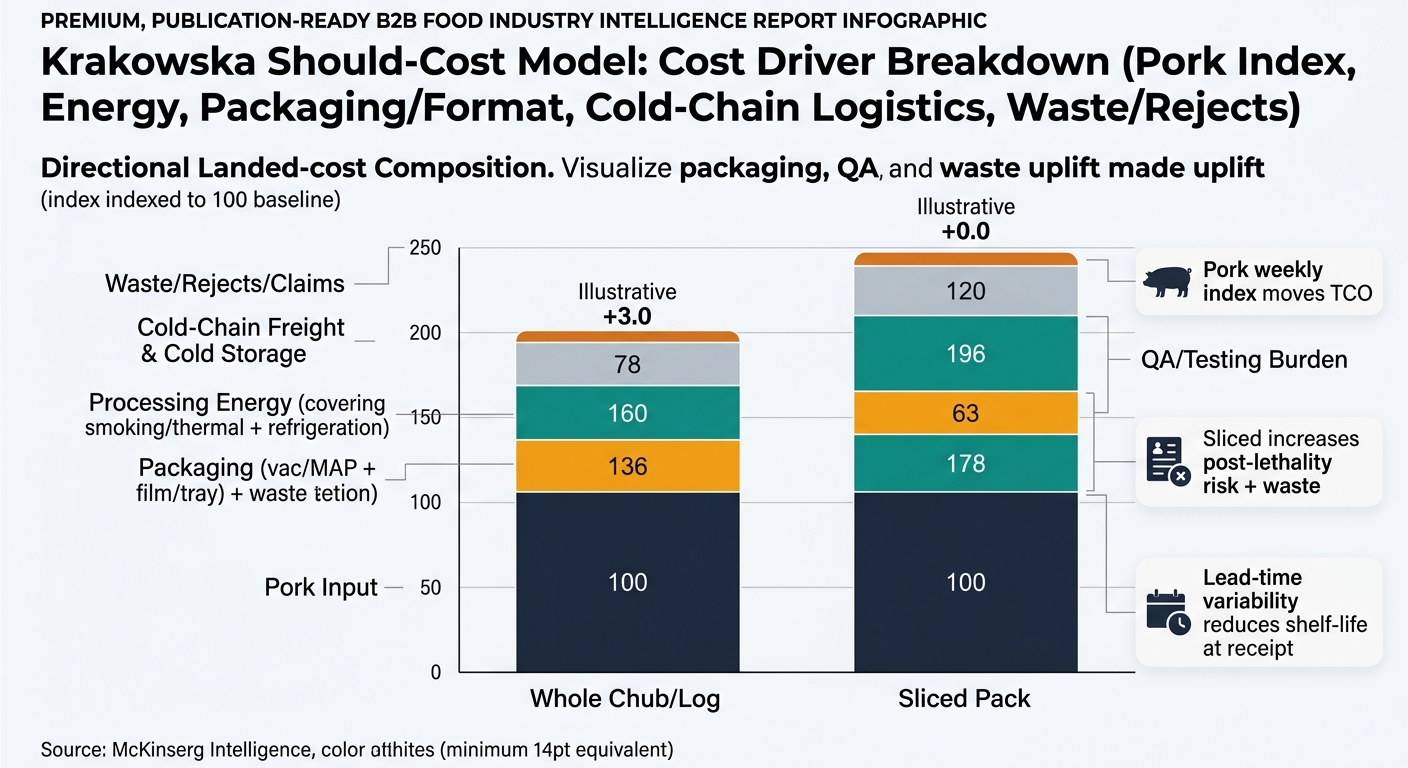
The tightest spec levers (chunk definition, smoke profile, casing diameter, and moisture/texture targets) reduce supplier optionality; procurement must decide where spec can flex without breaking the brand promise.
The EU microbiological criteria framework (Commission Regulation (EC) No 2073/2005, as amended) sets conditions under which Listeria monocytogenes limits such as 100 cfu/g across shelf-life may apply for certain ready-to-eat foods, depending on whether growth can occur and what the producer can demonstrate [4].
If you buy sliced Krakowska, treat post-lethality controls and environmental monitoring maturity as “commercially material,” because failures translate into holds, rework, shorter shelf-life, and supply interruption.
The highest-impact risks are not “price” risks; they’re discontinuity risks: plant incidents/recalls, animal disease shocks, and packaging/casing shortages that delay production.
EU microbiological criteria explicitly address Listeria in ready-to-eat foods—central for deli meats, especially sliced formats [4].
Your risk register should separate (1) food-safety interruption risk (holds/recalls), (2) single-site dependency, and (3) lane risk (cold-chain + border). Mitigations differ: dual-site qualification vs format change vs inventory buffers.
For chilled Krakowska, lead time variability is often more damaging than average lead time because shelf-life is a wasting asset.
BTOM’s phased SPS controls increased the operational importance of documentation readiness and border predictability for animal products moving EU→GB [2].
If any part of your network touches GB, treat “documentation completeness + inspection readiness” as a supplier performance metric; it directly affects OTIF, shelf-life at receipt, and claims.
Krakowska scalability is constrained by smokehouse capacity, skilled labor, and (for dry variants) maturation space—constraints that do not scale linearly with volume.
EU pigmeat dashboards and price/production monitoring provide context because upstream tightness can collide with processing bottlenecks [6].
For growth programs, prefer suppliers that can demonstrate multi-line smokehouse capacity, redundancy (second plant or partner plant), and packaging line flexibility (vac + MAP).
In cured meats, compliance risk often comes from labeling/claims and additive controls (nitrite/nitrate statements), while sustainability execution depends on traceability maturity and supplier documentation discipline.
Microbiological criteria are explicit and auditable at regulation level, but they do not replace plant-level controls and verification programs [4].
Set governance rules: what must be certified/audited (HACCP, traceability, labeling verification) versus what can be monitored as risk signals (incidents, border delays, capacity constraints).
The “cheapest” origin on unit price can be the most expensive on TCO once you price in rejects, shelf-life loss, and expedite freight.
Listeria criteria in the EU framework can drive testing, zoning, and release practices; these practices vary by plant maturity and strongly affect effective supply [7].
Use a structured scorecard to avoid false economies; require suppliers to quote both whole and sliced, and compare TCO under the same shelf-life-at-receipt assumption.
| Cost Element (Index) | Poland (A) | Germany (B) | Denmark (C) | What Typically Drives the Difference |
|---|---|---|---|---|
| Ex-works unit cost | 100 | 110–125 | 115–135 | Labor/energy cost base; scale; product mix |
| Packaging uplift (sliced vs whole) | +8–15% | +8–15% | +8–15% | Slicing labor + film/tray + QA sampling |
| Cold-chain logistics (to buyer DC) | 100–115 | 95–110 | 105–120 | Distance + backhaul availability + hubbing |
| Quality loss / waste risk (sliced) | Medium | Low–Medium | Low–Medium | Post-lethality hygiene maturity + shelf-life at receipt |
Treat it as a normalization tool, not a quote. Your actual deltas will depend on lane, MOQ, packaging spec, and shelf-life requirement.
| Dimension | Poland (A) | Germany (B) | Denmark (C) |
|---|---|---|---|
| Supply concentration risk | Medium (mitigable via multi-plant) | Low–Medium | Medium (fewer Krakowska-like alternates) |
| Food-safety interruption risk (sliced) | Medium | Low–Medium | Low–Medium |
| Lane / border friction exposure | Medium | Low–Medium | Medium |
| Spec authenticity risk (true Krakowska) | Low | Medium | Medium–High |
| Cost inflation risk | Medium | Medium–High | Medium–High |
The right choice depends on your top constraint: authenticity/spec, service level, or scalability—and whether you can operationalize dual-sourcing without spec drift.
BTOM-style controls show how documentation and border readiness can become a lead-time variable for animal products, increasing the value of suppliers with strong export documentation discipline [2].
Make the decision explicit: choose the option that best protects your KPI that is hardest to recover (usually fill rate and shelf-life), then negotiate cost with should-cost logic and format strategy.
| Your #1 Priority | Recommended Starting Point | Why |
|---|---|---|
| Authentic Krakowska spec | Poland (A) | Deepest Krakowska capability bench |
| Lowest supply interruption risk | Germany (B) | Typically strongest documentation + process discipline |
| Fastest recovery from disruption | Poland (A) with dual-source | More alternates if pre-qualified |
| Lowest hidden costs (rejects/waste) | Germany (B) | Often steadier quality + shelf-life at receipt |
| Scalability for growth | Denmark (C) or Germany (B) | Industrial capacity and standardization |
The highest-leverage move in Krakowska is usually not “re-bid for 2%”—it’s redesigning the sourcing model to reduce discontinuity and waste (whole-vs-sliced mix + pre-qualified alternates).
RTE microbiological criteria and border-control regimes create non-negotiable constraints that translate directly into supply continuity and cost-to-serve [7].
Set measurable targets and governance: (1) cap supplier concentration, (2) define acceptable spec flex, (3) track shelf-life-at-receipt and rejection rate as procurement KPIs, not just QA KPIs.
The hard problem in Krakowska isn’t finding suppliers—it’s timing decisions before the disruption shows up in fill-rate KPIs. Procurement teams that maintain near-real-time visibility on (1) pork input movements, (2) plant incident/recall signals, and (3) lane/border friction indicators can decide earlier when to rebalance volumes, trigger contingency sourcing, or temporarily flex specs—reducing the probability that the first signal you see is an out-of-stock.
(Analyzed at: Jul, 2026)
If you’re still single-sourcing sliced Krakowska on a fixed-price mindset, the highest-confidence upgrade is to contract a dual-source structure where at least 20–30% of volume is qualified as whole chub/log (even if your primary sales format is sliced). It works because it buys you shelf-life and switching speed: whole formats are more tolerant of lead-time noise and reduce post-lethality exposure, while keeping an alternate plant “warm” reduces the probability that a disruption turns into weeks of OOS. Use EU weekly pigmeat price reporting as the shared reference for should-cost timing and index logic, so increases are debated against a transparent upstream signal rather than after-the-fact surprises [3].


