
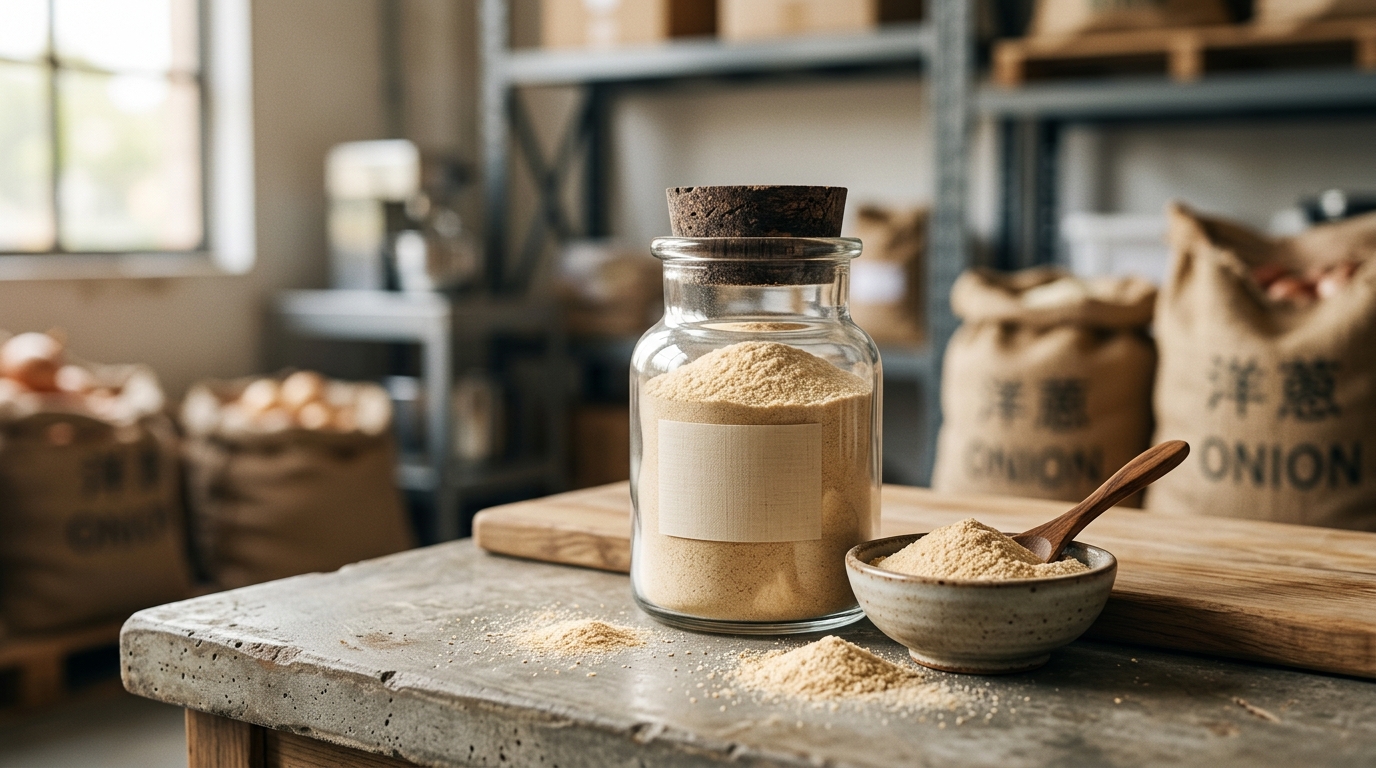
For Procurement & Sourcing leaders, onion powder is one of those “commodity-looking” ingredients where the real cost sits in variability: microbiology tier, moisture ingress/caking, duty exposure, and the governance load needed to keep plants running. This comparison translates origin choices (China vs India vs Egypt, plus EU corridor and US) into practical contracting and risk decisions for 2026 planning.
Insight: For onion powder, “cheapest origin” often loses once you factor microbiology tier, moisture control, and China-linked duty exposure into landed cost and continuity risk.
Data: Dehydrated onion is hygroscopic (moisture pickup drives caking and shelf-life loss). The international specification ISO 5559 (Dehydrated onion — Specification) is widely referenced in trade specs, and buyer specs commonly anchor around ~6% max moisture for dehydrated onion forms (powder/flour included), with water activity often used as an additional control. [3]
Procurement Impact: Your origin decision should be framed as a TCO and governance choice (duty + freight + rejects + rework + audit burden + disruption probability), not a unit-price decision.
Insight: China remains a scale-and-price benchmark for many buyers, but India often wins as the simplest non-China dual-source for tiered microbiology needs, while Egypt can be a pragmatic diversification lever when China concentration is politically uncomfortable.
Data: For US imports, additional duties can apply to China-origin goods under Chapter 99 / Section 301 mechanisms; the correct approach is to confirm the 8-digit HTS and then verify any Chapter 99 linkage and effective dates at time of entry using official USTR/USITC resources. [4]
Procurement Impact: If you are buying into the US, “China vs non-China” is often a duty strategy as much as a supply strategy.
| Option (Typical sourcing model) | Cost (Landed) | Quality consistency | Risk (macro + supply) | Lead time to US West Coast | Availability | Bottom line for Procurement |
|---|---|---|---|---|---|---|
| China origin (direct mill or exporter) | Medium–Low (but duty-sensitive) | Medium–High (supplier-dependent) | Medium–High (trade + port + compliance) | ~21–31 days port-to-port (Qingdao→LA typical) [2] | High | Best when you can manage duty exposure and have strong QA controls + backups. |
| India origin (direct dehydrator / spice ingredient processor) | Medium | Medium–High (tiered micro options common) | Medium (weather + infrastructure + lane variability) | Medium–Long (route dependent) | High | Strong choice for dual-sourcing and micro-tiered applications (e.g., RTE seasoning blends) if qualification is done early. |
| Egypt origin (processor/exporter) | Medium–High | Medium | Medium (regional + logistics) | Medium | Medium | Practical diversification option; often used to reduce China concentration even if unit price is not the lowest. |
| EU corridor (Netherlands/Germany re-pack / some processing) | High | High | Low–Medium | Shorter within EU; to US varies | Medium | Choose when governance, traceability, and documentation burden outweigh unit price (audit-ready supply). |
| US origin (domestic dehydrator / blender) | Highest | High | Low | Short | Medium | Best for service-level and rapid replenishment; often a “risk hedge” rather than the base-load source. |

Insight: Onion powder cost is a conversion story: raw onion solids/yield + drying energy + labor (peeling/sorting) + milling/sieving + packaging moisture protection + duty/freight.
Data: Onion dehydration references describe drying from high initial moisture to a low final moisture suitable for storage; the conversion is energy-intensive and yield-sensitive, and moisture control is central to shelf stability. [5]
Procurement Impact: A 2–4% FOB delta can be erased by duty, moisture-related claims, and micro “tier” upgrades (validated kill-step / treatment, where required by your HACCP/customer).

Insight: Onion powder failures are rarely about “taste preference” and usually about measurable spec drift: mesh distribution, moisture/aw, scorch/burn notes from overheating, and microbiology fit to your end-process.
Data: ISO 5559 is commonly used as a reference point for dehydrated onion specs, and ~6% max moisture is a widely used ceiling in buyer specifications for dehydrated onion forms. Use water activity as a companion control because it better indicates microbial growth potential than moisture alone. [3]
Procurement Impact: If your product is used in RTE seasoning (no kill-step after addition), you should pay for a micro tier that matches your HACCP reality—otherwise you pay later via holds, rework, or customer complaints.
Insight: Onion powder risk is a mix of agricultural shocks (crop quality/price), processing bottlenecks (dryer capacity/energy), and trade/logistics disruption.
Data: China’s onion production is regionally concentrated, but the specific “top provinces” can vary by year and by source; treat province mapping as a risk exercise you validate with supplier traceability and shipment/export evidence rather than relying on a single market report. (This matters because multiple suppliers can still share the same onion belt and export nodes.)
Procurement Impact: Concentration means correlated risk: one weather/energy/policy shock can hit multiple “different” suppliers if they draw from the same onion belt or share the same logistics nodes.
| Dimension | China | India | Egypt | EU corridor | US |
|---|---|---|---|---|---|
| Origin concentration risk | Medium–High | Medium | Medium | Low | Low |
| Trade / policy risk (US buyers) | High | Medium | Medium | Low | Low |
| Food safety / compliance risk (varies by supplier) | Medium | Medium | Medium | Low–Medium | Low |
| Logistics disruption sensitivity | Medium–High | Medium | Medium | Low | Low |
| Quality variability risk | Medium | Medium | Medium | Low | Low |
Insight: Onion powder is ambient, but it behaves like a moisture sponge; logistics is less about temperature and more about humidity control and documentation discipline.
Data: Public lane references vary, but a more typical planning assumption for Qingdao→Los Angeles is ~21–31 days port-to-port; end-to-end still depends on booking, cutoffs, customs, and inland drayage. [2]
Procurement Impact: Your OTIF performance is driven by variance (lead time swings), not average transit time; contract for packaging and shipment readiness, not just shipment date.
Insight: Scalability is not just “tons/year”; it’s the ability to scale the same spec across more lots without widening variability.
Data: Dehydrated onion supply chains commonly buffer with intermediate forms (flakes/granules) that feed powder lines; this helps availability but can mask lot-to-lot variability if incoming flake quality is inconsistent.
Procurement Impact: If you ramp volume quickly, you need governance: pre-agreed alternate lots, micro tier rules, and capacity signals (shipment history, line count, audit cadence).
Insight: For onion powder, compliance surprises usually come from documentation gaps (traceability, test methods) and evolving buyer bans/limits (residues, process aids, treatment methods).
Data: International standards exist for dehydrated onion specification and handling (e.g., ISO 5559), and buyers frequently require lot-level reporting and consistent methods. [3]
Procurement Impact: If your customers are multinational or your brand is audit-heavy, the “paperwork quality” of the supplier becomes a cost driver (fewer holds, fewer escalations, faster approvals).
Insight: The most practical way to choose origins is to compare relative cost drivers and risk flags rather than chasing a single global price index.
Data: Moisture ceilings (often ~6%) and micro-tier definitions are commonly used as practical decision thresholds; transit-time ranges provide context for safety stock planning. [3]
Procurement Impact: Use these tables to set negotiation guardrails (what you will pay extra for, and what you will not).
| Cost element | China | India | Egypt | EU corridor | US |
|---|---|---|---|---|---|
| FOB product | 1.00x | 1.05–1.20x | 1.10–1.30x | 1.30–1.60x | 1.50–2.00x |
| Duty risk (US-bound) | High variance | Low–Med | Low–Med | Low | Low |
| Quality failure cost (reject/rework risk) | Med | Med | Med | Low | Low |
| Expedite / continuity cost | Med–High | Med | Med | Low | Low |
| Risk area | China | India | Egypt | EU corridor | US |
|---|---|---|---|---|---|
| Policy/trade shock (US) | High | Medium | Medium | Low | Low |
| Port/logistics disruption | Med–High | Medium | Medium | Low | Low |
| Spec drift across lots | Medium | Medium | Medium | Low | Low |
| Audit/document readiness | Medium (supplier-dependent) | Medium | Medium | High | High |
Insight: The “right” origin depends on your downstream kill-step, customer audit pressure, and your tolerance for duty/policy volatility.
Data: Dehydrated onion is shelf-stable at low moisture/aw, but microbiology limits still matter for RTE contexts once rehydrated/used; many buyers differentiate standard vs low-bacteria tiers in procurement specs. [6]
Procurement Impact: Align origin strategy to product risk: the more RTE/low-kill-step the application, the more you should pay for governance and micro tier.
| Your top priority | Best-fit option | Why |
|---|---|---|
| Lowest landed cost (with governance) | China + qualified backup | Best cost potential, but must manage duty + compliance risk. |
| RTE / strict micro specs | India or EU corridor | More predictable micro-tier governance; fewer downstream holds. |
| Reduce China concentration quickly | India + Egypt (dual) | Lowers correlated policy risk without moving fully to high-cost corridors. |
| Audit-ready supply chain | EU corridor / US | Documentation and traceability reduce internal friction and customer escalations. |
Insight: The highest-confidence savings lever in onion powder is not squeezing FOB—it is reducing failure cost (rejects, holds, rework) through spec clarity and supplier governance, then using that credibility to negotiate.
Data: Moisture ceilings (often ~6%) and packaging discipline are repeatedly emphasized in dehydrated onion specifications and buyer guidance as practical shelf-life and handling thresholds. [3]
Procurement Impact: A governance-led strategy typically yields more stable landed cost and fewer escalations than a price-only RFQ.
Insight: Once you dual-source and tighten specs, the remaining hard problem is timing: knowing when to shift volume (spot vs forward, origin mix) before the market moves.
Data: Onion powder pricing remains structurally exposed to crop quality, energy, and logistics shocks; for procurement, the practical point is to monitor leading indicators (crop/harvest quality, freight conditions, and duty/policy changes) and pre-activate contingencies rather than reacting after suppliers extend lead times.
Procurement Impact: The next constraint becomes real-time visibility: shipment signals, lane reliability, policy/duty changes, and early warnings (weather/energy/logistics) that tell you when to activate contingencies—before shortages force you into off-spec supply.
If you’re supplying the US, treat your next onion powder award as a two-part contract: lock your spec and packaging controls first (moisture ~6% max, defined micro tier, liner/desiccant requirements), then split volume across China + one non-China origin so you can arbitrage duty/policy swings without emergency buys. Section 301/Chapter 99 exposure still changes the China landed-cost math depending on HTS and entry timing, so build a quarterly duty check into governance rather than arguing it at the dock. Teams that do this typically avoid the hidden cost of caking claims, holds, and premium freight—often the difference between “best price” and “best landed cost.” [1]


