
INDUSTRY TRENDS

Chicory Root Powder Supply Chain Map (for QSC Buyers): Physical Flow, Cost Lock-Points, and Spec Governance

Author
Team Tridge
DATE
August 28, 2026
7 min read
chicory-root-powder Cover
Unlock Full Data
Chicory Root Powder Market Intelligence
Prices · Trends · Origins · Forecasts

1) How Chicory Root Powder Physically Moves (and Where Costs “Lock In”)

Chicory-root-powder is structurally a root crop supply chain that turns into a powder-handling supply chain. The fixed cost-drivers are set early (crop solids/yield, harvest logistics) and then “locked in” again at processing (energy for drying/roasting or extraction/evaporation/spray-drying, plus yield loss and QA). Unlike many botanical powders, chicory has two distinct downstream pathways: (A) dried/roasted root powder (coffee-substitute flavor + fiber positioning) and (B) extracted, standardized inulin/FOS powders (functional fiber ingredient), with very different capex/energy profiles.

Insight: The chain is short in number of steps, but each step is high-leverage because moisture removal, thermal treatment, and particle-size control determine shelf stability, food-safety profile, and functional consistency.

Data (validated): Fresh chicory is often described as ~75% water by weight; industrial processes commonly dry cut pieces to below ~15%, often ~10–13%, before downstream handling—illustrating why drying is a major mass-loss and energy node [1].

Procurement Impact: The biggest “physics-driven” cost and quality inflection points sit at drying/roasting (micro + contaminants + flavor) or extraction/evaporation/spray-drying (standardization + purity), not at packaging or distribution.
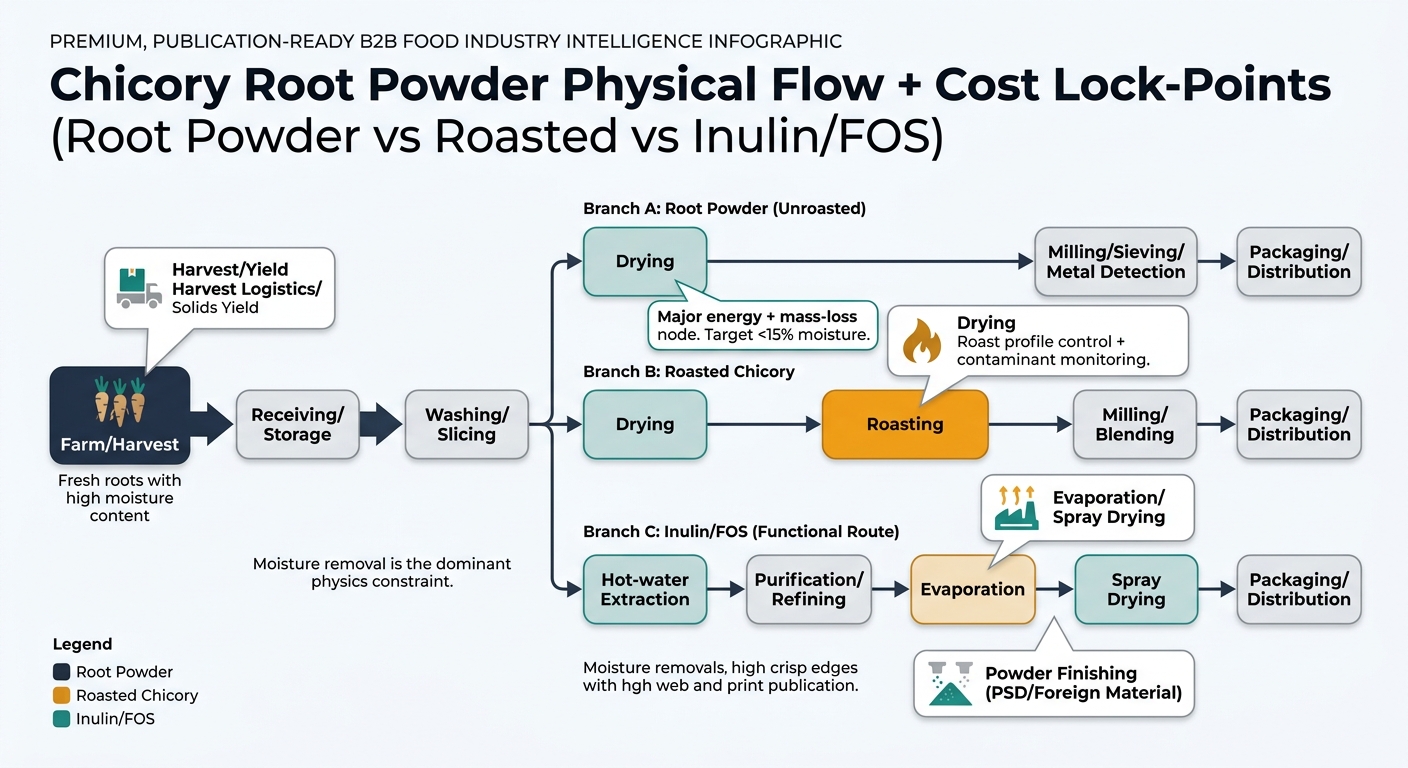
Left-to-right supply chain flow diagram for chicory root powder showing Farm/Harvest → Receiving/Storage → Washing/Slicing with three branches: A) Drying (target <15% moisture; major energy and mass-loss node) → Milling/Sieving/Metal Detection → Packaging/Distribution; B) Drying → Roasting (roast profile control and contaminant monitoring) → Milling/Blending → Packaging/Distribution; C) Hot-water Extraction → Purification/Refining → Evaporation → Spray Drying → Packaging/Distribution, with cost lock-point callouts at harvest logistics/solids yield, drying, roasting, evaporation/spray drying, and powder finishing plus a legend distinguishing product identities and a note that moisture removal is the dominant physics constraint.

2) Where Value Is Added: Per-Node Cost & Margin Structure (Physical + Financial)

Insight: Chicory-root-powder costs accumulate through (1) agricultural yield/solids, (2) energy-intensive moisture removal and/or extraction, and (3) powder finishing (milling, sieving, foreign-material control) that protects downstream handling and compliance.

Data (validated): Industrial chicory for inulin is commonly harvested in a fall window (often September–December in the northern hemisphere), which shapes plant utilization, storage discipline, and inventory planning [2].

Procurement Impact: Expect structurally higher fixed-cost exposure to energy, plant throughput, and seasonal raw-material logistics than to “simple blending/packing” economics.
1. Upstream / Raw Material (Industrial Chicory Roots)

  • Insight: Farm economics are driven by tonnage + root solids/inulin potential, because downstream yield (powder output per tonne of roots) is set by water content and carbohydrate profile.
  • Data (validated, corrected): For the inulin route, trade/industry literature consistently indicates Western Europe as a key production and export cluster. One peer-reviewed value-chain case study notes Belgium, Chile, and the Netherlands as the three largest exporters of inulin (by export share in the referenced database year), which is a practical proxy for downstream concentration even if farming is broader [2].
  • Procurement Impact: Physical supply continuity depends on a relatively concentrated processing/export base and a seasonal harvest cadence; disruptions at harvest (weather, labor, field access) propagate directly into processor utilization and finished powder availability.

2. Primary Processing Path A (Washing/Slicing + Drying of Root Chips)

  • Insight: Drying is the first major “cost lock”: it is energy-intensive, creates mass loss, and sets the baseline for micro stability and caking risk.
  • Data (validated): Patented industrial descriptions commonly cite fresh chicory at about 75% water, with drying targets below 15% (often 10–13%) before further processing [1].
  • Procurement Impact: Moisture targets are not just a shelf-life detail; tighter moisture (and water-activity control) typically means higher energy use, more stringent process control, and potentially fewer plants that can consistently hit spec at scale.

3. Primary Processing Path B (Roasting for Coffee-Style Chicory Powder)

  • Insight: Roasting converts a “fiber root” into a flavor ingredient, but it introduces a thermal-contaminant management burden (time/temperature control, roast uniformity, and lot segregation).
  • Data (validated, strengthened): In the EU, acrylamide mitigation is explicitly addressed in regulation, including a section for coffee substitutes containing >50% chicory, requiring documented control of critical roast conditions and mitigation measures when benchmark levels are exceeded [3].
  • Procurement Impact: Roasted chicory powder has an additional fixed control layer (roast profile + contaminant monitoring). That typically increases QA testing frequency and tightens process traceability expectations versus non-roasted dried root powder.

4. Secondary Processing (Milling, Sieving, Metal Detection, Standardization)

  • Insight: Milling turns dried chips into a powder with particle-size distribution (PSD) that governs flowability, dusting, hydration rate, and sensory impact; sieving and foreign-material controls protect both safety and line uptime.
  • Data (use with caution): Supplier spec sheets in the market commonly bundle physical attributes (e.g., bulk density/appearance) with microbiological expectations (e.g., pathogen absence with defined sample sizes). Individual PDFs vary in rigor and may not represent industry-wide norms, so treat them as examples—not standards [4].
  • Procurement Impact: PSD and bulk density are not cosmetic specs; they affect pneumatic conveying, hopper bridging, and blend uniformity. Changing mills/screens can shift performance even when “identity” stays the same.

5. Functional Ingredient Route (Extraction → Purification → Evaporation → Spray Drying for Inulin/FOS Powders)

  • Insight: Extracted inulin/FOS powders are a different physical product class: they trade agricultural variability for process standardization, but require high capex and sustained energy (evaporation + spray drying).
  • Data (validated): Technical descriptions of chicory inulin production commonly include washing/slicing, hot-water extraction, purification/refining, evaporation, and spray drying to a powdered product [4].
  • Procurement Impact: This route typically supports tighter compositional specs (e.g., “inulin content”) but structurally concentrates supply in fewer industrial sites and increases sensitivity to plant uptime and energy economics.

6. Packaging, Storage, and Distribution (Hygroscopic Powder Logistics)

  • Insight: Chicory powders are moisture-sensitive in storage and transit; liner integrity and warehouse humidity control are structural requirements to prevent caking and microbial growth.
  • Data (validated at principle level): Once dried/spray-dried powders leave the plant, packaging and storage conditions become the primary moisture barrier and a key control point for preventing quality drift (caking/flow issues) and hygiene deterioration.
  • Procurement Impact: Packaging format (multiwall bag + PE liner vs big bag) changes not only logistics cost but also the probability of moisture pickup and rework (screening, de-caking) at receipt.
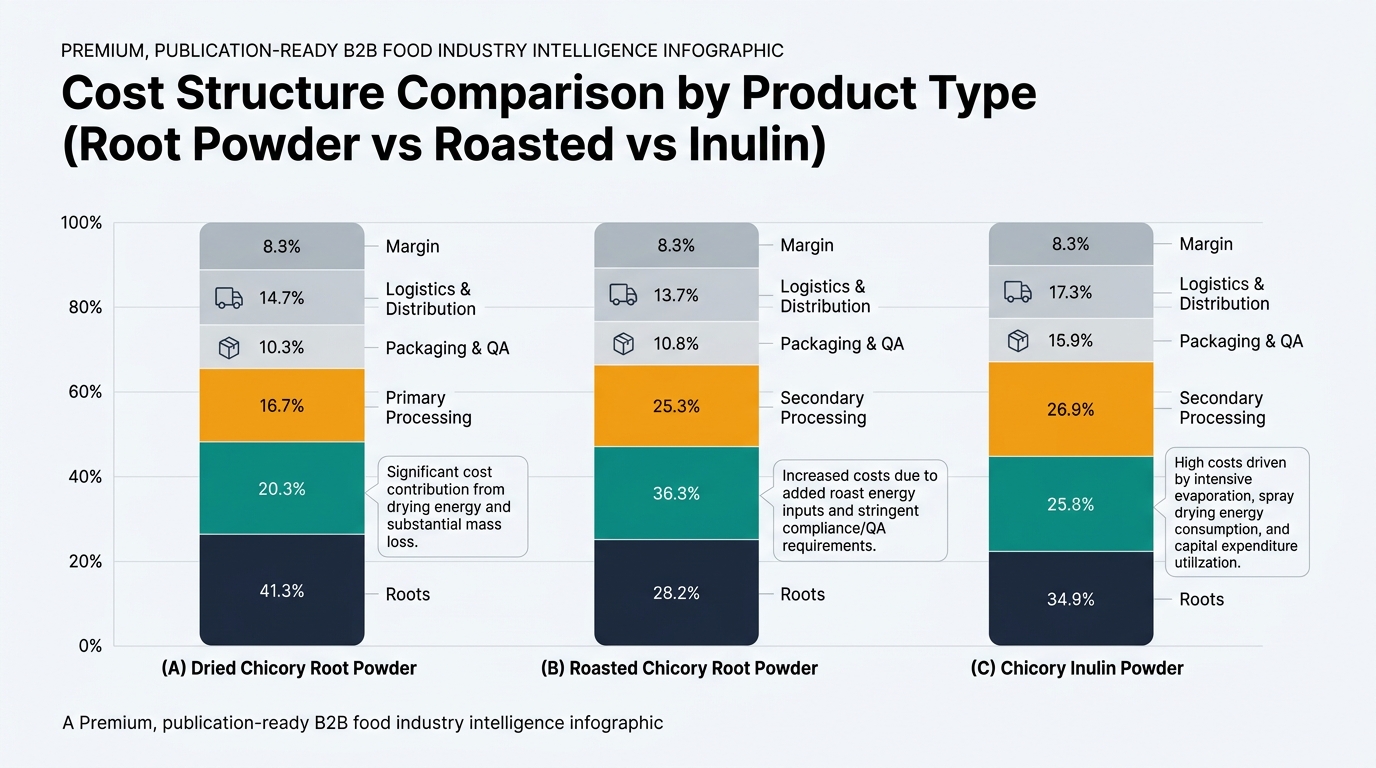
100% stacked bar chart comparing cost structure by product type for (A) Dried Chicory Root Powder, (B) Roasted Chicory Root Powder, and (C) Chicory Inulin Powder using node percentages (roots, primary processing, secondary processing, packaging & QA, logistics & distribution, margin), with callouts highlighting drying energy and mass loss for A, added roast energy and compliance/QA for B, and evaporation plus spray drying energy/capex utilization for C, with consistent colors and a legend.

Product-Level Cost Breakdown

A) Dried Chicory Root Powder (Non-Roasted; “Fiber Root Powder”)

Supply Chain Node Cost Ratio (% of Final Cost) Notes
Raw Material Cost (roots) 25% Yield/solids drive powder output per tonne of roots.
Primary Processing (wash/slice/dry) 30% Energy + mass-loss (water removal) + throughput constraints.
Secondary Processing (milling/sieving/foreign material) 15% PSD control, metal detection, wear parts, dust handling.
Packaging & QA 10% Liners, coding, micro testing, basic contaminants as required.
Logistics & Distribution 10% Ambient freight; humidity protection matters.
Wholesale/Converter Margin 10% Consolidation, repacking, inventory carrying.

B) Roasted Chicory Root Powder (Coffee-Style)

Supply Chain Node Cost Ratio (% of Final Cost) Notes
Raw Material Cost (roots) 20% Similar agricultural base, but roast yield and sorting affect usable output.
Primary Processing (dry + roast) 35% Added thermal step increases energy and process control burden.
Secondary Processing (milling/blending) 15% Roast uniformity + grind consistency; dust/explosion controls can add cost.
Packaging & QA 12% Additional monitoring often needed for roast-related contaminants and sensory specs.
Logistics & Distribution 8% Similar ambient shipping; odor migration and liner integrity matter.
Wholesale/Converter Margin 10% Often sold into beverage/coffee-alternative blends with converter handling.

C) Chicory Inulin Powder (Extracted + Spray-Dried Functional Fiber)

Supply Chain Node Cost Ratio (% of Final Cost) Notes
Raw Material Cost (roots) 18% Root quality still matters, but extraction standardizes the output.
Extraction + Purification 22% Water/chemistry, filtration, resins (if used), wastewater handling.
Evaporation + Spray Drying 25% High energy intensity; capex utilization is critical [4].
Packaging & QA 12% Tighter compositional and micro documentation; larger test panels are common.
Logistics & Distribution 10% Bulk bags, warehousing, inventory financing.
Manufacturer Margin 13% Concentrated industrial asset base typically requires stable margin for uptime/capex.

3) Structural Facts That Don’t Change (Even When the Market Does)

Reality 1: The crop base and industrial processing are geographically concentrated

Insight: Chicory for industrial uses is not globally ubiquitous; it clusters where agronomy, contracts, and processing plants already exist.

Data (validated, corrected): A peer-reviewed chicory-inulin value-chain case study highlights the Netherlands as a production/processing hub (example plant: Sensus BV) and notes exporter concentration among Belgium/Chile/Netherlands in the referenced trade data year—practically reinforcing concentration risk for buyers [2].

Procurement Impact: Concentration amplifies the operational impact of regional disruptions (harvest conditions, energy constraints, plant downtime) on finished powder availability.

Reality 2: Moisture removal is the unavoidable cost and stability fulcrum

Insight: Whether the end product is root powder or extracted inulin, the chain must remove a large amount of water (drying, evaporation, spray drying).

Data (validated): Industrial descriptions explicitly include drying fresh chicory pieces to <15% moisture for dried forms, and inulin production includes evaporation and spray drying of purified streams [1].

Procurement Impact: Energy and throughput are “hard physics” constraints. When plants are capacity-limited, lead times and lot availability tighten regardless of downstream packaging flexibility.

Reality 3: Thermal processing creates a distinct compliance profile

Insight: Roasted chicory is not just “darker powder”—it is a thermally processed plant ingredient with contaminant formation pathways that must be controlled.

Data (validated): The EU’s acrylamide regulation explicitly addresses mitigation and documentation expectations for coffee substitutes with high chicory content, making roast control and documented mitigation part of a defensible compliance posture [3].

Procurement Impact: Roasted powder programs typically require tighter roast-profile governance (time/temperature, lot segregation) and more robust documentation to support consistent compliance across lots.

Key Insights You Can Apply Immediately (Physical Map Summary)

  • Key Takeaways: Chicory-root-powder has two physically different supply chains—root powder (dry/roast → mill) versus functional inulin/FOS (extract → evaporate → spray dry)—and you should treat them as different cost structures, not substitutes.
  • Key Takeaways: The dominant fixed cost nodes are moisture removal (drying/evaporation/spray drying) and powder finishing (PSD + foreign-material control), because they govern yield, stability, and handling performance [1].
  • Key Takeaways: Roasting adds a structural compliance layer (acrylamide mitigation + documented roast controls in the EU context), which changes the QA burden versus non-roasted root powders [3].

The Bottom Line for Your Next Contract

(Analyzed at: Aug, 2026)

Treat chicory-root-powder as an energy-exposed, moisture-managed ingredient where the real risk sits in the drying/evaporation and (if applicable) roasting controls—not in the last-mile bag. In your next contract cycle, lock in (1) a single product identity (root powder vs roasted root powder vs extracted inulin/FOS), (2) a moisture/flowability control package (moisture or water-activity targets plus packaging/liner requirements), and (3) for roasted material, a documented acrylamide mitigation and roast-control narrative aligned to EU expectations if you sell into Europe [3]. Doing this early typically pays back as fewer holds/rejects and fewer line interruptions (de-caking, sieve-outs, blend variability)—and in a tight energy or capacity environment, the teams that pre-agree these “physics nodes” avoid the quiet 3–8% landed-cost creep that comes from expedited freight, rework, and last-minute re-qualification when a supplier can’t hold the process window.

Sourcing Window Radar
Chicory Root Powder — Global Harvest Calendar
INDIA SEASON ACTIVE
🇮🇳 India
JAN — DEC
🇨🇱 Chile
AUG — DEC
🇧🇪 Belgium
JAN — DEC
🇷🇺 Russia
OCT — OCT
🇫🇷 France
JAN — DEC
JanFebMarAprMayJunJulAugSepOctNovDec
Chicory Root PowderSupply Chain Intelligence
107 countries tracked
10
Exporters
10
Importers
$125M
Top Export Value
Top Exporters (2024)
🇧🇪
Belgium
$125M
🇨🇱
Chile
$70M
🇳🇱
Netherlands
$55M
🇲🇽
Mexico
$21M
🇹🇭
Thailand
$10M
+102 more
Top Buyers
🇺🇸 United States $82M🇮🇹 Italy $18M🇲🇽 Mexico $16M🇩🇪 Germany $16M🇨🇦 Canada $11M

References

  1. patents.google.com
  2. frontiersin.org
  3. eur-lex.europa.eu
  4. sciencedirect.com

Related Contents

Subscribe
→
By subscribing you agree to with our Privacy Policy and provide consent to receive updates from our company.
Thank you! Your submission has been received!
Oops! Something went wrong while submitting the form.
Subscribe to receive the latest blog posts, updates, promotions, and announcements from Tridge.
