

This guide maps the chicken frankfurter sausage supply chain in the way procurement leaders actually need it: where cost becomes hard to unwind, where capacity becomes the binding constraint, and where food-safety controls drive “fixed” overhead that shows up later as price, allocation, or service failures. It is written for sourcing managers who know procurement well, but are newer to the processed poultry sausage manufacturing reality.
Chicken frankfurter sausage is not a simple poultry commodity—it is a manufacturing + food safety + cold-chain system. The physical chain has a few “hard” nodes where costs and constraints become difficult to unwind later: (1) broiler growing economics (feed + flock health), (2) primary processing yields and creation of mechanically separated poultry (commonly referred to in plants as MSK/MSP; many procurement teams shorthand this as “MSC”) and trim, (3) secondary processing line capacity and lethality/cooling controls, and (4) packaging formats that dictate shelf-life and distribution options.
Insight: The chain’s biggest fixed constraints are biological conversion (feed-to-meat), plant throughput, and refrigerated time/temperature control, not just raw meat price.
Data: In the U.S., FSIS poultry chilling requirements are specified in 9 CFR 381.66, which includes time/temperature requirements for chilling. (Note: plants commonly manage to ≤40°F as an operational target aligned with food-safety handling expectations, but the regulatory text is more detailed than a single temperature line.) [3]
Procurement Impact: Even before you talk “strategy,” understanding where temperature control, yield loss, and line-time bottlenecks occur explains why supply can tighten suddenly and why two suppliers with the same recipe can have very different total cost-to-serve.
Physical flow (typical): Broiler production → slaughter/evisceration/chilling → deboning + trim + mechanically separated poultry creation → formulation (meat/MSK + water/ice + salt + binders/spices) → emulsification/stuffing → cook/smoke (lethality) → rapid chilling → peel/portion (if skinless) → pack (vacuum/MAP/frozen bulk) → cold storage → refrigerated/frozen distribution.

Insight: Frankfurter cost builds through a sequence of yield conversions (live bird to carcass, carcass to trim/MSK, batter to cooked link) plus controlled processing steps (emulsification, lethality, chilling) that require capital equipment, labor, sanitation downtime, and refrigeration.
Data: Ready-to-eat (RTE) meat/poultry products that are exposed to the environment after lethality must control Listeria monocytogenes under 9 CFR 430.4, which drives facility zoning, sanitation, and verification activity. [1]
Procurement Impact: Your “unit cost” is the sum of multiple conversion losses and compliance-driven overheads; small differences in yield, rework, and downtime at the processing nodes often matter more than small differences in raw material price.
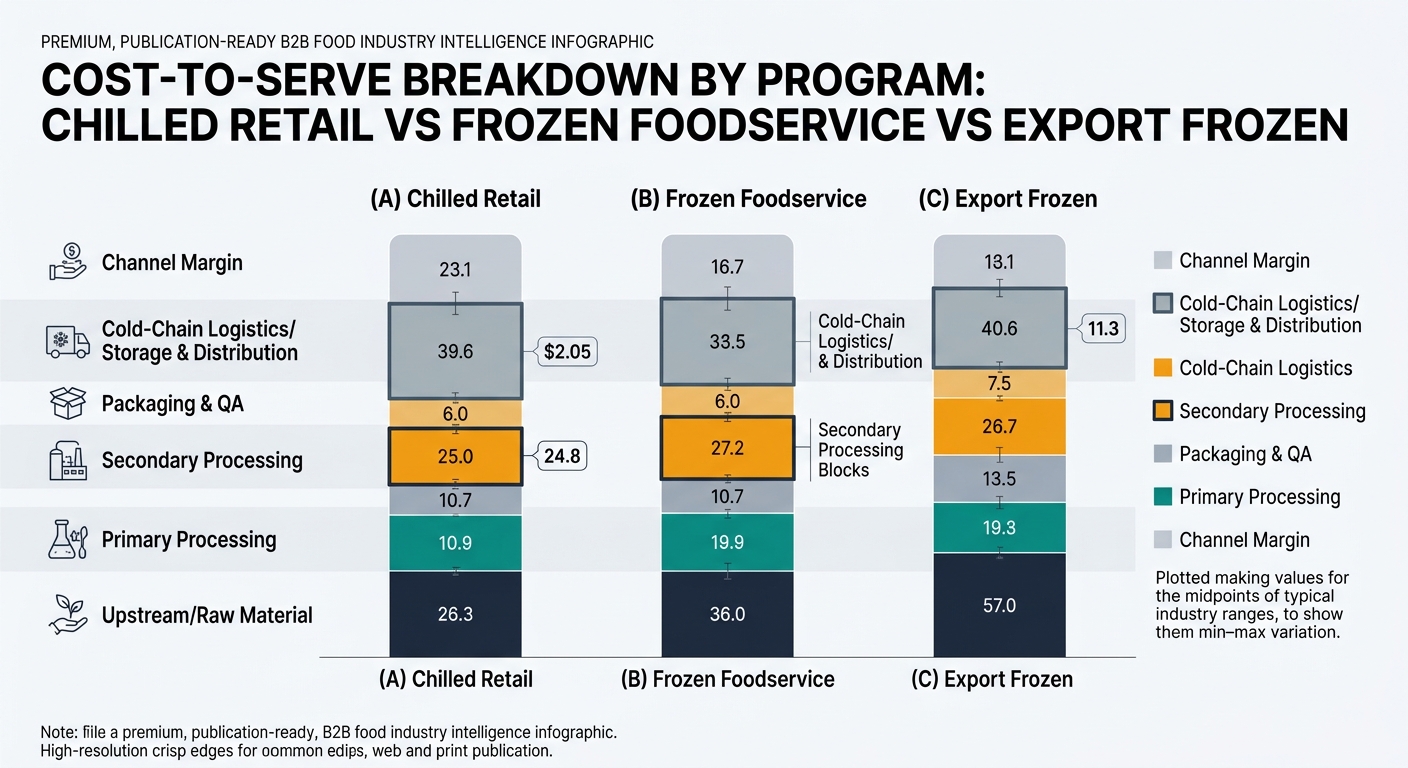
| Supply Chain Node | Cost Ratio (% of Final Cost) | Notes |
|---|---|---|
| Upstream / Raw Material | 30–40% | Live-bird economics embedded in trim/MSK cost; influenced by feed + flock health. |
| Primary Processing | 15–20% | Slaughter/chill/debone yields; mechanically separated poultry creation; compliance and refrigeration overhead. |
| Secondary Processing | 20–28% | Emulsification + cook/smoke + rapid chill; sanitation downtime and line utilization are key. |
| Packaging & QA | 8–12% | Film/labels/cartons + QA testing; packaging format drives shelf-life and returns. |
| Cold-Chain Logistics & Distribution | 8–12% | Refrigerated transport + warehousing; higher for dispersed retail footprints. |
| Wholesale/Retail Margin | 8–15% | Channel mix dependent; promo calendars can shift effective margin. |
| Supply Chain Node | Cost Ratio (% of Final Cost) | Notes |
|---|---|---|
| Upstream / Raw Material | 32–42% | Similar meat basis; formulation may allow slightly more flexibility in inputs. |
| Primary Processing | 15–20% | Yield + throughput; mechanically separated poultry availability can be a pinch point during tight supply. |
| Secondary Processing | 18–25% | Cook/smoke + freezing load; energy-intensive but can stabilize service. |
| Packaging & QA | 6–10% | Simpler bulk packaging; still label/allergen control critical. |
| Cold Storage + Distribution | 10–16% | Freezer warehousing and frozen freight; longer dwell times increase carrying cost. |
| Distributor/Foodservice Margin | 8–14% | Depends on distributor services and delivery frequency. |
| Supply Chain Node | Cost Ratio (% of Final Cost) | Notes |
|---|---|---|
| Upstream / Raw Material | 28–38% | Export competitiveness depends on input cost and co-product economics. |
| Primary Processing | 14–20% | Same conversion steps; documentation and inspection readiness add overhead. |
| Secondary Processing | 18–25% | Stable frozen spec helps; but strict customer specs can increase rework. |
| Packaging & QA | 8–12% | Cartons, pallet patterns, multilingual labels; higher compliance/document control. |
| Cold-Chain Logistics (Reefer + Port + Inland) | 12–20% | Reefer availability, port dwell, and inland drayage can dominate landed cost. |
| Importer/Distributor Margin | 6–12% | Varies by market structure and service obligations. |
Insight: The frankfurter supply chain is governed by a few non-obvious “physics” constraints: regulated food safety controls for RTE products, conversion yields that create irreversible cost, and cold-chain time/temperature discipline that defines serviceability.
Data: RTE products exposed after lethality must comply with Listeria control requirements under 9 CFR 430.4, which increases the fixed cost of producing and packaging frankfurters versus raw poultry. [1]
Procurement Impact: Supplier capability is less about “can they make a sausage” and more about whether they can repeatedly execute lethality, post-lethality hygiene, and chilled distribution without quality drift.
The Bottom Line for Your Next Contract (Analyzed at: Jul, 2026): Put cold-chain performance and contingency capacity into the commercial terms—not just QA boilerplate. With U.S. refrigerated truck rates sitting at seasonal highs in late July 2026 and capacity remaining tight, the “hidden” cost is increasingly service failures (shorts, late arrivals, code-life loss) that turn into credits and expedite freight. [6]
Write two measurable clauses: (1) minimum remaining shelf-life at receipt (by lane/DC) with a defined credit schedule, and (2) a pre-approved surge plan (secondary plant or co-pack lane) you can activate within weeks. It works because the chain’s true constraints are line time + sanitation + refrigerated time, and the dollars at stake typically show up as waste and premium freight—often more than the last 1–2% you negotiate off unit price.


