INDUSTRY TRENDS

Cashew Milk Cheese Supply Chain Map (Procurement View): Flow, Specs, and Where Costs Lock In

Author
Team Tridge
DATE
August 10, 2026
8 min read
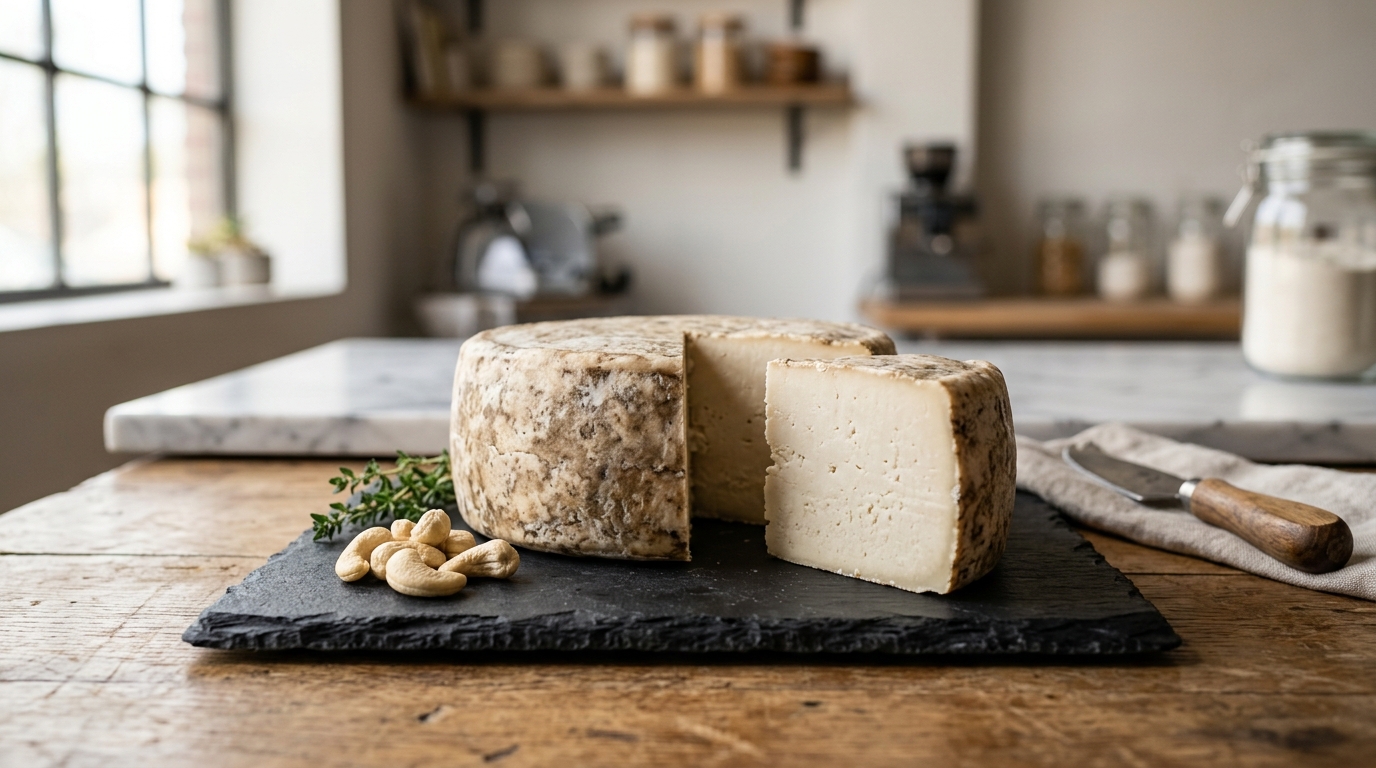
cashew-milk-cheese Cover
Unlock Full Data
Cashew Milk Cheese Market Intelligence
Prices · Trends · Origins · Forecasts

Cashew-milk-cheese looks like a “simple” plant-based SKU, but the cost and risk profile is set by a few physical choke points: kernel condition/yield, time-in-process under hygienic controls, and packaging + temperature protection. This guide maps the real flow and highlights where procurement (Quality/Safety/Compliance) can lock in stability through specs, verification, and change-control.

Executive Summary

  • Cost locks in at 4 nodes: kernel yield/condition, wet milling + solids standardization, hygienic hold/fermentation capacity, and barrier packaging + cold chain.
  • Kernel grades are real commercial standards: W-series grades refer to approximate kernels per pound (e.g., W240/W320), which links to size and typical pricing dynamics.
  • RTE refrigerated risk is environmental-control driven: FDA explicitly ties RTE contamination risk to sanitation and environmental monitoring for Listeria monocytogenes. [3]
  • Surface area multiplies failure modes: shreds/slices raise oxygen exposure and handling risk, making seal integrity and barrier specs disproportionately important.

1) How the Product Physically Moves (and Where Costs “Lock In”)

Cashew-milk-cheese is a downstream manufactured, ready-to-eat (often refrigerated) product built on two physical realities: (1) cashew kernels are the dominant upstream input by weight-adjusted value, and (2) cold-chain, hygiene zoning, and packaging barrier performance determine how much of your production actually survives to shelf-life.

Insight: The chain is short on paper but “cost-dense” at a few nodes—kernel conversion yield, fermentation/hold-time, hygienic design + environmental monitoring, and barrier packaging.

Data: Industrial cashew processing follows a consistent sequence (conditioning/roasting or steaming → shelling → drying → peeling → grading/quality controls → packaging), and FDA’s RTE enforcement guidance notes that Listeria monocytogenes can contaminate RTE foods due to improper sanitary conditions and that sanitation controls include environmental monitoring programs. [1] [3]

Procurement Impact: Your finished-goods cost is structurally shaped less by “ingredients list” complexity and more by (a) how much edible kernel mass you can reliably convert to a stable base, and (b) how much process time and packaging barrier you must buy to protect a high-moisture RTE food.

Physical flow (high level)

  • Upstream: Cashew kernels (whole or pieces) + functional fats (coconut oil/cocoa butter) + starch/hydrocolloids + cultures/acidulants.
  • Conversion: Clean/sort → soak/hydrate → wet-mill → standardize solids → emulsify.
  • Make: Ferment/acidify (if cultured) → thermal step and/or HPP (format-dependent) → cool.
  • Pack: High-barrier tubs/films, vacuum/MAP where needed → metal detection/X-ray as applicable.
  • Move: Refrigerated storage/transport → retail/foodservice cold chain.
Left-to-right supply chain flow for cashew milk cheese from upstream inputs through primary conversion, secondary manufacturing, packaging & QA release, and cold-chain logistics, with highlighted cost lock-in nodes (kernel yield/condition, wet milling + solids standardization, hygienic hold/fermentation capacity + environmental monitoring, and barrier packaging + cold chain) and callouts such as yield loss, time-in-process, seal integrity, and temperature excursions.

2) Where Cost and Margin Accumulate (Node by Node)

Insight: Costs stack in predictable places: kernel grade choice and yield loss upstream; time-in-process and sanitation intensity in manufacturing; and barrier packaging + cold chain downstream.

Data: Cashew kernels are standardized into grades (e.g., W240, W320) where the number indicates approximate kernels per pound (a size proxy that typically correlates with pricing). [2]

Procurement Impact: Even without changing the recipe, node-level choices (kernel form, hold-time, packaging format, distribution temperature) structurally determine scrap, rework, and shelf-life—i.e., the “fixed” cost footprint.

1. Upstream Inputs (Cashew Kernels + Functional Ingredients)

  • Insight: For cashew cheese, kernels behave like both “protein/fat body” and “texture engine,” so grade/form selection is a cost lever and a performance constraint.
  • Data: W-series grades are commercial categories tied to kernel count per pound (e.g., W240 and W320); pieces/broken grades are common where appearance is irrelevant. [2]
  • Procurement Impact: Pieces/broken kernels typically improve economics, but require tighter incoming specs (moisture, defects, oxidation/rancidity indicators) because you lose the “visual proxy” of intact wholes and variability shows up as separation, graininess, or off-notes.

Fixed cost drivers at this node (what you’re really paying for)

  • Kernel conversion yield: edible recovery after sorting/defect removal (foreign material, scorch, insect damage).
  • Quality losses: oxidation/rancidity risk in higher-surface-area pieces; more aggressive sorting/testing needed.
  • Functional add-ins: coconut oil/cocoa butter (melt), starch/hydrocolloids (slice/shred structure), cultures/acidulants (pH + flavor).

2. Primary Conversion (Cleaning/Sorting → Soaking → Wet Milling → Standardization)

  • Insight: This node is where “hidden” cost appears: water uptake, solids standardization, and filtration losses drive yield and consistency more than line speed.
  • Data: Cashew processing references consistently include grading/quality controls as integral steps, reinforcing that variability management is inherent to the input, not optional. [1]
  • Procurement Impact: If you don’t tightly control incoming kernel moisture/defects and your target solids, you pay twice—first in yield loss (more filtration rejects), then in downstream instability (separation or weak gel), which increases rework and short-dates.

Fixed cost drivers at this node

  • Soak time + sanitation: high water activity steps increase cleaning frequency and labor.
  • Milling energy + wear: particle size distribution affects mouthfeel and emulsion stability.
  • Standardization losses: trimming to target solids/fat can create unavoidable “off-spec” side streams.

3. Secondary Manufacturing (Emulsification → Fermentation/Aging or Acidification → Kill Step)

  • Insight: Time-in-process is a structural cost: cultured products “tie up” tanks/rooms and working capital, and they raise microbial control expectations.
  • Data: FDA’s Compliance Policy Guide describes how RTE foods can be contaminated if Listeria is allowed to contaminate RTE food because of improper sanitary conditions, and it explicitly calls out sanitation controls including environmental monitoring programs. [3]
  • Procurement Impact: The more your product relies on fermentation/hold steps (vs. simple acidification), the more you must budget for hygienic zoning, environmental swabbing programs, and controlled cooling—costs that don’t scale down gracefully at lower volumes.

Fixed cost drivers at this node

  • Hold/aging capacity: rooms, racks, time, and inventory carrying cost.
  • Micro program intensity: environmental monitoring, test-and-hold where applicable, and corrective sanitation.
  • Scrap risk: a single out-of-trend pH/texture batch can become total loss (especially for blocks/wheels).

4. Packaging & QA Release (Barrier, Seal Integrity, Label/Claims Control)

  • Insight: Packaging is not just materials; it is shelf-life insurance. For high-moisture plant-based cheese, oxygen and seal integrity often decide complaint rate (mold, off-flavors, separation) more than minor formulation tweaks.
  • Data: Cashew processing references treat packaging as a formal step after grading/quality controls, reinforcing that pack-out is part of quality preservation. [1]
  • Procurement Impact: Barrier film/tub selection, seal validation, and lot coding/traceability capabilities become fixed governance costs—especially when you run multiple SKUs (spreads, slices, shreds) with different headspace and surface-area exposure.

Fixed cost drivers at this node

  • Barrier materials: oxygen/moisture transmission performance; MAP/vacuum where used.
  • Seal validation + inspection: leak detection, torque/peel specs, in-line checks.
  • QA release: micro testing cadence, allergen verification (tree nut), label compliance checks.

5. Cold-Chain Logistics (Refrigerated Storage → Transport → Retail Handling)

  • Insight: Cold chain is a continuous cost, not a one-time freight line. Temperature excursions convert directly into shrink, credits, and short-dates.
  • Data: FDA notes that the longer ready-to-eat refrigerated foods contaminated with L. monocytogenes are stored, the more opportunities there are for growth—one reason chilled handling discipline matters. [4]
  • Procurement Impact: Distribution mode (chilled vs. frozen) structurally changes your cost base: chilled increases service-level constraints and shrink exposure; frozen can reduce spoilage but may require texture reformulation and different packaging.

Fixed cost drivers at this node

  • Refrigerated warehousing: energy, monitoring, and capacity constraints.
  • Reefer transport: higher per-mile costs and tighter scheduling.
  • Returns/shrink: quality claims often trace back to time-temperature abuse.

Product-Level Cost Breakdown

Note for readers: These ratios are illustrative (they will vary by volume, co-man overhead model, and channel fees), but they are directionally consistent with where costs structurally sit in refrigerated, high-moisture, packaged foods.

Grouped or 100% stacked bar chart comparing cost ratio by supply chain node for three cashew milk cheese formats—Refrigerated Spreadable (42/12/14/14/10/8), Sliceable Block (38/10/18/16/10/8), and Shreds (34/9/22/17/10/8)—segmented into upstream inputs, primary conversion, secondary manufacturing, packaging & QA, cold-chain logistics, and wholesale/retail margin, with an annotation that ratios are illustrative.

A) Refrigerated Spreadable (Tub/Cup)

Supply Chain Node Cost Ratio (% of Final Cost) Notes
Upstream inputs (kernels + fats/starch/cultures) 42% Kernels dominate; functional fats/starch stabilize texture.
Primary conversion (soak/mill/standardize) 12% Yield loss + sanitation + energy.
Secondary manufacturing (ferment/acidify + kill step) 14% Hold time and micro controls drive fixed overhead.
Packaging & QA 14% Tubs/lids + seal validation + micro testing.
Cold-chain logistics 10% Chilled storage and reefer freight.
Wholesale/retail margin 8% Lower than blocks due to higher velocity SKUs.

B) Sliceable Block (Vacuum Pack or MAP)

Supply Chain Node Cost Ratio (% of Final Cost) Notes
Upstream inputs (kernels + fats/starch/cultures) 38% Higher structuring fats/starch common for slice integrity.
Primary conversion (soak/mill/standardize) 10% Similar unit ops; tighter particle size control.
Secondary manufacturing (structure set + hold) 18% More scrap risk if texture/pH drifts; longer set time.
Packaging & QA 16% Barrier film, vacuum/MAP, seal integrity checks.
Cold-chain logistics 10% Similar chilled burden; blocks often heavier/denser cases.
Wholesale/retail margin 8% Private label can shift this mix.

C) Shreds (High Surface Area, Bagged)

Supply Chain Node Cost Ratio (% of Final Cost) Notes
Upstream inputs (kernels + fats/starch/cultures) 34% Formulation tuned to shred/melt; anti-cake aids sometimes used.
Primary conversion (soak/mill/standardize) 9% Similar, but downstream losses more visible.
Secondary manufacturing (structure + shred step) 22% Shredding adds mechanical loss and sanitation burden.
Packaging & QA 17% Bags + seals; oxygen control important due to surface area.
Cold-chain logistics 10% Higher cube/handling cost per lb than blocks.
Wholesale/retail margin 8% Often promoted; margin can be volatile by channel.
Unlock Full Data
Cashew Milk Cheese Market Intelligence
Prices · Trends · Origins · Forecasts

3) Structural Realities You Can’t Engineer Away

Insight: Three structural constraints shape availability, cost, and risk regardless of brand strategy: kernel grading economics, RTE environmental risk, and packaging/temperature physics.

Data: (1) Kernel grades (e.g., W240/W320) are standardized commercial categories tied to kernel count per pound; and (2) FDA frames Listeria monocytogenes as a key hazard for RTE foods and links control to sanitation and environmental monitoring programs. [2] [3]

Procurement Impact: These realities define the “non-negotiable” cost base: you can optimize within them, but you cannot eliminate them.

  • Structural reality #1 — Kernel form choice is a quality system choice. Pieces/brokens may reduce input cost, but they increase the need for incoming QC (oxidation, defects, foreign material) because variability expresses as texture/separation downstream.
  • Structural reality #2 — Refrigerated RTE manufacturing is an environmental-control business. The product’s safety profile is heavily shaped by facility hygiene zoning, sanitation execution, and environmental monitoring rigor, not just ingredient COAs. [3]
  • Structural reality #3 — Surface area multiplies risk and cost. Shreds and slices expose more surface area to oxygen and handling, so packaging barrier and seal integrity become disproportionately important versus blocks or tubs.

Key Insights to Carry Into Your Next Spec Review

Insight: Cashew-milk-cheese cost is structurally concentrated in (1) kernel yield/quality, (2) time-in-process and hygienic controls, and (3) barrier packaging + cold chain.

Data: Commercial kernel grading (W-series) standardizes upstream inputs; and FDA guidance emphasizes sanitation controls and environmental monitoring for Listeria in RTE foods. [2] [3]

Procurement Impact: The fastest way to stabilize performance is usually not adding new ingredients—it’s tightening the physical specs and controls at the few nodes where losses occur (incoming kernel condition, solids standardization, seal integrity, and temperature control).

Key Takeaways

  • Kernel grade/form sets your baseline yield and sensory variability.
  • Fermentation/hold time is a capacity and governance cost, not just a flavor choice.
  • Packaging barrier + seals are shelf-life determinants, especially for shreds/slices.
  • Cold chain is a continuous cost center that directly drives shrink.

The Bottom Line for Your Next Contract

(Analyzed at: Aug, 2026)

Lock your next 12-month co-man or finished-goods agreement around two “hard” controls: (1) an incoming-kernel spec that is explicit about form (whole vs. pieces), grade reference, and rancidity/defect acceptance, and (2) a packaging performance appendix that makes seal integrity verification + oxygen-control assumptions auditable.

This works because 2026 market signals still point to tightness/volatility in cashew raw material economics and processor margin pressure, which is exactly when silent spec drift and substitution risk rises. [5] If you prevent one meaningful short-date event or rework cycle on refrigerated RTE product, you’re typically protecting mid–five figures in credits, labor, and expedited freight over a year—before you even count brand risk tied to an RTE Listeria investigation trigger.

Unlock Full Data
Cashew Milk Cheese Market Intelligence
Prices · Trends · Origins · Forecasts

References

  1. cashews.org
  2. portalcomercioexterno.gov.mz (PDF)
  3. fda.gov (CPG Sec. 555.320)
  4. fda.gov (Listeria & listeriosis)
  5. vietnamnews.vn

Related Contents

Subscribe
→
By subscribing you agree to with our Privacy Policy and provide consent to receive updates from our company.
Thank you! Your submission has been received!
Oops! Something went wrong while submitting the form.
Subscribe to receive the latest blog posts, updates, promotions, and announcements from Tridge.
