This case study shows how a jerky brand reduced “surprise” costs by treating sriracha beef jerky as a multi-node supply chain (beef + spicy inputs + packaging), not a single SKU negotiation. The core message for sourcing teams: separate the cost stack, pre-qualify alternates at the nodes that can stop production, and lock governance around yield and water activity so switches don’t create quality or audit risk.
Insight: In sriracha beef jerky, the biggest “surprises” rarely come from finished-goods demand—they come from upstream beef volatility, chili/garlic continuity, and packaging lead times colliding with tight food-safety specs.
Data: Jerky economics amplify raw beef moves because dehydration drives major shrink (pounds-in vs. pounds-out), while shelf-stability expectations hinge on validated lethality plus water activity (aw) control. FSIS training/guidance for jerky highlights that FSIS does not define jerky as shelf-stable in standards of identity (9 CFR Part 319), even though consumers expect it to be shelf-stable, and it specifically calls out water activity (aw) as a key concept [2].
Procurement Impact: If you treat sriracha jerky like a “simple commodity snack,” you’ll over-focus on unit price and under-invest in qualification depth, spec governance, and cost-driver timing—exactly where margin and service failures originate.

Insight: The winning move wasn’t a single re-bid—it was separating the cost stack (beef vs. flavor vs. packaging vs. freight), then redesigning sourcing so each risk had a controllable lever.
Data: A mid-sized North American meat-snack brand (anonymized) restructured sourcing across beef inputs, sriracha-style flavor system, and packaging over ~20 weeks, after repeated service failures and cost spikes during a tight cattle supply backdrop. USDA NASS reported U.S. beef cow inventory at 27.6 million head as of January 1, 2026 (down 1% YoY) [1].
Procurement Impact: This is a template for procurement teams that need to protect margin and OTIF without loosening food-safety controls or “breaking” a flagship spicy SKU.
Insight: The company’s risk wasn’t just “high beef prices”—it was concentration plus spec rigidity, which turned normal market volatility into repeated production stops.
Data: The brand sold spicy jerky primarily in U.S. convenience and club channels, running ~1,200–1,600 MT/year finished goods across multiple SKUs. They were:
Procurement Impact: A single allocation event (pepper) or a single late pouch delivery forced either (a) line downtime, (b) emergency spot buys, or (c) a rushed spec change—each one expensive and audit-sensitive.
Insight: The “cost problem” presented as inflation, but the real cost leakage was expedite + downtime + yield variance.
Data: Over the prior 2 quarters, they recorded:
Procurement Impact: Even if a re-bid saved 2–3% on paper, it wouldn’t offset operational leakage unless the team changed the sourcing design.
Insight: They sequenced changes to protect food safety first (process/spec governance), then unlocked supplier competition (beef + packaging), then reduced disruption exposure (flavor alternates).
Data: The program ran in four waves over ~20 weeks, with cross-functional gates (QA + Ops + Procurement).
Procurement Impact: This sequence avoided the common failure mode: switching suppliers quickly, then discovering validation gaps that force rollbacks.
Insight: You can’t negotiate beef or co-man fees credibly until you align on what drives yield, aw performance, and rework risk.
Data: They created a “cost stack” that separated:
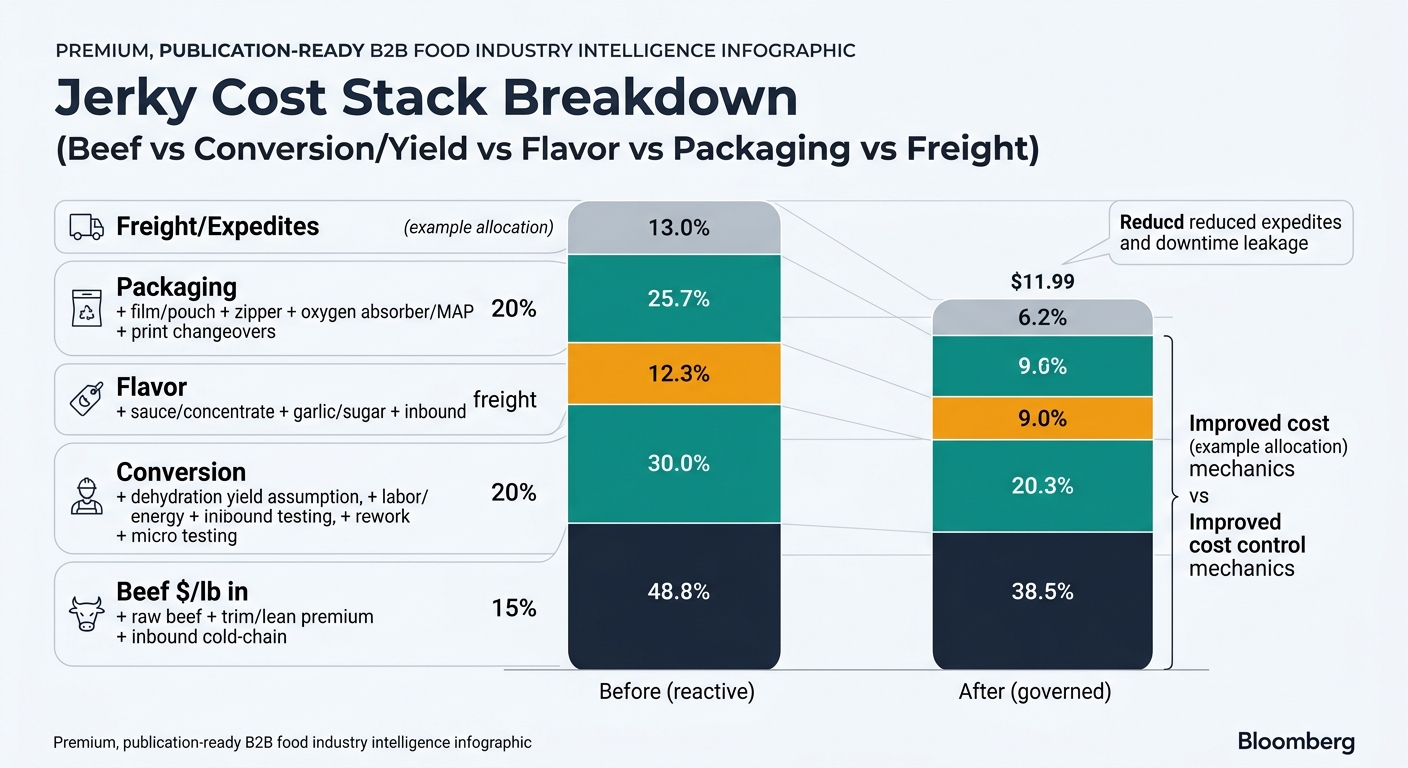
Procurement Impact: Procurement gained leverage to challenge “conversion adder” increases and to negotiate index-based mechanisms for the parts that truly move.
Insight: In tight cattle cycles, quarterly quotes can lag reality and invite margin-taking; index logic reduces disputes and stabilizes planning.
Data: U.S. cattle supply remains historically tight; USDA analysis describes drought and cattle-cycle dynamics as major drivers of herd size and supply tightness [4].
Actions taken:
Procurement Impact: They reduced single-source exposure while preventing “quote shock” and minimizing renegotiations mid-cycle.
Insight: The goal wasn’t to replace sriracha—it was to pre-qualify functionally equivalent flavor systems so allocations don’t stop the line.
Data: Public reporting shows certain sriracha supply chains have faced repeated chili supply constraints tied to drought/weather and supplier-specific issues, including production halts/shortage warnings in 2022–2024 [5].
Actions taken:
Procurement Impact: They gained time-to-switch measured in weeks (planned) instead of days (panic), reducing expedite and avoiding uncontrolled label/spec changes.
Insight: For jerky, packaging is both a shelf-life system and a supply risk; printed pouches turn small demand changes into big lead-time problems.
Data: High-barrier structures (often PET/PE with barrier layers such as EVOH) are common for oxygen/moisture management in shelf-stable foods, and material structure choices can constrain converter options [6].
Actions taken:
Procurement Impact: Packaging stopped being the “silent single point of failure,” and the team reduced MOQ-driven inventory swings.
Insight: The measurable win came from fewer disruptions and better negotiation posture—not from chasing the lowest quote.
Data: 12 months after implementation:
Procurement Impact: The organization shifted from reactive buying to governed sourcing—better margin protection with fewer audit and customer-service events.
Insight: The best comparison is not supplier count; it’s concentration, contract structure, and switchability.
| Dimension | Before | After | Why it mattered |
|---|---|---|---|
| Beef supply concentration | 85% single supplier | 60/40 split across 2 approved | Reduced allocation risk + improved leverage |
| Flavor system | 1 sriracha concentrate | 1 primary + 2 qualified alternates | Faster switch during chili constraints |
| Packaging | 1 printed pouch converter | 2 converters + selective generic film/labels | Reduced lead-time shocks and MOQ risk |
| Pricing mechanism | Quarterly quotes | Index-referenced + yield assumptions | Fewer disputes, clearer should-cost |
| OTIF | 86% | 96% | Fewer chargebacks + better retailer trust |
Procurement Impact: The portfolio became resilient without loosening food-safety rigor; QA and Ops became enablers rather than bottlenecks.
Insight: The transferable playbook is “control what you can, index what you can’t, and pre-approve what will eventually break.”
Data: The case exposed three recurring failure modes in spicy jerky:
Procurement Impact: Use these as diagnostic checks before you run your next RFQ.
Insight: The highest-ROI move in sriracha beef jerky is to dual-source the nodes that can stop production (beef, flavor, pouches) while locking governance around aw/yield so alternates don’t create hidden quality cost.
Data: U.S. beef cow inventory was 27.6M head as of January 1, 2026 (-1% YoY) [1], and sriracha chili supply disruptions have been repeatedly reported in recent years—both increase the probability of allocation events [3][5].
Procurement Impact: Teams that pre-qualify alternates and contract the cost drivers (not just the SKU price) reduce expedite, downtime, and chargebacks—often more than they save from a one-time unit-price re-bid.
Logical next step framing (non-promotional): The hardest question to answer with spreadsheets is timing—when a beef cost move is “commodity reality” vs. supplier margin, and when chili/packaging risk signals justify starting alternate qualification before allocations hit. That timing problem is where most sriracha jerky programs either protect margin quietly—or end up paying for disruption in public (stockouts, chargebacks, and emergency freight).
Beef supply tightness is still a live planning risk signal (USDA NASS put U.S. beef cows at 27.6M head on January 1, 2026) [1], and the last few years have shown that pepper-linked sriracha supply chains can go into allocation with little notice [3][5]. The high-conviction move is to contract your jerky program as a cost stack (beef index + conversion/yield + packaging) while keeping at least one pre-qualified flavor and pouch alternate under change control. When teams wait until the first allocation or pouch slip, they typically pay for it in expedites, downtime, and retailer penalties—costs that can easily erase a few points of negotiated unit-price savings.