
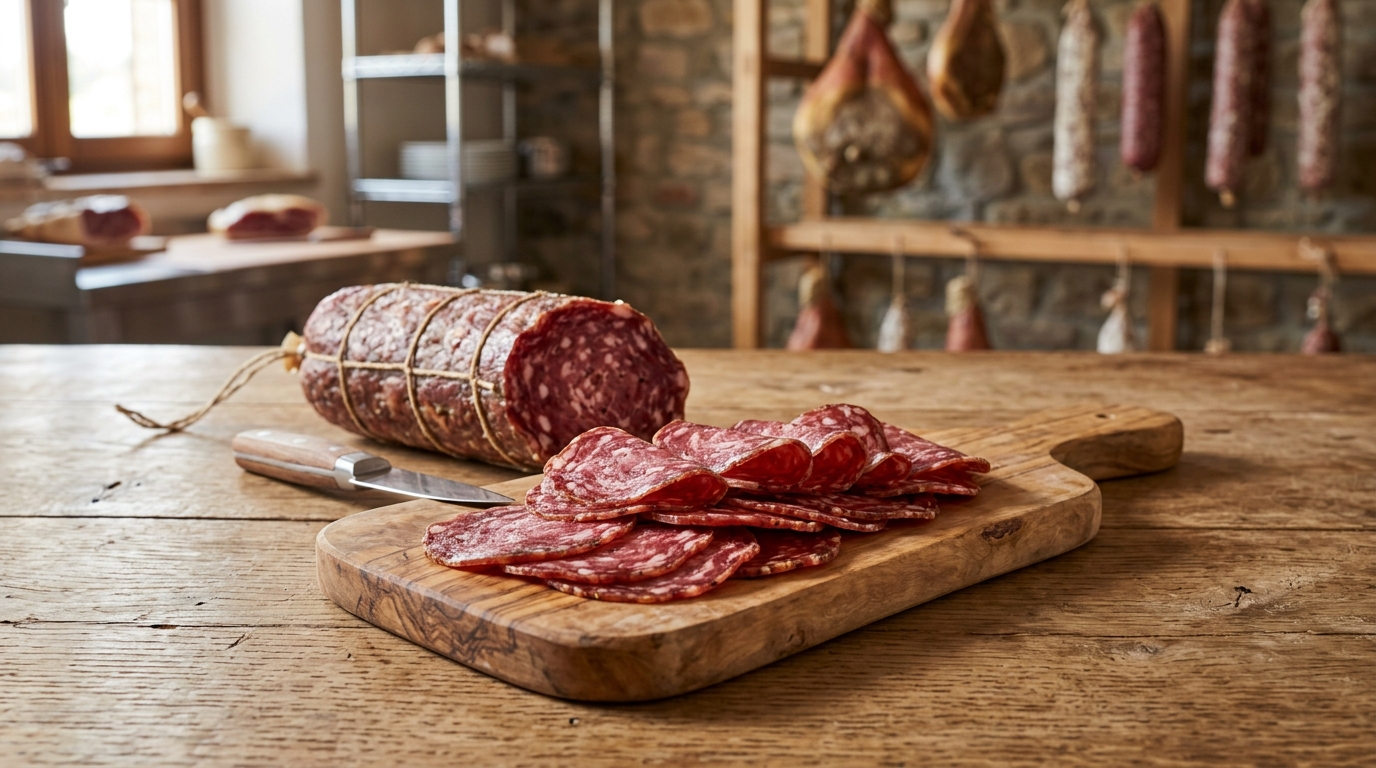
Genoa salami sourcing often looks like a straightforward cured-meat buy, but procurement outcomes are usually driven by two less-visible constraints: long curing cycles and the tighter RTE governance burden once product is sliced and packaged. This case study shows how one North American retailer reduced volatility and single-plant risk by treating “whole” and “sliced” as two different supply problems—and sequencing actions so QA and operations could move fast without waivers.
Insight: Genoa salami programs look “simple” (pork + spices + casing), but procurement outcomes are usually determined by two hidden constraints: long curing lead times and RTE (ready-to-eat) food-safety governance—especially once product is sliced and packaged.
Data (validated/clarified): Dry sausages like Genoa salami do have a shelf-life advantage in the whole/unopened format. USDA FSIS consumer guidance states that hard/dry sausage (e.g., pepperoni and Genoa salami), whole and unopened, can be stored indefinitely in the refrigerator (and up to ~6 weeks in a pantry), which is directionally why “whole chub” can function as a buffer format in planning [1].
Procurement Impact: If your buyer is negotiating only on $/lb and ignoring format-driven risk (whole vs sliced), they’ll miss the biggest levers: capacity reservation, spec governance, and contingency qualification sequencing.
Insight: The highest-value Genoa salami wins come from separating (a) pork-driven volatility from (b) manufacturing/QA-driven continuity risk, then contracting around both.
Data (plausibility note): In this case, the buyer changed only two things—contract structure and supplier topology—without changing the consumer-facing product. (The specific percentages below are anonymized internal performance metrics; they are plausible in-category but not externally verifiable without the retailer’s source data.)
Procurement Impact: You can credibly position “intelligence” as decision support (what to do next, in what order), not as generic market commentary.
Insight: The buyer’s “problem” wasn’t pork price alone—it was a mismatch between how they bought (spot-like behavior) and how the category produces (capacity-constrained, long-cycle, QA-heavy).
Data: A North American retail + club chain (anonymized) sourced ~1,250 MT/year of Genoa salami across:
Supply setup before changes:
What the buyer observed over 2 quarters:
Procurement Impact (validated/strengthened): In post-lethality exposed RTE meat programs, slicing/packaging is where “risk density” spikes because product can be re-exposed to the environment after the lethality step. FSIS’ Listeria rule framework (9 CFR 430) explicitly ties controls and verification expectations to post-lethality exposure, which is why buyers feel more friction (and more consequence) on sliced RTE items than on whole, sealed formats [2].
Insight: The team treated the program as two different categories—whole vs sliced—then built a dual-source plan that respected QA change-control.
Data: Actions were sequenced to avoid a common failure mode: contracting an alternate that can’t pass packaging + environmental monitoring expectations on time.
Procurement Impact: This is the repeatable playbook: stabilize the “format bottleneck” first (slicing/packaging capacity), then negotiate pork-driven volatility.
Insight: Sliced Genoa salami is where most continuity risk hides (sanitation windows, film availability, line scheduling, higher touch).
Data: The team created two internal lanes:
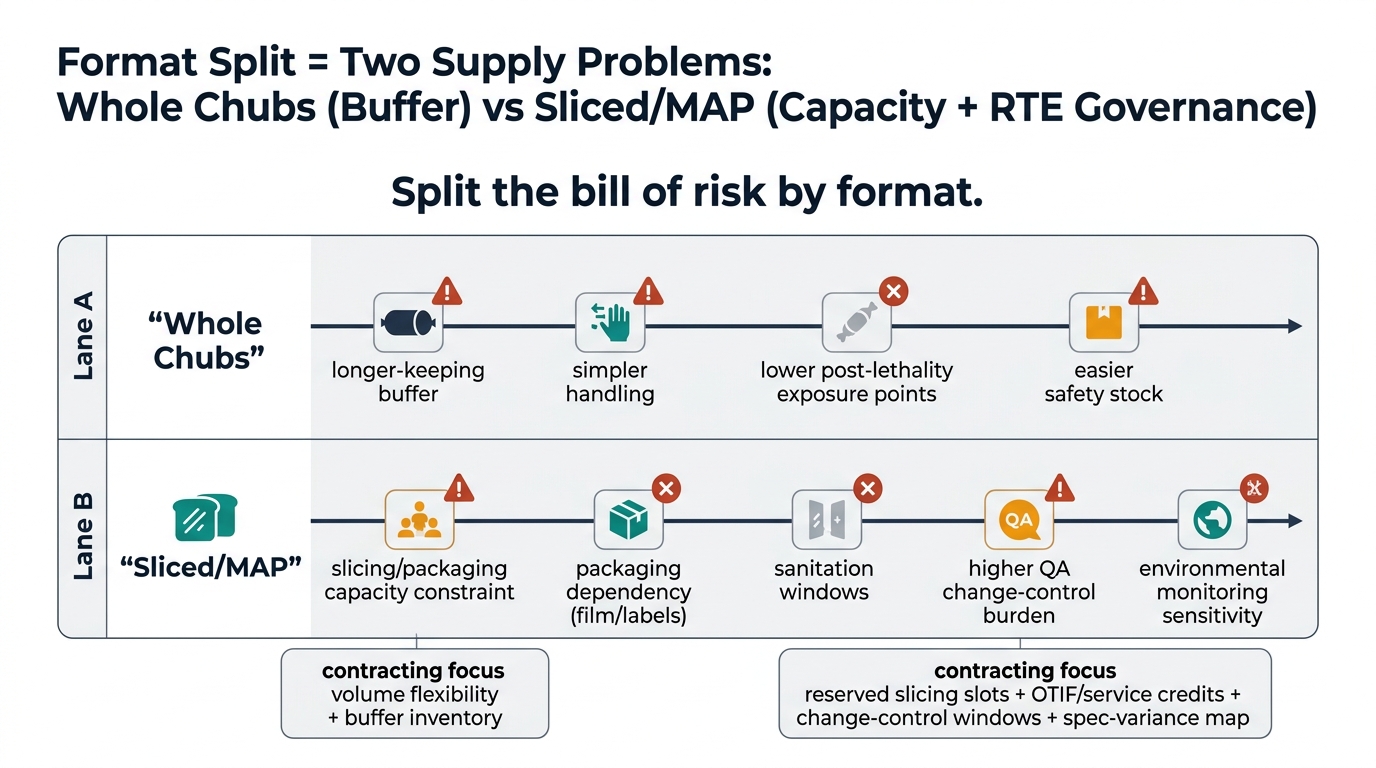
Procurement Impact: This allowed different contracting terms and different safety-stock logic without changing the consumer proposition.
Insight: In cured meats, the true scarce resource is often validated capacity (curing rooms + slicing slots), not raw pork.
Data: They renegotiated with the incumbent to:
Procurement Impact: Even when pork inputs move, reserved capacity reduces the probability of allocation and expensive expedites.
Insight: Dual-sourcing fails when “spec equivalence” is treated as binary; it’s usually a controlled set of tolerances (fat/lean, diameter, slice count, spice notes) with QA sign-off.
Data: The team built a spec-variance map for alternates:
Procurement Impact: This shortened QA cycles because stakeholders weren’t re-litigating the entire spec—only the approved tolerance bands.
Insight: Disputes happen when suppliers attribute increases to “pork” while buyers suspect margin expansion; transparency reduces friction and improves timing.
Data: They moved to a contract structure with:
Procurement Impact: Procurement could forecast variance and finance could model margin impact without waiting for supplier list-price letters.

Insight: The biggest measurable gains came from (1) reducing expedite frequency and (2) reducing single-plant exposure on sliced packs.
Data: Results were measured across 2 quarters after implementation.
Procurement Impact: These are metrics procurement leadership will accept as “real,” because they connect to P&L and service levels.
| Metric | Before | After | What drove it |
|---|---|---|---|
| Annualized unit cost (blended) | Baseline | -5.8% | Contract driver split + fewer expedites |
| Estimated annualized $ impact | — | ≈$1.02M | Based on ~$17.5M spend |
| OTIF (top 12 sliced SKUs) | 92% | 97% | Reserved slicing slots + clearer allocation rules |
| Single-plant exposure | 78% | 41% | Second sliced-capable source qualified |
| Confirmed lead time (avg) | 8.5 wks | 6.0 wks | Capacity reservation + better demand locking |
| QA change requests (emergency) | Frequent | Rare | Spec-variance map + change-control windows |
Unexpected benefit (validated/clarified): Inventory strategy improved. Whole chubs were used as a buffer where appropriate, leveraging the category’s long-keeping characteristics for whole/unopened hard/dry sausage in refrigeration [1].
Insight: Genoa salami sourcing is won by governance and sequencing: qualify alternates before disruption, and contract around capacity + RTE controls, not just pork.
Data (validated/clarified): RTE environments face ongoing Listeria control expectations, and environmental monitoring is a core discipline regulators look for. FDA’s environmental sampling materials explicitly discuss environmental monitoring plan effectiveness and sampling as a follow-up when pathogens are detected, reinforcing why “sliced RTE” governance can become the pacing item in a supplier switch [3].
Procurement Impact: If your buyer treats Genoa salami like a short-cycle commodity, they’ll underinvest in pre-qualification and overpay during disruptions.
Insight: Treat sliced Genoa salami as a capacity- and governance-constrained RTE program; treat whole chubs as the flexibility buffer—then contract and qualify suppliers accordingly.
Data (validated/clarified): Whole/unopened hard/dry sausage has long-keeping characteristics per USDA FSIS consumer storage guidance, while sliced RTE products elevate sanitation and environmental monitoring sensitivity—making capacity reservation and pre-qualification disproportionately valuable [1].
Procurement Impact: This framing typically unlocks 3–8% savings potential (less expedite, fewer emergency spec waivers, better negotiation posture) while materially reducing single-plant risk.
The hard part isn’t knowing that pork prices move—it’s knowing when a disruption signal (capacity, QA event, packaging constraint, logistics) is likely to hit your specific sliced SKUs early enough to (a) lock capacity, (b) shift volumes, or (c) activate a pre-qualified alternate without emergency governance shortcuts.
(Analyzed at: Jul, 2026)
Pork isn’t the only variable right now: USDA’s latest outlook still points to a tighter supply picture into the back half of 2026 as inventories/prod forecasts adjust, which keeps buyers vulnerable to short-notice supplier resets if they’re buying sliced Genoa like a spot item [4]. The high-conviction move is to contract your sliced/MAP lane around reserved slicing capacity + a driver-based price structure, while using whole chubs as the buffer format where your spec allows. Teams that do this typically stop paying “silent” costs—expedites, promo failures, and emergency QA work—that can easily add a few points of effective cost on a ~$15–$20M program even when headline pork indices look calm.


