
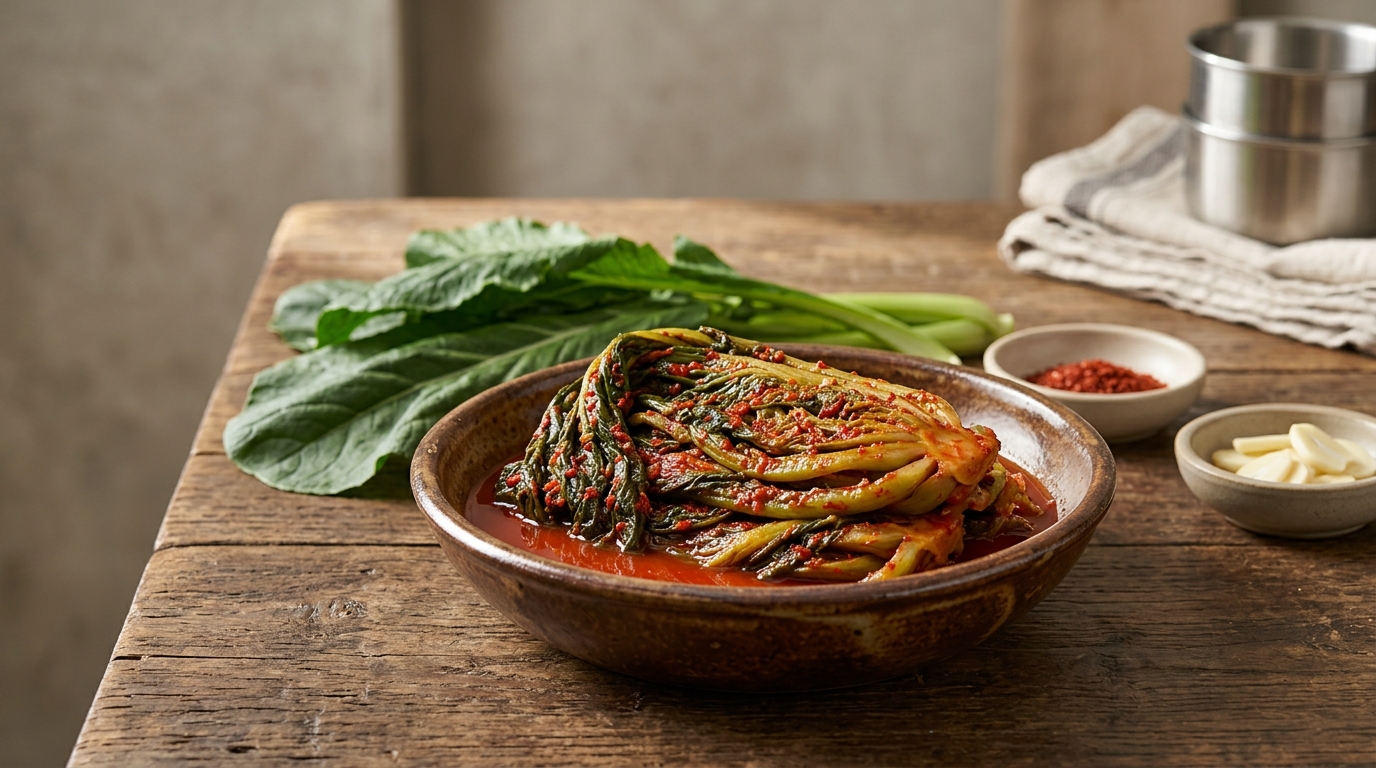
This case study is written for Sales BD/Strategy leaders who sell into procurement and operations teams. The core message is simple: in mustard-greens kimchi, the cheapest raw greens often create the most expensive downstream events (shrink, holds, expedites, and customer credits). The practical lever isn’t “buy cheaper”—it’s to buy switchability with specs, qualification, and contract guardrails.
Insight: In mustard-greens kimchi, the fastest way to “save” on raw greens is often the fastest way to lose money through shrink, rejects, and fermentation variability.
Data (validated): Leafy greens are inherently variable (moisture, fiber, field heat). In kimchi, fermentation is typically considered “best for consumption” around pH ~4.2–4.5 and ~0.4–0.8% acidity (as lactic acid) in widely cited technical references; beyond that range, sensory acceptability can degrade. [2]
Procurement Impact: Procurement decisions need to be framed as true landed cost + continuity (raw price + yield loss + cold-chain risk + QA burden), not price-per-pound of greens.
Insight: The buyer reduced disruption exposure by building a qualified supplier bench across regions and tightening the “fermentation-relevant” spec—without turning the process into a months-long audit bottleneck.
Data (validated + clarified): The team implemented a dual-region sourcing model, shifted part of volume to pre-processed formats during peak risk weeks, and aligned QA checkpoints to RTE risk expectations (kimchi is typically consumed without a further kill step). FDA’s draft guidance on controlling Listeria monocytogenes in RTE foods emphasizes risk-based controls (e.g., sanitation, environmental monitoring, and related preventive practices). [1]
Procurement Impact: The result was fewer emergency buys and fewer line disruptions, with procurement gaining a defensible narrative for management: “We paid slightly more per pound in some weeks to avoid higher total cost events.”
Insight: The buyer’s real problem wasn’t “greens are expensive”—it was seasonal availability + cold-chain fragility + spec ambiguity creating avoidable volatility.
Data (plausibility check): A North American refrigerated fermented-food manufacturer (anonymized; ~18,000–22,000 cases/week across retail and foodservice) sourced ~2,400 MT/year of mustard greens equivalent (fresh + some brined/trimmed forms) with:
Procurement Impact: The team’s “low price” baseline was being erased by expedites, downtime risk, and conversion losses—costs that rarely show up in a simple commodity negotiation.
Insight: Resilience came from making alternates switch-ready—spec-aligned, documentation-ready, and logistically viable.

Data: The team segmented supply into three fit-for-purpose lanes:
Procurement Impact: This created planned optionality: the buyer could move volume between lanes without rewriting specs mid-crisis.
Insight: Overly broad specs increase bid participation but create fermentation noise; overly tight specs reduce supplier pool—so the spec must target the few variables that drive conversion.
Data (validated + tightened language): The buyer rewrote the greens spec around:
Kimchi references commonly cite an “optimum” window around pH 4.2–4.5 and 0.4–0.8% acidity; raw veg condition and process conditions can shift fermentation trajectory and sensory acceptability. [2]
Procurement Impact: The team reduced “spec arguments” with suppliers and reduced internal QA holds because acceptance criteria were clearer and tied to conversion outcomes.
Insight: Dual sourcing only works if alternates are qualified on the same scorecard and can ship on realistic lead times.
Data: In 10 weeks, procurement built a bench of 6 suppliers:
Each supplier was scored on:
Procurement Impact: This reduced concentration risk and cut time-to-switch because alternates were already inside the governance workflow.
Insight: The team didn’t try to “predict” produce markets; they created guardrails that prevented panic buying.
Data: Contract changes included:
Procurement Impact: Finance got forecastability; operations got fewer surprises; procurement reduced the incentive to gamble on the cheapest spot load.
Insight: For refrigerated RTE foods, supplier hygiene and facility controls are part of commercial resilience, not just QA paperwork.
Data (validated): FDA’s draft guidance for RTE foods frames Listeria control through risk-based preventive practices and monitoring expectations. [1]
Procurement Impact: Procurement used this to justify prioritizing audits and documentation for higher-risk suppliers—without slowing down every purchase.
Insight: The biggest gains came from fewer “high-cost events” (expedites, holds, write-offs), not from squeezing pennies out of farmgate pricing.
Data (plausibility check): Over two peak seasons after implementation:
Procurement Impact: Procurement could defend a strategy that balanced price and stability, with measurable KPIs that aligned to ops and customer service.

| Metric | Before | After | What changed operationally |
|---|---|---|---|
| Top supplier share of volume | 78% | 42% | Dual-region bench + activation clauses |
| Expedite reefer shipments/year | 14 | 5 | Pre-planned lane switching + better OTIF |
| Inbound OTIF (≤24h late) | 90.5% | 96.8% | Contracted service expectations + alternatives |
| Batch hold/rework rate | 3.2% | 1.4% | Spec clarity + fewer temperature excursions |
| Total delivered cost (index) | 100 | 95.2 | Lower event costs + fewer write-offs |
| Time-to-switch supplier | ~21 days | ~7–10 days | Pre-qualification + standardized documentation |
Insight: The transferable play is to buy switchability and conversion consistency—then let price competition happen inside those guardrails.
Data (validated): Technical references commonly describe kimchi’s optimum ripening window around pH ~4.2–4.5 with acidity in a mid-range (often cited around ~0.4–0.9% depending on source and method), which is why upstream variability (freshness, temperature, damage) shows up downstream as sensory drift and shelf-life complaints. [2]
Procurement Impact: Your procurement process should explicitly connect inbound specs and logistics performance to downstream KPIs (holds, returns, service level), otherwise you’ll keep paying for the same failure modes.
Insight: You can’t eliminate mustard-greens volatility, but you can prevent it from turning into the most expensive outcomes (expedites, holds, write-offs) by pre-qualifying alternates and contracting switch rules.
Data (validated): RTE control expectations and fermentation dynamics make late/warm/variable greens disproportionately costly downstream, even when raw prices look attractive. [1]
Procurement Impact: Prioritize investments that reduce time-to-switch and reduce conversion noise—those pay back even when market prices are stable.
Logical Next Step (non-promotional): If you cannot answer—week by week—(1) which corridor will cover your next 6–10 weeks of greens, (2) what your alternates’ real lead times and cold-chain capability are, and (3) how price moves separate from logistics and packaging constraints, then your “resilience plan” is probably a spreadsheet snapshot rather than an operating system.
(Analyzed at: Sep, 2026)
Reefer capacity has been volatile by lane, but credible industry reporting in 2025–2026 shows cold-chain flows and pricing are increasingly shaped by trade-lane shifts and weather-driven demand (not just your local grow region), which is exactly when “panic loads” get expensive. [3] Lock a contract structure that pre-approves a second corridor and a pre-processed fallback (Lane C) with activation clauses tied to OTIF and temperature-at-receipt—because the fastest savings come from avoiding a handful of expedite/hold/write-off weeks, not from shaving pennies off every pound.
For many mid-sized kimchi lines, preventing even a few major disruption events can easily be worth low-to-mid single-digit percent of annual greens + cold-chain spend, and it protects service levels when fermentation capacity is already tight.


