
INDUSTRY TRENDS

Carob Powder Supply Chain Map (QSC Lens): Physical Flow, Cost Lock-In Nodes, and Spec Controls

Author
Team Tridge
DATE
August 18, 2026
7 min read
carob-powder Cover
Unlock Full Data
Carob Powder Market Intelligence
Prices · Trends · Origins · Forecasts

This guide maps how carob powder is physically produced and where cost, quality, and compliance risk “lock in” along the chain. It’s written for procurement + Quality/Safety/Compliance teams who need an auditable way to compare suppliers, tighten specs, and reduce first-90-day non-conformances—without needing to be a carob domain expert.

Executive Summary

  • Co-product reality: Carob powder depends on de-seeding (kibbling) economics because seeds feed the locust bean gum (LBG/E410) chain, while pulp becomes powder. [1]
  • Biggest lock-in nodes:Drying/cleaning/de-seeding set cleanliness and yield; roasting + milling/sieving set sensory + functional performance. [1]
  • Spec anchors that prevent silent failures: moisture, ash/foreign matter, particle size distribution (PSD), and roast/color targets—plus method discipline on COAs.
  • Compliance touchpoints: pesticide residue expectations (EU MRL regime) can create import/customer holds; plan testing/COA fields accordingly. [2]
  • Governance move: require method-anchored specs and lot-level COA completeness (including packaging barrier details) to reduce rework and dispute cycles.
A left-to-right process flow showing the physical transformation of carob pods into carob powder, including orchards/harvest, drying & aggregation, cleaning/de-stoning, kibbling/de-seeding with seed stream to LBG/E410 and pulp stream to powder, optional roasting levels, milling & sieving (PSD control), packaging & QA release (COA), and logistics/containers; cost lock-in nodes and spec controls (moisture, ash/foreign matter, PSD, color/roast target, packaging barrier/liner) are highlighted.

1) How Carob Powder Is Physically Built (and Where Costs “Lock In”)

Carob powder is a Mediterranean-origin, pod-based ingredient whose economics are shaped by a co-product split: processors typically de-seed pods because the seeds feed the locust bean gum (LBG/E410) chain, while the seedless pulp becomes powder via roasting and milling. That single structural fact concentrates value at the kibbling/de-seeding step and makes downstream powder availability partially dependent on seed/LBG incentives, not just pod harvest volume. [1]

Insight: The “physical map” is short (pods → de-seed → roast/mill → pack → ship), but each node has a distinct, largely fixed cost driver: harvest labor and drying stability upstream; yield loss and foreign-matter removal at kibbling; energy and control of roast profile in secondary processing; and moisture/odor protection in packaging and ocean freight.

Data: Industry and technical descriptions place kibbling (seed/pulp separation) as the first mechanical step, followed by roasting and fine milling/sieving to specification particle size. [1]

Procurement Impact: The highest leverage “physical” parameters to control across suppliers are (1) roast profile (color/flavor), (2) moisture (caking + microbiological stability), (3) ash/foreign matter (cleaning effectiveness), and (4) particle size distribution (processing and dispersion performance).

2) Where Cost and Margin Accumulate (Node-by-Node)

Insight: Carob powder costs do not accumulate evenly—value concentrates where (a) yield is determined (cleaning, de-stoning, de-seeding) and (b) energy + process control create a repeatable roast and grind.

Data: References describe de-seeding/kibbling as the key mechanical separation step, while roasting/milling drives final powder properties. (Note: the exact numeric spec examples in the original draft are supplier-specific; treat them as illustrative, not industry-wide norms.) [1]

Procurement Impact: Even before commercial terms, your physical risk exposure is set by which node your supplier truly controls (integrated processor vs. trader/blender) and whether they can hold moisture/particle size/ash consistently lot-to-lot.
1. Upstream / Raw Material (Orchards, Harvest, Drying, Aggregation)

  • Insight: Upstream costs are dominated by harvest labor and post-harvest stabilization (drying), because pods must be dry enough to store and ship without mold risk or downstream caking.
  • Data: Carob is a seasonal pod crop in Mediterranean geographies; quality and downstream processability are sensitive to water availability and post-harvest handling. [3]
  • Procurement Impact: Variability introduced here shows up later as (a) moisture drift (caking, flowability failures), (b) off-notes from poor handling, and (c) inconsistent grind behavior (more rework/sieving loss at the mill).

2. Primary Processing (Cleaning, De-stoning, Kibbling/De-seeding)

  • Insight: This is the yield-and-contamination control node: removing stones/foreign matter and separating seeds from pulp determines both powder cleanliness and the co-product value capture (seed stream for LBG).
  • Data: Process descriptions identify deseeding/kibbling as the step that yields “kibbled carob,” after which roasting and milling produce carob powder; seeds route into gum production. [1]
  • Procurement Impact: If this node is under-invested (screens, aspiration, magnets/metal detection discipline), you see higher ash/foreign matter, more customer complaints, and higher downstream QA burden (more incoming inspection and re-sieving).

3. Secondary Processing (Roasting + Milling + Sieving/Standardization)

  • Insight: Roasting and milling convert an agricultural pulp into a functional powder; energy, time/temperature control, and sieve management are the main fixed cost drivers.
  • Data: Technical references describe carob powder production as roasting + milling of kibbled (deseeded) carob. [1]
  • Procurement Impact: This node drives the two most frequent “silent failures” in plants: (1) sensory drift (roast level) that changes finished product color/flavor and (2) dispersion/handling drift (particle size + moisture) that changes mixing times, dusting, and line performance.

4. Packaging & QA Release (Bulk Bagging, Liners, COA/Testing)

  • Insight: Packaging is not cosmetic—carob powder is moisture- and odor-sensitive; packaging barrier quality and warehouse discipline protect the process investment made upstream.
  • Data: Supplier specifications commonly define shelf life in sealed packaging and prescribe cool, dry storage; microbiological criteria are typically stated on specs/COAs (with pathogen expectations depending on supplier program and customer requirements). (Validate your target micro limits by application and market.)
  • Procurement Impact: Weak liners, poor pallet wrap, or humid warehouses convert into caking, higher micro counts, and shortened usable life—issues that rarely trace back cleanly unless packaging specs and lot traceability are tight.

5. Logistics & Distribution (Containerization, Import Handling, Repack/Redistribution)

  • Insight: Logistics cost is driven less by temperature control (ambient) and more by moisture protection, handling damage, and the complexity of documentation/holds for destination-market compliance.
  • Data: EU compliance expectations for plant-origin foods can include pesticide residue conformance to Maximum Residue Levels (MRLs), with official tools provided to look up MRLs by commodity/active substance; this can translate into testing/hold time at import or customer QA release. [2]
  • Procurement Impact: The physical risk during transit is “water + time”: container humidity events and long dwell times raise caking risk and can degrade flowability—often showing up as non-conformances only after receipt.

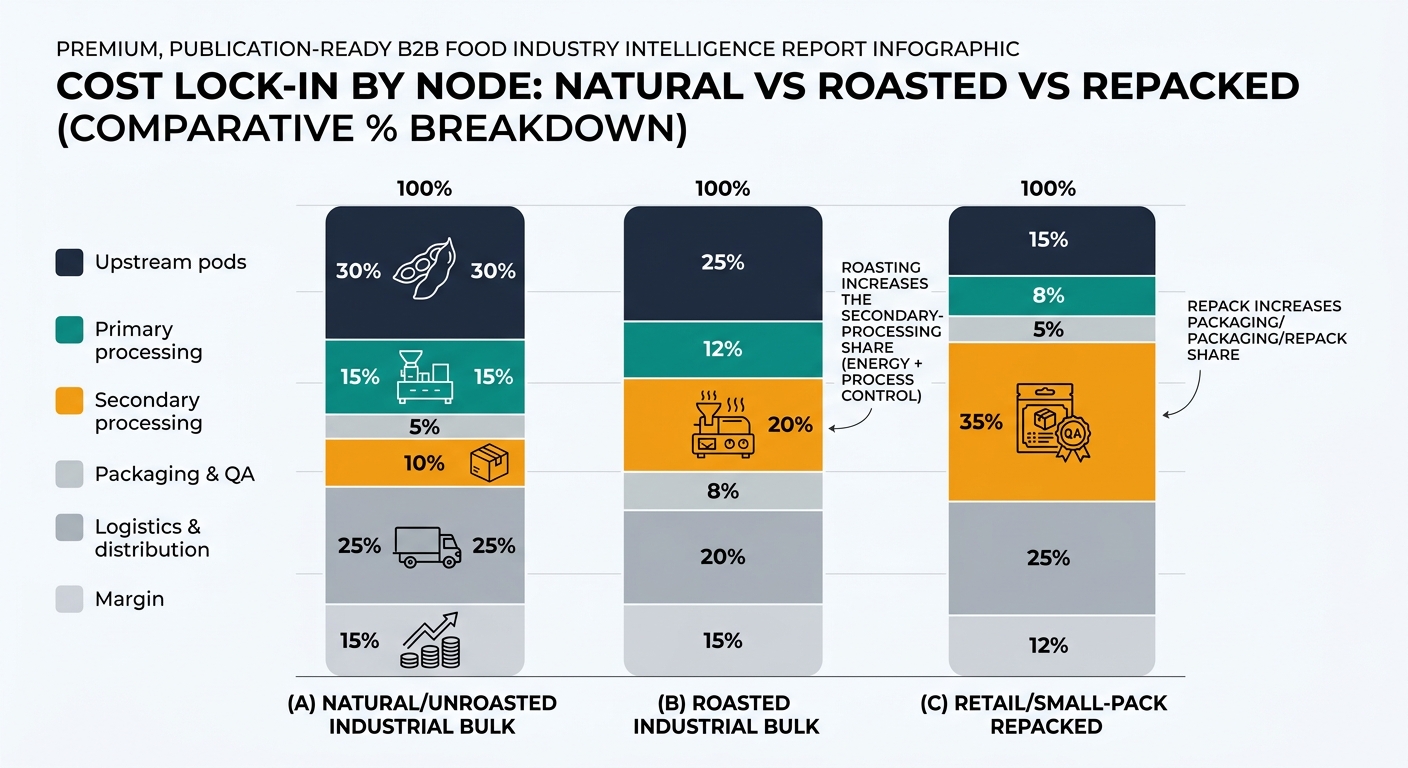
Product-Level Cost Breakdown

A comparative stacked bar chart with three bars showing the cost ratio breakdown for (A) Natural/Unroasted Industrial Bulk, (B) Roasted Industrial Bulk, and (C) Retail/Small-Pack Repacked. Each bar is segmented by supply chain nodes (Upstream pods, Primary processing, Secondary processing, Packaging & QA, Logistics & distribution, Margin) with each segment labeled with the exact percentages from the tables, plus a legend and annotations noting that roasting increases secondary-processing share and repack increases packaging/repack share.

A) Natural (Unroasted) Carob Powder (Industrial Bulk)

Supply Chain Node Cost Ratio (% of Final Cost) Notes
Upstream pods (harvest + drying + aggregation) 35% Seasonal labor + drying stability drive base cost and reject risk.
Primary processing (cleaning + de-seeding) 18% Yield loss, foreign matter removal, equipment depreciation.
Secondary processing (milling + sieving) 15% Lower energy than roasted, but tight PSD still costs.
Packaging & QA 10% Liner quality + micro/chem testing + COA release.
Logistics & distribution 12% Moisture protection in transit + import handling.
Wholesale/ingredient distribution margin 10% Varies with channel and service level.

B) Roasted Carob Powder (Light/Medium/Dark Roast, Industrial Bulk)

Supply Chain Node Cost Ratio (% of Final Cost) Notes
Upstream pods (harvest + drying + aggregation) 30% Same agricultural base; quality sorting matters for roast consistency.
Primary processing (cleaning + de-seeding) 17% Cleanliness/ash baseline set here; co-product (seed) economics sit adjacent.
Secondary processing (roasting + milling + sieving) 23% Energy + process control + standardization to color/flavor targets.
Packaging & QA 10% Packaging protects from rehydration; micro program is customer/market dependent.
Logistics & distribution 10% Container humidity management remains a core risk.
Wholesale/ingredient distribution margin 10% Channel-dependent.

C) Retail/Small-Pack Carob Powder (Repacked)

Supply Chain Node Cost Ratio (% of Final Cost) Notes
Upstream + primary processing 35% Embedded cost from pods through de-seeding.
Secondary processing 15% Roast/mill costs embedded; often already paid upstream.
Repack + packaging materials 22% Small-pack packaging, labeling, line labor, higher scrap.
QA/food safety release 8% Lot relabeling controls + additional verification.
Logistics & distribution 10% Higher handling touches, more damage risk.
Retail/wholesale margin 10% Dependent on channel and brand positioning.
Unlock Full Data
Carob Powder Market Intelligence
Prices · Trends · Origins · Forecasts

3) Structural Facts That Don’t Change (But Drive Outcomes)

Insight: Carob powder behaves like a simple commodity only on paper; structurally, it is a co-product-driven, seasonally harvested, process-sensitive powder.

Data: The supply chain separates seeds from pulp early (kibbling/deseeding), with seeds feeding locust bean gum production and pulp feeding powder; this creates a persistent link between powder availability and seed/LBG processing economics. [1]

Procurement Impact: Your physical continuity and spec consistency depend on whether your supplier has stable access to pods and runs controlled, repeatable roasting/milling—more than on “country of origin” alone.

Reality 1: Co-product economics shape physical routing of pods

  • Insight: Processors don’t just make powder—they allocate pods between pulp products (powder/syrup/feed) and seed products (LBG chain).
  • Data: References distinguish clearly: carob powder is produced from the fruit pod after removal of seeds, while the gum is produced from the seeds/endosperm. [4]
  • Procurement Impact: When seed value is high, de-seeding throughput and seed recovery discipline can tighten; powder output can become a secondary optimization problem, affecting availability and standardization bandwidth.

Reality 2: Moisture is the “hidden variable” behind multiple failure modes

  • Insight: Moisture is simultaneously a quality, safety, and logistics variable (flowability, caking, microbial stability).
  • Data: Supplier specs commonly cap moisture and tie storage to dry conditions; method and sampling discipline matter as much as the numeric limit.
  • Procurement Impact: If you only watch sensory and micro but not moisture drift and packaging barrier, you’ll miss the root cause of many non-conformances (especially after long transit or humid storage).

Reality 3: “Same mesh” does not mean same performance

  • Insight: Particle size specs are often expressed as % through a sieve, but two powders can pass the same mesh and still behave differently due to fines distribution, agglomeration, and moisture.
  • Data: Technical references emphasize that processing (roast + milling) drives functional properties; PSD reporting should be paired with method details and sample conditioning. [1]
  • Procurement Impact: Without a consistent PSD method and sample prep discipline, you can see mixing variability and dusting differences even when suppliers “meet spec” on paper.

Key Insights You Can Apply Immediately (Physical Map Only)

  • Insight: The supply chain’s highest-leverage control point is the processor’s de-seeding + roast/mill capability, not the trader layer.
  • Data: Process sources place deseeding/kibbling early, with roasting/milling defining final powder characteristics. [1]
  • Procurement Impact: When qualifying or comparing materials, treat “deseeding method, roast control evidence, sieve management, and packaging barrier” as core physical evidence—not optional technical trivia.
  • Insight: Typical spec anchors are moisture, ash/foreign matter, and particle size distribution, plus pathogen expectations and destination-market chemistry (e.g., pesticides/heavy metals as applicable).
  • Data: EU MRL frameworks are maintained via official databases and regulations; this is a predictable source of holds if your COA/test plan is incomplete for the destination market. [2]
  • Procurement Impact: These parameters map directly to plant pain: caking/flow (moisture), cleanliness and mineral load (ash/foreign matter), and mixing/dusting (particle size).

4) The Bottom Line for Your Next Contract

The single fastest-payback move is to contractually require a method-anchored, lot-level COA for moisture, ash/foreign matter, PSD, and roast/color target—plus a packaging barrier spec (liner type and sealing) that protects against container humidity. (Analyzed at: Aug, 2026) This works because the biggest avoidable failures in carob powder still originate at fixed physical nodes (drying/cleaning/deseeding and roast/mill control), while compliance friction most often shows up as preventable documentation/testing gaps against destination-market residue expectations (notably EU MRL regimes). [1] If you don’t lock these controls into the contract, you’re effectively budgeting for re-sieving, extra incoming testing, and dispute cycles—costs that can quietly run into low single-digit percent of annual spend even when unit price looks “competitive.”

Unlock Full Data
Carob Powder Market Intelligence
Prices · Trends · Origins · Forecasts

References

  1. sciencedirect.com
  2. food.ec.europa.eu
  3. cost-fruitcrews.eu
  4. en.wikipedia.org

Related Contents

Subscribe
→
By subscribing you agree to with our Privacy Policy and provide consent to receive updates from our company.
Thank you! Your submission has been received!
Oops! Something went wrong while submitting the form.
Subscribe to receive the latest blog posts, updates, promotions, and announcements from Tridge.
