
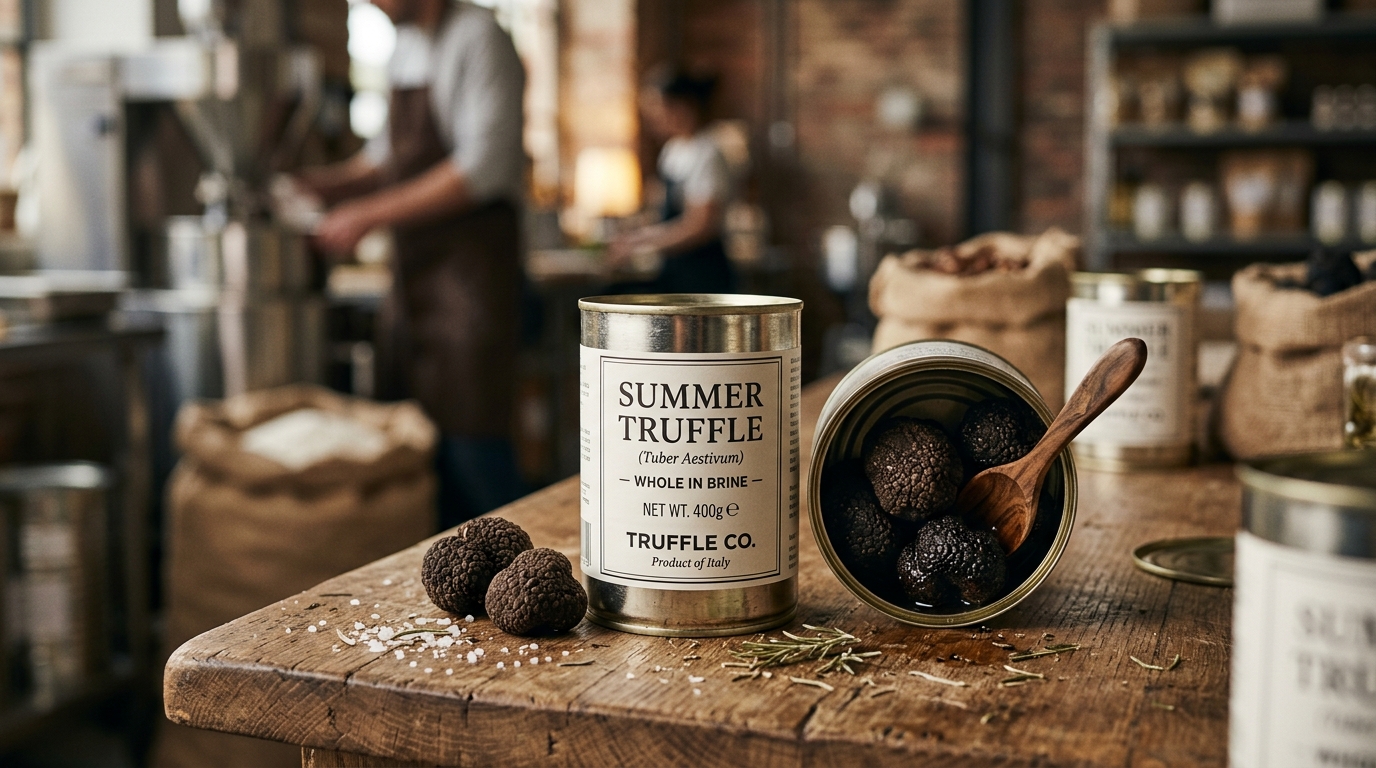
Canned (jarred/tinned) summer truffle is a high-value, shelf-stable ingredient built from a highly perishable, seasonal raw material. For Purchase–Quality, Safety, and Compliance teams, the practical takeaway is simple: most downstream outcomes (sensory consistency, food safety defensibility, and import/audit readiness) are determined upstream (harvest handling + cleaning) and midstream (container-closure + scheduled thermal process), not in distribution.
Canned (jarred/tinned) summer truffle is a shelf-stable outcome of a highly perishable, seasonal raw material. The chain is built around two hard constraints: (1) harvest happens in a narrow window (often strongest in July–August in many European regions), and (2) shelf stability is “engineered” by a validated thermal process applied to a specific product–container combination. [4]
Insight: The physical chain is less about cold chain and more about first-mile speed (soil removal + grading) and midstream process control (retort/closure integrity).
Data: In US regulatory terms, low-acid foods are those with finished equilibrium pH > 4.6 and water activity (aw) > 0.85; acidified foods must achieve and maintain equilibrium pH ≤ 4.6 per the scheduled process. [1]
Procurement Impact: Your downstream quality and compliance outcomes are “locked in” upstream (harvest handling) and at the retort node (validated process + container closure), not at distribution.

Quick win: Treat “product + packing medium + container type + retort schedule” as one inseparable technical system; changes in any one element change heat transfer and therefore the scheduled process requirements and the evidence you must hold. [5]
Insight: In canned summer truffle, cost is structurally front-loaded (raw material yield + labor) but margin is often earned midstream (standardization + shelf-life creation) and downstream (branding/formatting).
Data: Retort processing is defined by the time–temperature history at the cold point and quantified via lethality concepts like F0; literature notes over-processing can be used to “buy” sterility assurance at the expense of sensory quality and energy cost. [6]
Procurement Impact: Expect the biggest quality/cost tensions at (a) grading/cut selection and (b) retort intensity vs sensory retention; these are structural, not “supplier preference.”

| Supply Chain Node | Cost Ratio (% of Final Cost) | Notes |
|---|---|---|
| Raw Material (fresh truffles) | 45% | Seasonality + yield/defect mix dominate; high sensitivity to trim loss. |
| Primary Processing | 12% | Cleaning/grading labor + yield loss; foreign-matter controls. |
| Secondary Processing | 8% | Whole handling is slower; brine formulation and vacuum/closure steps. |
| Retort Sterilization | 10% | Energy/steam + throughput + validation burden; sensory trade-off. |
| Packaging & QA | 10% | Glass/tin + lids + labels + closure verification + records. |
| Logistics & Distribution | 7% | Ambient freight; breakage/corrosion risk management. |
| Brand/Wholesale Margin | 8% | Channel margin for finished-goods positioning. |
| Supply Chain Node | Cost Ratio (% of Final Cost) | Notes |
|---|---|---|
| Raw Material (fresh truffles) | 40% | Often uses smaller/irregular grades; still high cleaning burden. |
| Primary Processing | 12% | Similar cleaning intensity; grading routes material to cut lines. |
| Secondary Processing | 12% | Cutting increases labor and surface-area losses; style affects heat transfer and can change scheduled process needs. [5] |
| Retort Sterilization | 10% | Same sterility objective; cycle depends on container/style and cold-point behavior. [6] |
| Packaging & QA | 9% | Net drained weight control + label/spec documentation. |
| Logistics & Distribution | 7% | Ambient; case handling damage risk. |
| Brand/Wholesale Margin | 10% | Often sold as standardized ingredient with service expectations. |
| Supply Chain Node | Cost Ratio (% of Final Cost) | Notes |
|---|---|---|
| Raw Material (fresh truffles) | 35% | Lower grade input but variable defect rate; yield risk remains. |
| Primary Processing | 13% | Heavy cleaning/inspection; trim sorting. |
| Secondary Processing | 10% | Filling larger containers; brine dosing; closure control at scale. |
| Retort Sterilization | 12% | Larger formats can be throughput-limiting; validation is container-specific. [5] |
| Packaging & QA | 10% | Container cost + closure checks + records. |
| Logistics & Distribution | 10% | Heavier units; handling equipment; damage and demurrage exposure. |
| Processor Margin | 10% | Value from standardization + compliance burden. |
Insight: The category’s “non-obvious” constraints are technical and biological, not commercial: climate sensitivity upstream, and process validation complexity midstream.
Data: Summer truffle production is linked to weather extremes (notably drought), and retort safety assurance depends on product–container specifics with scheduled process expectations and pH/aw definitions that trigger regulatory coverage. [2]
Procurement Impact: Resilience and compliance are structurally determined by (a) origin agronomy variability and (b) how many distinct SKUs/styles/containers you ask the chain to validate and control.
(Analyzed at: Aug, 2026)
Lock your contract around one or two “process families” (e.g., sliced in brine in glass and pieces in brine in cans) and require the supplier to maintain a stable scheduled-process evidence pack per family (container size, style, medium, closure checks, and deviation handling). This works because FDA’s LACF framework is explicitly tied to the product + container system, and format variation is what quietly multiplies validation, records, and hold-release friction. [5]
In the current European heat/drought backdrop, you should expect more variability in incoming defect mix and sensory outcomes—so the cost of “format sprawl” tends to show up as extra holds, rework, and missed production windows rather than a neat line-item increase. [3]


