INDUSTRY TRENDS

Canned Skipjack Tuna Supply Chain Map, Cost Structure, and 2026 Procurement Levers (US Import Lens)

Author
Team Tridge
DATE
April 29, 2026
8 min read
canned-skipjack-tuna Cover
Unlock Full Data
Canned Skipjack Tuna Market Intelligence
Prices · Trends · Origins · Forecasts

Canned skipjack tuna looks “simple” because it ships ambient, but the real procurement levers sit upstream (raw fish access and handling) and midstream (loining yield, canning uptime, packaging readiness, and QA release discipline). This guide maps the physical chain and explains where cost and continuity risks actually lock in—so sourcing leaders can negotiate with the right facts and qualify alternates before allocation or compliance holds force expensive spot buys.

Executive Summary

  • Cost locks in upstream and midstream: raw fish availability + conversion yield + packaging readiness drive most landed-cost variance—more than finished-goods freight.
  • WCPO is structurally important: most global skipjack supply comes from the Western & Central Pacific, so regional catch/management actions ripple into loin and can pricing. [1]
  • Two-step conversion is normal: whole fish → pre-cooked loins → cans creates a predictable “handoff risk” for quality, documentation, and lot integrity. [2]
  • US governance is documentation-heavy: NOAA SIMP requires harvest/chain data for tuna imports; missing/weak data can turn into holds, demurrage, or relabeling. [3]
  • 2026 planning lens: freight is calmer than 2024 peaks but still volatile; treat logistics and packaging as continuity constraints, not afterthoughts. [4]

1) How the Category Is Physically Built (and Where Costs “Lock In”)

Canned skipjack tuna is a long, industrial chain that starts with tropical purse-seine fishing and ends as a sterile, shelf-stable product shipped ambient in containers. The biggest cost decisions are physically “locked in” upstream (fish availability, access, freezing/handling) and midstream (loining/canning yields, packaging materials, retort energy, QA systems). Downstream, the product is logistically simple (ambient), but service performance depends on port reliability, documentation completeness, and packaging/label accuracy.

Insight: The chain is less about cold-chain distribution and more about upstream catch economics + midstream conversion yield and packaging inputs.

Data: Skipjack is commonly caught in tropical oceans (with the Western & Central Pacific a dominant supply region) and processed through a two-step conversion: whole fish → pre-cooked loins → canned product; each conversion step has yield loss (cook loss + trimming) that magnifies upstream cost shocks. [1]

Procurement Impact: Your landed cost and continuity are structurally driven by (1) raw fish access/availability, (2) loining/canning capacity and yield discipline, and (3) packaging + compliance readiness—more than by finished-goods freight alone.
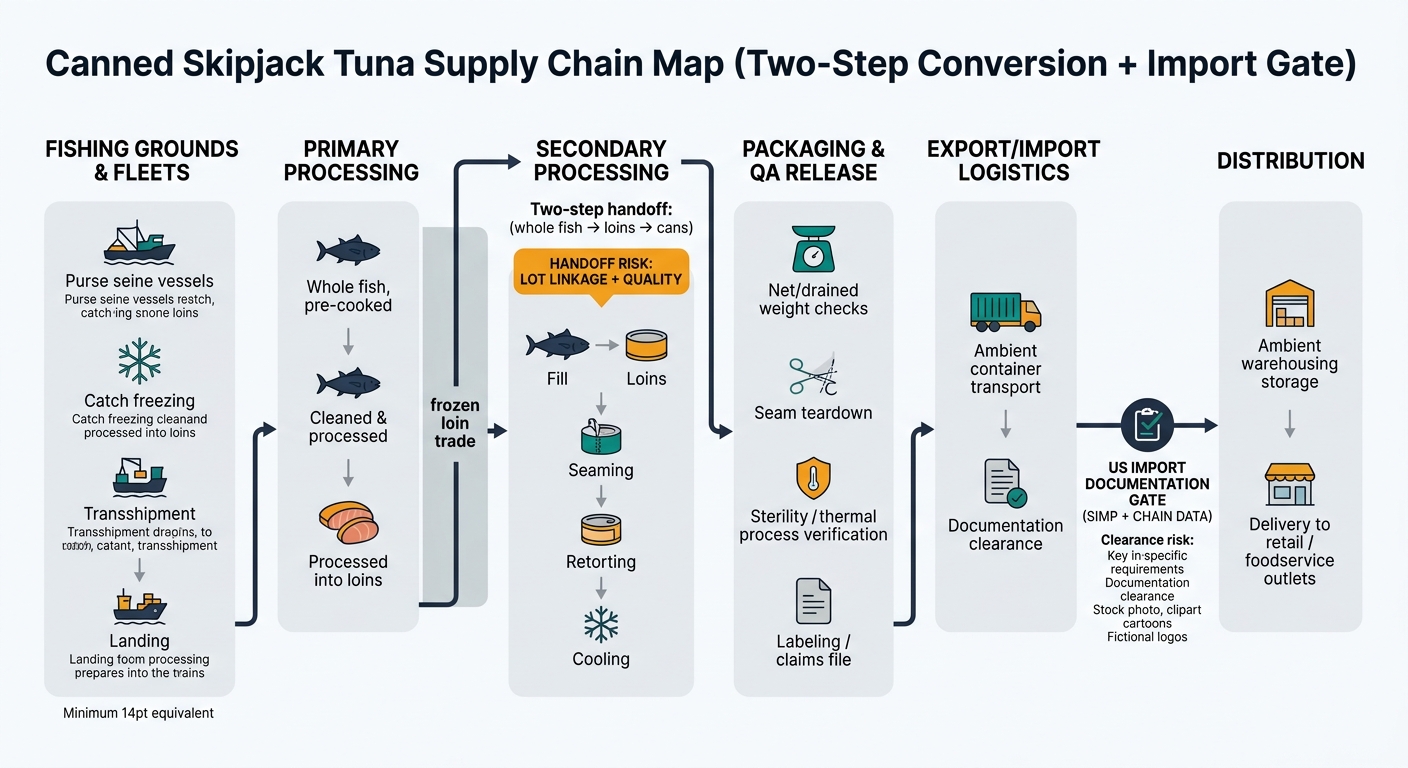
Supply chain flow (physical map)

  • Fishing grounds & fleets (catch, freezing, transshipment/landing)
  • Primary processing (pre-cook, clean, loin; often traded internationally)
  • Secondary processing (fill, seam, retort, cool; shelf-stable)
  • Packaging & QA release (weights, seam integrity, sterility, labeling/claims)
  • Export/import logistics (ambient containers; documentation-driven clearance)
  • Distribution (ambient warehousing; retailer OTIF/service)
A left-to-right supply chain flow diagram showing: (1) Fishing grounds & fleets (purse seine; catch/freezing/transshipment/landing), (2) Primary processing (pre-cook, clean, loin; frozen loin trade), (3) Secondary processing (fill, seam, retort, cool), (4) Packaging & QA release (net/drained weight checks, seam teardown, sterility/thermal process verification, labeling/claims file), (5) Export/import logistics (ambient container + documentation clearance), (6) Distribution (ambient warehousing to retail/foodservice). Visually emphasize the two-step handoff (whole fish → loins → cans) with a bold connector and a callout for 'handoff risk: lot linkage + quality'. Add a distinct 'US Import Documentation Gate (SIMP + chain data)' checkpoint icon between Export/Import and Distribution to reinforce clearance risk without showing any dashboard UI.

2) Where Money Is Made (and Lost): Cost & Margin by Node

Insight: In canned skipjack, “value-add” margin tends to concentrate where conversion risk is highest: loining yield, canning line uptime, packaging procurement, and compliance release.

Data: The largest variable input is typically raw fish (ex-vessel/frozen whole or loins). The largest non-fish volatility tends to come from metal packaging (tinplate/aluminum ends), edible oils (for oil-packed SKUs), and energy for pre-cook/retort.

Procurement Impact: Understanding node economics helps you interpret why two suppliers with the “same spec” can price differently—one may be structurally advantaged on yield, packaging sourcing, or plant utilization rather than fish cost alone.
1. Upstream / Raw Material (Fishing, Freezing, Landing)

  • Insight: This node sets the base cost curve because skipjack is a high-volume commodity and the chain cannot “manufacture” supply if catch rates or access tighten.
  • Data: Key cost drivers are fuel, crew, gear/FAD programs (where used), access fees/royalties in EEZs, observer/compliance costs, and at-sea freezing/handling. Quality risk begins here: time/temperature abuse elevates histamine risk later (a core HACCP hazard for scombrotoxin-forming species like tuna). [5]
  • Procurement Impact: Even when you buy finished cans, upstream conditions determine whether suppliers can run lines at full plan or shift to allocation; upstream quality discipline reduces downstream rejects, claims, and rework.

2. Primary Processing (Pre-cook, Cleaning, Loining)

  • Insight: Loining is yield-sensitive and labor/energy intensive; small yield differences compound into meaningful cost differences per finished case.
  • Data: Typical cost drivers include thaw control, pre-cook/steam energy, labor-intensive cleaning (skin/bone removal), yield loss (cook loss + trimming), and QA testing (histamine, sensory, contaminants monitoring). Byproduct credits (meal/oil) can partially offset costs but vary by plant integration.
  • Procurement Impact: Loining capability and yield discipline influence not just price but consistency: variable loin quality and moisture control can create downstream fill/texture variability and drained-weight nonconformance risk.

3. Secondary Processing (Canning: Fill, Seam, Retort)

  • Insight: Canning is a high-throughput manufacturing step where uptime, changeover efficiency, and sterility assurance determine true unit economics.
  • Data: Major cost drivers include canning line labor, retort energy, water/utilities, maintenance/downtime, and yield loss from fill control and rework. Sterility is non-negotiable: process authority, thermal validation, and seam integrity controls are fixed-cost capabilities that separate plants.
  • Procurement Impact: Plants with stronger process control can run tighter tolerances on fill/drained weight with fewer holds, which reduces hidden costs (chargebacks, relabeling, delayed shipments) even when unit price looks similar.

4. Packaging, QA Release & Claims (Cans, Ends, Labels, Casepack)

  • Insight: Packaging is often the largest non-fish cost bucket and a common root cause of compliance and service failures.
  • Data: Tinplate/aluminum ends, cartons, labels, inks, adhesives, and coding/traceability systems drive cost. QA release includes net/drained weight verification, seam teardown checks, incubation/sterility verification programs, and label/claim substantiation packs (e.g., sustainability program documentation where applicable).
  • Procurement Impact: Packaging sourcing strength (metal contracts, spec control, artwork governance) directly affects continuity: packaging shortages or artwork errors can stop shipments even when fish and plant capacity are available.

5. Export/Import Logistics (Ambient Containers + Documentation)

  • Insight: Finished goods are ambient, but lead time is structurally long because the chain is document- and port-dependent.
  • Data: Costs include ocean freight, port/handling, insurance, inland drayage, and working capital tied up in pipeline inventory. Clearance risk clusters around documentation completeness (harvest/chain data and recordkeeping requirements for tuna under NOAA SIMP; plus market-specific health certificates where required, labeling compliance, and IUU-related controls). [3]
  • Procurement Impact: A “cheap” origin can become expensive if it produces recurring holds, demurrage, relabeling, or missed delivery windows; logistics reliability is a cost driver via inventory buffers and service penalties.
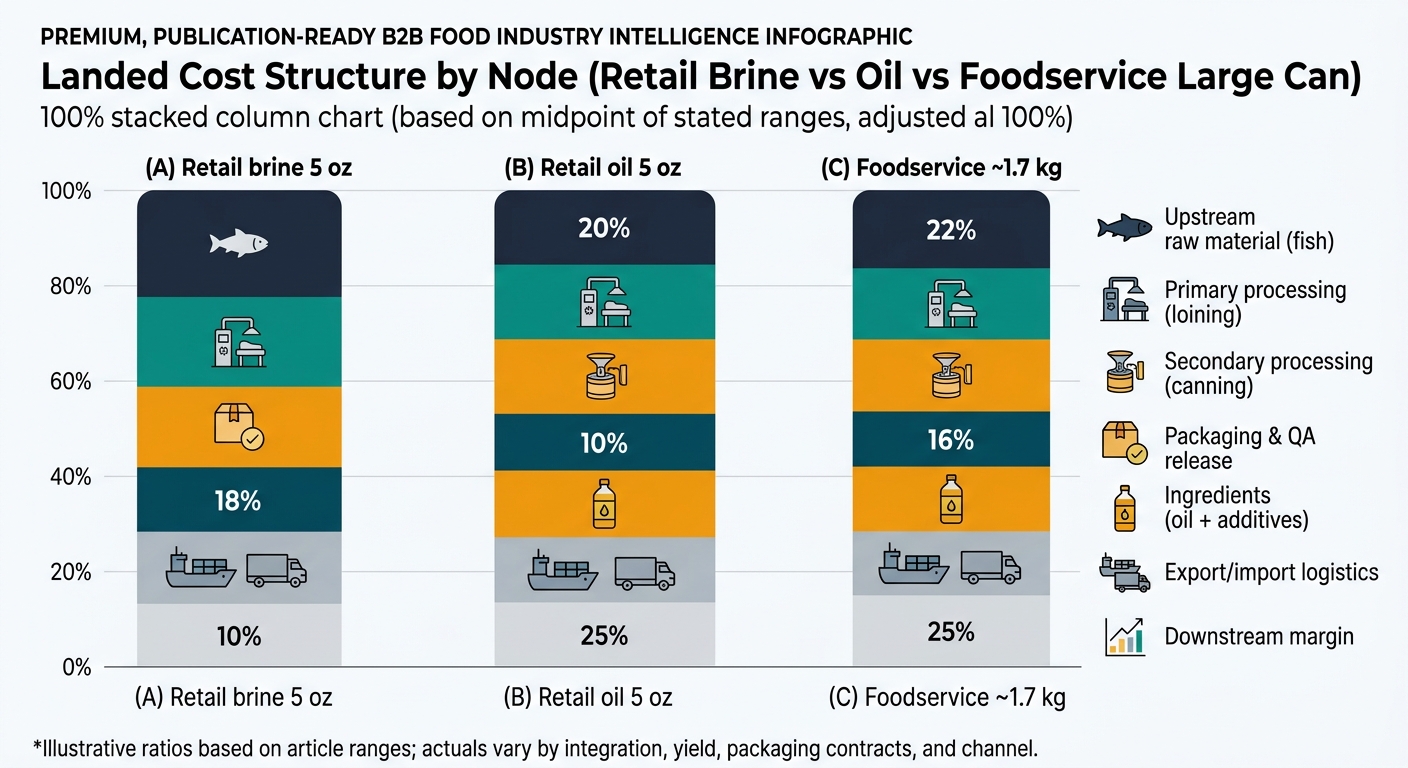
A 100% stacked chart with three bars representing: (A) Retail brine 5 oz, (B) Retail oil 5 oz, (C) Foodservice ~1.7 kg. Each bar segmented by the same nodes: Upstream raw material (fish), Primary processing (loining), Secondary processing (canning), Packaging & QA release, Ingredients (oil + additives; only for oil SKU), Export/import logistics, Downstream margin. Use the midpoint of each stated range for segment sizes (e.g., brine fish 47.5%, loining 11.5%, canning 14%, packaging 16%, logistics 8.5%, margin 14%—adjust proportionally so each bar totals 100%). Include a footnote: 'Illustrative ratios based on article ranges; actuals vary by integration, yield, packaging contracts, and channel.'

Product-Level Cost Breakdown

A) Standard Retail Canned Skipjack in Brine (e.g., 5 oz / 142 g can)

Supply Chain Node Cost Ratio (% of Final Cost) Notes
Upstream raw material (fish) 40–55% Dominant driver; depends on whether priced off whole fish or loins and on yield assumptions.
Primary processing (loining) 8–15% Labor/energy + yield loss; varies by integration and efficiency.
Secondary processing (canning) 10–18% Line labor, retort energy, downtime, fill control and rework.
Packaging & QA release 12–20% Cans/ends + cartons/labels; QA systems and release testing add fixed capability costs.
Export/import logistics 5–12% Ocean freight + port/inland; working capital sensitivity with long lead times.
Downstream margin (importer/brand/retail) 8–20% Varies widely by channel, service requirements, and promotional intensity.

B) Retail Canned Skipjack in Vegetable Oil (same can size)

Supply Chain Node Cost Ratio (% of Final Cost) Notes
Upstream raw material (fish) 35–50% Fish share can dilute because oil adds material cost.
Primary processing (loining) 8–14% Similar mechanics as brine; yield still critical.
Secondary processing (canning) 10–18% Oil handling and fill control increase sensitivity to weight compliance.
Packaging & QA release 12–20% Metal packaging remains a major non-fish driver.
Ingredients (oil + minor additives) 5–12% Oil quality/spec (flavor stability) becomes a meaningful cost and quality lever.
Export/import logistics 5–12% Ambient shipping; same documentation dependencies.
Downstream margin (importer/brand/retail) 8–20% Channel-dependent.

C) Foodservice / Institutional Large Can (e.g., 1.7 kg / “6 lb” class)

Supply Chain Node Cost Ratio (% of Final Cost) Notes
Upstream raw material (fish) 45–60% Larger formats often emphasize protein yield and drained weight performance.
Primary processing (loining) 8–15% Labor/yield sensitivity remains; texture consistency matters for end-use.
Secondary processing (canning) 8–15% Economies of scale on line time, but higher consequence of a single lot hold.
Packaging & QA release 8–15% Packaging ratio can be lower per kg vs retail, but can/end specs are critical.
Export/import logistics 5–12% Heavy cases influence inland freight; pipeline inventory still material.
Downstream margin (distributor/foodservice) 8–18% Service-level and contract distribution structure drive variance.
Sourcing Window Radar
Canned Skipjack Tuna — Global Harvest Calendar
ECUADOR SEASON ACTIVE
🇪🇨 Ecuador
APR — OCT
🇹🇭 Thailand
APR — OCT
🇵🇪 Peru
APR — OCT
🇵🇭 Philippin.
APR — OCT
🇻🇳 Vietnam
APR — OCT
JanFebMarAprMayJunJulAugSepOctNovDec

3) Structural Facts Every Procurement Manager Should Know (Industry Constants)

Reality 1: The chain is “two-step” by design (whole fish → loins → cans)

Insight: Many supply networks are effectively built around loin availability, not just whole fish landings.

Data: Pre-cooked frozen loins are a globally traded intermediate; this enables canneries to decouple fishing geography from canning geography, but introduces an extra yield/QA interface. [2]

Procurement Impact: Traceability, documentation, and quality controls must bridge two manufacturing steps; gaps often appear at the handoff (loin specs, moisture/texture, lot integrity).

Reality 2: Packaging and compliance can be the binding constraint even when fish is available

Insight: Finished-goods continuity frequently fails at “non-fish” choke points.

Data: Metal packaging supply (cans/ends), artwork governance, and label/claim substantiation are discrete dependencies; a single missing label approval or packaging shortage can idle a plant.

Procurement Impact: Your risk map must include packaging and documentation readiness as first-class constraints, not administrative afterthoughts.

Reality 3: Quality economics are driven by measurable tolerances, not taste alone

Insight: Canned tuna quality is largely a compliance and process-control problem: weight, seam integrity, sterility, and oxidation management.

Data: Key technical specs that drive cost of poor quality include net/drained weight tolerances, seam teardown metrics, thermal process validation, histamine control upstream (time/temperature control under seafood HACCP), and oxidation/rancidity control in oil-packed SKUs (oil quality + oxygen management + storage). [5]

Procurement Impact: Plants with stronger statistical process control and QA release discipline usually have lower hidden costs (holds, rework, claims), even if their headline conversion cost is higher.

Key Insights (What to Remember When You Look at Any Supplier Network)

  • Insight: Raw fish sets the base, but conversion yield and packaging determine who can reliably hit spec at scale.
  • Data: Yield loss occurs at pre-cook/cleaning and again at fill/drained-weight control; packaging (metal + labels) is often the largest non-fish input; logistics is ambient but document-sensitive.
  • Procurement Impact: When you compare suppliers, separate “fish cost exposure” from “manufacturing capability exposure” (yield discipline, uptime, QA release, packaging control). The highest operational risk is often not a vessel—it’s a plant stop caused by packaging, documentation, or a QA hold.

The Bottom Line for Your Next Contract

(Analyzed at: Apr, 2026)

Write your contract like the chain actually works: specify the two-step traceability and documentation package (whole fish lot → loin lot → finished can lot) and make it a release gate alongside net/drained weight and seam/sterility controls. This is the most reliable way to prevent the expensive failure mode US importers keep paying for—product that exists, but can’t clear or ship cleanly because SIMP data, label/claim files, or lot linkage is incomplete. [3]

With freight still prone to episodic spikes on Asia–US lanes, the teams that avoid “paper holds” and last-minute relabeling typically protect mid-single-digit total landed cost and, more importantly, avoid the service-level hit that triggers emergency buys at the worst possible time. [4]
Canned Skipjack TunaSupply Chain Intelligence
143 countries tracked
10
Exporters
10
Importers
$1.41B
Top Export Value
Top Exporters (2024)
🇪🇨
Ecuador
$1.41B
🇪🇸
Spain
$797M
🇵🇭
Philippines
$416M
🇮🇹
Italy
$313M
🇳🇱
Netherlands
$262M
+138 more
Top Buyers
🇺🇸 United States $1.15B🇮🇹 Italy $971M🇪🇸 Spain $899M🇬🇧 United Kingdom $539M🇯🇵 Japan $384M

References

  1. fisheries.noaa.gov
  2. indecon.com
  3. fisheries.noaa.gov
  4. ups.com
  5. fda.gov
Subscribe
By subscribing you agree to with our Privacy Policy and provide consent to receive updates from our company.
Thank you! Your submission has been received!
Oops! Something went wrong while submitting the form.
Subscribe to receive the latest blog posts, updates, promotions, and announcements from Tridge.