INDUSTRY TRENDS

Canned Nameko Mushrooms: Supply Chain Flow, Control-Point Costs, and Spec Levers for Quality, Safety & Compliance

Author
Team Tridge
DATE
August 24, 2026
8 min read
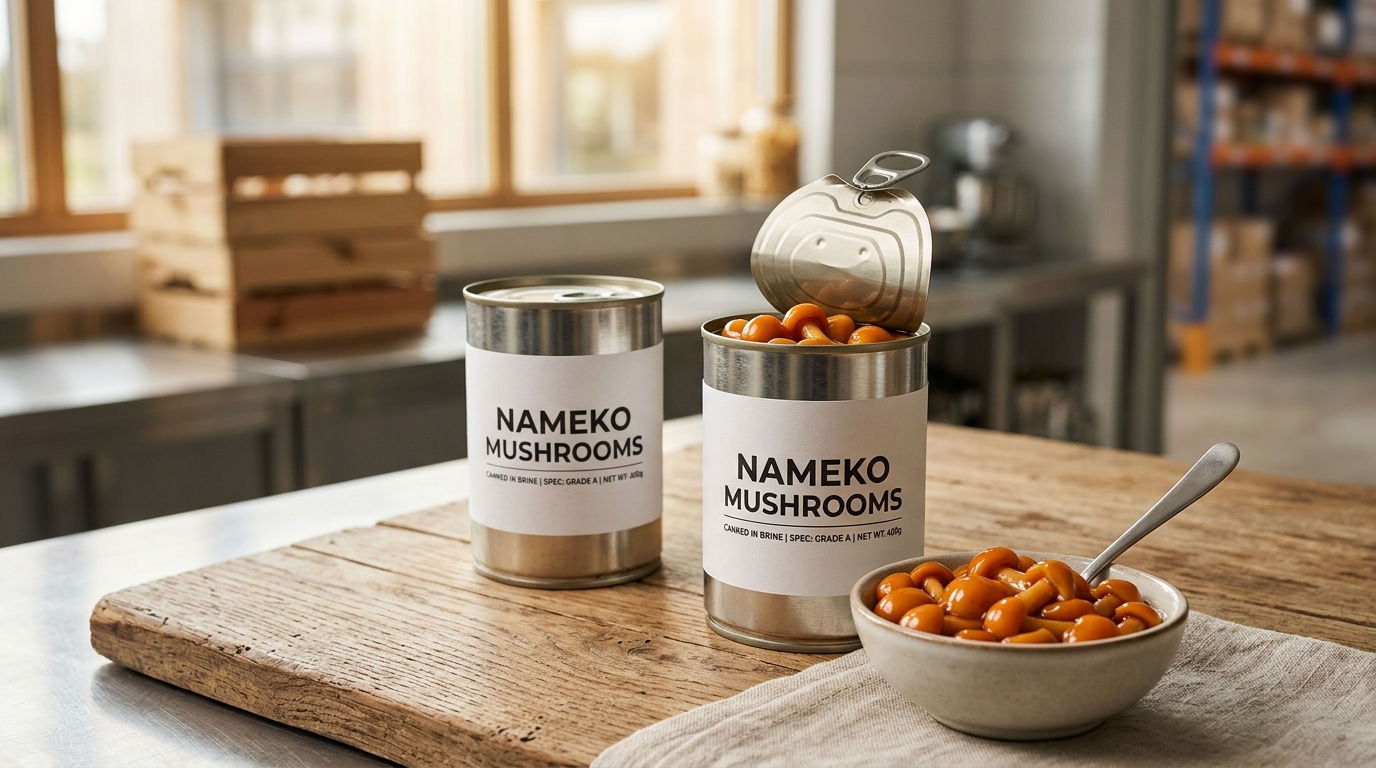
canned-nameko-mushroom Cover
Unlock Full Data
Canned Nameko Mushroom Market Intelligence
Prices · Trends · Origins · Forecasts

This guide is written for Purchase—Quality, Safety, and Compliance teams who are experienced in procurement but newer to the canned nameko vertical. The goal is to translate the physical reality of how nameko is cultivated, packed, and retorted into practical spec and verification choices—so you can qualify suppliers faster without lowering the safety bar, and reduce complaint-driven cost-to-serve.

Executive Summary

  • Three control points drive most outcomes: raw material grading/yield, validated thermal processing (commercial sterility), and container closure integrity (double seam + handling). [1]
  • Packaging is structurally “expensive” and risk-sensitive: tinplate/ends and closure control are often among the largest conversion-cost nodes, and metal/container inputs remain a volatility driver. [2]
  • Retort capacity is a real throughput ceiling: lead time and scheduling discipline are constrained by retort availability and documentation requirements for low-acid canned foods. [1]
  • Brine chemistry × can system interactions matter: corrosion, off-notes, and seam-side failures often trace to formulation/container compatibility and storage/handling—not “mushroom grade.” [3]

1) The Physical Map: Where Cost Gets “Locked In” From Grow Room to Can

Insight: Canned nameko is built around two non-negotiable bottlenecks: controlled-environment cultivation (yield stability) and validated retort thermal processing (commercial sterility + throughput). Once mushrooms are harvested, value is “locked in” quickly by grading, fill control (drained weight), and container closure integrity (double seam quality + container/coating compatibility). [4]

A left-to-right process flow showing the physical chain for canned nameko from controlled-environment cultivation through harvest, washing/sorting/grading, blanch/pre-cook, filling with brine or seasoned liquor, seaming/double seam closure, retort scheduled thermal processing for commercial sterility, cooling, hold/release with QA records, case-pack, ambient storage, and export/ocean freight, with prominent callouts for raw material grading/yield, validated thermal processing, and container closure integrity plus small cost/risk notes at each node.

Data: A typical industrial chain runs: bottle/block cultivation → rapid harvest-to-wash/sort → blanch or pre-cook (as applicable) → fill with brine/seasoned liquor → seam/close → retort → cool → hold/release → case-pack → ambient export. In practice, the heaviest fixed-cost drivers are utilities (grow rooms + steam), packaging (tinplate/ends/cartons), and QA labor for closure/process records and verification. [2]

Procurement Impact: Most downstream cost and risk outcomes trace back to three physical control points: (1) raw mushroom grade/yield, (2) retort capacity + process discipline, and (3) can system performance under storage/transport (corrosion, dents, leakers). Your specs and incoming verification should map to these points—not just a generic COA.

2) Cost and Margin Structure by Node (What Each Step Physically Adds)

Insight: In canned nameko, cost doesn’t accumulate evenly—packaging and thermal processing often dominate conversion cost, while raw material variability drives the biggest swings in drained weight performance, texture, and appearance.

Data: Typical cost stack includes: cultivation inputs + yield loss, labor-heavy grading, steam/energy for blanch + retort, tinplate/ends/labels/cartons, and freight for heavy ambient product (high gross weight due to brine + metal). [5]

Procurement Impact: When quality, safety, or compliance teams see recurring non-conformances (drained weight, seam defects, swells, corrosion), the root cause is usually tied to one node’s physical controls. Mapping complaints to nodes shortens investigations and avoids over-correcting specs.

1. Upstream / Raw Material (Cultivation & Harvest)

  • Insight: Nameko supply is cultivation-driven (commonly bottle/block systems), so reliability depends on spawn/substrate quality, contamination control, and stable utilities—not open-field seasonality.
  • Data: Cost drivers concentrate in utilities (climate control/humidity/ventilation) and labor for inoculation/harvest; yield losses from contamination events are a major swing factor. Nameko’s characteristic gelatinous/viscid surface is a known trait that can be amplified by maturity and handling, then perceived as “slime” post-process. [6]
  • Procurement Impact: If suppliers cannot evidence consistent cultivation hygiene and lot segregation, you’ll see downstream variability that no retort setting can “fix” (soft texture, excess mucilage perception, inconsistent piece integrity).

2. Primary Processing (Sorting, Washing, Grading, Pre-cook/Blanch)

  • Insight: This node determines whether you buy “uniform pieces that fill predictably” or mixed lots that fight drained weight and defect limits.
  • Data: Major costs are labor and water (washing/inspection), plus blanch energy where used. Blanching and subsequent steps materially change mushroom weight/texture, and brine composition can influence final grade/appearance—so grading and pre-cook choices cascade into drained weight and sensory outcomes. [7]
  • Procurement Impact: Drained weight disputes and texture complaints often originate here: loose grading increases fragments and compressibility in the can, causing fill variability and sensory drift (cloudy brine, broken pieces, uneven bite).

3. Secondary Processing (Filling, Seaming, Retort Sterilization)

  • Insight: This is the highest-severity safety node: commercial sterility depends on a scheduled process and disciplined deviation handling; quality depends on fill control and seam integrity. [4]
  • Data: Fixed costs include retort capacity, steam/energy, and QA labor for monitoring and records. Key variables include headspace control, seam setup, retort come-up time, process time/temperature, and post-process cooling. Regulators explicitly expect closure evaluations and recorded observations “at intervals of sufficient frequency,” and trained closure inspection oversight is a defined requirement in low-acid canning contexts. [8]
  • Procurement Impact: If a supplier’s process authority/validation evidence is weak, your risk isn’t “slightly more spoilage”—it’s high-severity failure modes (swells, leakers, or worst-case sterility loss). Treat seam teardown competency and retort record integrity as core capability, not paperwork.

4. Packaging & QA (Can System, Coatings, Corrosion Control, Release)

  • Insight: Canned mushrooms are packaging-sensitive: the can system (tinplate, lacquer, ends) must be compatible with brine chemistry over shelf life, and seam control must survive handling.
  • Data: Packaging is often a top conversion cost: tinplate can + end, labels, cartons—plus seam checks and hold/release practices. Corrosion and product–metal interactions are driven by formulation chemistry, coating integrity, and storage conditions; seam-side vulnerabilities and coating defects can become failure points over time. [3]
  • Procurement Impact: If you see corrosion, metallic notes, pinholing, or elevated leakers, the corrective action usually lives here (coating spec, seam setup, brine control, case-pack). Tightening mushroom grade specs won’t solve packaging chemistry or seam physics.

5. Logistics & Distribution (Ambient Storage, Ocean Freight, Damage Risk)

  • Insight: Canned nameko is heavy and damage-sensitive: cost-to-serve is disproportionately driven by cube/weight and by damage-related defects (dents, seam stress, label scuffing).
  • Data: Major costs include ocean freight, palletization, case materials, and warehousing. Physical risk concentrates in rough handling (dents that can compromise integrity) and storage/temperature cycling that can accelerate quality drift in marginal container–product systems. [9]
  • Procurement Impact: A stable supplier can still generate downstream non-conformances if packaging and pallet patterns aren’t designed for long ambient transit. Damage rate becomes a hidden tax via claims, rework, and intensified inspection.
Sourcing Window Radar
Canned Nameko Mushroom — Global Harvest Calendar
CHINA SEASON ACTIVE
🇨🇳 China
JAN — DEC
🇯🇵 Japan
JAN — OCT
🇭🇰 Hong Kong
JAN — JAN
JanFebMarAprMayJunJulAugSepOctNovDec

Product-Level Cost Breakdown

A three-bar stacked chart comparing product-level cost ratios for canned nameko in brine, canned nameko in seasoned broth (soy/dashi), and glass-jar nameko, segmented by upstream/raw material, primary processing, secondary processing, packaging & QA, logistics & distribution, ingredients, and wholesale/retail margin, using the exact table percentages and noting that packaging & QA is largest and secondary processing is a consistent cost driver.

A) Canned Nameko in Brine (Standard)

Supply Chain Node Cost Ratio (% of Final Cost) Notes
Upstream / Raw Material 22% Cultivation utilities + labor; yield loss from contamination drives variability.
Primary Processing 10% Sorting/grading/washing; blanch energy where used.
Secondary Processing 18% Filling + seaming + retort steam/energy; throughput constrained by retort capacity.
Packaging & QA 28% Tinplate/ends/cartons + seam teardown + release controls; major fixed cost driver; can-input volatility is a recurring market factor. [2]
Logistics & Distribution 12% Heavy ambient freight; damage risk (dents/leakers) adds indirect cost.
Wholesale/Retail Margin 10% Channel margin varies by market and pack size.

B) Canned Nameko in Seasoned Broth (Soy/Dashi Style)

Supply Chain Node Cost Ratio (% of Final Cost) Notes
Upstream / Raw Material 18% Same cultivation base; sometimes tighter visual grade needs for appearance in seasoned packs.
Primary Processing 9% Similar sorting/grading; more attention to defect removal for clarity/appearance.
Secondary Processing 19% Retort still dominates; seasoning handling adds line complexity and changeover cost.
Packaging & QA 27% Can system compatibility becomes more sensitive to formulation chemistry.
Ingredients (Seasoning Base) 10% Added cost for soy/dashi components; allergen/label control workload increases.
Logistics & Distribution 10% Similar freight profile; sometimes higher case-pack protection for premium SKUs.
Wholesale/Retail Margin 7% Often positioned differently; margin depends on channel strategy.

C) Glass-Jar Nameko (Premium Segment)

Supply Chain Node Cost Ratio (% of Final Cost) Notes
Upstream / Raw Material 20% Often higher visual-grade requirement for premium presentation.
Primary Processing 10% More stringent grading/defect removal; higher labor intensity.
Secondary Processing 16% Thermal processing still required; line speed may be slower due to container handling.
Packaging & QA 32% Glass + closures + protective materials; breakage controls and torque/vacuum checks.
Logistics & Distribution 12% Higher damage risk (breakage) and higher protective packaging cost.
Wholesale/Retail Margin 10% Premium positioning; channel-dependent.

3) Structural Realities You Can’t Spec Away

Insight: The biggest constraints in canned nameko are structural (capacity, physics, and documentation depth), not “supplier effort.”

Data: Across origins, three constants repeat: retort capacity limits, packaging chemistry/seam physics, and multi-tier traceability complexity (grower → processor → packer/exporter).

Procurement Impact: These realities shape what “good” looks like in specs, QA plans, and supplier qualification evidence.

Reality 1: Retort capacity is the throughput ceiling (and drives lead time discipline)

  • Insight: Retort sterilization is a shared, schedule-constrained asset; it sets the maximum exportable volume regardless of cultivation output.
  • Data: Retort operations require validated schedules, controlled come-up and cooling, and documented deviations—adding time and QA overhead that can’t be compressed indefinitely. [4]
  • Procurement Impact: When supply tightens, shortcuts tend to appear as record gaps, rushed changeovers, or weaker hold/release discipline—conditions that increase non-conformance risk.

Reality 2: Can performance is a system interaction (brine chemistry × coating × storage)

  • Insight: Corrosion, off-notes, and some swell/leaker outcomes are predictable interactions between formulation and container system over time.
  • Data: Salt level, pH, dissolved oxygen, and coating integrity influence corrosion propensity; dents and seam stress during transit convert marginal seams into leakers. [3]
  • Procurement Impact: Your technical spec must treat brine parameters and container/coating as linked controls; otherwise, you’ll chase symptoms (complaints) instead of stabilizing the system.

Reality 3: Traceability depth is often weaker than buyers assume in cultivated specialty mushrooms

  • Insight: Even cultivated products can have fragmented upstream lots if mushrooms are aggregated across grow rooms or contract growers before processing.
  • Data: Aggregation can occur at collection points or processors; without disciplined lot coding and segregation, finished goods lots may map to multiple upstream sources.
  • Procurement Impact: In an incident, shallow lot linkage expands recall scope, increases disposal and brand exposure, and slows root-cause investigations.

Key Insights (What to Remember When You Read a Spec or a COA)

  • Insight: Canned nameko quality and safety outcomes are engineered by three controls: grading (uniformity), sterilization discipline (retort), and container integrity (seams + coating compatibility).
  • Data: Packaging and thermal processing are typically heavy fixed-cost nodes, while the biggest variability driver is raw material yield/grade (cascading into drained weight and texture performance). [5]
  • Procurement Impact: Treat the product as a system (mushroom + brine + container + process + transit). Recurring issues become easier to diagnose when you map them to the node where the physics actually changes.

The Bottom Line for Your Next Contract

(Analyzed at: Aug, 2026)

Given ongoing tinplate/can-input volatility and the regulatory expectation for documented, frequent closure/process checks, the highest-leverage move is to contractually require a lot-level evidence bundle: scheduled-process/retort record extract, container-closure (double seam) check records, and brine control results tied to the specific can/end system used. [2] This works because most high-cost failures in shelf-stable mushrooms (leakers, swells/spoilage investigations, corrosion complaints) are driven by packaging/closure and process discipline—not by tightening cosmetic grade specs after the fact. If you prevent even a modest slice of damage/complaint-driven claims and intensified inspections, it’s common to protect low-to-mid single-digit percent of annual cost-to-serve in this heavy, return-sensitive category—without making any unit-price promises.

Canned Nameko MushroomSupply Chain Intelligence
126 countries tracked
10
Exporters
10
Importers
$61M
Top Export Value
Top Exporters (2024)
🇮🇹
Italy
$61M
🇪🇸
Spain
$26M
🇵🇱
Poland
$10M
🇷🇴
Romania
$5M
🇩🇪
Germany
$4M
+121 more
Top Buyers
🇯🇵 Japan $42M🇺🇸 United States $29M🇩🇪 Germany $16M🇰🇷 South Korea $13M🇭🇰 Hong Kong $10M

References

  1. fda.gov
  2. americanactionforum.org
  3. pubmed.ncbi.nlm.nih.gov
  4. fao.org
  5. usitc.gov
  6. americanmushroom.org
  7. ams.usda.gov
  8. ecfr.io
  9. inspection.canada.ca

Related Contents

Subscribe
→
By subscribing you agree to with our Privacy Policy and provide consent to receive updates from our company.
Thank you! Your submission has been received!
Oops! Something went wrong while submitting the form.
Subscribe to receive the latest blog posts, updates, promotions, and announcements from Tridge.
