INDUSTRY TRENDS

Canned Coconut Cream Supply Chain Map: Where Quality Locks In and Landed Cost Accumulates (Procurement Guide)

Author
Team Tridge
DATE
April 29, 2026
8 min read
canned-coconut-cream Cover
Canned Coconut Cream
Powered by Tridge Eye
🇺🇦 Ukraine↑ 12.1%
$2.41/kg
Wholesale reference prices across 53 markets

Executive Summary

  • Quality locks in at the processor, not the importer: emulsion stability (separation/texture) is set by homogenization + heat load; downstream can only detect defects. [1]
  • Two structural bottlenecks: retort/seaming capacity and the availability of the right cans/ends/labels can constrain supply even when coconuts are available. [2]
  • Freight remains volatile into 2026: plan lead time as a range and expect reliability shocks on key East–West trades. [3]
  • Cost reality: raw coconut/yield + packaging + ocean freight are the most “fixed” landed-cost blocks; savings usually come from spec/format flexibility and risk-tiered governance, not squeezing conversion alone.

1) How Canned Coconut Cream Actually Moves (and Where Costs “Lock In”)

Canned coconut cream is a dense, shelf-stable emulsion whose cost and risk profile is set less by the can itself and more by (1) mature coconut availability and extraction yield, (2) processing discipline (homogenization + thermal process), and (3) heavy-weight logistics. The physical chain is short, but each node is a quality gate: once fat% and emulsion stability are set at the plant, downstream players can only detect problems—not fix them. Emulsion separation in coconut milk/cream is a known physical defect risk influenced by homogenization and sterilization conditions. [1]

Insight: The supply chain is built around a small number of “conversion points” where raw coconuts become a standardized, sterilized emulsion; most downstream value is packaging, compliance, and distribution rather than transformation.

Data: Typical flow is: smallholder coconuts → aggregation → extraction/standardization → homogenization → retort sterilization in cans + seam formation/inspection → case packing → ambient container export → importer/DC → retail/foodservice/industrial users.
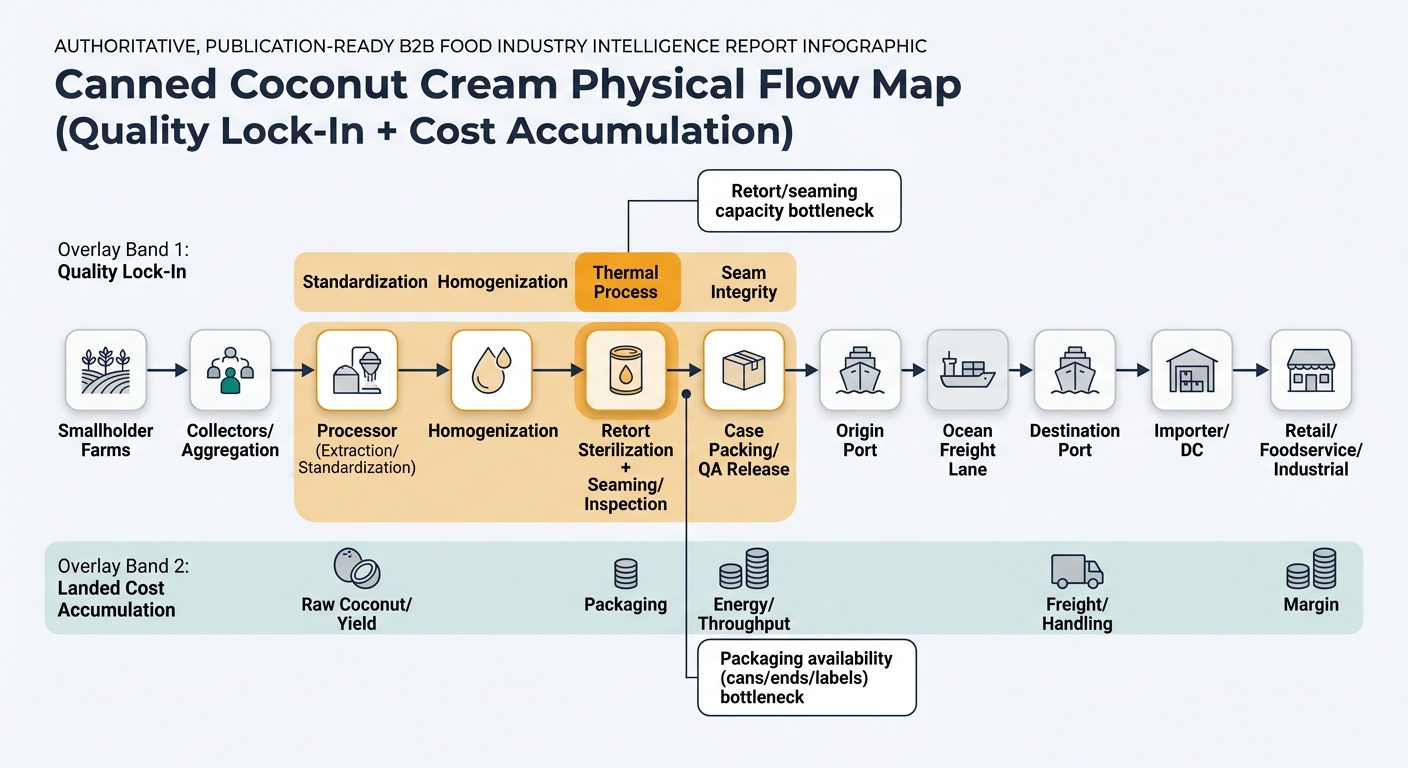
Left-to-right flowchart mapping canned coconut cream from smallholder farms through aggregation, processing (extraction/standardization, homogenization), retort sterilization and seaming/inspection, QA release, origin port, ocean freight, destination port, importer/DC, and end users; includes overlay bands highlighting where quality locks in and where landed cost accumulates, plus callouts for retort/seaming capacity and packaging availability bottlenecks.

Procurement Impact: Your physical map should treat the processor/retort line as the critical control node (quality + continuity), and treat ocean freight + can supply as the largest non-coconut fixed cost blocks that reliably shape landed cost.

  • Quick Win: Document your current flow as “origin coconuts → named processor/retort site → port of export → lane → importer/DC.” If any of those fields are “unknown” or “via trader,” you don’t yet have a decision-grade physical map.

2) Where Money Accumulates: Per-Node Cost and Margin Structure

Insight: Costs stack in predictable buckets: raw coconut + yield loss (upstream), energy/water/labor + downtime (processing), can/ends + cartons (packaging), and freight/handling (logistics). Margin tends to be earned at the processor/packer and again at the importer/distributor—because they absorb quality, compliance, and inventory risk.

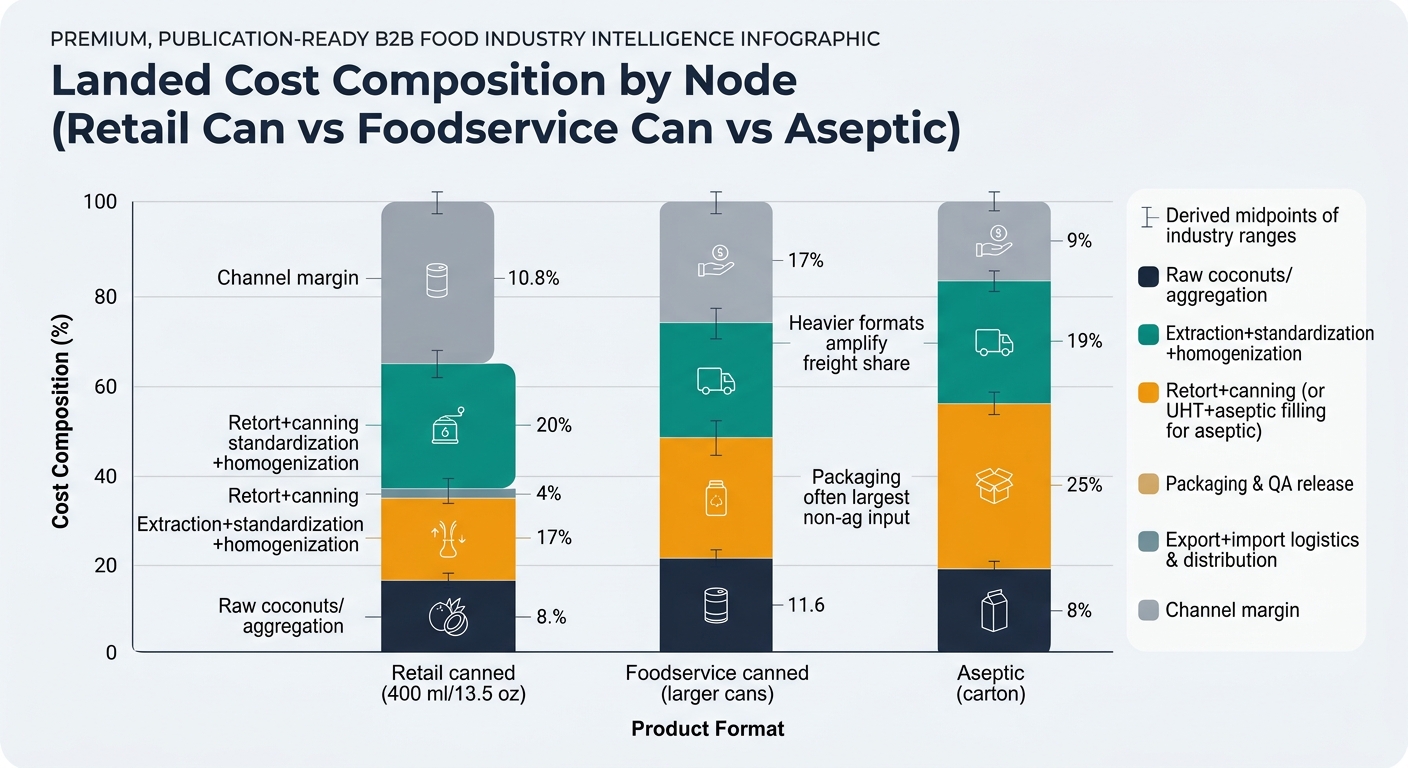
Data: Canned coconut cream is mostly water + fat; you pay to move weight. Retort processing adds energy and throughput constraints, while packaging metal and ends are often the largest non-ag input.

Procurement Impact: When you compare supply options, you’re effectively choosing a cost structure (yield + energy + packaging + freight) and a failure mode (quality drift vs. logistics delay vs. documentation gaps).
1. Upstream / Raw Material (Farms, Collectors, Aggregation)

  • Insight: Coconut cream economics start with mature nut availability and kernel quality; extraction yield and fat% consistency are “baked in” before the factory.
  • Data: Key physical drivers are nut size/maturity, time-to-processing (spoilage risk), and competing demand for coconuts (oil/copra, desiccated coconut, water). Aggregation is fragmented (smallholders + collectors), so variability is structural.
  • Procurement Impact: Expect natural batch variability in fat% and sensory unless the processor has strong standardization controls; upstream volatility shows up later as either (a) more water added to hit volume or (b) higher reject/separation risk.

2. Primary + Secondary Processing (Extraction, Standardization, Homogenization)

  • Insight: This is the main value-creation node: turning variable kernels into a repeatable emulsion (fat%, viscosity, separation tolerance) at scale.
  • Data: Core unit operations include washing/blanching (site-specific), comminution, mechanical pressing, filtration, standardization (water addition to target fat% where permitted), and homogenization. Emulsion stability in canned coconut milk/cream is commonly improved by homogenization (fat globule size reduction) and can be supported by emulsifiers where allowed. [1]
  • Procurement Impact: Process discipline determines total cost of quality later: a supplier that can hold tight fat% and emulsion stability usually has higher conversion cost but lower rejection/complaint exposure.

3. Thermal Processing + Canning (Retort Sterilization, Seam Integrity, Pack-Out)

  • Insight: Retort and canning are the “point of no return”: commercial sterility and container integrity determine shelf life, safety risk, and downstream claims exposure.
  • Data: Major cost drivers are steam/energy, retort capacity (throughput constraint), container handling, seamers, inspection/verification, and process records/calibration. US FDA inspection guidance and lab methods emphasize that improper retorting/cooling can stress seams, and seam integrity defects can be critical. [2]
  • Procurement Impact: If your spec is additive-free (no stabilizers/emulsifiers), this node becomes more sensitive: emulsion stability must come from raw material selection + homogenization + thermal profile control, not formulation “insurance.”

4. Packaging & QA Release (Cans/Ends, Linings, Labels, Case Pack)

  • Insight: Packaging is often the largest non-coconut cost block, and it is also a compliance gate (label, lining, traceability).
  • Data: Cost concentrates in cans + ends, cartons/cases, pallets, labels, and QA release testing. Technical variables include can size (e.g., ~400 ml/13.5 oz retail vs larger foodservice), internal lacquer/lining selection, seam inspection frequency, and rust risk from storage humidity.
  • Procurement Impact: Format rigidity (specific can size, label language, country marks) narrows feasible packers and increases the chance that packaging availability—not coconuts—becomes the bottleneck.

5. Export Logistics, Import Handling, and Ambient Distribution

  • Insight: Because coconut cream is heavy and shelf-stable, the chain is optimized for ambient containers—but freight, port dwell time, and handling damage are recurring cost and loss drivers.
  • Data: Landed cost drivers include inland drayage to port, container availability, ocean freight, insurance, customs clearance, destination drayage, and warehousing. Freight rate volatility and schedule reliability risk have persisted post-2024/2025 disruptions and remain a planning constraint into 2026. [4]
  • Procurement Impact: Your real lead time is a distribution (not a single number): variability here drives stock policy and service level outcomes even when the factory is stable.
Stacked bar chart comparing landed cost composition by node for three formats: retail canned coconut cream (400 ml/13.5 oz), foodservice canned (larger cans), and aseptic carton; segments include raw coconuts/aggregation, extraction/standardization/homogenization, retort+canning or UHT+aseptic filling, packaging & QA release, export+import logistics & distribution, and channel margin, with notes that heavier formats amplify freight share and packaging is often the largest non-ag input.

Product-Level Cost Breakdown

A) Retail Canned Coconut Cream (e.g., 400 ml / 13.5 oz)

Supply Chain Node Cost Ratio (% of Final Cost) Notes
Upstream raw coconuts + aggregation 30–45% Dominated by farmgate nut price + yield variability.
Extraction + standardization + homogenization 10–18% Water/energy/labor + yield loss + sanitation.
Retort + canning operations 6–12% Steam/energy + line throughput + verification/records.
Packaging & QA release (can/ends/labels/cases) 12–22% Cans/ends typically the biggest non-ag input.
Export + import logistics & distribution 12–20% Heavy product; damage and dwell time add hidden cost.
Importer/wholesale/retail margin 10–18% Compensation for inventory risk + market access.

B) Foodservice Canned Coconut Cream (larger cans)

Supply Chain Node Cost Ratio (% of Final Cost) Notes
Upstream raw coconuts + aggregation 32–48% Similar exposure to nut availability and maturity.
Extraction + standardization + homogenization 10–18% Larger runs can improve efficiency if specs are stable.
Retort + canning operations 6–12% Throughput and retort scheduling remain constraints.
Packaging & QA release 10–18% Packaging cost per kg can improve vs small retail units.
Export + import logistics & distribution 12–22% Weight still drives freight; cases are heavier/denser.
Foodservice distribution margin 8–15% Depends on channel structure and delivery model.

C) Aseptic Coconut Cream (carton alternative often evaluated vs cans)

Supply Chain Node Cost Ratio (% of Final Cost) Notes
Upstream raw coconuts + aggregation 30–45% Same raw material reality as canned.
Extraction + standardization + homogenization 10–18% Similar, but formulation/processing may differ by plant.
UHT + aseptic filling operations 8–15% Higher equipment and validation intensity vs basic canning.
Packaging & QA release (aseptic material, caps, cases) 14–26% Packaging can be a larger share than cans depending on format.
Export + import logistics & distribution 10–18% Often lighter per serving; still ambient but damage modes differ.
Importer/wholesale margin 8–16% Channel-dependent.
Sourcing Window Radar
Canned Coconut Cream — Global Harvest Calendar
THAILAND SEASON ACTIVE
🇹🇭 Thailand
APR — OCT
🇱🇰 Sri Lanka
APR — OCT
🇵🇭 Philippin.
APR — OCT
🇮🇳 India
APR — OCT
🇸🇬 Singapore
APR — OCT
JanFebMarAprMayJunJulAugSepOctNovDec

3) Structural Realities You Can’t “Optimize Away”

Insight: Canned coconut cream has a few non-obvious constraints that persist across suppliers and years; they shape availability, quality consistency, and the true bottlenecks.

Data: These are physical and industrial-structure facts—independent of short-term market cycles.

Procurement Impact: Treat these as design constraints when setting specs, approvals, and operational expectations.

  • Reality 1 — Quality is an emulsion problem, not just a fat% number.
  • Insight: Two lots can both meet fat% but behave differently (separation, graininess, mouthfeel) because droplet size distribution, homogenization energy, and heat load drive stability.
  • Data: Separation of coconut milk/cream is a recognized defect; research on canned coconut milk shows homogenization and sterilization conditions materially affect stability and rheology. [1]
  • Procurement Impact: Spec sheets that only state fat% and microbiological limits are incomplete for brand-sensitive products; you need physical performance specs (separation/viscosity) to prevent downstream surprises.
  • Reality 2 — Retort capacity and packaging supply are “hard” bottlenecks.
  • Insight: Even when coconuts are available, pack-out can be constrained by retort throughput scheduling and the availability of cans/ends/labels in the right format.
  • Data: Retort is batch/time intensive; seam integrity is a critical control point emphasized in canned-food inspection guidance, and packaging changeovers reduce effective capacity. [2]
  • Procurement Impact: When you see delayed shipments, the root cause is often industrial capacity or packaging availability—not farm supply—so mitigation requires visibility into the packer’s physical constraints.
  • Reality 3 — Freight and handling damage are structural for dense canned goods.
  • Insight: Canned coconut cream is expensive to move per unit of edible solids; long dwell times and rough handling create real loss rates (dents, seam stress, rust).
  • Data: Freight rate volatility has been elevated in recent years and is expected to remain a risk factor into 2026; longer routings and congestion dynamics can reduce schedule reliability. [4]
  • Procurement Impact: The physical lane (port pair + transit + handling steps) is part of product quality assurance; a “same spec” product can arrive with very different defect rates depending on logistics discipline.

Key Insights (What to Remember When You Look at Any Supplier)

  • Key Takeaways: The processor/retort site is the critical control point for repeatability; downstream players mostly detect defects rather than correct them.
  • Key Takeaways: The most reliable fixed cost blocks are (1) raw coconut + yield loss, (2) packaging (cans/ends/cases), and (3) ocean freight for a heavy product.
  • Key Takeaways: “Meets fat%” is necessary but not sufficient; emulsion stability and heat-load effects explain many real-world quality failures (separation, texture drift, cooked notes). [1]
  • Key Takeaways: Retort throughput and packaging coordination are structural capacity constraints that can limit supply even when coconuts are plentiful.

The Bottom Line for Your Next Contract

(Analyzed at: Apr, 2026)

Write your next canned-coconut-cream contract around two auditable anchors: the named manufacturing/retort site (and seaming controls) and the exact packaging specification (can/end/lining + label format), then tie service levels to shipment-level documentation (thermal process records summary + seam inspection evidence + packaging lot trace). FDA guidance is clear that seam integrity failures and retort/cooling stresses can turn into “leakers” and spoilage risk, and in practice these issues show up downstream as disputes, rejections, and emergency rebuys. [5] With freight volatility still a 2026 reality, the teams that win are the ones who can separate “factory constraint” vs “lane disruption” fast—because a single missed container can easily translate into mid-single-digit landed-cost impact once you include expediting, write-offs, and lost service levels. [4]

Unlock Full Data
Canned Coconut Cream Market Intelligence
Prices · Trends · Origins · Forecasts

References

  1. sciencedirect.com
  2. fda.gov (Inspection Guide: Low-Acid Canned Food Manufacturers, Part 3 Attachments)
  3. spglobal.com
  4. unctad.org (Review of Maritime Transport 2025 overview)
  5. fda.gov (PDF)
Subscribe
By subscribing you agree to with our Privacy Policy and provide consent to receive updates from our company.
Thank you! Your submission has been received!
Oops! Something went wrong while submitting the form.
Subscribe to receive the latest blog posts, updates, promotions, and announcements from Tridge.