INDUSTRY TRENDS

Canned Cockle Meat Supply Chain Map, Bottlenecks, and Cost Drivers (Procurement Manager Guide)

Author
Team Tridge
DATE
July 14, 2026
8 min read
canned-cockle-meat Cover
Canned Cockle Meat
Powered by Tridge Eye
🇺🇦 Ukraine↓ 1.9%
$3.86/kg
Wholesale reference prices across 22 markets

Canned cockle meat looks like a simple shelf-stable item, but its cost and availability are governed upstream by harvest-area legality, purification/relaying throughput, and meat yield after cooking and shucking. This guide maps the physical chain end-to-end and explains where cost “locks in,” so procurement leaders can negotiate and govern specs using the right economic unit: drained edible yield.

Executive Summary

  • Two real bottlenecks: approved/open harvest waters and depuration/relaying + shucking throughput—retort lines are rarely the true constraint.
  • Regulated-market reality: production-area classification (A/B/C) drives required treatments; Class C commonly implies relaying for at least two months before further steps, embedding time and cost. [1]
  • Economic unit:drained weight (edible yield) is what you pay for; net weight can hide meaningful yield differences and claim risk. [2]
  • Cost drivers that move fastest: raw cockle access (open/closed days), shucking labor productivity, and packaging metal (tinplate + easy-open ends).
  • Governance implication: supplier selection and contracts work best when specs, costing, and performance reviews are normalized to drained kg delivered + defect limits.

1) How the Physical Supply Chain Is Built (and Where Cost “Locks In”)

Canned cockle meat is physically a bivalve safety-and-yield business disguised as a shelf-stable grocery item. The cost base is largely set before the can is even filled—by harvest-area access (open vs. closed waters), live handling, depuration/relaying where required, and the meat yield you get after cooking and shucking.

Insight: The chain is short on paper, but it has two hard bottlenecks: (1) safe, legally harvestable growing waters and (2) depuration/relaying + shucking capacity (labor and equipment).

Data: In regulated markets, live bivalves harvested from more contaminated classified areas are not eligible to go straight to market; they typically require purification and/or relaying pathways depending on classification (A/B/C), adding time, infrastructure, and testing. [1]

Procurement Impact: Most downstream “volatility” you experience is the downstream expression of upstream constraints: closures, depuration/relaying throughput, labor availability, and yield loss.

Physical flow (typical)

  • Harvest / aquaculture (live in shell) → rapid cooling/holding + traceability
  • Primary processing (washing/sorting, depuration/conditioning where required, cooking to open shells, shucking, de-gritting)
  • Canning / retort (fill + seam + sterilize + cool + incubation/hold-release)
  • Packaging & QA release (labeling, lot coding, finished-goods testing)
  • Ambient logistics & import clearance (health docs, facility approvals, inspections)
A left-to-right supply chain flow showing: (1) Harvest/Aquaculture (live in shell) → (2) Live holding + traceability → (3) Washing/sorting → (4) Depuration or Relaying (classification-driven) → (5) Cook-open → (6) Shucking → (7) De-grit/inspection → (8) Filling & seaming → (9) Retort sterilization → (10) Cooling + incubation/hold-release → (11) Label/case-pack/QA release → (12) Ambient logistics + import clearance. Visually flag the two key bottlenecks with callouts/icons: 'Approved/Open Harvest Waters' and 'Depuration/Relaying + Shucking Throughput'. Add a small legend noting: 'Retort lines are typically not the primary constraint'. Avoid any dashboard-like UI; use clean icons and simple arrows.

Quick Win: When mapping suppliers, treat “harvest-area legality + purification/relaying access + shucking throughput” as the true upstream capacity—not just the number of retort lines.

2) Where Money Accumulates: Per-Node Cost & Margin Structure

Insight: Canned cockles are a classic “high pass-through, low forgiveness” product: small percentage changes in upstream yield or compliance time cascade into large changes in unit cost because shells are heavy, meat yield is limited, and rework options are constrained once sterilized.

Data: Production-area classification (A/B/C) is explicitly used to determine whether live bivalves can go direct or must be purified/relayed (and in Class C scenarios, relayed for a minimum period is commonly required), structurally adding handling time and cost. [1]

Procurement Impact: Your landed cost is structurally dominated by (a) raw material access and yield, (b) labor and energy in shucking/retort, and (c) packaging metal + compliance overhead.
1. Upstream / Raw Material (Wild harvest or aquaculture, live in shell)

  • Insight: The upstream “asset” is not just cockles—it’s access to approved waters and the right to harvest them when they’re open.
  • Data: Harvest areas are classified and can be restricted; classification determines permitted routes to market and required treatments. [1]
  • Procurement Impact: Raw material cost is structurally sensitive to (1) open/closed days, (2) size distribution (count/kg), and (3) mortality in holding—each directly affecting meat yield and effective cost per drained kg.

Fixed cost drivers

  • Licensing/bed access
  • Local harvest labor
  • Short-haul transport
  • Ice/live holding
  • Traceability documentation

Typical loss points

  • Mortality before processing
  • Mud/sand load (cleaning time)
  • Undersize grading

2. Primary Processing (Purification/conditioning, cook-open, shuck, de-grit)

  • Insight: This node is where food safety controls and yield reality collide: you pay for time, water, labor, and rejects.
  • Data: EU hygiene rules describe classification-linked pathways and requirements for live bivalves, including purification/relaying concepts and constraints (and, in practice, relaying time can be measured in weeks/months depending on classification and competent-authority rules). [3]
  • Procurement Impact: Even if your finished product is shelf-stable, upstream bivalve rules and purification/relaying throughput determine lead time, available volumes, and the probability of lot downgrades.

Fixed cost drivers

  • Depuration tanks/seawater systems
  • Microbiological monitoring
  • Wastewater treatment
  • Cooking fuel/steam
  • Shucking labor intensity
  • Mechanical separation and inspection

Quality cost drivers

  • Grit/sand removal (time + reject)
  • Shell fragment control
  • Size sorting (spec compliance)

3. Secondary Processing / Manufacturing (Filling, seaming, retort sterilization)

  • Insight: Retort turns a perishable input into a stable product—but it also locks in defects (texture, oxidation notes, fill variability) and makes rework expensive.
  • Data: Codex standards for bivalves reference standardized approaches for net/drained weight determination (often via recognized analytical methods such as AOAC, depending on the specific Codex standard and product form), reflecting how compliance is verified rather than negotiated. [2]
  • Procurement Impact: Drained weight compliance is not a paperwork exercise; it’s a manufacturing control problem driven by meat variability, fill accuracy, and brine ratio—directly influencing claim rates and effective cost per edible kg.

Fixed cost drivers

  • Retort energy (steam)
  • Seaming maintenance
  • Line labor
  • Can handling losses
  • Incubation/hold-release inventory time

Technical spec anchors (typical)

  • Can size
  • Net weight
  • Drained weight
  • Pack medium (brine/sauce)
  • Salt/acid profile
  • Lot coding

4. Packaging, QA Release, and Export Readiness (Label, case-pack, documentation)

  • Insight: For canned bivalves, packaging is both a cost input (metal + easy-open ends) and a compliance surface (labeling, traceability, origin/species declarations).
  • Data: Official classification/controls frameworks link market access to documented controls and verified status of harvest areas and handling steps, increasing the value of clean documentation trails. [1]
  • Procurement Impact: Packaging and QA are where “small” differences (label language, allergen statements, drained weight declaration format, lot code readability) become shipment holds, relabeling cost, or customer chargebacks.

Fixed cost drivers

  • Tinplate/easy-open ends
  • Label printing changeovers
  • Carton and pallet specs
  • QA lab testing
  • Export/health documentation preparation

5. Logistics & Distribution (Ambient freight + border controls)

  • Insight: Shelf-stable logistics reduce cold-chain cost, but port reliability and documentation quality become the main physical risks.
  • Data: Regulatory frameworks for bivalves emphasize competent-authority oversight and controls tied to classification and handling steps, which increases the penalty for documentation gaps at border/inspection points. [3]
  • Procurement Impact: Your landed cost is structurally exposed to delays (demurrage, storage, working capital) more than spoilage—especially when shipments are held for document review or sampling.

Fixed cost drivers

  • Ocean freight + inland drayage
  • Insurance
  • Port handling
  • Broker fees
  • Inspection/hold costs

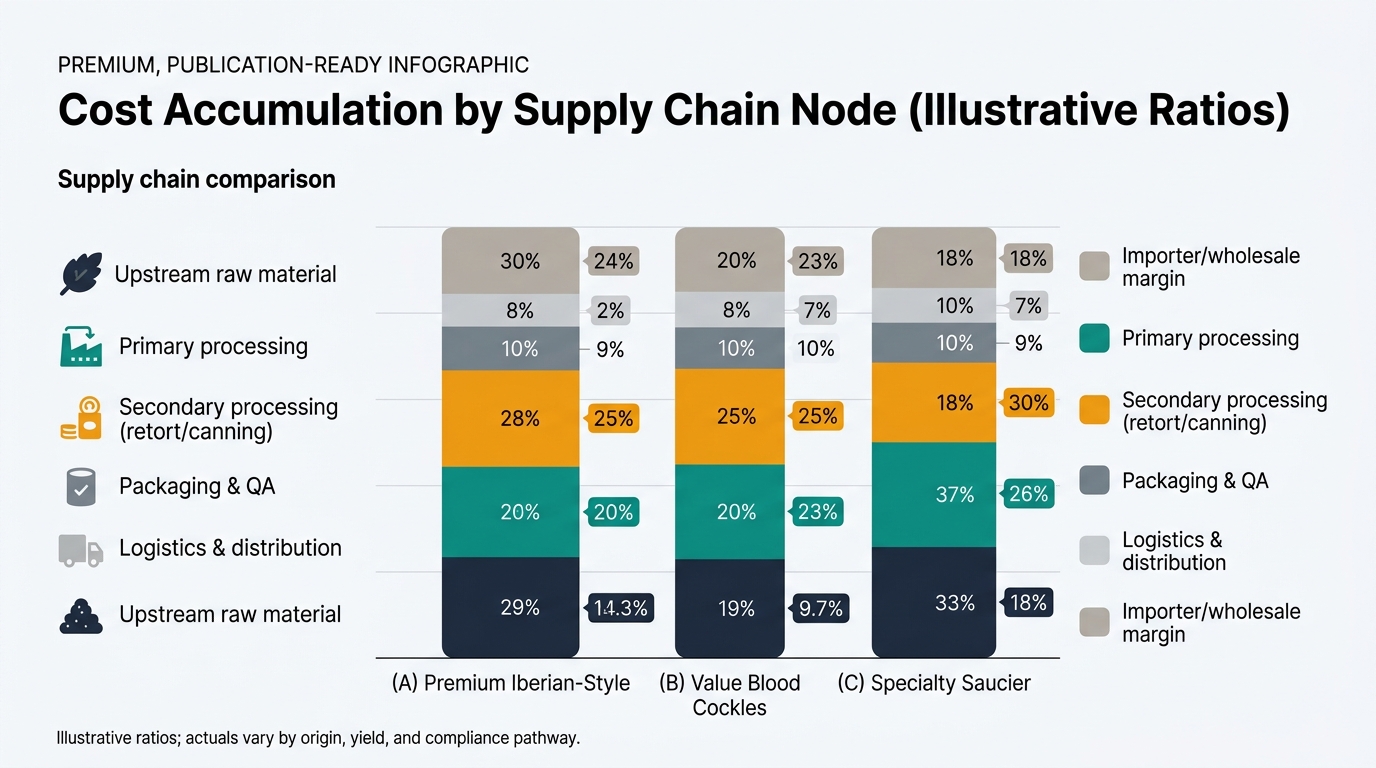
Product-Level Cost Breakdown (Illustrative Ratios)

Comparative chart converting the three illustrative cost breakdown tables into a single chart with three bars: (A) Premium Iberian-Style, (B) Value Blood Cockles, (C) Specialty Saucier. Each bar is segmented by the same nodes: Upstream raw material, Primary processing, Secondary processing (retort/canning), Packaging & QA, Logistics & distribution, Importer/wholesale margin, using the exact percentages shown in the article tables. Includes footnote text: 'Illustrative ratios; actuals vary by origin, yield, and compliance pathway.' Editorial styling (not product UI).

A) Premium Iberian-Style Canned Cockles (Cerastoderma edule, retail)

Supply Chain Node Cost Ratio (% of Final Cost) Notes
Upstream raw material (live cockles) 35% Harvest-area access + size distribution drive effective meat cost.
Primary processing 20% Depuration/conditioning + shucking labor + de-grit/rejects.
Secondary processing (retort/canning) 15% Retort energy + seam control + hold-release inventory.
Packaging & QA 12% Easy-open ends, labels, lab testing, documentation.
Logistics & distribution 8% Ambient freight; delays add working-capital drag.
Importer/wholesale margin 10% Channel handling, financing, compliance overhead.

B) Value Canned Blood Cockles (Anadara/Tegillarca, brine, foodservice)

Supply Chain Node Cost Ratio (% of Final Cost) Notes
Upstream raw material 30% Aquaculture/harvest variability; safety scrutiny can raise testing load.
Primary processing 25% Shucking throughput and grit control dominate unit economics.
Secondary processing (retort/canning) 15% Fill accuracy affects drained yield and claims.
Packaging & QA 10% Larger cans reduce packaging cost share per kg.
Logistics & distribution 10% Higher weight per shipment; port delays still material.
Importer/wholesale margin 10% Foodservice distribution and credit terms.

C) Specialty “Saucier” Cockles (seasoned sauce packs, retail)

Supply Chain Node Cost Ratio (% of Final Cost) Notes
Upstream raw material 28% Meat component share lower vs. sauce + branding.
Primary processing 18% Same yield constraints; sensory sorting more important.
Secondary processing 20% Sauce prep, viscosity control, higher changeover complexity.
Packaging & QA 14% More label complexity; higher artwork SKUs.
Logistics & distribution 8% Ambient.
Importer/wholesale margin 12% Specialty retail markups.
Sourcing Window Radar
Canned Cockle Meat — Global Harvest Calendar
CHINA SEASON ACTIVE
🇨🇱 Chile
AUG — NOV
🇨🇳 China
JAN — NOV
🇻🇳 Vietnam
JAN — OCT
🇪🇨 Ecuador
AUG — AUG
🇪🇸 Spain
JAN — AUG
JanFebMarAprMayJunJulAugSepOctNovDec

3) Structural Facts Every Procurement Manager Should Know (Non-Obvious, Non-Negotiable)

Reality 1: “Bivalve safety” is a water-quality and classification system, not a factory-only system

Insight: For cockles, the upstream environment is part of the production system; factory controls can’t fully substitute for harvest-area legality and monitoring.

Data: Production-area classification determines what treatment is required before live bivalves can be marketed; persistent contamination can restrict or prevent harvesting/marketing pathways. [1]

Procurement Impact: Supply can disappear structurally (closure/prohibition), not just become more expensive—so physical sourcing maps must include harvest-area status pathways, not just processor names.

Reality 2: Depuration/relaying and shucking are the throughput governors

Insight: Retort capacity is visible; depuration/relaying and shucking labor are the hidden constraints.

Data: EU/UK frameworks explicitly embed treatment pathways and, in Class C scenarios, commonly require relaying for a minimum period (often at least two months) unless competent authorities provide otherwise under defined conditions. [4]

Procurement Impact: Lead time and available volume are structurally constrained by biological and labor throughput, which also raises the cost of “last-minute” volume requests.

Reality 3: Drained weight is the economic unit—net weight is not

Insight: For bivalves in liquid packs, the edible yield is governed by drained weight control and meat size variability.

Data: Codex standards reference standardized drained-weight determination methods for bivalve products, reflecting how compliance is practically assessed. [2]

Procurement Impact: Two products with the same net weight can have meaningfully different edible yields and claim risk; drained-weight capability is a manufacturing competence, not a label detail.

Quick Win: When you compare suppliers, normalize specs and internal costing around drained kg delivered, not “cases” or net kg.

Key Insights You Can Use Immediately (Physical Map Only)

  • Insight: The supply chain’s “fixed” cost base is set upstream by harvest-area access, purification/relaying needs, and meat yield after shucking.
    Data: Live bivalve classification and treatment requirements structurally add time and infrastructure; drained weight is formally measured using standardized methods. [1]
    Procurement Impact: The most reliable way to anticipate landed-cost swings is to track physical constraints: closure risk, depuration/relaying throughput, shucking labor, retort energy, and packaging metal.
  • Insight: Quality failures are often “baked in” before canning (grit, fragments, size distribution), while canning locks them in.
    Data: Regulatory and good practice concepts around conditioning/purification and official controls reinforce that cleanliness/vitality and contamination control are designed steps in the chain, not afterthoughts. [3]
    Procurement Impact: Supplier capability should be evaluated by their upstream handling and de-grit controls as much as their finished-goods COA.

4) The Bottom Line for Your Next Contract

(Analyzed at: Jul, 2026)

Treat packaging metal and ends as a first-class cost driver in 2026 negotiations: tinplate has shown upward pressure in 2026 and can pricing is still sensitive to metal pass-through, so locking a clear indexation logic (what moves with metal vs. what is supplier margin) helps you avoid “mystery” increases. [5] Pair that with a contract spec that prices on drained kg delivered and hard defect limits (grit/shell fragments), because that’s where yield physics convert into cost and claims. Done well, this can reduce the likelihood of paying for non-edible weight and can easily swing effective edible cost by mid-single digits over a cycle—while late corrections after retort typically show up as chargebacks, expediting, or emergency buys.

Unlock Full Data
Canned Cockle Meat Market Intelligence
Prices · Trends · Origins · Forecasts

References

  1. gov.uk
  2. fao.org
  3. eur-lex.europa.eu
  4. cityoflondon.gov.uk
  5. packtrax.com

Related Contents

Subscribe
→
By subscribing you agree to with our Privacy Policy and provide consent to receive updates from our company.
Thank you! Your submission has been received!
Oops! Something went wrong while submitting the form.
Subscribe to receive the latest blog posts, updates, promotions, and announcements from Tridge.
