

Canned BBQ-flavored beef is a retort-processed, shelf-stable, value-added meat product where availability and cost are governed less by “beef exists” and more by (1) manufacturing-beef specs and yields, (2) retort throughput and QA release gates, and (3) metal packaging supply (cans/ends). Once beef is cooked, sauced, sealed, and thermally processed to commercial sterility, the product becomes logistics-friendly (ambient) but change-unfriendly: spec changes and alternate sourcing often require validations and label re-approvals. [1]
Insight: The supply chain is a sequence of “gates” (raw material → cook/yield → retort capacity → can/end availability → QA release) where each gate adds fixed conversion cost and constrains flexibility.
Data: Typical physical flow: cattle/live procurement → slaughter/deboning → trim/blends or beef chunks → pre-cook (shred/chunk) → sauce batching → can filling/seaming → retort → incubation/QA release → case-pack/palletize → ambient distribution.
Procurement Impact: The highest-impact cost drivers are often set before the finished good exists: lean-point selection, cook yield assumptions, retort minutes per can, and can/end specs determine both unit economics and how quickly supply can be flexed.

Insight: In canned BBQ beef, cost is “built” through yield loss, line efficiency, and packaging/retort constraints—not just raw beef price.
Data: The same SKU can swing materially in total cost if (a) cook shrink rises, (b) seam defect scrap increases, or (c) easy-open ends tighten supply.
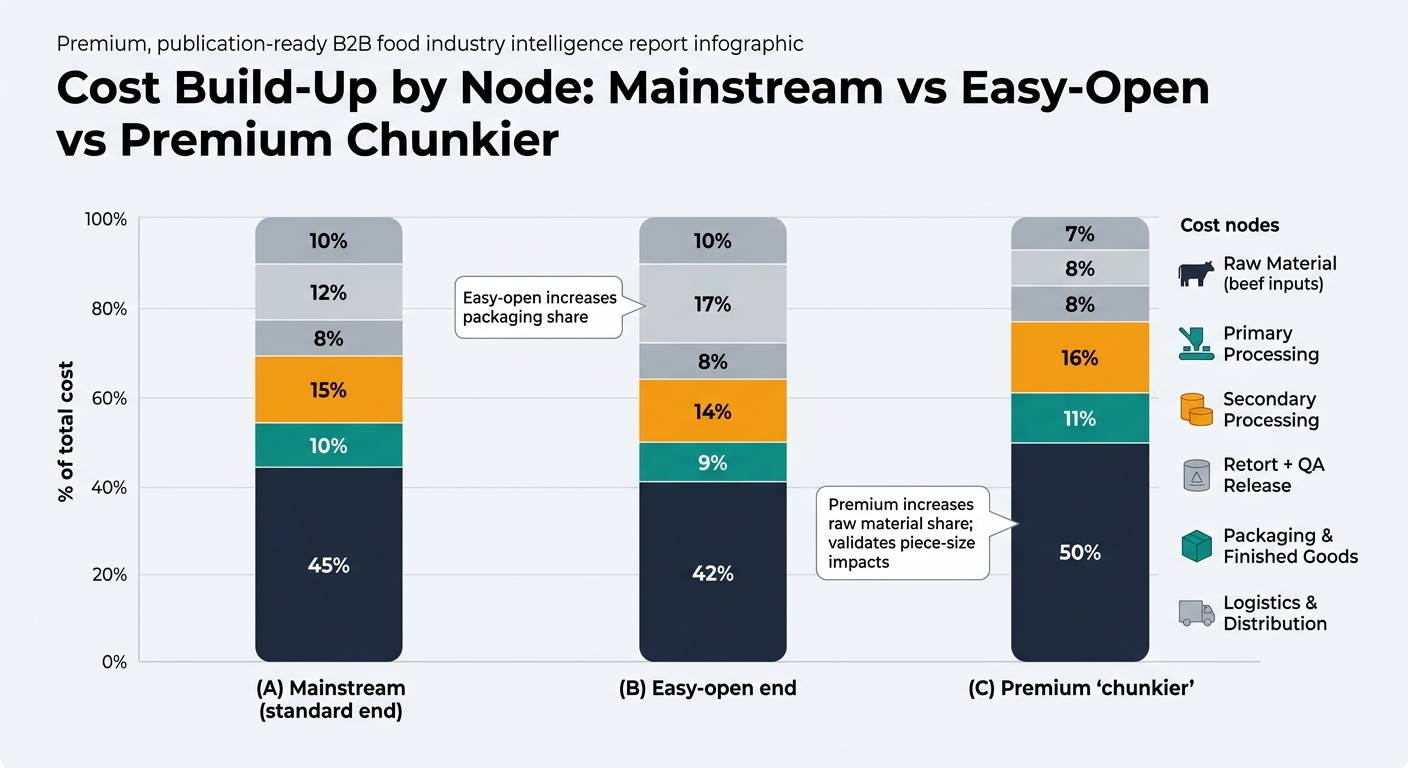
Procurement Impact: To understand total cost of ownership later, you need a node-by-node view of what is structurally expensive vs. what is variable.
| Supply Chain Node | Cost Ratio (% of Final Cost) | Notes |
|---|---|---|
| Raw Material (beef inputs) | 45% | Dominant driver; lean-point and usable yield matter as much as quote. |
| Primary Processing | 10% | Deboning/trimming labor + cold storage/freezing + yield loss. |
| Secondary Processing | 15% | Cook shrink, batching, line efficiency, rework/scrap. |
| Retort + QA Release | 8% | Retort minutes + validation + QA holds/working capital days. |
| Packaging & Finished Goods | 12% | Can body/end, labels, corrugate; seam-related scrap can inflate. |
| Logistics & Distribution | 10% | Weight-driven freight; dent/damage risk adds hidden cost. |
| Supply Chain Node | Cost Ratio (% of Final Cost) | Notes |
|---|---|---|
| Raw Material (beef inputs) | 42% | Slightly lower share as packaging/end premium rises. |
| Primary Processing | 9% | Similar to standard; depends on input form (fresh vs frozen). |
| Secondary Processing | 14% | Similar, but line speed may change with end/seam dynamics. |
| Retort + QA Release | 8% | Similar; QA may tighten seam teardown frequency for new ends. |
| Packaging & Finished Goods | 17% | Easy-open ends can add cost and availability risk. |
| Logistics & Distribution | 10% | Heavy product; pallet stability and case strength remain key. |
| Supply Chain Node | Cost Ratio (% of Final Cost) | Notes |
|---|---|---|
| Raw Material (beef inputs) | 50% | Larger pieces often require higher-value cuts or tighter trim control. |
| Primary Processing | 11% | More sorting/trim discipline; potential yield trade-offs. |
| Secondary Processing | 16% | Piece integrity + cook control reduce breakage; may slow throughput. |
| Retort + QA Release | 8% | Larger pieces can alter heat penetration assumptions and validations. [1] |
| Packaging & Finished Goods | 8% | Similar can cost, but tighter dent tolerance due to premium positioning. |
| Logistics & Distribution | 7% | Slightly lower share if price point is higher; freight still real. |
Insight: In shelf-stable meat, retort minutes are the bottleneck that determines how much finished product can be made on short notice.
Data: Retort scheduling is constrained by cycle time, vessel count, basket configuration, and validation requirements; adding volume often requires longer shifts or additional vessels—neither is instant. [1]
Procurement Impact: When supply is tight, the limiting factor may be sterilization capacity and QA release cadence, which affects lead time reliability even if raw beef and cans are in stock.
Insight: “A can is a can” is false—body gauge, end type, lining/coating, and seam geometry must match seamer tooling and validated parameters.
Data: Seam defects (false seam, cutover, droop) create scrap and potential safety risk; changing can/end suppliers can require setup work, seam studies, and tighter incoming inspection. [2]
Procurement Impact: Packaging is both a cost driver and a qualification constraint; alternate packaging sources can exist, but they are not plug-and-play.
Insight: BBQ flavor is the visible part; the economics are driven by lean-point, piece size distribution, sauce solids, and net weight control.
Data: Cook shrink and sauce pickup vary by fat content and cut; viscosity/Brix influences fill accuracy and line speed; tighter drained-weight or piece-count expectations increase rework risk.
Procurement Impact: Overly rigid specs can convert into chronic hidden costs: higher giveaway, more rework, more holds, and lower throughput.
(Analyzed at: Oct, 2026)
Write your next canned BBQ beef RFP so suppliers must price and commit by pack format + retort schedule, not just “$/case”—specifically: validated can/end set, seamer setup expectations (including seam teardown cadence), and the retort window they can actually reserve for you. This works because commercial sterility programs and container integrity controls make retort time and seam performance the non-negotiable gates that determine real lead time and scrap risk. [4]
If you don’t force that transparency up front, you typically discover constraints late—then pay for the recovery through production holds and expedited freight, which is a very plausible high-single-digit swing in landed cost on disrupted lanes for a heavy, damage-prone canned product. [3]


