
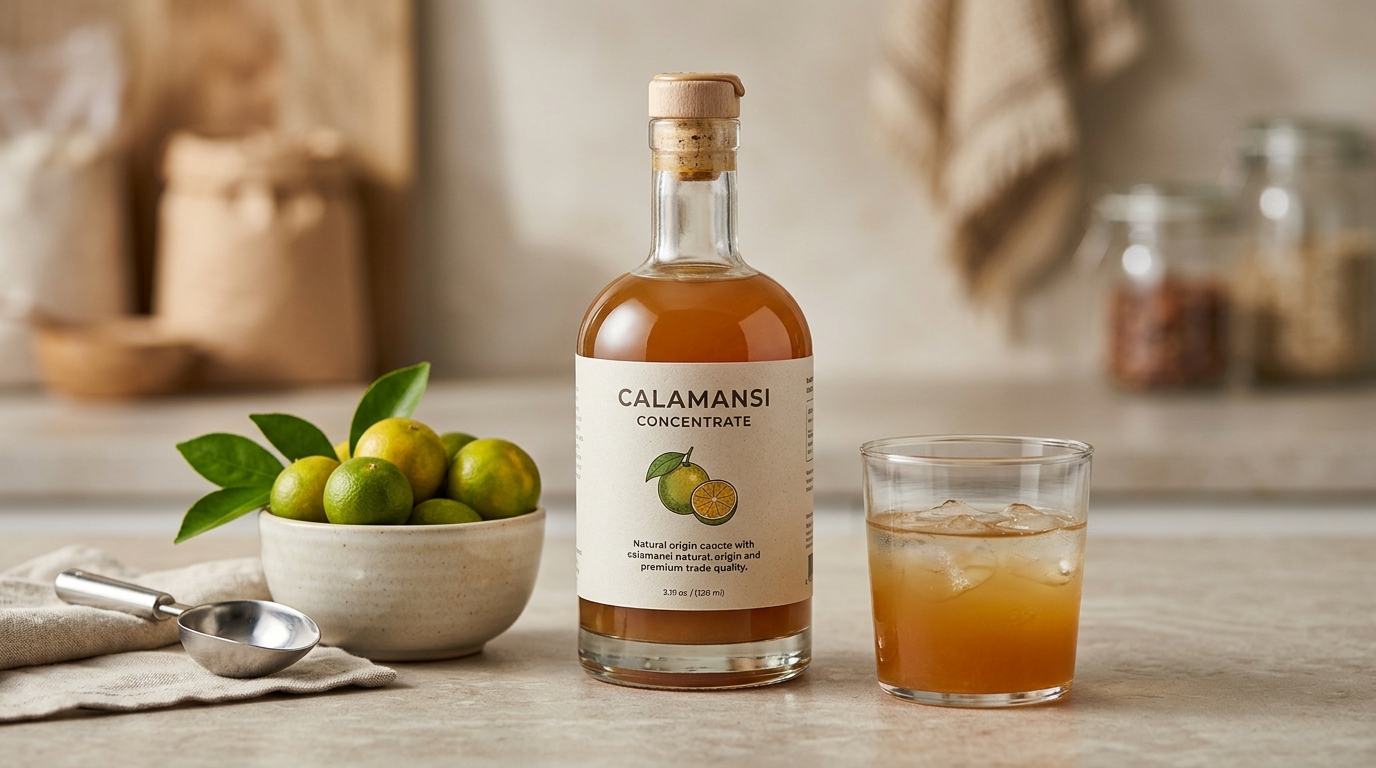
Calamansi concentrate is physically “made” by moving value upstream: you remove water close to farms (to avoid hauling low-value mass), then protect aroma/color through controlled processing and packaging so it survives export handling.
The dominant flow is Southeast Asia origin fruit → near-origin extraction → vacuum evaporation (often multi-effect) → blending/standardization → aseptic drum/tote export; the tightest choke points are extraction line uptime, evaporator steam economy, and aseptic packaging availability.
Your landed cost and lot-to-lot quality are largely determined before the product ever hits a vessel—at (1) fruit maturity/handling time-to-press and (2) concentrate finishing (°Brix/acid standardization + packaging format).

In calamansi concentrate, cost is not evenly distributed—raw fruit drives yield and flavor, evaporation drives energy cost, and packaging/logistics determine whether quality survives transit.
Evaporation is structurally energy-intensive; in juice concentration, steam efficiency and number of effects are central to operating cost, and industrial lines often use multi-effect evaporators to reduce steam per kg water removed. [1]
Even without discussing “how to buy,” you can read a supplier’s physical competitiveness by asking: (a) fruit-to-juice yield controls, (b) evaporator configuration/steam-use discipline, (c) aseptic capability and QC release discipline.
The fruit is the concentrate’s largest “embedded variable”—it sets soluble solids potential, acidity profile, and peel oil risk before any plant step can correct it.
PSA tracks calamansi as a major fruit crop and publishes quarterly production and top producing regions—useful for understanding origin concentration and seasonal quarters (rather than assuming “flat year-round” supply). [3]
Expect fixed cost drag from aggregation losses (rejects/shrink) and quality sorting; the more fragmented the grower base, the more cost sits in collection logistics, grading labor, and traceability paperwork.
This node converts perishable fruit into a manageable intermediate (single-strength juice) but also creates the biggest irreversible quality failure modes: oxidation, microbial load, and peel oil carryover.
Standard juice processing sequences (wash/sort → extract → clarify/filtration → heat treatment) are designed to reduce fermentability risk and stabilize for downstream concentration; time-to-press and sanitation directly affect yeast/mold risk and off-notes.
Primary processing cost is dominated by labor + water/wastewater + yield loss (pulp/seed/peel + filtration losses). Plants with weak screening/clarification typically push variability downstream, increasing rework and downgrades at finishing.
Evaporation is the “steam-to-value” step: you pay to remove water while trying not to cook out volatiles or darken color; aroma recovery/add-back (when used) is a capital and operating cost lever.
Fruit juice concentration is commonly done by vacuum evaporation to reduce thermal damage; energy efficiency improves with multiple effects and related steam-economy measures. [1]
This node is where suppliers build consistency: blending to target °Brix and acidity (with agreed methods), managing concentrate viscosity/flow, and controlling residence time. Expect fixed cost sensitivity to energy prices, boiler reliability, and evaporator downtime (fouling/CIP time).
Packaging is not “just a container”—it is a preservation technology that determines whether the concentrate can ship ambient or must live in a reefer chain.
FDA inspection guidance for aseptic processing and packaging describes the sterile zone, commercial sterility expectations, and common bag/fitment concepts used in bulk aseptic systems. [2]
Aseptic capability shifts cost from cold-chain OPEX to packaging materials + sterile handling discipline. QA release costs include COA testing (°Brix, titratable acidity, microbiology, sensory; residues where required) and hold-time inventory.
Logistics cost is structurally “format-driven”: aseptic concentrate can often move as ambient freight; frozen concentrate is physically safer for some aroma/color specs but depends on reefer availability and uninterrupted cold chain.
The physical rationale for concentrating is to reduce storage and transport burden by removing water; the trade is that shelf-stability depends on validated processing/packaging controls (especially for aseptic pathways). [5]
Landed cost variability often comes from demurrage/dwell time, port handling, and temperature excursion risk (for frozen). Import-side holds can add working-capital cost if documentation or sampling delays release.

| Supply Chain Node | Cost Ratio (% of Final Cost) | Notes |
|---|---|---|
| Raw Material Cost (fruit) | 55% | Fruit maturity and sorting losses dominate; fragmented collection adds handling cost. |
| Primary Processing | 20% | Extraction labor, water/wastewater, sanitation, yield loss from pulp/seed/peel. |
| Packaging & QA | 8% | Drums/totes, COA testing, hold-time inventory. |
| Logistics & Distribution | 12% | Heavier water content increases freight cost per unit of solids. |
| Processor/Distributor Margin | 5% | Lower value density limits margin. |
| Supply Chain Node | Cost Ratio (% of Final Cost) | Notes |
|---|---|---|
| Raw Material Cost (fruit) | 35% | Still the largest quality/yield driver, but water removal raises value density. |
| Primary Processing | 15% | Extraction + stabilization; poor control here creates downstream rework. |
| Secondary Processing (evaporation/standardization) | 20% | Steam/energy + evaporator uptime + aroma management. [5] |
| Packaging & QA (aseptic) | 12% | Aseptic bags/fittings, sterile filling discipline, release testing/holds. [2] |
| Logistics & Distribution | 13% | Ambient ocean freight often feasible; import handling and inland freight remain material. |
| Processor/Exporter Margin | 5% | Margin reflects capability (consistency, compliance, aseptic execution). |
| Supply Chain Node | Cost Ratio (% of Final Cost) | Notes |
|---|---|---|
| Raw Material Cost (fruit) | 30% | Tighter maturity and defect thresholds raise effective fruit cost. |
| Primary Processing | 12% | Faster time-to-press and stricter sanitation reduce oxidation/fermentation risk. |
| Secondary Processing (evaporation + aroma system) | 28% | Essence/aroma recovery systems add capex/opex and tighter controls. [5] |
| Packaging & QA | 15% | More stringent sensory and stability release; often tighter oxygen control expectations. |
| Logistics & Distribution | 10% | May still ship aseptic ambient; sometimes chilled handling to protect volatiles. |
| Processor/Exporter Margin | 5% | Capability premium is earned via consistency and defect avoidance. |
Calamansi concentrate behaves like a specialty citrus: the physics of perishability, energy-intensive concentration, and packaging format constraints create hard floors under cost and hard ceilings on flexibility.
(1) Calamansi is a tracked major fruit crop with identifiable producing regions by quarter; (2) evaporation is inherently energy intensive and improved via multi-effect steam economy; (3) aseptic processing/packaging has defined sterile execution expectations that drive shelf-stability outcomes. [3]
These structural facts explain why suppliers emphasize (a) origin-side processing, (b) evaporator/boiler reliability, and (c) aseptic discipline—because failures at these points are expensive to correct downstream.
In calamansi concentrate, the best predictor of consistent supply and consistent quality is not a brochure claim—it’s whether the supplier controls three physical choke points: fruit intake discipline, evaporation discipline, and packaging discipline.
PSA quarterly reporting shows calamansi production concentration by region; multi-effect vacuum evaporation is a core efficiency lever in juice concentration; FDA guidance highlights the control expectations around aseptic processing/packaging for shelf-stable pathways. [7]
When you compare suppliers, map them on: (1) intake/traceability + sorting capability, (2) evaporator configuration/uptime and aroma handling, (3) aseptic packaging format options and QA release rigor. Those three explain most lot-to-lot variance and most hidden cost.
(Analyzed at: Jul, 2026)
Standardize your contract around one “export-ready” pathway (aseptic bulk concentrate) and harden the release gate: require method-defined °Brix and titratable acidity, a minimum microbiological panel, and an agreed maximum release hold time tied to lot documentation completeness.
This works because the biggest avoidable failures in this category happen at the packaging/QA interface—once a lot is packed, any sterility or documentation miss turns into port dwell, blocked inventory, or emergency replacement buys.
With Philippine calamansi pricing showing year-on-year increases in mid-2026 (a proxy for tighter fruit economics in some periods), the cost of being forced into spot cover is more likely to show up as expedited landed-cost shock than as a small unit-price delta. [4]


