
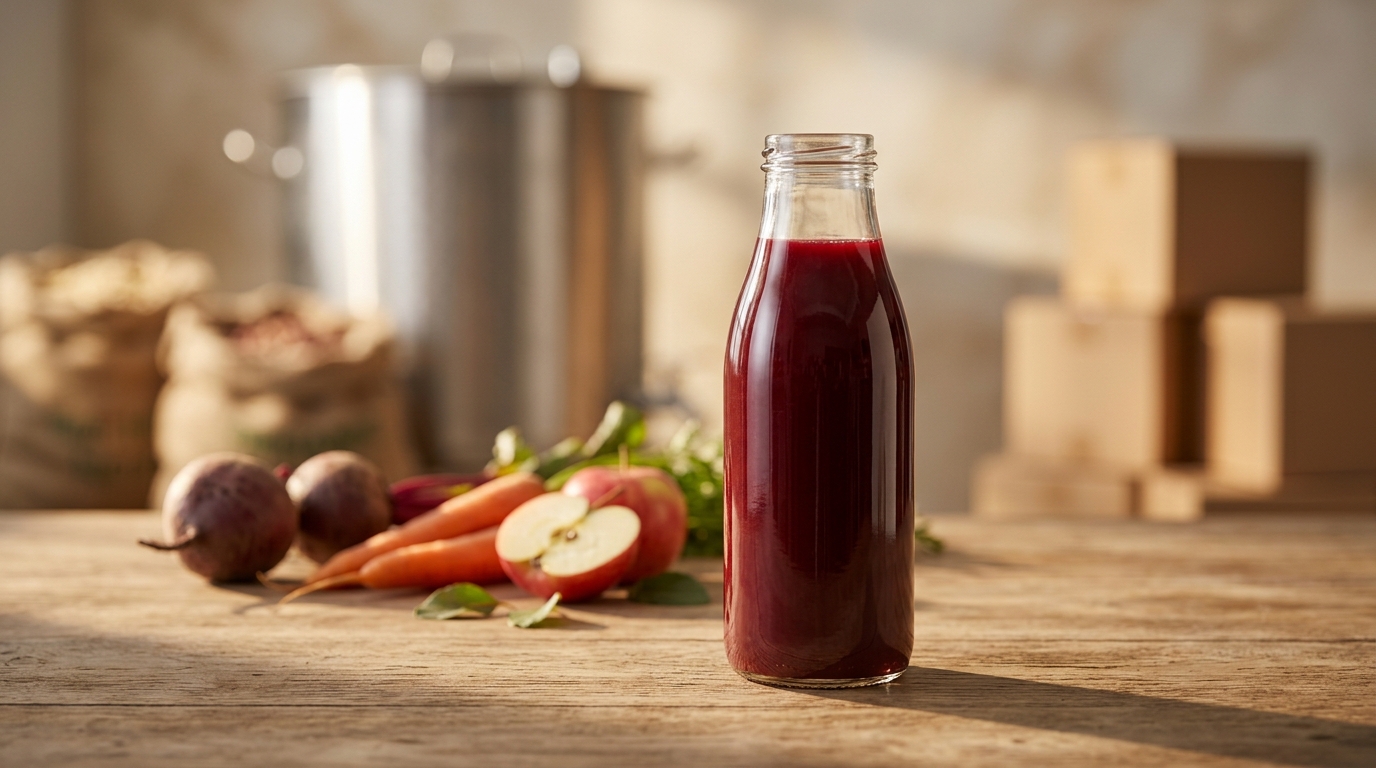
If you buy no-added-sugar ABC (apple–beet–carrot) juice concentrate as a single “commodity,” you’ll routinely miss the real drivers of delivered pricing: inventory timing, processing capacity, and spec risk. This guide shows how to separate continuity from pricing, govern substitutions, and use COA/lot evidence to negotiate through lag windows without breaking spec or compliance.
ABC concentrate pricing rarely moves as a clean “cost-plus” of apples + carrot + beet. The disconnect comes from timing (inventory lags), capacity (evaporation and aseptic lines), and spec risk (color/flavor standardization) — so upstream crop softness can coexist with flat-to-up finished concentrate offers.

The direction in the draft is credible, but the specific percentages (e.g., “apple down 8–12% yet AJC down only 2–5%”) should be treated as scenario ranges, not universal facts. What is well-supported is the mechanism: AJC offers often lag underlying fruit economics by roughly 6–16 weeks due to inventory/contracting timing. (blog.tridge.com) Carrot pricing also shows meaningful variability by region and month (illustrative published market series exist), reinforcing that non-apple components can move independently [1].
If you negotiate ABC as a single line item, you donate margin to suppliers during lag windows and you absorb surprise spikes when carrot/beet tightens. The “alpha” move is to negotiate component transparency (even if you buy a pre-blend): define a pricing logic that separates apple-driven moves (typically slower, inventory-lagged) from carrot/beet-driven moves (faster, allocation-prone), and tie each to a review cadence that matches how that component actually reprices.
Insight: The buying window opens when spot fruit signals turn but finished concentrate offers haven’t moved yet.
Data (validated / strengthened): Ask for the production month (or production range) of the lots being quoted and request lot-level traceability that links COA → production date → origin. This is not busywork: USDA’s apple processing reporting makes clear that AJC is traded with defined spec bands (Brix minimums, acidity ranges, color ranges) and is sold/quoted in lots/periods—meaning lot timing matters [2].
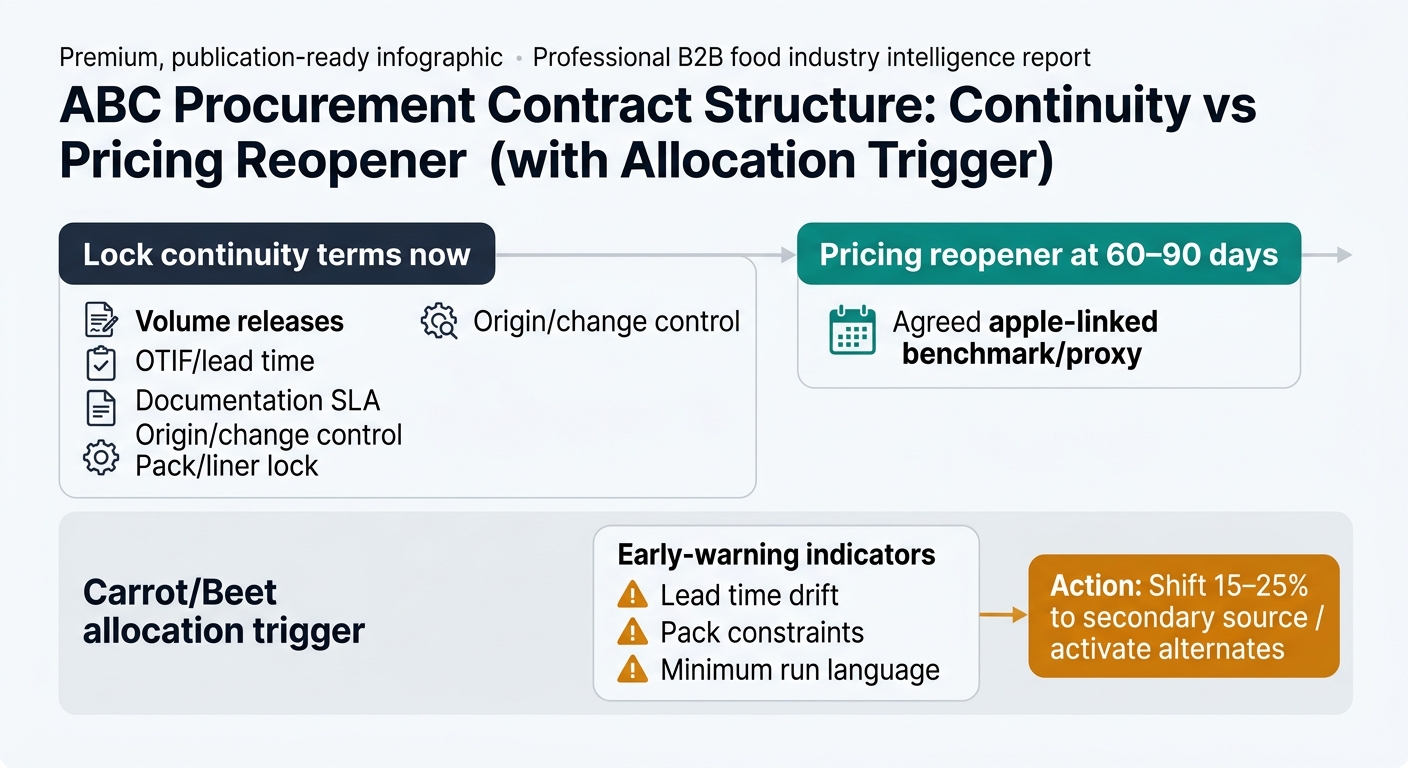
Procurement Impact: Use a two-step lever: (1) negotiate a short bridge (e.g., 60–90 days) at current price while you validate new-crop economics, then (2) reopen pricing with a pre-agreed trigger (e.g., “if agreed AJC benchmark ranges in agreed origins move >X% for Y consecutive weeks/months”). This protects supply continuity while preventing you from locking in a stale cost base.
Ask every incumbent for a one-page “lot economics” snapshot: production month range, pack format, and whether the quote reflects new-crop or carryover inventory. If they can’t answer cleanly, assume you’re paying for their optionality.
Add three non-price award gates: (1) allowable origin list + change control, (2) pack format/liner spec locked with penalties for unilateral changes, (3) documentation SLA (COA + traceability packet delivered within X days of shipment) tied to payment terms.
Intelligence-driven procurement improves outcomes not by “finding a cheaper quote,” but by tightening the decision loop: earlier signals, cleaner benchmarks, and fewer late-stage disqualifications.
The table’s “before/after” numbers (e.g., “30–60% fewer expedite events”) are credible targets but should be positioned as outcome ranges observed when governance is tightened, not guaranteed results. The structural logic is sound: ABC combines multiple upstream crops and processing constraints, so portfolio design (coverage, alternates, triggers) reduces the expensive tail (premium freight, emergency buys, line interruptions, QA hold inventory).
| Dimension | Before (traditional) | After (intelligence-driven) |
|---|---|---|
| Supplier coverage | 2–3 incumbents, same origins | 6–10 qualified options across 2–3 origin clusters |
| Pricing posture | Annual reprice; weak triggers | Component-aware triggers; 60–90 day reopeners during lag windows |
| Risk response | React after delays/holds | Early-warning thresholds tied to inventory, lead time, and origin signals |
| Measurable result | 1–3 expedite events/year; frequent spec exceptions | 20–50% fewer expedite events (typical target range); fewer spec waivers; tighter budget variance |
You typically don’t “save” only on unit price; you reduce the expensive tail: premium freight, emergency spot buys, line interruptions, and QA hold inventory. For many beverage programs, cutting just one major disruption can outweigh a 1–2% unit price concession.
Build a quarterly “ABC performance pack” that merges three views: (1) price vs last contract, (2) OTIF + lead time drift, (3) COA range creep (Brix/pH/color) by supplier and production month. The first time you see range creep, you have negotiating leverage before the plant complains.
The same disconnect mechanics show up in other fruit/veg inputs: inventory lags, capacity floors, and spec-driven cost-in-use.
Citrus concentrates and berry purees often show lag between farmgate/crop news and delivered concentrate pricing because processors sell through inventory and defend utilization floors; natural colors can gap up on small shocks because qualified capacity is narrow.
If you standardize how you detect lag windows, allocation signals, and COA drift, you get repeatable leverage across categories — and you stop relearning the same lesson every renewal cycle.
ABC concentrate forces procurement to manage multi-input volatility under tight governance — exactly where intuition breaks.
You’re balancing at least three upstream crops, two processing models (component vs pre-blend), and multiple failure modes (allocation, spec drift, documentation gaps). Separately, the U.S. market’s apple juice supply is meaningfully import-linked (with Turkey and China prominent in recent years), which increases exposure to freight/FX/trade and reinforces the need for benchmark discipline [5].
When you can consistently time buys around lag windows, prevent allocation surprises, and hold COA ranges stable, you demonstrate procurement value in the language leadership cares about: fewer disruptions, tighter forecast accuracy, and defensible supplier governance.
If your current ABC offers feel “sticky” even though apple signals are softening, don’t accept a flat annual lock. Use the lag window to negotiate continuity first (volume releases, pack format, documentation SLAs), then insert a 60–90 day pricing reopener tied to agreed apple-linked benchmarks and a separate trigger for carrot/beet allocation events. That structure exploits the most common disconnect in this market — finished concentrate pricing reflecting older-cost inventory — while protecting you from the fast spikes that come from narrower carrot/beet capacity. Teams that formalize this split typically avoid the two most expensive outcomes: overpaying during down cycles and scrambling into premiums during allocation.
(Analyzed at: Oct, 2026)
Given how often AJC pricing lags underlying fruit economics by weeks (commonly cited at roughly 6–16 weeks), the highest-confidence move right now is to stop signing “one-shot” annual ABC pricing. (blog.tridge.com) Lock continuity and governance immediately (origins, pack/liner, COA + traceability SLAs), then add a 60–90 day pricing reopener tied to an agreed AJC reference and a separate trigger for carrot/beet allocation signals. This works because it forces the supplier to re-price once the lots you’re actually receiving reflect new economics, while protecting you from the faster, capacity-driven shocks in the smaller components. On a typical beverage program, avoiding just one allocation-driven premium freight event or one month of paying a stale price floor can easily be worth mid–high six figures versus a “simple” annual lock, depending on volume and pack format.


