

Procurement teams usually don’t lose money on Munich malt because they “missed the market.” They lose money because they treat a processed, capacity-constrained input like a simple barley conversion. This guide shows how to spot the common lag between malting barley and Munich malt offers, translate it into contract structure, and tell a credible commercial story that Finance and Operations will sign.

Treat the barley-to-malt spread as a negotiation and timing tool, not a curiosity.
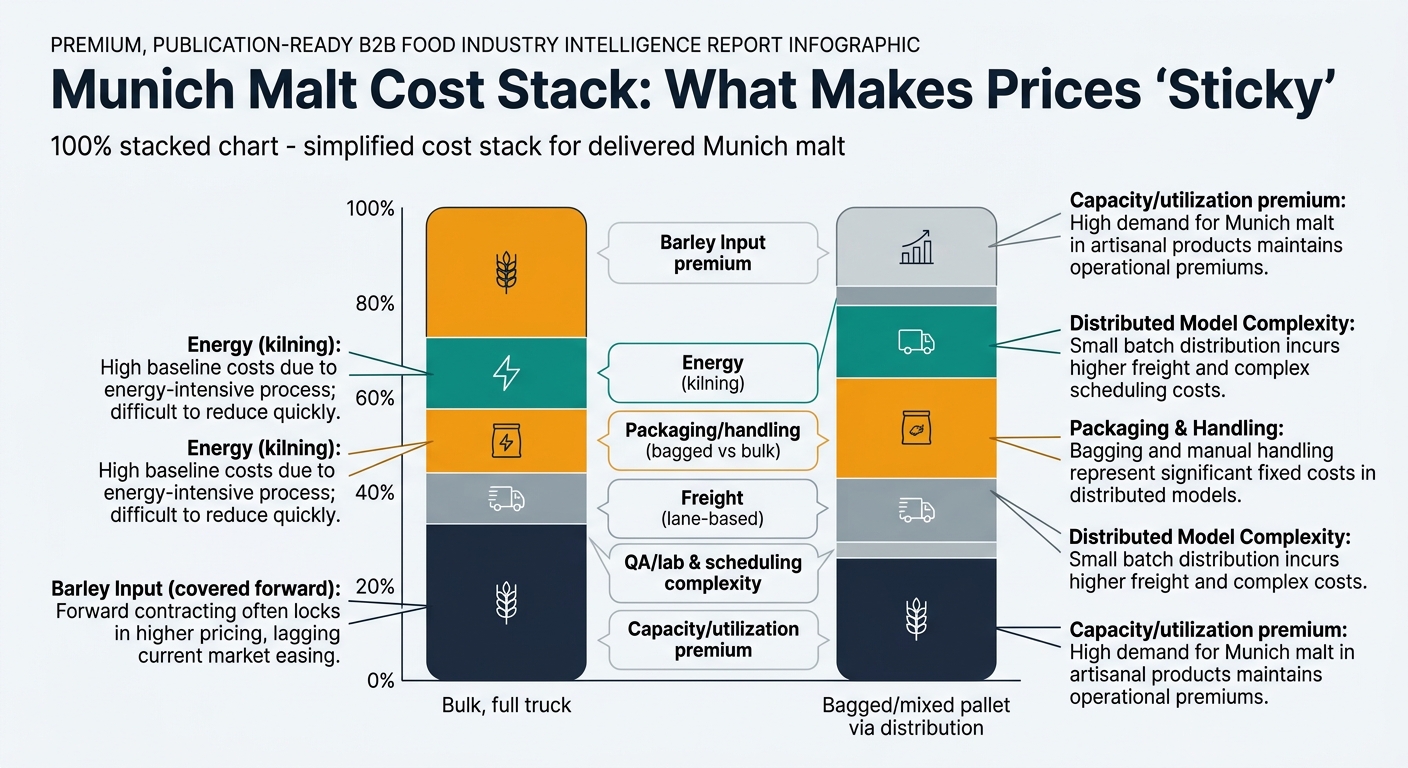
When barley softens but Munich malt doesn’t, ask for a two-part reset: (1) hold today’s price for continuity, (2) add a dated re-opener (60–90 days) tied to a transparent reference basket (barley + energy proxy + freight lane) and your realized service level (OTIF/lead time). You’re not asking for charity—you’re asking for pricing to reflect a lag you can evidence.
| Dimension | Before (traditional) | After (intelligence-driven) |
|---|---|---|
| Supplier set | 1 incumbent + 1 backup “on paper” | 3 qualified options with staged volumes |
| Benchmark cadence | Quarterly, anecdotal | Monthly comparable offers by lane/pack |
| Contract structure | Fixed price, weak service terms | Hybrid: volume bands + re-opener + OTIF-linked remedies |
| Volatility exposure | Spot coverage during shortfalls | Planned spot window + inventory triggers |
| Typical outcome | Overpay 5–10% on 30–50% of volume in lag periods | Capture 3–7% vs. passive buying + fewer expedites |
You stop debating “is this price fair?” and start deciding “what do we lock, what do we float, and what do we dual-source?”
Build a one-page “award logic” that pairs each supplier with a role: primary continuity, price challenger, surge capacity. Then align contract terms to that role (e.g., challengers must honor short lead times to earn volume).
If barley has softened recently but Munich malt offers haven’t moved, don’t wait passively for suppliers to “do the right thing.” Use the lag as leverage: secure near-term volume for continuity, then negotiate a dated price re-opener (60–90 days) tied to a transparent input basket and your service requirements. The window exists because maltsters are still pricing off earlier coverage and capacity constraints—your job is to make that visible and contract around it. Teams that consistently structure deals this way tend to capture mid-single-digit savings versus spot-chasing, while also reducing the operational cost of late deliveries and allocation surprises.
(Analyzed at: Jul, 2026)
EU malting barley indicators have been volatile into July 2026 (roughly ~€180–€206/ton depending on the snapshot), while energy remains a meaningful variable for kilned specialty malts—Germany’s wholesale power averaged about €102/MWh in Q1 2026. [1] If you’re renewing Munich malt in the next 45–90 days, don’t bet your budget on immediate pass-through: lock continuity for the next 6–10 weeks, then write a 60–90 day re-opener tied to a simple barley + energy proxy basket and enforceable OTIF/lead-time remedies. Teams that skip the re-opener typically give away a few percent in “sticky” pricing during the lag—then pay again in expediting when service tightens.


