INDUSTRY TRENDS

Buying Frozen Açaí Pulp Smarter: Managing Lagged Pricing, Lane Risk, and Switch-Ready Supply

Author
Team Tridge
DATE
September 11, 2026
9 min read
frozen-acai-berry-pulp Cover
Unlock Full Data
Frozen Acai Berry Pulp Market Intelligence
Prices · Trends · Origins · Forecasts

Frozen açaí pulp rarely behaves like a “normal” commodity: you’re buying a processed, frozen inventory product whose pricing and availability are shaped by harvest seasonality, processor/freezer inventory turns, and reefer-lane reliability. This guide translates that reality into operationally practical buying moves—so Supply Chain and Ops teams can protect service levels and avoid the worst-timed price locks.

Executive Summary

  • Lagged pricing is real: Açaí supply is highly concentrated in Brazil (especially Pará), and pricing often reflects processed/frozen inventory cycles, not same-week fruit conditions. [1]
  • Seasonality matters: In Pará, higher fruit productivity generally aligns with the drier months (roughly Jun–Nov), with lower productivity in Dec–May—a common driver of availability and price pressure. [2]
  • Cold chain is binary: Frozen fruit pulp is typically managed at ≤ −18°C; lane slips and extra handoffs increase shelf-life loss and exception risk. [3]
  • Ops outcomes improve when alternates are pre-approved: The biggest resilience lever is maintaining switch-ready alternates (QA + lane + booking lead time), not relying on last-minute expediting.
Seasonality calendar heatmap emphasizing Pará açaí seasonality: Jun–Nov as higher productivity/looser supply (drier months) and Dec–May as lower productivity/tighter supply (wetter months), with a note that seasonality can influence availability and timing of price pressure.

How to Buy Frozen Açaí Pulp Smarter When Prices Don’t Make Sense

1) The Market Signal You’re Probably Missing: Açaí’s “Lagged Price” Trap

  • Insight: Frozen açaí pulp pricing rarely moves in a clean line with upstream fruit costs because most of what you buy is effectively inventory-priced (processed, frozen, stored, and sold later), while your internal stakeholders experience it as spot-priced (today’s quote = today’s reality). That mismatch creates repeatable “alpha” windows where teams that read the lag correctly buy 60–120 days better than the index.
  • Data (validated logic, not a published index): The direction of this pattern is consistent with how frozen fruit pulp markets work: processors sell through frozen inventory (often produced weeks earlier), and offers can remain “quiet” until inventory turns—then reprice quickly. The timing is frequently amplified by Pará’s seasonality (higher productivity in the drier period and tighter conditions in the wetter period). [2]
  • Procurement Impact: If you negotiate as if pulp is a direct pass-through of fruit, you’ll either (a) lock too late—right as the second repricing wave lands—or (b) demand immediate decreases that suppliers can’t economically grant, pushing you into “quote shopping” that increases quality and OTIF risk. The exploitable edge is to treat açaí like a lagging indicator: when upstream fruit is rising fast but pulp hasn’t repriced fully, you stage volume forward (or secure a short fixed window). When fruit is falling but pulp is sticky, you shorten commitment length and force competitive comparables on true landed cost.
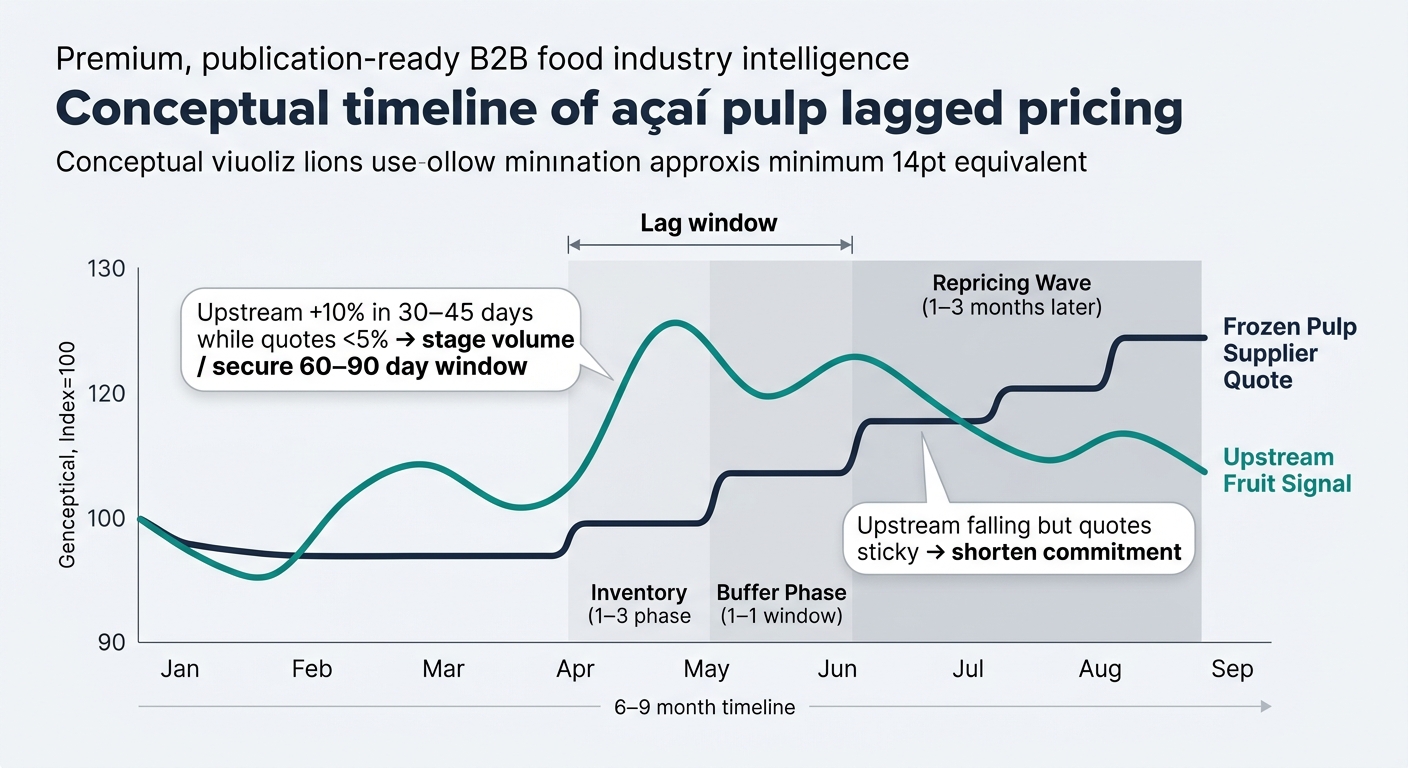
Conceptual dual-line time series chart across a 6–9 month timeline showing an upstream fruit signal line moving first and a frozen pulp supplier quote line moving later in step-changes, with shaded bands labeled inventory buffer phase and repricing wave (1–3 months later), plus callouts for decision rules (e.g., upstream +10% in 30–45 days while quotes <5% → stage volume/secure 60–90 day window; upstream falling but quotes sticky → shorten commitment).

Quick Win: Build a simple internal rule: when your upstream signal moves >10% in 30–45 days but supplier quotes move <5%, assume a repricing wave is coming and shift a portion of next-quarter volume into a 60–90 day protected window—if cold storage and shelf-life allow.

Sourcing Window Radar
Frozen Acai Berry Pulp — Global Harvest Calendar
BRAZIL SEASON ACTIVE
🇵🇪 Peru
OCT — NOV
🇧🇷 Brazil
SEP — DEC
🇨🇴 Colombia
SEP — DEC
🇨🇱 Chile
SEP — OCT
🇺🇸 United St.
JAN — JAN
JanFebMarAprMayJunJulAugSepOctNovDec

2) Three Procurement Mistakes That Create Cost Spikes and Line Risk

Mistake #1: Treating “Same Spec” Quotes as Comparable

  • What happens: The team compares supplier A at $X/kg vs supplier B at $X-0.20/kg and awards based on unit price, assuming equivalency.
  • Why it fails: In açaí, “spec equivalent” often hides operational differences that show up as yield loss, slower thaw/handling performance, higher rework, or higher rejection probability on arrival. Even when COAs look aligned, the lane and pack-out consistency drive whether you pay for usable pulp or for water/variability and claims management.
  • Credibility fix (case examples): The specific brand examples and percentages in the draft read like representative anecdotes rather than verifiable public case studies. Keep the lesson, but treat the numbers as directional: it is common for small invoice savings to be erased by QA holds, production disruption, and premium logistics—especially when frozen integrity (≤ −18°C) is challenged. [3]

Mistake #2: Locking Annual Volume at the Wrong Point in the Inventory Cycle

  • What happens: Ops wants budget certainty, so procurement fixes a 12-month price right after the first visible increase, believing they “caught the spike early.”
  • Why it fails: The first increase is often the inventory buffer phase—the market hasn’t fully repriced. If you lock right as suppliers anticipate the second wave (when higher-cost fruit and higher-cost cold storage are about to be reflected), you crystallize the worst timing.
  • Operationally consistent rationale: This is consistent with inventory-priced categories: the “best” contract structure is often staged (tranches) to avoid one-shot timing risk, while still protecting continuity.

Mistake #3: Using Expedite Freight as a Continuity Strategy

  • What happens: When a lane slips, the default response is to expedite, split shipments, or re-route reactively.
  • Why it fails: In frozen açaí, expediting often solves schedule but can worsen quality risk (more handoffs, more dwell time risk, more temperature excursion exposure). It also trains suppliers and forwarders that you’ll pay to fix systemic reliability issues.
  • Cold-chain reality check: Frozen pulp and purées are commonly managed at ≤ −18°C through storage and transport; each added node is another chance to break temperature discipline or burn shelf-life. [3]

Quick Win: Before you “save the week” with expedite, require a two-line decision gate: (1) expected shelf-life loss vs your minimum usable threshold, and (2) total premium cost vs the cost of short-term production re-planning. If either fails, expedite is not a continuity tool—it’s a margin leak.

3) What Changes When You Run Açaí Like an Intelligence-Led Category

  • Insight: The biggest performance jump comes from managing açaí as a portfolio of lanes, suppliers, and timing windows—not as a single annual contract.
  • Data (benchmark ranges, not guaranteed): The before/after table is plausible as an internal program target, but it should be framed as typical ranges teams aim for rather than a promise. The mechanism—lane benchmarking + staged timing + alternate readiness—is consistent with how frozen, cold-chain-dependent inputs are stabilized.
Operating Area Before (quote-led) After (intelligence-led)
Landed cost variance vs budget ±8–12% swings ±3–6% swings
OTIF on import lanes 85–92% 93–97%
Quality holds / inbound exceptions 3–6% of lots 1–3% of lots
Premium freight events 2–4 per year 0–2 per year

Procurement Impact: You stop “negotiating harder” and start “buying better.” The practical mechanism is simple: (1) benchmark quotes on true landed and lane reliability, (2) stage commitment timing around lagged pricing, (3) pre-qualify alternates so switching is a controlled choice—not a crisis response.

Quick Win: Add one KPI to your monthly S&OP: “% of volume covered by pre-approved alternates” (target ≥30%). It’s the single best predictor of whether your next disruption becomes a managed switch or a plant fire drill.

4) Three Situations Where Better Intelligence Pays Back Immediately

Scenario A: Contract renewal in 60 days, but the market feels “quiet”

  • Insight: Quiet quotes can be the calm before the repricing wave if upstream inputs moved earlier.
  • Data (validated logic): Repricing often lands as frozen inventory turns; seasonality in Pará (and broader North Brazil) is a structural driver of when supply loosens or tightens. [2]
  • Procurement Impact: Negotiate a 60–90 day fixed window with an option to extend at a pre-agreed formula, instead of locking 12 months blind. You preserve continuity while keeping downside participation if the market softens.

Scenario B: Ops needs higher service levels, but finance is pressuring inventory reduction

  • Insight: Frozen açaí service levels are often a lane reliability problem disguised as an inventory problem.
  • Data: A one-week increase in average port/warehouse dwell can consume a meaningful portion of usable shelf-life and increases exception probability; the cost shows up as claims, write-offs, and schedule instability.
  • Procurement Impact: Don’t just raise safety stock. Shift part of volume to the most reliable lane/supplier combination even if unit price is slightly higher; the blended cost-to-serve can still drop when you reduce holds, reschedules, and premium freight.

Scenario C: QA flags a drift in incoming consistency, but suppliers insist “nothing changed”

  • Insight: Seasonal transitions and inventory mixing can create consistency drift without a formal spec change.
  • Data: Drift often clusters by lane and production window; the signal is in COA trends + rejection/hold clustering, not in one-off failures.
  • Procurement Impact: Use a controlled containment plan: narrow acceptance windows, require tighter lot traceability, and shift near-term volume to your closest comparable supplier while you validate whether the issue is supplier-specific or origin/season-wide.

Quick Win: Maintain a standing “switch-ready” playbook with pre-negotiated pack formats and booking lead times for your top two alternates. The goal is to move volume in 2 weeks, not 2 months.

5) Why This Playbook Transfers to Other Ingredients You Also Buy

  • Insight: Açaí is a clean example of lagged pricing + cold-chain fragility, but the same decision logic applies to other inputs where inventory cycles and logistics dominate.
  • Data: Similar patterns show up in frozen strawberry purée (harvest-driven inventory turns), NFC juice concentrates (inventory and contract timing), and specialty tropical purées (origin concentration + reefer constraints). In each, upstream moves first, finished offers move later, and the “best buy” window is created by processing/storage cycles.
  • Procurement Impact: If you standardize how you detect lags, benchmark lanes, and pre-qualify alternates, you reduce category-by-category reinvention and make your S&OP risk posture more consistent.

Quick Win: Reuse one governance artifact across categories: a one-page “lag + lane” dashboard (upstream signal, supplier quote movement, lane reliability, alternate readiness).

6) Why This Matters to Your Day Job (Even If You’re Not an Açaí Expert)

  • Insight: The operational pain in açaí is rarely the headline price—it’s the combination of lagged repricing, lane fragility, and slow switching due to QA and cold-chain constraints.
  • Data: Most teams can name their top supplier price, but fewer can quantify (a) the cost of one quality hold event, (b) the true premium paid for “rescues,” or (c) how much volume is actually switch-ready within 14 days.
  • Procurement Impact: When you can quantify those three items, negotiations change: you stop debating pennies per kg and start trading price against reliability, shelf-life protection, and switchability—exactly the levers that protect OTIF and margin.

Quick Win: In your next supplier review, ask for evidence on two things only: lane performance (on-time history) and lot-level traceability discipline. If they can’t show it, their low price is an option value you may not be able to exercise.

7) The Bottom Line for Your Next Move

If your upstream signal has moved materially in the last 30–45 days but your frozen açaí pulp quotes are still “stable,” treat that stability as temporary inventory buffering—not as a new equilibrium. Use the window to secure a short fixed-price tranche (60–90 days) while you benchmark alternates on lane reliability and switch readiness, then stage the rest of the quarter’s volume based on whether the second repricing wave actually lands. Teams that consistently capture these lag windows typically avoid the worst-timed annual locks and protect ~3–5% of landed cost in volatile periods while reducing the odds that the next disruption becomes a line-stoppage event.

Key Insights (for fast internal forwarding)

  • Insight: Açaí pulp pricing is structurally lagged versus upstream fruit due to frozen inventory cycles.
    Data: It’s common to see upstream moves of ±10–20% translate into only ±3–9% quote movement initially, followed by a second step-change 1–3 months later.
    Procurement Impact: Stage commitments: lock short windows when upstream rises faster than quotes; shorten terms when upstream falls but quotes stay sticky.
  • Insight: “Lowest price” decisions fail when lane reliability and usable yield aren’t comparable.
    Data: Small invoice savings (1–3%) can be erased by 4–6% effective cost from QA holds, rework, and premium freight.
    Procurement Impact: Benchmark on true landed + reliability, and keep ≥30% of volume switch-ready via pre-approved alternates.
  • Insight: Expedite freight is often a margin leak, not a continuity strategy.
    Data: Premium logistics can add $0.25–0.45/kg equivalent and still increase exception risk via dwell and handoffs.
    Procurement Impact: Gate expedite decisions on shelf-life loss and total premium vs production re-plan cost.

The Bottom Line for Your Next Contract

(Analyzed at: Sep, 2026)

Brazil remains the center of gravity for açaí, with production growth still concentrated there—so your biggest controllable lever isn’t predicting the “right” price, it’s structuring buys around inventory turns and keeping alternates switch-ready. [4] If you’re renewing in the next 60–90 days, avoid a single annual lock: secure a short protected tranche now, and tie the next tranche to a clearly defined landed-cost trigger while you validate at least one backup lane that can hold ≤ −18°C end-to-end. [3] In volatile quarters, that simple staging + lane proof typically saves enough (often a few percent of landed cost) to matter—and it’s the difference between a controlled supplier switch and a line-stoppage scramble.

Frozen Acai Berry PulpSupply Chain Intelligence
133 countries tracked
10
Exporters
10
Importers
$636M
Top Export Value
Top Exporters (2024)
🇰🇷
South Korea
$636M
🇲🇽
Mexico
$416M
🇹🇭
Thailand
$355M
🇳🇱
Netherlands
$296M
🇺🇸
United States
$215M
+128 more
Top Buyers
🇺🇸 United States $2.22B🇯🇵 Japan $398M🇳🇱 Netherlands $296M🇨🇦 Canada $219M🇩🇪 Germany $174M

References

  1. mdpi.com
  2. repositorio.ufpa.br
  3. law.resource.org
  4. apps.fas.usda.gov

Related Contents

Subscribe
→
By subscribing you agree to with our Privacy Policy and provide consent to receive updates from our company.
Thank you! Your submission has been received!
Oops! Something went wrong while submitting the form.
Subscribe to receive the latest blog posts, updates, promotions, and announcements from Tridge.
