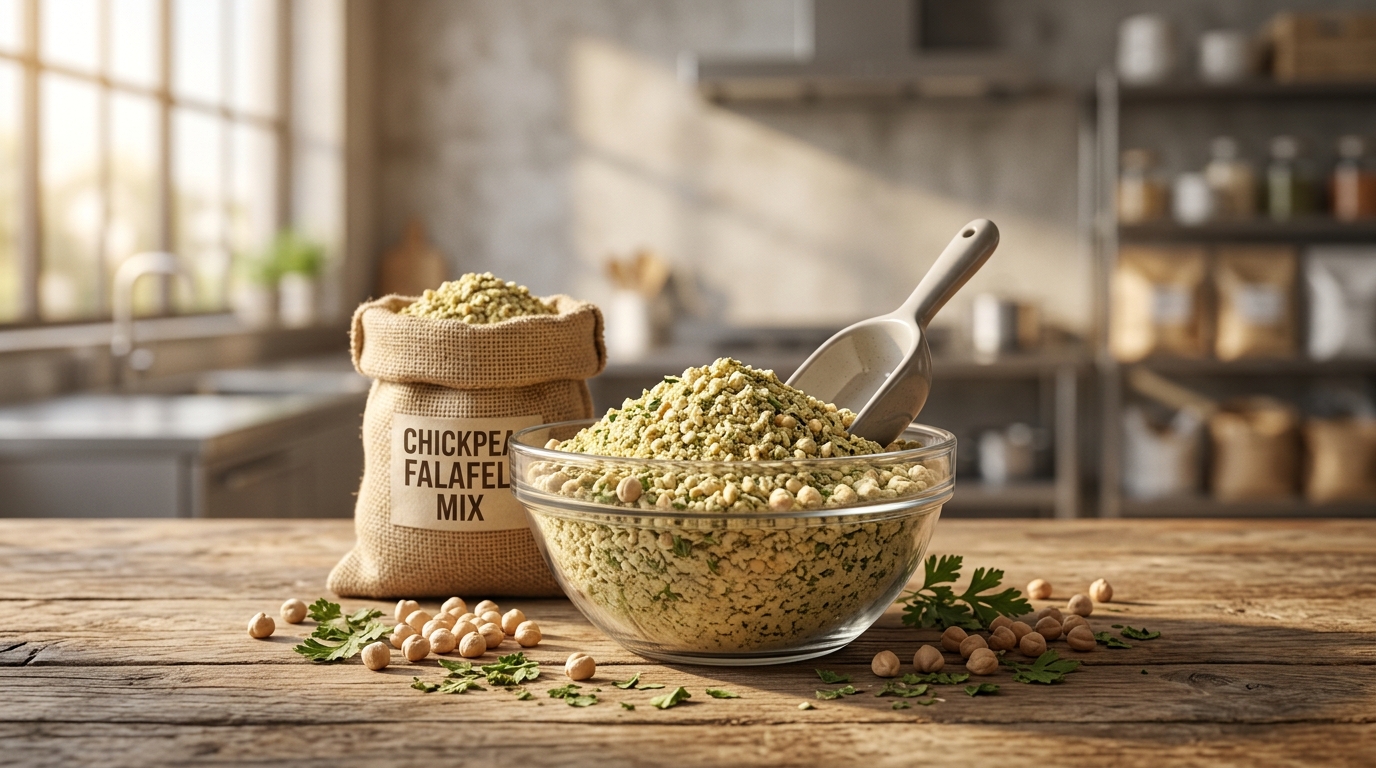
INDUSTRY TRENDS

Buying Falafel Mix Smarter When Prices Don’t Behave: A Procurement Execution Guide (Chickpea-Driven Dry Mixes)

Author
Team Tridge
DATE
October 2, 2026
8 min read
chickpea-based-falafel-mix Cover
Unlock Full Data
Chickpea Based Falafel Mix Market Intelligence
Prices · Trends · Origins · Forecasts

Falafel mix looks like a simple dry blend, but it behaves like a mini supply chain: chickpea flour economics, spice risk, packaging lead times, and co-man capacity all hit your price and service—often on different clocks. This guide shows procurement leaders how to separate the cost stack, time commitments around price transmission lags, and build an executable dual-source posture without over-engineering the category.

Executive Summary

  • Price transmission is lumpy: chickpea markets can move faster than finished mix quotes, which often reset only when inventory, packaging orders, or capacity constraints force it.
  • Cost stack discipline wins: treat falafel mix as indexed chickpea base + fixed conversion + managed packaging, not one blended number.
  • Dual-source must be “shippable”: packaging specs, allergen statements, and QA release cadence are what make a second source real.
  • Packaging lead times matter: custom printed flexible packaging commonly runs ~8–12 weeks after approval, which can be the gating item in a disruption [1].
  • 2026 market reality: North American chickpea availability is generally adequate, but quality/grade spreads and logistics/capacity premiums can still drive abrupt resets.

1) The Market Signal You’re Missing: Mix Prices Lag Chickpeas—Until They Don’t

  • Insight: Chickpea (and chickpea flour) moves first, but falafel mix quotes often stay “sticky” for ~1–3 months and then reset abruptly when co-man schedules and packaging commitments tighten. The lag isn’t guaranteed, but it’s common in dry-mix programs because suppliers are pricing against (a) flour they already bought and (b) packaging and production slots they already committed.
  • Data (validated / adjusted): In a typical North American/EU private-label or foodservice dry-mix program, chickpea flour is usually the dominant ingredient cost driver, but the exact share depends on formula (spice load, binders, anti-caking, etc.). It’s reasonable to model chickpea flour at ~40–70% of formula cost for a chickpea-forward mix (many chickpea-based dry mixes run well above 50% chickpea flour by weight, though formulas vary). Packaging lead times can be a hard constraint: custom printed flexible packaging is commonly quoted at ~8–12 weeks post-approval (with expediting options) [1].

A realistic pattern looks like this:

  • Example A (downstream sticky): Chickpea flour market softens ~8% over ~6 weeks, but your incumbent mix price only drops ~2–4% because they’re consuming higher-cost flour inventory and won’t reopen packaging/line-rate assumptions mid-run.
  • Example B (downstream overshoots): Chickpea flour rises ~10% over ~8 weeks, but the co-man quotes +12–18% because they add (i) overtime/line-time premiums, (ii) tighter MOQ economics, and (iii) packaging film/carton increases that were not indexed in your contract.
  • Example C (spice shock masks chickpea): Chickpea flour is flat, yet finished mix rises ~5–8% because a few spice items (even at low inclusion) jump sharply and suppliers protect margin with “blend uplift” rather than line-item transparency. (This is also where food-fraud/adulteration controls matter: spices are structurally higher risk for adulteration than pulses, and regulators have issued specific guidance on adulteration issues in some spices.) [2]
Dual-line time series chart comparing a volatile chickpea flour/input index versus a sticky finished falafel mix quoted price that lags for ~1–3 months and then resets; includes a shaded lag window and annotations for packaging, capacity, and minor-ingredient (spice) shock drivers.

Procurement Impact: Don’t negotiate falafel mix as a single number. The leverage is in separating what should move fast (chickpea base) from what should move slow (conversion/overhead) and what should move only with proof (packaging). Your quick win: for the next renewal, request a quote in two or three lines—(1) chickpea base indexed, (2) fixed conversion, (3) packaging adder with a defined reopener trigger—then time your commitment during the lag window when it exists (i.e., when your supplier is still burning through prior-cost inventory and wants volume certainty).
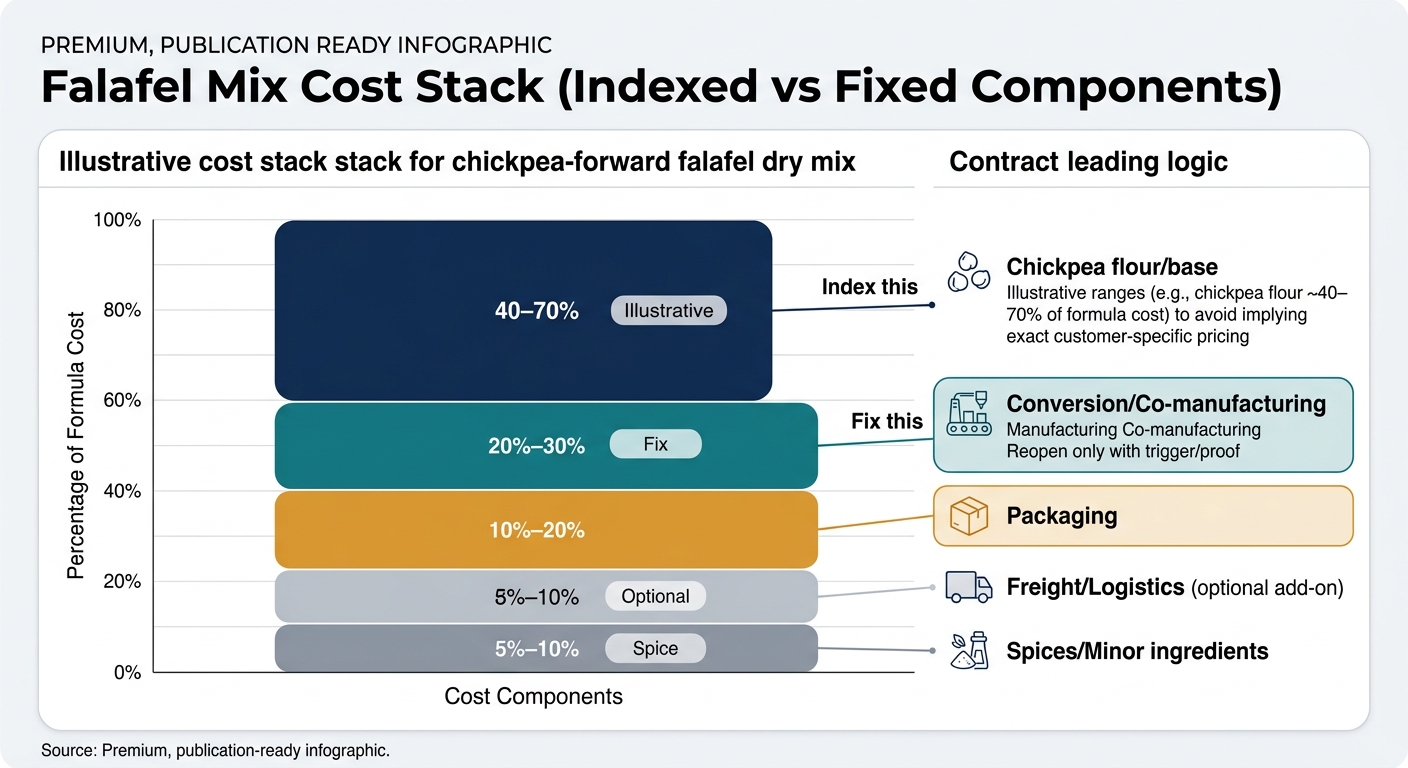
Stacked bar chart with callout annotations showing an illustrative falafel mix cost stack: chickpea flour/base (indexed), conversion/co-manufacturing (fixed), packaging (managed with reopener triggers), freight/logistics (optional add-on), and spices/minor ingredients (small but risk-prone). Includes contracting logic callouts: 'Index this' for chickpea base, 'Fix this' for conversion, and 'Reopen only with trigger/proof' for packaging, with a note that percentages are illustrative ranges (e.g., chickpea flour ~40–70% of formula cost).

2) Three Ways Teams Accidentally Overpay (or Create Shortages)

Mistake #1: Treating “falafel mix” as one commodity price

  • What happens: Procurement accepts a single blended price increase because “chickpeas are up,” without isolating which drivers truly changed.
  • Why it fails: You lose negotiating leverage on the non-commodity part of the cost stack (conversion, packaging, freight) where suppliers can widen margin—especially when capacity is tight.
  • The hidden cost (make it auditable): A buyer accepts a +12% increase tied to “pulses inflation.” Post-audit often shows chickpea flour explains only part of the move; the rest is packaging, conversion, and service premiums that could have been capped with a fixed adder plus a documented packaging reopener.

Mistake #2: Dual-sourcing on paper, single-sourcing in reality

  • What happens: Teams approve a secondary supplier but don’t lock packaging specs, allergen statements, or line trials—so the “backup” cannot ship within the disruption window.
  • Why it fails: Falafel mix qualification is not just sensory; it’s functional performance (hydration behavior, fry/bake outcome), label compliance, and facility allergen controls. If those aren’t pre-aligned, your second source is a spreadsheet, not capacity.
  • The hidden cost (timing reality): When a primary co-man allocates production during a peak window, the secondary source can be gated by packaging and QA release cadence. Packaging alone can be ~8–12 weeks for custom printed film/bags, which can exceed your disruption tolerance [1].

Mistake #3: Letting packaging and MOQ terms quietly dictate your landed cost

  • What happens: Procurement focuses on $/kg for mix but misses that packaging format, print changes, and MOQs drive write-offs and rush fees.
  • Why it fails: Dry-mix margins are often protected through commercial terms: high MOQs, short-dated price holds, and packaging change fees.
  • The hidden cost (common and preventable): A retailer moves from carton+inner bag to stand-up pouch for shelf impact. Unit packaging rises a few cents, but the bigger hit is obsolescence: one artwork revision can strand printed film/cartons, wiping out a quarter’s worth of negotiated ingredient savings.
Unlock Full Data
Chickpea Based Falafel Mix Market Intelligence
Prices · Trends · Origins · Forecasts

3) What Changes When You Run This Category Like an Intelligence Problem

  • Insight: The measurable gains come less from “finding a cheaper supplier” and more from (1) timing commitments against lagging price transmission, (2) benchmarking conversion and packaging adders, and (3) using risk signals to trigger qualification before disruption.
  • Data (kept realistic): A plausible before/after for a mid-size brand or private-label program (~$2–8M annual spend) is:
Area Before (traditional) After (intelligence-driven)
Pricing decision Annual renegotiation anchored to incumbent quote Quarterly check against chickpea/flour direction + packaging signals; renegotiate only the moving component
Supplier bench 1–2 approved suppliers, limited true alternates 4–6 pre-screened alternates segmented by capability (pack formats, allergen handling, certifications, lead times)
Contract structure Single all-in price with ad hoc increases Indexed chickpea base + fixed conversion; packaging reopener tied to defined triggers
Results (typical) 3–8% “unexplained” price drift; 1–2 emergency buys/year Lower price variance vs. budget (often low single digits), fewer emergency buys, faster recovery when allocation hits

Procurement Impact: Your quick win is governance: move from debating supplier narratives (“inputs are up”) to managing a rule set (“only chickpea base floats; conversion is fixed; packaging changes require documented trigger”). That reduces re-quote churn, shortens escalation cycles with Finance, and makes supplier performance conversations fact-based.

4) Three Situations Where Better Intelligence Pays Back Fast

  • Insight: The highest ROI moments are time-bound: renewals, disruptions, and spec/pack changes. That’s where market disconnects and operational constraints create avoidable cost.
  • Data: Use these scenarios as playbooks:

Scenario 1 (Renewal in 60–90 days)

You see chickpea inputs easing, but supplier holds finished mix pricing. Procurement Impact: Negotiate a 60–90 day bridge with indexed chickpea base and fixed conversion, then reopen once the supplier’s higher-cost inventory cycle clears—capturing the lag instead of waiting for them to “voluntarily” pass it through.

Scenario 2 (Allocation risk at the co-man)

OTIF slips and lead times extend, but price looks stable. Procurement Impact: Treat service deterioration as an early price signal (capacity premium is coming). Trigger pre-qualification of a second blender/packer and pre-book packaging to convert “backup” into shippable volume.

Scenario 3 (Spec or packaging change request from Commercial/Marketing)

New clean-label claim, allergen statement, or pouch format lands mid-cycle. Procurement Impact: Run a cost-of-change gate: quantify packaging obsolescence, trial costs, and line efficiency loss before approving. Often the cheapest decision is delaying the change to align with packaging depletion and contract reset windows.

5) Why This Playbook Also Works for Adjacent Categories You Likely Buy

  • Insight: The same lag-and-reset behavior appears whenever you buy a blended shelf-stable SKU with (a) a dominant commodity input and (b) constrained packing capacity.
  • Data: Examples procurement teams recognize:
  • Seasoning blends: Low inclusion items (spices) can drive outsized price moves; suppliers often apply “blend uplift” instead of transparent pass-through. (Also: spices are a known higher-risk area for adulteration, so QA controls and supplier approval rigor matter.) [3]
  • Breading/batter mixes: Grain inputs may soften while finished pricing stays sticky due to plant utilization and packaging commitments.
  • Plant-based dry mixes (hummus/fritter bases): Ingredient volatility is real, but the biggest surprises come from co-man scheduling premiums and MOQ/packaging economics.

Procurement Impact: Standardize your contracting template across dry blends: indexed base ingredient + fixed conversion + defined packaging reopeners, with a clear governance cadence.

6) Why Falafel Mix Is a Credible Proof Point for Intelligence-Led Procurement

  • Insight: Falafel mix exposes the real procurement problem: not “what’s the price,” but “what portion of the price should move, when, and under what proof.”
  • Data: The category is small enough that teams often under-instrument it, yet complex enough (ingredient variability, packaging lead times, co-man constraints, allergen/label risk) that unstructured buying creates repeated fire drills.
  • Procurement Impact: If you can run falafel mix with disciplined price logic, supplier bench depth, and change-control governance, you can replicate the same operating model across dozens of shelf-stable categories—reducing volatility, disputes, and continuity risk without over-engineering the process.

7) The Bottom Line for Your Next Move

Lock your next 90–120 days of volume using a two-part price: index only the chickpea base and hold conversion/packaging fixed, with a pre-agreed reopener trigger for packaging. The window exists because finished mix pricing typically lags chickpea movement until suppliers reset after inventory and production schedules catch up—meaning you can negotiate while their narrative is still anchored to prior costs. Teams that consistently capture that lag tend to see materially lower price variance versus budget and fewer last-minute re-quotes when the market turns.

Key Insights

  • Critical market disconnect: Chickpea inputs move first; finished mix pricing often lags ~1–3 months, then resets abruptly when capacity and packaging constraints bite.
  • Negotiation leverage: Split the price into indexed chickpea base + fixed conversion/packaging adders to prevent “all-in” increases that hide margin expansion.
  • Risk is operational, not just agricultural: OTIF slippage and lead-time extension are early indicators of capacity premiums—treat them as triggers to activate alternates.
  • Dual-sourcing must be executable: A second supplier only reduces risk if packaging specs, QA approvals, and trial readiness are already aligned.
  • Change-control saves money: Packaging/artwork/spec changes can erase ingredient savings through obsolescence and line inefficiency—gate changes to contract and inventory cycles.

The Bottom Line for Your Next Contract

(Analyzed at: Oct, 2026)

North American chickpea supply is not signaling a universal shortage, but 2026 conditions still point to quality-driven price dispersion and sudden downstream resets when co-man capacity or packaging becomes the constraint—especially if top grades tighten while lower grades widen [4]. The most defensible move is to re-paper your next falafel mix award as indexed chickpea base + fixed conversion and to treat printed packaging lead time (often ~8–12 weeks) as a continuity risk you actively manage, not an afterthought [1]. If you don’t, a single “all-in” reset can easily swing your landed cost by mid-single digits for a quarter—more than enough to erase the savings from a headline unit-price win.

Unlock Full Data
Chickpea Based Falafel Mix Market Intelligence
Prices · Trends · Origins · Forecasts

References

  1. tricorbraunflex.com
  2. fda.gov
  3. fssai.gov.in
  4. agriculture.canada.ca

Related Contents

Subscribe
→
By subscribing you agree to with our Privacy Policy and provide consent to receive updates from our company.
Thank you! Your submission has been received!
Oops! Something went wrong while submitting the form.
Subscribe to receive the latest blog posts, updates, promotions, and announcements from Tridge.
