INDUSTRY TRENDS

Buying Andouille Smarter When Pork Drops but Finished Prices Don’t: A Practical Sourcing Playbook

Author
Team Tridge
DATE
July 29, 2026
8 min read
classic-andouille-sausage Cover
Unlock Full Data
Classic Andouille Sausage Market Intelligence
Prices · Trends · Origins · Forecasts

This guide helps Sales and customer-facing procurement conversations explain a common (and frustrating) reality in classic andouille: pork inputs can soften while finished smoked-sausage pricing stays sticky. The goal isn’t to “win” an index argument—it’s to contract the real bottlenecks (inspected capacity, smokehouse time, and cold-chain execution) and capture value during predictable lag windows.

Executive Summary

  • Decoupling is normal: Finished andouille can lag pork moves because plants price around capacity, inventory carry, and service risk, not just meat inputs.
  • Negotiation window: The most actionable leverage often appears ~4–12 weeks after a meaningful pork move, before replacement-cost relief is fully reflected in supplier economics.
  • Contract what matters: Tie price mechanisms to OTIF/lead time/ship windows so “savings” don’t get paid back in expedites and shorts.
  • Resilience beats heroics: Pre-qualified alternates can cut disruption response from months to weeks, but only if sensory/QA/logistics are validated in advance.

1) The Market Signal You’re Missing: Why Pork Can Fall While Andouille Stays High

Classic andouille pricing rarely tracks pork in a clean, same-month way. The “alpha” is recognizing when the finished-goods market is being held up by capacity, inventory, and service risk—not by meat input costs—and using that disconnect to reset your negotiation posture.
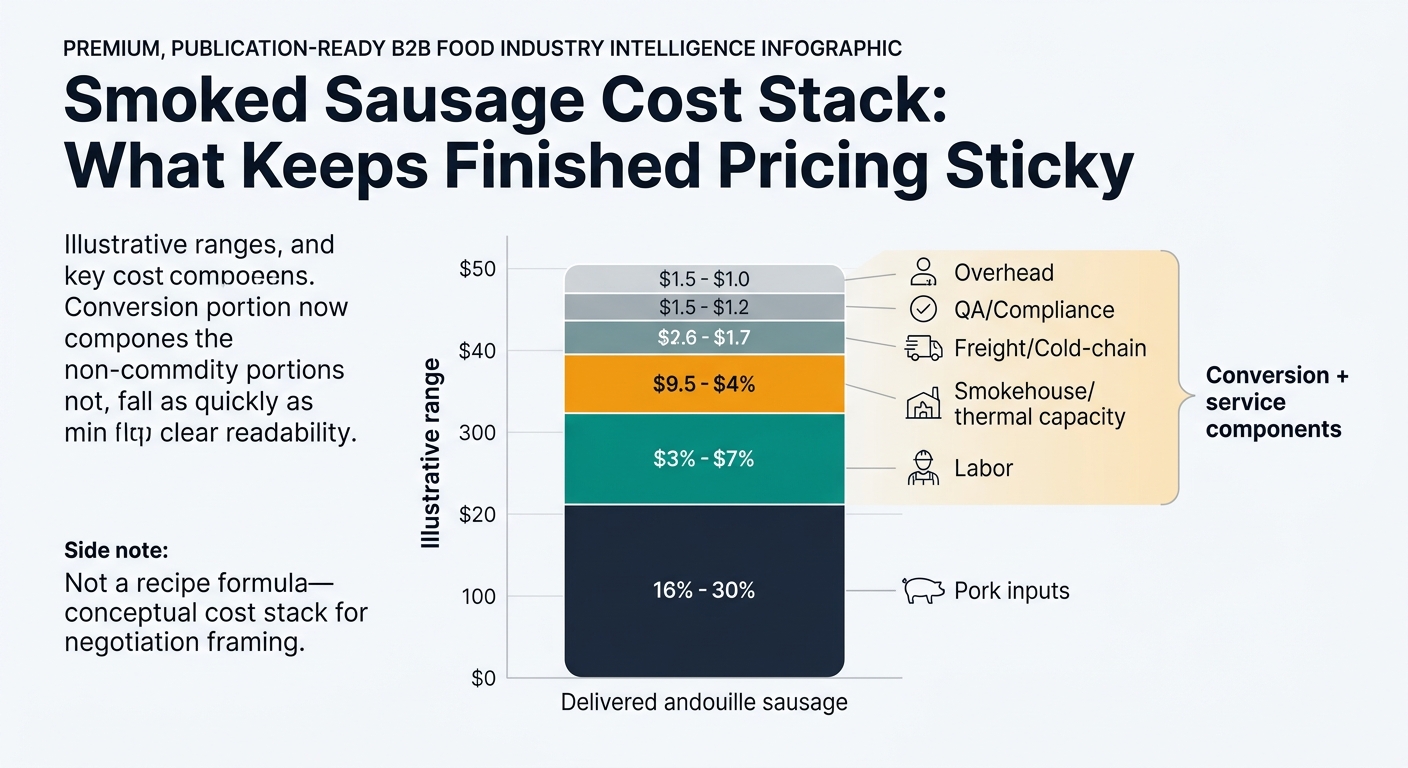
Why Pork Inputs and Finished Andouille De-Couple (and how to trade it)

  • Insight: A 6–10% drop in pork input markets can show up as only a 1–3% movement in delivered andouille pricing for 60–120 days, especially for smoked/cooked SKUs. (Directional relationship is realistic; the exact percentages vary by formula, inventory position, and contract structure.)
  • Data: In a typical smoked sausage run, pork is usually the largest cost driver, but the price you pay also embeds (1) smokehouse/thermal capacity scarcity, (2) labor and sanitation downtime, (3) inventory bought at last month’s higher pork cost, and (4) OTIF risk premiums when refrigerated capacity tightens. A realistic example: a pork input benchmark drops ~8% over 4–8 weeks; your supplier’s weighted-average raw material cost may only fall ~3–5% in that same window if they are still consuming higher-cost frozen trim/blocks purchased earlier. Meanwhile, if their smokehouse schedule is >90% committed, they have little incentive to “give back” margin quickly.
  • Stacked bar chart showing an illustrative delivered andouille cost stack (pork inputs, labor, smokehouse/thermal capacity, packaging, freight/cold-chain, QA/compliance, overhead) with highlighted conversion and service components that tend to stay sticky; includes a note that it is conceptual for negotiation framing, not a recipe formula.
  • Procurement Impact: Don’t negotiate as if you’re buying pork; negotiate as if you’re buying line time + compliance + cold-chain execution. Your leverage window is when pork has already moved down but (a) the supplier is still quoting old formulas, and (b) you can credibly offer something they value more than price—stable call-offs, fewer changeovers, or a frozen program that smooths their schedule.
Dual-line 6–12 month indexed timeline (base=100) comparing a pork input benchmark dropping over 4–8 weeks versus a smaller, slower decline in finished andouille delivered price; includes a shaded band labeled typical pass-through lag of about 4–12 weeks, callouts for inventory carry/blended cost, smokehouse and inspected capacity, and service-risk premium (reefer/labor), plus an annotation that the pattern is illustrative and magnitude varies by formula, inventory, and terms.

The two most exploitable anomalies

  • Insight: The biggest negotiation wins come from (1) inventory lag and (2) service-risk premiums that stay embedded after conditions normalize.
  • Data:
  • Inventory lag: Many plants effectively carry several weeks of combined raw/frozen, WIP, and finished-goods coverage for smoked items, which creates a built-in delay between pork moves and true replacement cost.
  • Service-risk premium: During tight reefer markets or when plant attendance is volatile, suppliers bake in “just-in-case” pricing. When freight loosens or staffing stabilizes, that premium often persists unless challenged. Recent reefer market reporting shows spot rates can swing sharply around seasonal capacity events, reinforcing why suppliers protect margin when cold-chain risk rises [1].
  • Procurement Impact: Build a simple “disconnect tracker” for every renewal: pork input change vs. supplier price change vs. your own order stability (forecast accuracy, rush orders, changeovers). When pork is down and your demand plan is stable, you can credibly ask for a temporary giveback (e.g., 60–90 day rebate or a short-term price band) without forcing a full list-price reset.

Key Takeaways

  • Trade the bottleneck: You’re not just buying meat; you’re buying inspected capacity and cold-chain reliability.
  • Time your asks: The best leverage is often 30–90 days after pork moves, before supplier quotes fully “catch up.”
  • Pay for what you need: If you need OTIF and shelf-life, price must be tied to service terms—not just commodity indices.

2) Three Ways Teams Usually Lose Money (Even When They “Win” the Price)

Mistake #1: Negotiating only off a pork index

  • What happens: The buyer demands a fixed discount because pork is down, and the supplier agrees—then quietly tightens service (longer lead times, constrained ship windows, less flexibility on pack changes).
  • Why it fails: Andouille is capacity- and compliance-constrained; if you don’t contract for line time and service, you’ll “save” 2% and then spend 3–6% on expedites, substitutions, or short shipments.
  • The hidden cost (illustrative pattern): Teams that push only for price concessions often see priority shift toward steadier accounts when schedules tighten. The operational penalty shows up as OTIF slippage during peak weeks, which can force emergency buys at a higher net landed cost than the concession.

Mistake #2: Treating backup supply as a paper exercise

  • What happens: Teams “dual source” by collecting a second quote, but they don’t run samples, validate smoke profile, or confirm cold-chain performance.
  • Why it fails: When the primary plant has a hold, audit issue, or capacity shock, the backup can’t ship to spec or can’t pass QA fast enough. The gap is rarely the recipe alone; it’s process control (smokehouse consistency, cook/shrink yield, packaging integrity).
  • The hidden cost: A retailer-approved label change and sensory re-approval can take 8–16 weeks; during that window, you pay spot premiums or accept out-of-stocks that cost far more than the “savings” from single-sourcing.

Mistake #3: Switching suppliers without pricing the switch-cost stack

  • What happens: A new co-packer offers a 3–5% lower quote, so procurement flips volume quickly.
  • Why it fails: Qualification (HACCP review, allergen program validation, label sign-off), trial runs, and logistics setup add time and cost; quality drift shows up as claims, purge, casing failures, or inconsistent heat/smoke.
  • The hidden cost: Realistic switch-cost stack is often 2–4% of annual spend in year one (trials, rework, QA time, freight lane learning). If complaint rates rise even modestly (e.g., +0.5–1.0% of cases), the “cheaper” supplier can become more expensive by quarter two.
Unlock Full Data
Classic Andouille Sausage Market Intelligence
Prices · Trends · Origins · Forecasts

3) What Changes When You Run the Category Like an Intelligence Problem

Before (Traditional approach)

  • Sourcing: Two incumbent quotes, refreshed at renewal
  • Benchmarking: Informal comparison to last year’s price and a pork index snapshot
  • Risk assessment: “They’ve always delivered”
  • Result: You overpay during lag windows (often 3–8% on a meaningful share of volume) and still get surprised by capacity constraints 1–3 times per year.

After (Intelligence-driven approach)

  • Sourcing: Supplier landscape segmented by capability (smoked/cooked vs. fresh, natural vs. collagen casing, retail pack vs. foodservice bulk) and by available line time
  • Alerts: Triggers when pork benchmarks move beyond a threshold and when freight/labor/capacity signals imply the finished-goods market won’t follow
  • Risk scoring: Concentration exposure by plant + lane + SKU, updated monthly
  • Result (typical, not guaranteed): More predictable negotiations (e.g., 2–4% better net price capture during disconnect periods), improved OTIF (commonly +3–7 points when service terms are contracted), and faster time-to-switch (cutting contingency activation from ~8–12 weeks to ~2–6 weeks with pre-qualification).

4) Three Moments When Better Intelligence Pays Back Immediately

Scenario A: Renewal in 60 days and pork just moved

  • Insight: Renewals are where suppliers “bank” the lag—keeping prices high even after input relief.
  • Data: If pork benchmarks have fallen 6–10% in the last 4–8 weeks, replacement-cost relief is coming—but may not yet be reflected in their blended inventory cost.
  • Procurement Impact: Push for a short-term mechanism (90-day price band, rebate, or index collar) rather than fighting for a permanent list reset you won’t get.

Scenario B: Your forecast is noisy and you’re paying for it

  • Insight: Volatility is a hidden tax in smoked sausage because it destroys schedule efficiency.
  • Data: Extra changeovers and short-notice orders consume scarce smokehouse windows; suppliers recover that cost via higher pricing or poorer service.
  • Procurement Impact: Trade forecast discipline for price: offer frozen pull-ahead, steadier weekly call-offs, or fewer pack changes in exchange for a lower conversion adder.

Scenario C: A plant incident hits the region

  • Insight: Disruptions propagate faster through processed meats than buyers expect because qualification is slow.
  • Data: Even a short production interruption can take weeks to unwind due to backlog, sanitation resets, and downstream cold storage constraints. Separately, real-world recalls and compliance events do occur in RTE sausage categories, reinforcing why “paper dual-sourcing” is not true resilience [2].
  • Procurement Impact: Activate a pre-approved alternate for 10–20% of volume immediately to protect shelf presence, even if the alternate is 2–4% higher—because the stockout cost is usually larger.

5) The Same Playbook Works on Adjacent Categories You Also Buy

  • Insight: Andouille teaches a broader lesson: in value-added foods, the bottleneck is often conversion capacity, not the raw commodity.
  • Data: Similar disconnects show up in:
  • Bacon and smoked ham: pork bellies/primals move fast; finished smoked items move with inventory and smokehouse capacity.
  • Ready-to-eat deli meats: labor, sanitation, and compliance constraints create persistent service-risk premiums.
  • Prepared meal kits (gumbo/jambalaya components): packaging availability and cold-chain lanes can dominate landed cost even when ingredients soften.
  • Procurement Impact: If your team can separate “commodity moves” from “conversion constraints,” you’ll stop negotiating the wrong driver—and you’ll stop being surprised by service failures.

6) Why This Andouille Example Persuades Skeptical Stakeholders

  • Insight: The category punishes spreadsheet-only sourcing because sensory, compliance, and cold-chain realities convert small mistakes into expensive outages.
  • Data: The same 2–4% you fight over in price can be erased by one quarter of weaker OTIF, a delayed label approval, or a failed backup qualification.
  • Procurement Impact: This is why leadership responds to an intelligence-led narrative: it links market timing to operational outcomes—price capture and resilience—so procurement is no longer judged only on last invoice.

7) The Bottom Line for Your Next Move

Use the next pork-down window to negotiate a time-boxed giveback (60–90 days) tied to a clear input move and a service commitment (OTIF, lead time, ship windows), instead of chasing a permanent list-price reset. The window exists because finished andouille pricing lags replacement cost while suppliers keep a service-risk premium embedded—especially when smokehouse schedules are tight. Teams that consistently trade stability and line-time efficiency for short-term price mechanisms tend to capture a few points of net cost improvement without increasing outage risk, while spot buyers often give those points back in expedites and service failures.

The Bottom Line for Your Next Contract

(Analyzed at: Jul, 2026)

Right now, treat cold-chain execution as a priced risk, not an afterthought: reefer spot markets have remained volatile around seasonal capacity events, and that volatility is exactly what keeps “service premiums” embedded in processed-meat quotes [1]. In your next renewal, lock a 60–90 day rebate or collar that activates when pork benchmarks move, but only in exchange for tighter ship windows and OTIF language—because the fastest way to lose a 2–4% price win is to buy it back in expedites and shorts. If you move early (before the supplier refreshes blended inventory costs), you’re typically negotiating a few points of net landed cost on a category where execution failures can erase that spread in a single quarter.

Unlock Full Data
Classic Andouille Sausage Market Intelligence
Prices · Trends · Origins · Forecasts

References

  1. dat.com
  2. content.govdelivery.com

Related Contents

Subscribe
→
By subscribing you agree to with our Privacy Policy and provide consent to receive updates from our company.
Thank you! Your submission has been received!
Oops! Something went wrong while submitting the form.
Subscribe to receive the latest blog posts, updates, promotions, and announcements from Tridge.
