INDUSTRY TRENDS

Butternut Squash Purée Supply Chain: How It Moves, Where Cost Builds, and What Procurement Should Lock Down

Author
Team Tridge
DATE
September 30, 2026
8 min read
butternut-squash-puree Cover
Unlock Full Data
Butternut Squash Puree Market Intelligence
Prices · Trends · Origins · Forecasts

Butternut squash purée looks like a “simple” ingredient, but it behaves like an engineered input: seasonal agricultural variability is converted into repeatable viscosity/solids/color through processing, validated lethality controls, and packaging choices that permanently shape landed cost and service risk. This guide maps the real physical flow and the structural cost anchors so procurement teams can negotiate and dual-source with fewer surprises.

Executive Summary

  • Two structural pathways drive most cost and risk: aseptic (ambient distribution, higher technical/QA overhead) vs frozen (lower aseptic-system overhead, higher cold-chain and energy exposure) [1].
  • Butternut purée is typically low-acid, so safety depends on validated thermal processing controls; for aseptic/low-acid hermetically sealed formats, FDA’s LACF framework and process filing expectations matter to supplier reliability [2].
  • Packaging formats commonly include ~40 lb bag-in-box and 55-gallon drums/totes, and the format you buy changes handling loss, batch control, and logistics cost—not just “packaging price” [3].
  • Cost breakdown tables are directional, not universal: real ratios swing mainly with yield/defect rate, energy, packaging material costs, and (for frozen) freezer/reefer costs.
  • 2026 market lens: cold storage is still structurally expensive to build and operate, so frozen programs remain more exposed to logistics/energy volatility even when vacancy loosens [4].

1) The Physical Map You’re Actually Buying Into (Flow + Fixed Cost Anchors)

Butternut squash purée is a seasonal crop converted into a year-round industrial ingredient by “stabilizing” it into either aseptic (ambient, unopened) or frozen (cold-chain) formats. The physical chain is short, but the cost stack is not: yield loss (peel/seed/trim), thermal energy, packaging system complexity, and storage/logistics mode are the structural cost anchors that don’t go away even when markets are calm.

Insight: The supply chain is built to compress a bulky, perishable vegetable into a microbiologically stable, pumpable ingredient—most costs come from converting raw mass into standardized solids/texture safely.

Data: Typical industrial packaging spans bag-in-box (often ~40 lb), bag-in-drum (often 55-gallon drums), and bulk totes; processors offer both aseptic and frozen formats depending on downstream handling and shelf-life needs [3].

Procurement Impact: Your landed cost and service reliability are structurally tied to (1) raw yield + defect rate, (2) aseptic vs frozen pathway, and (3) packaging choice (drum/tote/BIB)—not just “vegetable price.”

A two-lane supply chain flow diagram starting with Grow/Harvest + Curing/Storage (whole squash), then shared steps (Wash/Peel/Deseed/Cook → Milling/Standardize → Thermal Process), then splitting into Aseptic Pack-Out (sterile fill, ambient unopened) → Ambient Warehousing → Dry Freight Distribution and Frozen Pack-Out (freeze step, frozen packaging) → Frozen Storage → Reefer Distribution, with callouts for yield loss, thermal energy, packaging system complexity, and storage/transport mode.

Physical flow (typical)

  • Grow/harvest + curing/storage (whole squash) →
  • Primary prep (wash/peel/deseed/cook) →
  • Purée manufacture (mill/standardize/thermal process) →
  • Pack-out (aseptic or frozen) + QA release →
  • Warehousing + distribution (ambient or frozen)

2) Where Cost and Margin Accumulate (Node-by-Node Reality)

Insight: Across processed vegetable purées, “cost” is less about the number of steps and more about how expensive each step is to execute consistently at industrial scale—especially yield, heat, packaging, and QA.

Data: Butternut squash is generally treated as a low-acid vegetable in industrial context (often cited around pH ~6 in examples), which is why processors rely on validated thermal controls and hygienic design rather than acidity for safety. Note: pH varies by variety, maturity, and formulation; procurement should require supplier COAs by lot rather than assuming a single value [5].

Procurement Impact: Cost/margin tends to concentrate at the processor because that’s where yield is realized (or lost), safety is assured, and a “variable farm product” becomes a “repeatable ingredient.”
1. Upstream / Raw Material (Squash Supply)

  • Insight: The processor is buying “processable mass,” not retail-grade squash—field variability (size, rot, solids) becomes a direct cost driver because it changes usable yield per ton.
  • Data (directional): Soluble solids (often referenced via °Brix) can vary across lots; industrial programs commonly specify solids/texture outcomes rather than buying against a generic name alone.
  • Procurement Impact: When raw lots run watery or defect-heavy, the same inbound tonnage produces fewer finished kilograms and can force more evaporation/thermal work downstream—raising conversion cost even if inbound price is unchanged.

2. Primary Processing (Wash, Peel, Deseed, Cook)

  • Insight: This node is a “mass reduction” step: peel/seed removal and trimming create unavoidable shrink, and the labor/water/waste-handling bill scales with inbound tonnage, not finished yield.
  • Data: Industrial vegetable prep typically includes high-throughput washing, mechanical peeling/trim, seed removal, and a cook/soften step (steam/boil/roast) before milling; waste streams (peel/seed/fiber) must be handled continuously.
  • Procurement Impact: Plants with better mechanical prep efficiency and waste handling can run higher throughput during pack windows; plants with constrained peeling/trim capacity often become the bottleneck that limits total seasonal output.

3. Secondary Processing (Milling, Standardization, Thermal Kill Step)

  • Insight: This is where purée becomes an ingredient: particle size, viscosity, color, and microbiological safety are “manufactured attributes,” not farm attributes.
  • Data (validated directionally): Commercial specs commonly include °Brix ranges paired with sensory/color and micro criteria; published butternut purée specs do show defined acceptance windows, reflecting agricultural variability and standardization needs.
  • Procurement Impact: Tight specs (fine particle size, tight viscosity window, strict color) increase rework risk (blending/standardizing) and can lower effective yield if off-spec lots are downgraded or held for disposition.

4. Packaging & QA Release (Aseptic vs Frozen)

  • Insight: Packaging is not just a container choice; it defines the entire control system (sterility assurance vs cold-chain dependence) and drives capex, QA intensity, and handling cost.
  • Data: FDA inspection guidance notes that aseptic processing/packaging inspections for low-acid foods are complex and emphasizes following filed scheduled processes and controls (commonly associated with LACF expectations) [1].
  • Procurement Impact: Aseptic programs tend to embed higher fixed technical overhead (validation, sterile zones, packaging material controls), while frozen programs embed higher ongoing logistics overhead (freezer storage, reefer transport, energy).

5. Storage, Handling, and Distribution (Ambient vs Frozen Logistics)

  • Insight: Purée is dense and viscous; packaging format determines how easily it moves through warehouses and how much “hidden handling” is required (thaw time, pumping, tote/drum management).
  • Data (validated as common practice): Industrial purée suppliers commonly offer bag-in-box, drums, and totes, with both frozen and aseptic variants depending on customer batch size and handling systems [3].
  • Procurement Impact: Small-format BIB can reduce partial-container waste and improve batch control for smaller plants, while drums/totes reduce packaging cost per kg but can increase residual loss and handling constraints (forklift time, pump setup, drum heating/thawing for frozen).
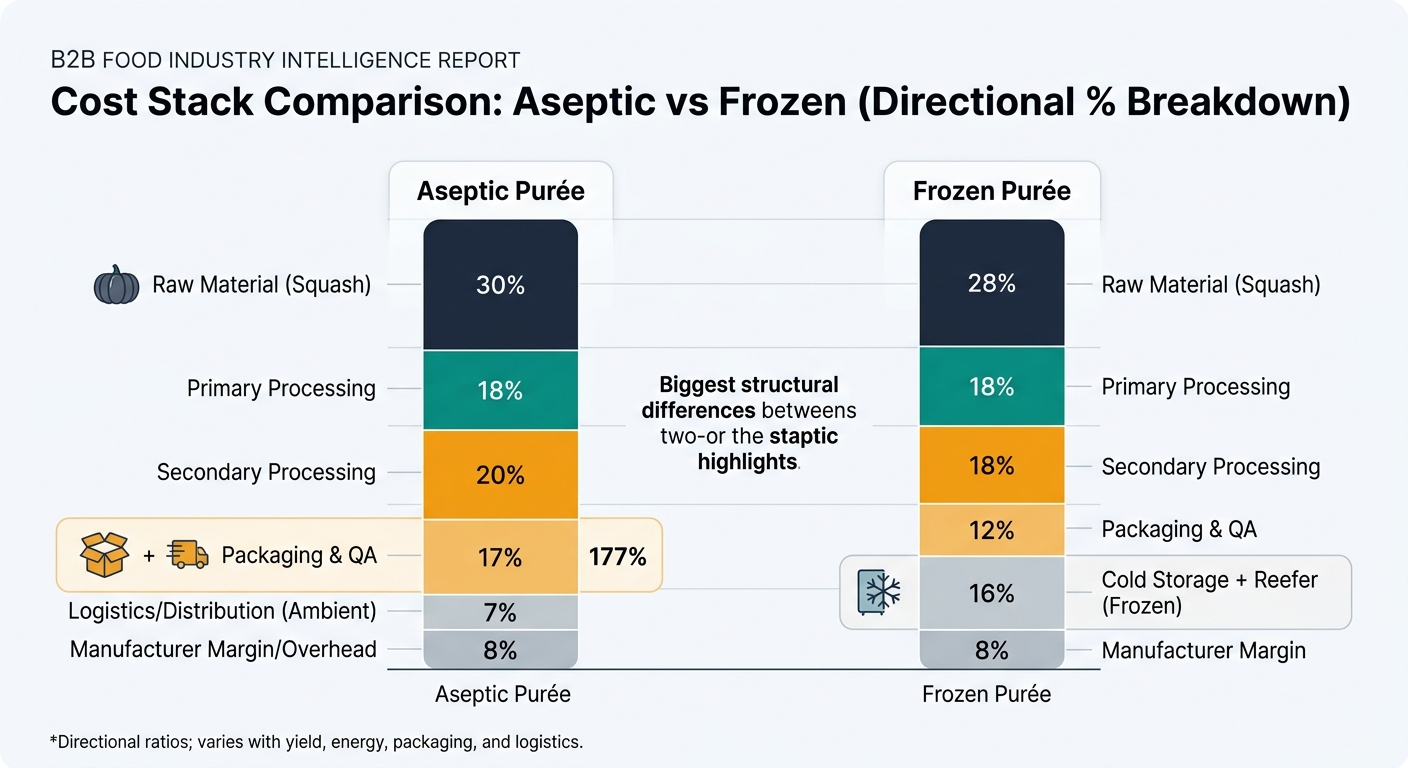
Two stacked bars comparing directional cost breakdown for Aseptic Purée (30/18/20/17/7/8) versus Frozen Purée (28/18/18/12/16/8) across Raw Material, Primary Processing, Secondary Processing, Packaging & QA, Logistics/Distribution or Cold Storage + Reefer, and Manufacturer Margin/Overhead, highlighting higher Packaging & QA for aseptic and higher Cold Storage + Reefer for frozen, with a footnote that ratios vary with yield, energy, packaging, and logistics.

Product-Level Cost Breakdown (Directional, for procurement conversations)

A) Aseptic Butternut Squash Purée (Bulk Ingredient)

Supply Chain Node Cost Ratio (% of Final Cost) Notes
Raw Material Cost (squash) 30% Driven by usable yield and defect rate at intake.
Primary Processing 18% Peel/seed/trim shrink + labor/water/waste handling.
Secondary Processing 20% Milling/standardization + thermal energy + line efficiency.
Packaging & QA 17% Aseptic materials + sterility controls + micro release [1].
Logistics & Distribution 7% Ambient warehouse + dry freight (unopened).
Manufacturer Margin/Overhead 8% Plant overhead, downtime risk, working capital.

B) Frozen Butternut Squash Purée (Bulk Ingredient)

Supply Chain Node Cost Ratio (% of Final Cost) Notes
Raw Material Cost (squash) 28% Similar yield sensitivity as aseptic.
Primary Processing 18% Prep shrink is largely format-agnostic.
Secondary Processing 18% Milling/cook remains significant; may be slightly lower than aseptic sterility-system overhead.
Packaging & QA 12% Frozen liners/cartons/drums + QA release (no aseptic sterility system).
Cold Storage + Reefer Distribution 16% Freezer warehousing, energy, reefer freight capacity exposure.
Manufacturer Margin/Overhead 8% Overhead + seasonal utilization constraints.

C) “Fine-Finished” Purée for Sensitive Applications (e.g., baby-food base)

Supply Chain Node Cost Ratio (% of Final Cost) Notes
Raw Material Cost (squash) 26% Often tighter inbound screening and traceability requirements.
Primary Processing 18% More sorting/trim discipline to reduce defects/off-flavors.
Secondary Processing 24% Finer milling/filtration, tighter viscosity/particle distribution control.
Packaging & QA 18% Higher testing intensity; aseptic commonly used for ambient stability [1].
Logistics & Distribution 6% Often ambient (aseptic) to avoid cold-chain variability.
Manufacturer Margin/Overhead 8% Higher compliance overhead and release holds.
Sourcing Window Radar
Butternut Squash Puree — Global Harvest Calendar
SOUTH AFRICA SEASON ACTIVE
🇿🇦 South Afr.
JAN — DEC
🇨🇳 China
JAN — MAR
🇵🇦 Panama
FEB — FEB
🇨🇱 Chile
FEB — FEB
JanFebMarAprMayJunJulAugSepOctNovDec

3) Structural Facts That Don’t Change (Even When Markets Do)

Insight: A few “physics-and-food-safety” constraints dominate this category: low-acid safety controls, seasonal throughput limits, and spec-driven standardization losses.

Data: (1) FDA guidance highlights that low-acid foods packaged in hermetically sealed containers are regulated under 21 CFR Part 113 (LACF), and aseptic systems have specific process control and filing expectations; (2) published supplier specs show defined acceptance windows for parameters like solids/Brix, reflecting real agricultural variability that processors manage via blending/standardization [2].

Procurement Impact: These are the non-negotiables that shape availability, lead time, and “why two suppliers can quote the same item but behave differently in production.”

Reality 1 — Low-acid nature makes process control a first-order constraint

  • Insight: Butternut purée’s typical pH profile means safety relies heavily on validated thermal processing and hygienic design (especially for aseptic).
  • Data: FDA inspection materials emphasize following filed scheduled processes and documented controls for aseptic/LACF operations [1].
  • Procurement Impact: Plants with mature aseptic systems and documentation discipline can be structurally more reliable; plants without it may default to frozen or shorter shelf-life options.

Reality 2 — The “pack window” creates a hard capacity ceiling

  • Insight: Even if demand is steady year-round, the chain’s physical conversion capacity is constrained by seasonal harvest + plant line time.
  • Data (validated as common practice): Many processors run multiple vegetable purées through shared assets (prep lines, cookers, mills, fillers), and packaging options (drums/totes/BIB) are designed to move volume efficiently during campaigns [3].
  • Procurement Impact: Supply continuity is structurally linked to whether a processor can secure enough raw tons and run enough hours during the campaign to build inventory.

Reality 3 — Specs are “manufacturing instructions,” not just quality language

  • Insight: Brix/solids, viscosity, particle size, and color targets determine how much blending, rework, and segregation happens inside the plant.
  • Data (directional): Published specs show defined acceptance windows and “typical butternut” sensory requirements; ranges differ by supplier and product positioning.
  • Procurement Impact: Two purées that both meet “butternut purée” can behave differently in your kettles/fillers; the tighter your spec, the more you’re implicitly paying for process control and sorting discipline.

Key Insights You Can Reuse Internally (Fast, Factual, Non-Strategic)

  • Key Takeaways: The dominant fixed cost drivers are yield loss in prep, thermal energy, packaging system overhead (aseptic vs frozen), and storage/logistics mode (ambient vs cold-chain).
  • Key Takeaways: Butternut purée is often treated as low-acid, so safety and shelf stability depend on validated process controls—especially in aseptic formats under LACF expectations [2].
  • Key Takeaways: Packaging formats like ~40 lb bag-in-box and 55-gallon drums/totes are common; the format changes handling loss, batch control, and logistics cost, so it should be part of the sourcing spec—not an afterthought [3].

The Bottom Line for Your Next Contract

(Analyzed at: Oct, 2026)

Treat the next butternut purée award as a format-and-logistics decision as much as a price decision: lock your contract around a primary format (aseptic or frozen) plus a pre-negotiated fallback format and pack style (e.g., drum ↔ bag-in-box) with defined functional specs (solids/Brix, viscosity, particle size, color, micro limits). This works because low-acid processing control and packaging system discipline are structural differentiators under FDA’s LACF/aseptic expectations, and frozen programs remain more exposed to cold-chain cost volatility given the high operating and build-cost intensity of cold storage even as vacancy loosens [2][4].

If you don’t pre-wire that flexibility, the first disruption typically shows up as expedited reefer moves, short-shipped POs, and line downtime—often turning a “few cents per pound” win into a low-single-digit % hit to effective ingredient cost once waste and recovery freight are counted.

Butternut Squash PureeSupply Chain Intelligence
132 countries tracked
10
Exporters
10
Importers
$62M
Top Export Value
Top Exporters (2024)
🇨🇱
Chile
$62M
🇸🇰
Slovakia
$59M
🇵🇱
Poland
$54M
🇪🇸
Spain
$51M
🇩🇪
Germany
$49M
+127 more
Top Buyers
🇺🇸 United States $56M🇩🇪 Germany $53M🇳🇱 Netherlands $42M🇨🇿 Czechia $22M🇨🇦 Canada $20M

References

  1. fda.gov
  2. fda.gov
  3. stahlbush.com
  4. nmrk.com
  5. pfvn.us

Related Contents

Subscribe
→
By subscribing you agree to with our Privacy Policy and provide consent to receive updates from our company.
Thank you! Your submission has been received!
Oops! Something went wrong while submitting the form.
Subscribe to receive the latest blog posts, updates, promotions, and announcements from Tridge.
