INDUSTRY TRENDS

Butter Sourcing (2026): Cost, Allocation Risk, and the Levers Procurement Teams Actually Control

Author
Team Tridge
DATE
March 16, 2026
9 min read
Butter Cover
Tridge Eye Data Intelligence Solution

This report is powered by Tridge Eye Data Intelligence.

Every data point, price signal, and supply risk insight in this analysis comes from the same platform that procurement and sourcing leaders worldwide rely on daily. As you read, consider what this level of market intelligence could do for your sourcing decisions.

Explore Tridge Eye →

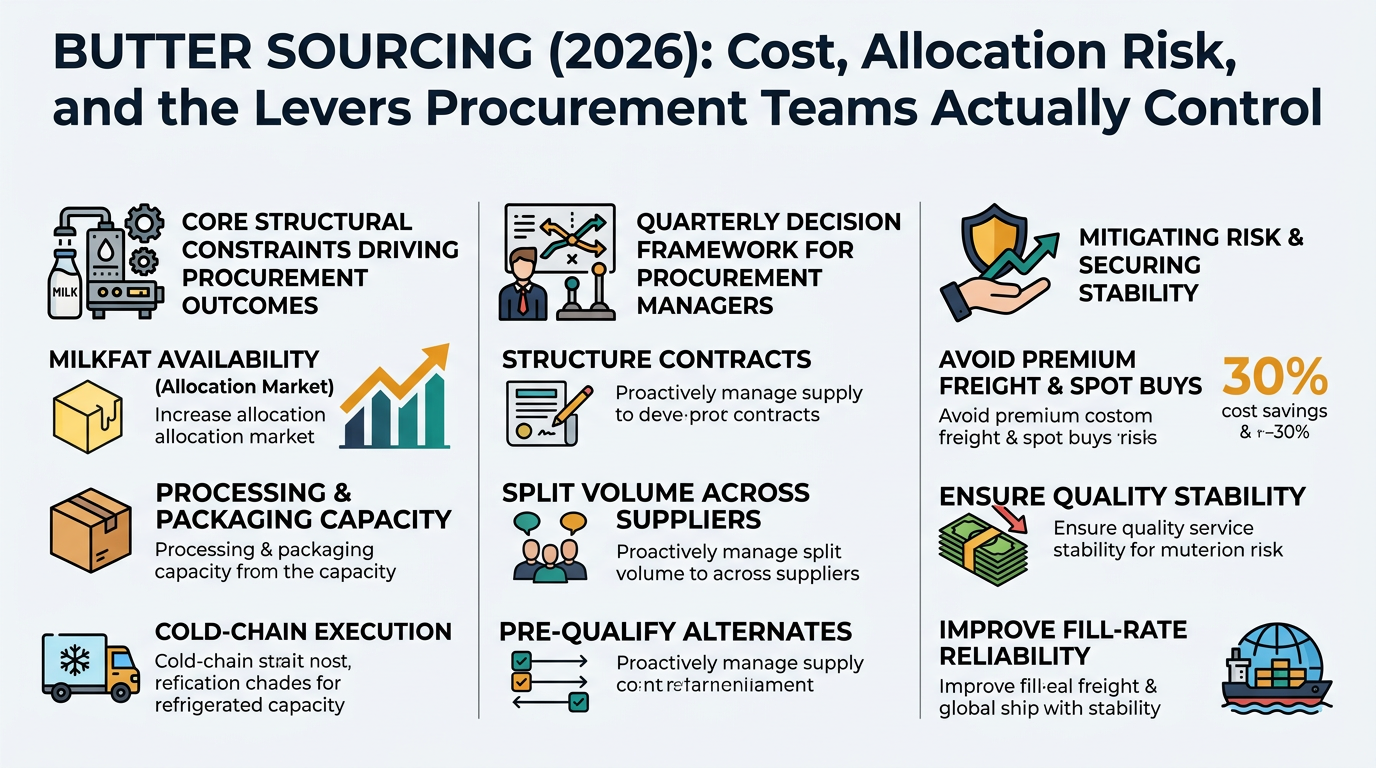
Butter looks like a straightforward commodity, but procurement outcomes (cost, fill-rate, and quality stability) are driven by a tighter set of structural constraints: milkfat availability, processing/packaging capacity, and cold-chain execution. This guide translates those mechanics into the decisions procurement and sourcing managers need to make each quarter—how to structure contracts, how to split volume across suppliers, and how to pre-qualify alternates so you’re not forced into premium freight and spot buys when the market tightens.

Executive Summary

  • Butter is a milkfat allocation market, not just a “butter market.” Milkfat gets reallocated across butter, AMF/butteroil, and cream-based products; this is why price and availability can move in ways that surprise non-dairy buyers.
  • Legal/spec anchors matter: In the U.S., “butter” is defined as containing not less than 80% milkfat by weight (statutory standard).
  • Global standard reference: Codex butter standard commonly referenced by multinationals sets minimum 80% milkfat and maximum 16% moisture.
  • Your service risk can diverge from your contract price because the tightest constraint is often packaging line time, cold storage, or logistics, not churn output.
  • 2026 planning context (practical implication): With U.S. market commentary and outlooks pointing to strong milk supply and high milkfat levels in the recent period and competitive butter pricing supporting exports, buyers should still treat “cheap butter” as a potential allocation/packaging/logistics risk problem, not a guaranteed availability signal.

Key Insights

(Analyzed at: Mar, 2026)

Butter Infographic
  • Strategy: Hold
  • Reliability: Medium
  • Potential Saving: 4% ~ 10%
  • Insight: If you’re currently over-exposed to spot or short resets because prices have been soft, resist the temptation to chase only the lowest $/lb. Use the current pricing environment to re-balance toward governance and continuity:
  • lock a baseline volume with enforceable allocation/service language,
  • keep a controlled float on indexed volume for flexibility, and
  • use the window to qualify 1–2 alternates per critical spec/pack format (especially retail bricks vs. industrial blocks).
  • The savings comes less from “calling the bottom” and more from avoiding the predictable costs of disruption: premium freight, short-ships, rework, and claims.

1) What the Butter Supply Chain Actually Looks Like (So Your Strategy Matches Reality)

Butter is not a “simple dairy SKU.” It is a milkfat allocation business wrapped in cold-chain constraints.

A left-to-right supply chain flow diagram showing the practical nodes that drive procurement outcomes: (1) Farm milk production (with milk volume + milkfat % callouts), (2) Separation/cream management (split into cream vs skim streams), (3) Secondary processing decision gate (Butter vs AMF/Butteroil diversion), (4) Packaging & QA (branch for retail bricks/tubs vs industrial 25 kg blocks; add callouts for changeovers/line time), (5) Cold-chain logistics & storage (chilled vs frozen; temperature excursion risk icon), (6) End markets (industrial/foodservice/retail; seasonal peak callout). Add a prominent overlay banner:

Ground-truth flow (industrial + retail):

  1. Farm milk production (raw milk)
  2. Milk volume and milkfat % are the real upstream constraints.
  3. Weather, feed economics, herd productivity, and regulations affect both milk yield and butterfat yield.
  4. Primary processing (separation & cream management)
  5. Dairies separate milk into cream (fat stream) and skim (protein stream).
  6. Cream can be pulled into other channels (e.g., fresh cream, ice cream), which can tighten butter input availability.
  7. Secondary processing (churning / AMF production)
  8. Cream becomes butter (typically ~80%+ fat) and byproduct buttermilk.
  9. Many plants can also convert fat into AMF/butteroil (lower moisture, easier storage/transport), which competes with butter for the same fat stream.
  10. Packaging & QA (spec-locking step)
  11. Retail bricks/tubs vs. industrial blocks (e.g., 25 kg) have different labor/line constraints.
  12. Spec differences (salted/unsalted, cultured, fat %, moisture, micro limits, packaging) reduce interchangeability.
  13. Cold-chain logistics & storage
  14. Butter can ship chilled or frozen; temperature excursions create texture and oxidation risks.
  15. Logistics is not “just freight”—it is a service-level and quality-risk variable.
  16. End markets (industrial, foodservice, retail)
  17. Retail demand peaks seasonally (holidays), while industrial demand depends on bakery/confectionery cycles.
  18. When markets tighten, suppliers prioritize customers with clearer specs, better forecasting discipline, and stronger allocation terms.

Two composition facts that matter to sourcing:

  • In the U.S., butter is defined as containing not less than 80% milkfat by weight (statutory standard). (Source: 21 U.S.C. § 321a)
  • Codex butter standard commonly used as a global reference sets ≥80% milkfat and ≤16% moisture. (Source: Codex Stan for Butter)

2) Where the Money Goes: Cost & Margin Build-Up by Node (And Why “Price per lb” Misleads)

Below is the practical procurement takeaway: your realized cost is a function of (a) milkfat economics, (b) processing/packaging capacity, and (c) cold-chain + quality fallout.
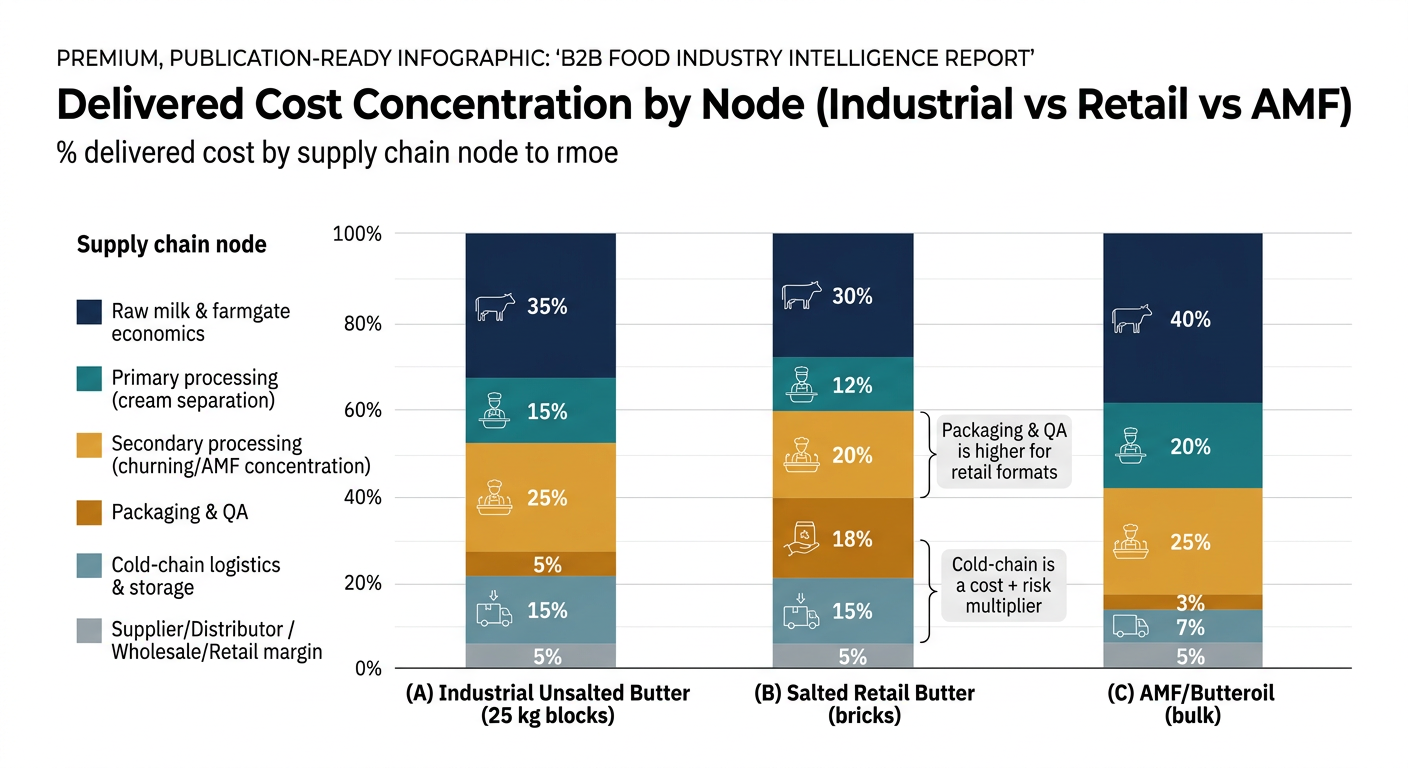
A three-bar stacked chart comparing % of delivered cost by supply chain node for: (A) Industrial Unsalted Butter (25 kg blocks), (B) Salted Retail Butter (bricks), (C) AMF/Butteroil (bulk). Use the exact node labels from the tables: Raw milk & farmgate economics; Primary processing (cream separation); Secondary processing (churning/AMF concentration); Packaging & QA; Cold-chain logistics & storage (or Logistics & storage for AMF); Supplier/Distributor margin (or Wholesale/Retail margin for retail). Display the percentages shown in the article tables and include a legend. Add a small annotation callout on the retail bar emphasizing

2.1 Upstream / Raw Milk (Farm Level)

Key insight: Butter is a milkfat product—so upstream volatility is driven by milkfat availability, not just milk volume.

What moves your cost here

  • Feed and energy costs, weather stress (heat/drought), herd productivity.
  • Shifts in milk composition: higher butterfat output can increase cream availability and pressure butter prices downward.

Procurement implication

  • If you only track supplier quotes, you miss an earlier signal: milkfat output and cream availability can shift your negotiation posture before supplier resets hit your inbox.

2.2 Primary Processing / Cream Separation (Dairy Plant Allocation)

Key insight: Butter competes with other uses of cream; when cream is tight, butter input economics change even if raw milk is stable.

Cost drivers

  • Cream value vs. alternative channels (fresh cream, ice cream, foodservice cream).
  • Plant utilization: separation and cream handling capacity.

Procurement implication

  • In tight cream markets, suppliers may push allocation language and shorter commitments; your contract structure matters as much as unit price.

2.3 Secondary Processing (Butter Churning / AMF Conversion)

Key insight: Churn capacity and the butter-vs-AMF decision create “step changes” in availability.

Cost drivers

  • Energy and labor, yield control (moisture/fat targets), downtime/maintenance.
  • The option to divert fat into AMF/butteroil can reduce butter availability depending on customer mix and export/storage economics.

Procurement implication

  • If your spec allows (or your formulation can), qualifying AMF as a contingency can reduce cold-chain exposure and widen your supplier pool.

2.4 Packaging & Quality Assurance (The Hidden Capacity Constraint)

Key insight: Packaging format is often the real bottleneck—not butter production.

Cost drivers

  • Retail foil/carton lines are labor- and changeover-heavy.
  • QA testing, sensory grading, micro limits, and certification costs.

Procurement implication

  • If you buy multiple formats (retail + industrial), treat them as different supply chains.
  • “Same butter, different pack” is not interchangeable during disruptions.

2.5 Cold-Chain Logistics & Storage (Cost + Risk Multiplier)

Key insight: Cold-chain is where low price turns into high total cost.

Cost drivers

  • Reefer trucking/containers, cold storage, inventory carrying.
  • Quality fallout (texture issues, oxidation/rancidity risk) from temperature excursions.

Procurement implication

  • A slightly higher ex-works price can be cheaper than premium freight + claims + downtime.

2.6 Wholesale/Retail/Distributor Margin (Where Volatility Gets “Smoothed” or “Amplified”)

Key insight: Downstream pricing lags can mask market turns.

  • Retail pricing often adjusts slower than industrial/B2B; promotions and tender cycles create lag.
  • Industrial buyers feel volatility faster through cream/butter indices and supplier resets.

Product-level cost build (illustrative, modeled)

These ratios are illustrative to show where cost concentrates; actuals vary by region, supplier scale, contract terms, and service requirements. They are directionally realistic for procurement planning conversations (where to focus), not accounting statements.

A) Industrial Unsalted Butter (25 kg blocks, chilled, domestic)

Supply Chain Node Cost Ratio (% of delivered cost) What usually drives variance
Raw milk & farmgate economics 45% Milkfat availability, feed/energy, seasonality
Primary processing (cream separation) 8% Cream market tightness, plant utilization
Secondary processing (churning) 12% Energy/labor, churn capacity, downtime
Packaging & QA 6% Block line capacity, QA requirements
Cold-chain logistics & storage 14% Reefer rates, distance, storage days
Supplier/Distributor margin 15% Allocation risk premium, service level

B) Salted Retail Butter (bricks, domestic distribution)

Supply Chain Node Cost Ratio (% of delivered cost) What usually drives variance
Raw milk & farmgate economics 35% Milkfat economics
Primary processing (cream separation) 7% Cream allocation
Secondary processing (churning) 10% Plant efficiency
Packaging & QA 15% Foil/carton, changeovers, labor
Cold-chain logistics & storage 10% DC network, shelf-life management
Wholesale/Retail margin 23% Promo cycles, retailer terms

C) AMF / Butteroil (bulk, often for industrial use)

Supply Chain Node Cost Ratio (% of delivered cost) What usually drives variance
Raw milk & farmgate economics 50% Milkfat economics
Primary processing (cream separation) 8% Cream value
Secondary processing (AMF concentration) 15% Energy, equipment, yield
Packaging & QA 5% Bulk handling, testing
Logistics & storage 7% Less cold-chain intensity vs butter
Supplier/Distributor margin 15% Availability + spec assurance

3) The Structural Fact Buyers Miss: Butter Is a “Milkfat Allocation” Market

If you remember one structural rule, make it this:

  • Butter supply is constrained by milkfat, and milkfat is constantly being re-allocated across:
  • butter
  • AMF/butteroil
  • cream-based products
  • (indirectly) broader dairy plant optimization

This is why you can see:

  • Butter prices soften even when milk volume is flat, if butterfat output rises.
  • Butter availability tighten even when milk is plentiful, if cream is being pulled into other channels or packaging capacity is constrained.

Recent market commentary has explicitly linked U.S. butter price softness to stronger milk production and increases in milkfat content, leaving more cream available for churns. (Source: Food Business News citing RaboResearch, Sep 2025)

4) The Critical Insight for Procurement: Why Your Contract Price and Your Service Risk Diverge

Butter buyers often assume “higher price = more secure supply.” In practice, price and fill-rate can decouple because the tightest constraint may be:

  • packaging line time (not butter output)
  • cold storage availability
  • plant downtime/maintenance
  • allocation decisions during tight markets

So the procurement problem is not just “what’s the right price?” It’s:

  1. What’s my exposure to allocation or service failure?
  2. Which suppliers have redundancy (plants, packaging formats, logistics optionality)?
  3. Which contract clauses convert a ‘relationship’ into a measurable service commitment?

5) Where Procurement Teams Typically Get Butter Wrong (Even If They’re Great at Other Categories)

  1. Treating butter like a simple commodity
  2. Buying purely on $/lb and ignoring packaging capacity, cold-chain, and spec interchangeability.
  3. Over-indexing on a single “best price” supplier
  4. Concentration looks efficient—until allocation hits and your cheapest supplier is the first to cut fill.
  5. Not separating the portfolio by spec criticality
  6. Unsalted vs salted, cultured vs sweet cream, 80% vs 82%+ fat, packaging format—these change substitutability and qualification time.
  7. Leaving allocation and quality dispute terms vague
  8. In butter, ambiguity becomes downtime, premium freight, and claims disputes.
  9. Waiting for disruption to qualify alternates
  10. QA lead times make “emergency sourcing” slow and expensive.

6) How Intelligence-Driven Sourcing Changes the Outcome (Decisions, Not Dashboards)

The goal is measurable: lower realized cost volatility without increasing stockout risk.

What changes when you use intelligence correctly

  1. You shift from invoice-following to signal-led buying
  2. Track price signals and drivers (milkfat output, seasonal production patterns, regional tightness) to decide:
  3. what % to keep indexed vs fixed
  4. when to lock volume
  5. when to keep spot flexibility
  6. You stop treating suppliers as interchangeable
  7. Benchmark suppliers on:
  8. footprint redundancy (plants/regions)
  9. lead-time behavior in tight periods
  10. packaging capability match
  11. quality incident patterns (where available)
  12. You convert risk into contract structure
  13. Use risk signals to justify:
  14. allocation clauses
  15. service-level remedies
  16. spec substitution pathways
  17. safety stock triggers
  18. You maintain an always-ready alternate bench
  19. Pre-qualify alternates by spec + packaging + certifications so switching is days, not weeks.

7) Strategic Use Cases Procurement Leaders Actually Run in Butter

Use case A: Reduce cost volatility without raising outage risk

Decision you face: How much to lock (fixed) vs float (indexed/spot) for the next 90–180 days.

Operational checklist:

  • Segment demand into:
  • must-run (no substitution)
  • substitutable (spec/format flexibility)
  • opportunistic (can shift timing)
  • Define trigger points:
  • lock incremental volume when market signals move outside your volatility band
  • Document rationale using observable indicators (not supplier narratives).

Outcome: fewer emergency buys and more defensible budget performance.

Use case B: Pre-qualify alternates before seasonal tightness

Decision you face: Which alternates to qualify first (you can’t qualify everyone).

Operational checklist:

  • Build a longlist by region and spec fit
  • Shortlist by:
  • packaging match (industrial blocks vs retail formats)
  • cold-chain reach to your plants
  • certifications and audit readiness
  • Run a QA fast-track plan (samples, micro, sensory, functional trials).

Outcome: shorter time-to-switch and reduced premium freight.

Use case C: Balance price vs allocation reliability

Decision you face: How to split volume across suppliers to protect fill.

Practical portfolio model:

  • Primary supplier (50–70%): best total cost + proven service
  • Secondary (20–40%): comparable spec, different footprint/logistics
  • Emergency (5–10%): higher cost, fast lead-time, pre-approved

Outcome: controlled premium for resilience instead of uncontrolled outage cost.

Use case D: Strengthen governance where butter quality risk is highest

Decision you face: Where to spend SRM time (audits, QBRs, corrective actions).

Operational checklist:

  • Rank suppliers by exposure = volume share × spec criticality × site concentration × incident history
  • Standardize scorecards and escalation triggers
  • Align QA + Ops + Procurement on what constitutes a “stop-ship” event.

Outcome: lower hidden costs (claims, rework, customer complaints) and faster resolution.

8) Why This Matters Beyond Butter (For the Categories Butter Buyers Usually Own Too)

Butter is a clean example of a broader procurement truth: the biggest risks sit at the intersections (spec × capacity × logistics), not at the invoice line.

Similar patterns show up in categories butter buyers often manage alongside dairy fat:

  • Cheese (blocks/shreds/slices)
  • Packaging format and shred capacity can constrain supply even when milk is available.
  • Cocoa / chocolate
  • Volatility is not just price—it’s grind capacity, origin concentration risk, and quality specs.
  • Edible oils (palm/soy/canola)
  • Substitution looks easy until labeling, functionality, and customer acceptance lock you in.
  • Frozen bakery inputs
  • Cold-chain and storage capacity can dominate total cost and service levels.

Intelligence-led sourcing is how procurement teams make these constraints visible early enough to act.

9) Why Butter Is a High-Power Example for Prospective Customers

Butter is one of the best “proof categories” because it forces procurement to manage all five realities at once:

  • Cost: milkfat-driven volatility and index transmission
  • Continuity: allocation risk and packaging bottlenecks
  • Resilience: alternate qualification lead times and spec interchangeability limits
  • Governance: quality disputes, micro/sensory performance, audit readiness
  • Decision speed: seasonal swings and rapid shifts in cream/butter balances

When a team can run butter with disciplined signals, portfolio design, and contract governance, they typically can apply the same operating model across the rest of refrigerated and ingredient spend.

Tridge Eye Data Intelligence Solution

Make Faster, Data-Driven Sourcing Decisions

The insights in this report are just the starting point. Tridge Eye is the data intelligence solution that gives procurement and sourcing leaders real-time market signals, price benchmarks, and supply risk alerts — so you can act before the market moves.
Explore Tridge Eye →

References

  1. uscode.house.gov
Subscribe
By subscribing you agree to with our Privacy Policy and provide consent to receive updates from our company.
Thank you! Your submission has been received!
Oops! Something went wrong while submitting the form.
Subscribe to receive the latest blog posts, updates, promotions, and announcements from Tridge.