
Bulk frozen raspberries look simple on paper (“frozen fruit in a carton”), but procurement outcomes are largely decided upstream: harvest handling speed, processor throughput during peak weeks, and how rigorously the cold chain is managed. This guide maps the physical flow and shows where cost, quality, and claims exposure become hard to reverse—so you can negotiate and govern the category on total landed cost and continuity, not just unit price.
Bulk frozen raspberry is a short-season, high-handling commodity that becomes an industrial ingredient only after it passes through three physical “gates”: (1) harvest handling speed, (2) processor sorting + freezing capacity, and (3) cold-chain integrity to the buyer’s dock. Once fruit is frozen and packed, most cost is already sunk—downstream players mainly add cold storage, freight, compliance, and working-capital carry.
Insight: The supply chain is best understood as a race against time (field → cold → freeze) followed by a long period of cold storage and controlled distribution.
Data: In Codex’s quick-frozen raspberry standard, the quick-freezing process is not regarded as complete unless and until the product temperature has reached -18°C (0°F) at the thermal center after thermal stabilization. [1]
Procurement Impact: Your landed cost and service reliability are structurally driven by (a) harvest labor and field logistics, (b) processor defect-removal and freezing throughput during peak weeks, and (c) months of cold storage + reefer transport where temperature abuse becomes quality loss and claims.

Insight: In frozen raspberries, “value add” is mostly physical risk removal—defect sorting, food-safety controls, and temperature control—rather than transformation.
Data: Codex frames the product as prepared from fresh, clean, sound, ripe and stemmed raspberries, then quick frozen so the maximum crystallization range is passed quickly, and held to -18°C at the thermal center. [1]
Procurement Impact: Cost is concentrated upstream (fruit + labor) and at the processor (sorting, yield loss, freezing energy, QA). Downstream costs are predictable but punitive when disrupted (reefer delays, temperature excursions, detention, rework).
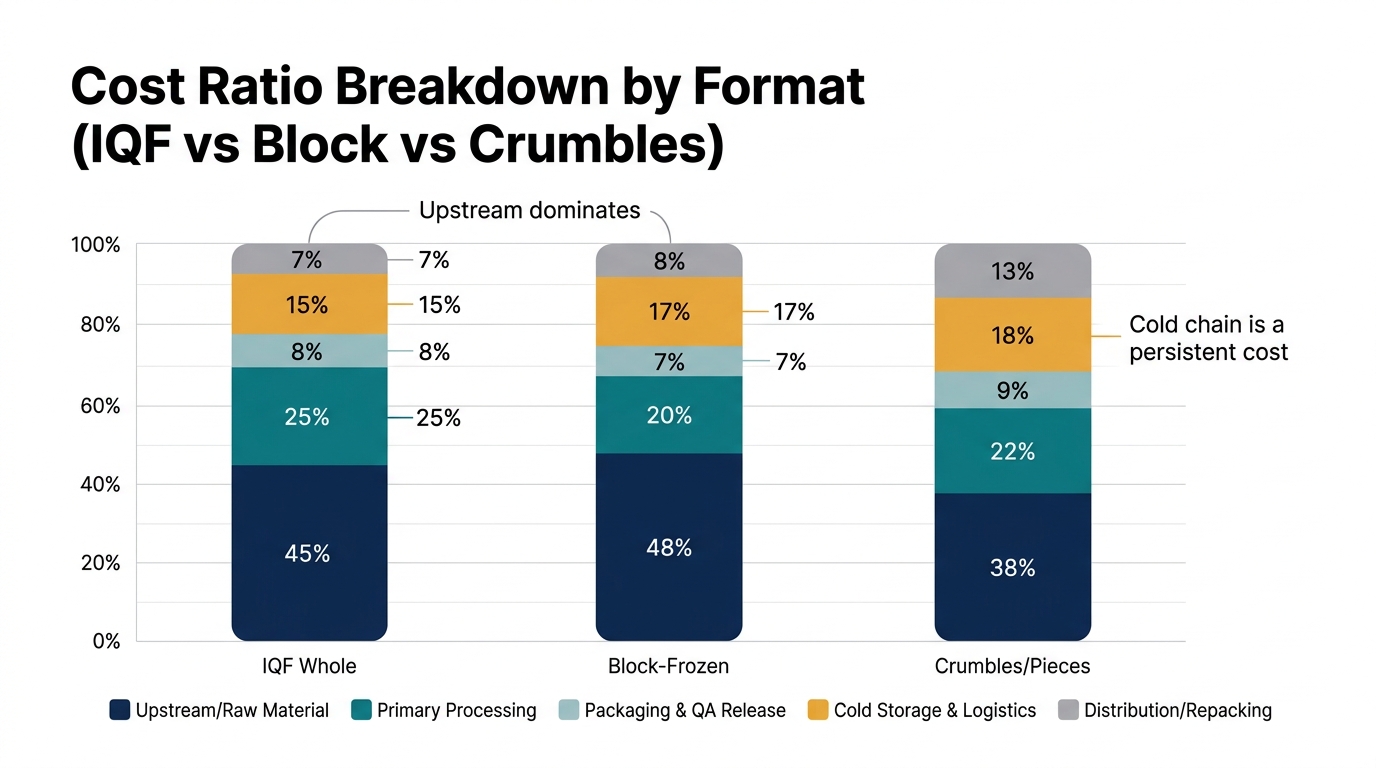
| Supply Chain Node | Cost Ratio (% of Final Cost) | Notes |
|---|---|---|
| Upstream / Raw Material | 45% | Farmgate fruit + harvest labor + field logistics; quality at harvest drives downstream yield loss. |
| Primary Processing | 25% | Sorting/defect removal, freezing energy, pack-out yield, capacity utilization. |
| Packaging & QA Release | 8% | Liners/cartons/pallets, metal detection/X-ray, sampling/testing, traceability controls. |
| Cold Storage & Logistics | 15% | Cold storage carry + reefer inland/ocean + port/handling; temperature monitoring and claims overhead. |
| Distribution / Repacking | 7% | Local warehousing, repack labor, compliance docs, service margin. |
| Supply Chain Node | Cost Ratio (% of Final Cost) | Notes |
|---|---|---|
| Upstream / Raw Material | 48% | Similar fruit cost base; may tolerate slightly higher breakage depending on end-use. |
| Primary Processing | 20% | Lower per-kg freezing/handling complexity vs IQF, but still sorting-driven. |
| Packaging & QA Release | 7% | Often simpler packaging, but same food-safety expectations. |
| Cold Storage & Logistics | 17% | Similar cold-chain costs; blocks can be denser to ship but still reefer-dependent. |
| Distribution / Repacking | 8% | More likely to go through ingredient handlers serving processors. |
| Supply Chain Node | Cost Ratio (% of Final Cost) | Notes |
|---|---|---|
| Upstream / Raw Material | 38% | Uses fruit that may not hold whole-berry integrity; still tied to harvest economics. |
| Primary Processing | 22% | Sorting still matters (foreign material), but whole-berry yield constraints are relaxed. |
| Packaging & QA Release | 9% | Often higher scrutiny for foreign material because pieces can “hide” defects. |
| Cold Storage & Logistics | 18% | Similar cold-chain cost; higher surface area can increase dehydration sensitivity. |
| Distribution / Repacking | 13% | Frequently blended, reworked, or repacked into customer-specific formats. |
Insight: Frozen berries are structurally exposed to enteric virus risk because freezing preserves the product but does not reliably eliminate viruses introduced upstream.
Data: FDA’s FY2019–FY2023 frozen berry sampling (collected Nov 2018–Sep 2023) tested more than 1,500 samples and detected HAV in 5 raspberry samples and norovirus in 3 raspberry samples (each well under 1% prevalence for raspberries), with FDA reporting no statistically significant difference by domestic vs import status. [2]
Procurement Impact: Food-safety cost is structurally front-loaded: sanitation, worker hygiene, water controls, and preventive controls must be designed into farm and plant operations because downstream cold chain does not “fix” upstream contamination.
Insight: Grade standards describe general defect tolerance and appearance, but industrial buyers typically layer on tighter foreign-material, micro, residue, and performance-at-thaw requirements.
Data: USDA AMS frozen berry grade standards describe “Fancy” (Grade A) frozen berries as practically uniform typical color, practically free from defects, and scoring not less than 85 points under the USDA scoring system. [3]
Procurement Impact: Your true “spec cost” is created by the delta between generic grade language and your customer/plant reality (line performance, defect sensitivity, micro hold-and-release). That delta determines how many suppliers can realistically qualify and how much yield loss the processor must price in.
Insight: Farms create volume; processors create usable, compliant volume. Freezing tunnels, sorting lines, and QA release capacity are the hard constraints during peak weeks.
Data: Codex explicitly anchors product identity in the freezing process (rapid crystallization, -18°C core) and controlled handling through distribution, making processing + cold chain the defining infrastructure. [1]
Procurement Impact: When the system is stressed, the limiting factor is often not acres harvested but plant throughput (sorting intensity, defect load, freezing capacity) and cold storage space—driving format availability (IQF vs block) and lot-release timing.
(Analyzed at: Jul, 2026)
Write your next bulk-frozen-raspberry contract to pay for cold-chain discipline and processor release capacity, not just a CFR/DDP unit price: require lot-level evidence that product reached -18°C at the thermal center, define temperature-monitoring/claims rules from pack-out through delivery, and cap repacking “touchpoints” unless pre-approved. This works because the irreversible losses you actually pay for—clumping, dehydration/freezer burn, and downgrade into crumbles/puree—are usually created after freezing by handling and temperature excursions, while the market is still dealing with tight refrigerated transport conditions in 2026. [1]
A typical 1–3% swing in claim/write-off rate on an annual program is often worth more than a small headline price concession, and it’s measurable within a quarter.


