INDUSTRY TRENDS

Bulk-Frozen Aronia (Chokeberry): Physical Supply Chain Map and the Cost “Lock-In” Points

Author
Team Tridge
DATE
July 10, 2026
8 min read
bulk-frozen-aronia-berry Cover
Unlock Full Data
Bulk Frozen Aronia Berry Market Intelligence
Prices · Trends · Origins · Forecasts

Bulk-frozen aronia is a classic “short-harvest, long-supply” ingredient: almost all of the commercial value is created by freezing fast, holding cold for months, and moving reliably in reefer lanes. For procurement teams, the practical win is knowing where cost and risk become hard to change (sorting yield, storage months, temperature assurance), so you can write specs and contracts that protect total landed cost—not just $/kg.

Executive Summary

  • Cold-chain baseline: Quick-frozen and frozen-food guidance repeatedly anchors storage/distribution around −18°C (0°F), and Codex-aligned codes describe quick freezing as complete when the product reaches −18°C at the thermal centre after stabilization. [1]
  • Seasonality is structural: Typical harvest timing is late August–September in major temperate production regions, forcing inventory carry and working-capital cost into the category. [2]
  • Origin concentration matters: Poland is widely cited as the world’s largest chokeberry producer, concentrating a meaningful share of industrial-scale capability in one geography. [3]
  • 2026 cost reality: Electricity price volatility (notably in Europe) remains a material input to freezing and cold storage economics, so energy clauses and storage assumptions should be explicit in contracts. [4]

1) How the Physical Market Is Built (and Where Costs “Lock In”)

Bulk-frozen aronia (black chokeberry) is a seasonal, processing-first berry that becomes a year-round ingredient only because the chain is built around rapid freezing, deep cold storage, and long inventory carry. The physical map is simple on paper—farm → freezing plant → cold storage → reefer transport → importer/DC → industrial user—but the cost structure is not: energy, yield loss, and documentation-heavy QA accumulate at multiple nodes.

Insight: The supply chain is designed to convert a short harvest window into stable, contractable frozen inventory; the “fixed” cost drivers are freezing energy, storage months, and defect/foreign material control.

Data (validated): Codex-aligned codes of practice commonly describe quick freezing as complete when the product temperature reaches −18°C at the thermal centre after thermal stabilization, and international guidance continues to reference −18°C as the storage/distribution reference temperature for quick-frozen foods. [1]

Procurement Impact: If you don’t map where temperature control, sorting intensity, and inventory carry happen physically, you will misread why two “IQF aronia” offers can diverge in true usable cost.

Physical flow (ground truth)

  • Farming/harvest (late summer–early autumn in temperate zones): berries harvested and moved quickly to a plant to limit leakage/softening.
  • Primary processing (cleaning/sorting/IQF or block freezing): wash + de-stem/leaf removal + optical/manual sorting, then tunnel IQF or block freezing.
  • Cold storage & inventory carry: frozen lots held to supply year-round demand.
  • Export logistics (reefer): palletized cartons/bags moved via reefer truck and/or ocean reefer; temperature excursions are a claim/rejection risk.
  • Import distribution & end use: importers/distributors hold stock; industrial users dose IQF into blends or press/extract into juice/concentrate/powder.
Flowchart diagram showing the bulk-frozen aronia supply chain from farm/harvest through receiving, washing/cleaning, de-stemming/foreign material removal, optical/manual sorting, IQF tunnel or block freezing, cold storage (months), export reefer transport (truck/ocean), importer/DC cold storage, and industrial user (blend/press/extract), with callouts marking where cost and risk lock in (harvest handling/time-to-plant, sorting intensity and reject yield, freezing energy and throughput, storage months carrying cost, temperature assurance with logger/claims, and packaging integrity affecting dehydration/clumping), including −18°C/0°F baseline icons at freezing, storage, and reefer nodes.

2) Where Money Accumulates: Per-Node Cost & Margin Structure

Insight: Aronia’s cost stack is less about “one expensive step” and more about compounding losses and overhead: farmgate variability → sorting rejects → freezing energy → months of storage → reefer risk controls.

Data (validated, with a caveat): Poland is widely cited as the world’s largest producer of chokeberry/aronia, and it is a meaningful base for industrial processing. Treat this as a real concentration signal, even if exact global share varies by source and year. [3]

Procurement Impact: Even without discussing buying strategy, you should expect the chain’s economics to be shaped by (a) regional processing scale, (b) energy and storage intensity, and (c) quality/foreign material control costs at the plant.
1. Upstream / Raw Material (Farming & Harvest)

  • Insight: Farm economics are dominated by yield variability and harvest logistics, because aronia is typically grown for processing and must reach the freezing plant quickly.
  • Data (validated): Harvest timing is commonly described as late August to September (varies by weather, cultivar, and region), reinforcing why freezing plants run hard in a short window and then carry inventory. [2]
  • Procurement Impact: The farm node “locks in” cost through fruit maturity/defect mix (which later becomes sorting rejects) and time-to-plant (which affects leakage and soft fruit that won’t survive IQF handling).

2. Primary Processing (Cleaning, Sorting, IQF/Block Freezing)

  • Insight: This is the chain’s main value-defining transformation: foreign material removal + defect sorting + freezing method (IQF vs block) determine downstream usability.
  • Data (validated): Codes of practice for quick-frozen foods describe quick freezing completion at −18°C at the thermal centre after stabilization; this supports using −18°C as a procurement baseline for temperature expectations and verification. [1]
  • Procurement Impact: The processing node is where you pay for (a) sorting intensity (stems/leaves are a known issue in berries), (b) yield loss from rejects, and (c) freezing energy + throughput constraints; these directly affect true cost per usable kg.

3. Cold Storage & Inventory Carry (Origin and/or Destination)

  • Insight: Cold storage is not a “logistics afterthought”—it is a production requirement because aronia is seasonal but demand is year-round.
  • Data (validated): Public food-safety guidance and Codex-related materials repeatedly reference freezer storage at 0°F (−18°C) or below as the baseline for frozen condition. [5]
  • Procurement Impact: Storage months convert into fixed carrying cost (energy + warehouse handling + pallet positions) and quality risk (dehydration/freezer burn if packaging integrity/glazing is weak), which shows up as clumping, drip loss, and color performance variability.

4. Packaging & QA Release (Bulk Packs, Documentation, Food Safety Systems)

  • Insight: For exportable frozen berries, packaging and QA are a control system: they protect against dehydration/oxidation and create the paperwork trail that prevents border/receiver holds.
  • Data (validated/strengthened): Aronia is commonly traded not only as frozen fruit but also as juice concentrate around 65° Brix in ingredient channels; published product specs and portfolio references support ~65 Brix as a typical concentrate point. [6]
    (Note: concentrate specs vary by supplier, filtration, and target application—procurement should lock in a range and test method.)
  • Procurement Impact: Costs here are driven by poly liners/cartons, metal detection/X-ray expectations, lab testing, and the labor to compile compliant documentation; weak QA release increases the probability of receiving holds and disposal/rework.

5. Reefer Logistics & Distribution (Export/Import, Temperature Assurance)

  • Insight: Reefer transport is a risk-priced service: you are buying both transit and temperature stability, with claims exposure if excursions occur.
  • Data (validated): International guidance continues to use −18°C as the reference for storage/distribution of quick-frozen foods, which is why temperature records (logger data) and clear responsibility for excursions matter in contracts. [7]
  • Procurement Impact: Logistics cost is not just freight—it includes temperature monitoring, insurance/claims handling, and variability buffers (extra lead time and safety stock), which become material in cold-chain-dependent categories.
Unlock Full Data
Bulk Frozen Aronia Berry Market Intelligence
Prices · Trends · Origins · Forecasts

Product-Level Cost Breakdown

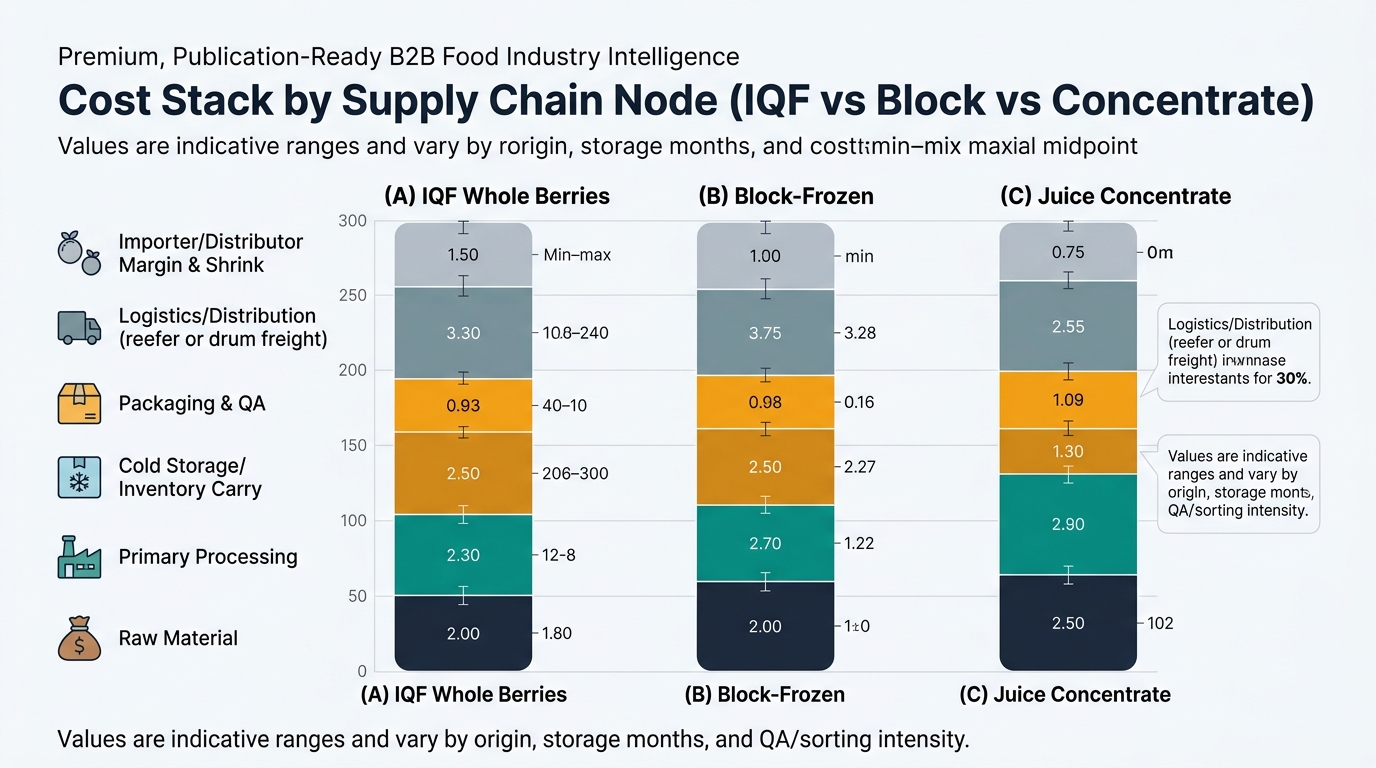
Comparative stacked bar chart showing the cost stack by supply chain node for (A) IQF whole aronia berries, (B) block-frozen aronia, and (C) aronia juice concentrate, with consistent color segments for raw material, primary processing, cold storage/inventory carry, packaging and QA, logistics/distribution, and importer/distributor margin and shrink; segments use midpoints of the article’s cost ratio ranges and include min–max range indicators, with a note that values are indicative and vary by origin, storage months, and QA/sorting intensity.

A) IQF Whole Aronia Berries (Industrial Bulk)

Supply Chain Node Cost Ratio (% of Final Cost) Notes
Raw Material Cost (farmgate fruit) 35–50% Yield variability and maturity/defect mix drive effective cost.
Primary Processing (sorting + IQF) 18–28% Optical/manual sorting, de-stemming/foreign material control, freezing energy, reject loss.
Cold Storage & Inventory Carry 8–15% Seasonal inventory build; energy + pallet positions + handling.
Packaging & QA Release 5–10% Bulk cartons/liners, lab tests, documentation, food safety system overhead.
Reefer Logistics & Distribution 10–20% Reefer freight + temperature assurance + congestion/variability buffers.
Importer/Distributor Margin & Shrink 5–12% Working capital, shrink, re-palletizing, order picking.

B) Block-Frozen Aronia (Further Processing / Pressing Feedstock)

Supply Chain Node Cost Ratio (% of Final Cost) Notes
Raw Material Cost 40–55% Often tolerates wider size/appearance range than IQF, but still sensitive to defects/foreign matter.
Primary Processing (clean + block freeze) 12–22% Lower IQF tunnel intensity, but still requires cleaning/sorting and freezing energy.
Cold Storage & Inventory Carry 8–16% Similar storage dependence as IQF.
Packaging & QA Release 4–8% Bulk blocks, liners, pallet stability; QA release still required for export.
Reefer Logistics & Distribution 10–20% Same cold-chain constraints; block format can reduce handling losses for some users.
Importer/Distributor Margin & Shrink 5–10% Handling, breakage, claims administration.

C) Aronia Juice Concentrate (Ingredient Form, ~65 °Brix typical)

Supply Chain Node Cost Ratio (% of Final Cost) Notes
Raw Material Cost 30–45% Fruit quality affects press yield and color/polyphenol performance.
Primary Processing (pressing/extraction) 10–18% Press yield, enzyme aids (if used), filtration/clarification choices.
Secondary Processing (evaporation to concentrate) 15–25% Energy-intensive evaporation; throughput and fouling/cleaning cycles matter.
Packaging & QA Release 6–12% Drums/IBCs, controls where applicable, COA parameters (Brix/acidity/micro).
Cold Storage / Chilled Storage 4–10% Depending on pack style and preservation method.
Logistics & Distribution 8–16% Drum freight, temperature management, import handling.
Importer/Distributor Margin 5–12% Inventory carry and customer service for ingredient users.

3) Structural Facts Every Procurement Manager Should Treat as “Constants”

Reality 1: The chain is structurally seasonal, so inventory carry is built-in

Insight: Aronia supply is physically constrained by a short harvest window; the market’s year-round availability is manufactured via freezing and storage.

Data (validated): Harvest is commonly described as late August to September, which implies the category must either (a) buy-and-hold inventory or (b) accept higher in-season spot exposure and higher stockout risk. [2]

Procurement Impact: Storage capacity and energy economics are structural—not cyclical—so landed cost always includes some level of cold-storage overhead and working-capital time.

Reality 2: “Quality” is mostly a sorting and foreign material problem, not a flavor tweak

Insight: For IQF berries, the operational pain is often stems/leaves/foreign material, clumping, and dehydration—issues that originate in harvest handling and are (partly) corrected by sorting and packaging.

Data (validated): Quick-frozen guidance anchors expectations around a frozen condition (commonly ≤ −18°C) and emphasizes maintaining frozen product temperatures in storage/distribution, reinforcing why temperature control and packaging integrity drive usable quality. [7]

Procurement Impact: The plant’s sorting technology and reject policy are structural drivers of yield loss and therefore true cost per usable kg.

Reality 3: Processing scale is geographically concentrated, shaping capacity and documentation norms

Insight: A large share of industrial chokeberry/aronia volume is tied to Central/Eastern Europe, especially Poland, where frozen fruit and chokeberry juice processing are established.

Data (validated): EU trade communications explicitly describe Poland as the world’s largest producer of chokeberry, supporting the concentration argument (even if exact shares vary). [3]

Procurement Impact: Concentrated processing footprints create structural dependencies on regional energy costs, labor availability for sorting, and export documentation practices.

Key Insights (What You Should Remember When You Read Any Spec Sheet)

  • Insight: The physical chain is a cold-chain manufacturing system; freezing and storage are not “logistics,” they are the product.
    Data (validated): International guidance continues to reference −18°C as the reference temperature for storage/distribution of quick-frozen foods, and public guidance uses 0°F (−18°C) as the freezer baseline. [7] [5]
    Procurement Impact: The most “fixed” cost drivers you can’t wish away are sorting/reject loss, freezing energy, storage months, and reefer temperature assurance.
  • Insight: Product form (IQF vs block vs concentrate) changes where cost sits—labor/sorting vs energy/processing vs packaging.
    Data (validated): Aronia concentrate is commonly specified around ~65° Brix in ingredient channels, supporting the idea that “form choice” changes storage/handling and QA demands. [6]
    Procurement Impact: Comparing offers across forms requires a node-by-node view of yield, storage, and handling losses rather than a single $/kg number.

4) The Bottom Line for Your Next Contract

The Bottom Line for Your Next Contract (Analyzed at: Jul, 2026): Treat energy and cold-chain assurance as contract terms, not background assumptions. Europe’s electricity price volatility remains a real input to freezing and storage economics, so if you’re buying Poland/Eastern Europe-origin material, you’ll protect total landed cost by contracting with explicit storage-month assumptions, temperature-record expectations, and a clear excursion/claims protocol—then negotiating the price around those verifiable service levels. This works because the biggest “silent” cost leaks in aronia are almost never farmgate; they’re yield loss from sorting/handling and value loss from temperature/packaging failures after you’ve already paid. In practice, tightening those terms is often worth a natural 3–8% swing in effective usable cost (and far more in a disruption) because it reduces rejects, holds, and emergency buys. [4]

Bulk Frozen Aronia BerrySupply Chain Intelligence
130 countries tracked
10
Exporters
10
Importers
$468M
Top Export Value
Top Exporters (2024)
🇨🇦
Canada
$468M
🇵🇱
Poland
$310M
🇨🇱
Chile
$263M
🇲🇾
Malaysia
$220M
🇺🇸
United States
$218M
+125 more
Top Buyers
🇺🇸 United States $893M🇩🇪 Germany $317M🇹🇭 Thailand $222M🇨🇦 Canada $194M🇳🇱 Netherlands $191M

References

  1. law.resource.org
  2. aroniaberry.ca
  3. policy.trade.ec.europa.eu
  4. iea.org
  5. foodsafety.gov
  6. floridabulksales.com
  7. who.int

Related Contents

Subscribe
→
By subscribing you agree to with our Privacy Policy and provide consent to receive updates from our company.
Thank you! Your submission has been received!
Oops! Something went wrong while submitting the form.
Subscribe to receive the latest blog posts, updates, promotions, and announcements from Tridge.
