
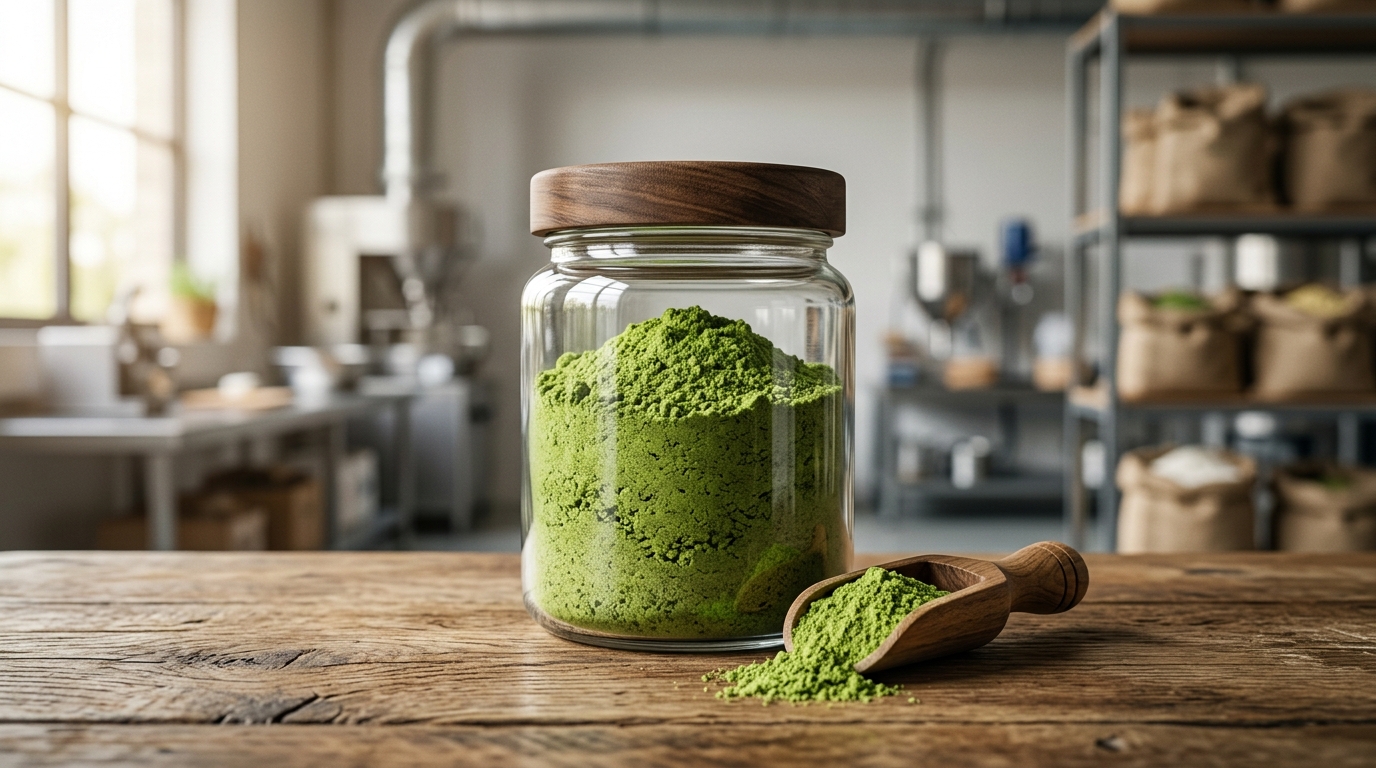
This guide maps how broccoli powder physically moves from farm to finished ingredient, and where quality, food safety, and compliance outcomes get “locked in.” It is written for QSC-focused procurement teams who need audit-defensible supplier approvals, spec governance that reduces holds/NCs, and practical control points that align to how broccoli powder is actually made.
Broccoli powder is not a single “commodity line”—it is a conversion chain that turns a high-water, fragile vegetable into a shelf-stable, low-moisture ingredient. The physical reality is simple: most cost is created by removing water (energy + time), then protecting the powder from moisture pickup (packaging + handling discipline).
Insight: The supply chain is a water-removal-and-protection system: wash/trim → (often) blanch → dry → mill/sieve → package → ship/store dry.
Data: Industrial drying is commonly benchmarked in energy per kg of water evaporated; literature cites ~2,620 kJ/kg (theoretical) and notes typical industrial dryers often consume above ~4,500 kJ/kg water evaporated in practice (wide ranges by dryer type and operating conditions). [1]
Procurement Impact: Even before any “market” factors, the chain’s fixed economics are driven by (1) conversion ratio from fresh broccoli to powder, (2) dryer energy efficiency and throughput, and (3) moisture-barrier packaging and warehouse humidity control—because powder that reabsorbs moisture turns into caking, oxidation, and yield loss.
Quick win: When you map suppliers, always record the drying method (hot-air/drum vs spray vs freeze-dry) and the packaging format (liner type + seal method). Those two fields explain most downstream variability in color, flavor, and shelf stability.

Insight: Costs accumulate in predictable “physics-driven” buckets: field yield + trim loss, water removal, particle engineering, and moisture protection.
Data: Drying energy is often expressed per kg water evaporated; literature commonly cites ~2,620 kJ/kg theoretical and >4,500 kJ/kg practical industrial use as a typical benchmark (with spray drying often higher). [1]
Procurement Impact: If you want stable incoming quality, your spec and supplier documentation must align to the node that actually controls the attribute (e.g., moisture is controlled by drying + packaging, not by farming alone).
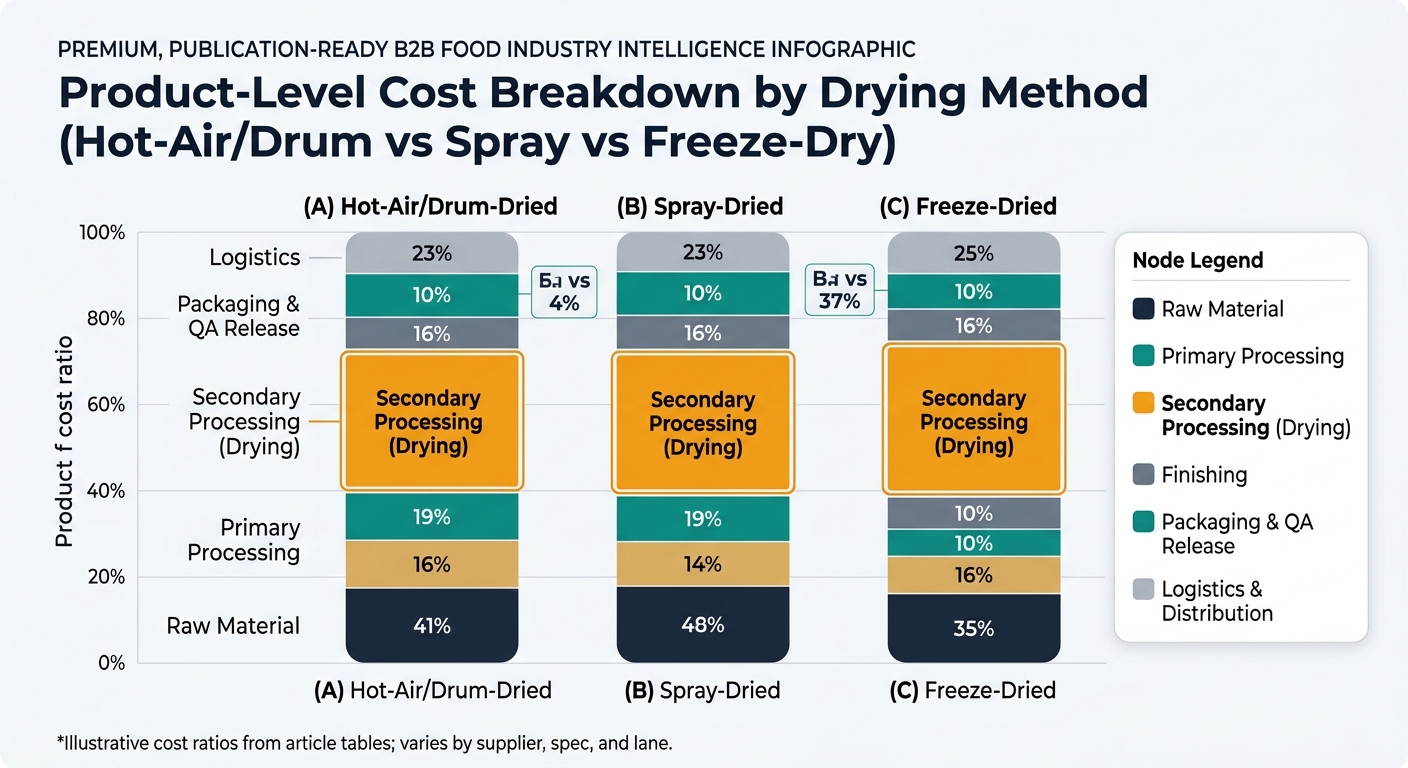
| Supply Chain Node | Cost Ratio (% of Final Cost) | Notes |
|---|---|---|
| Raw Material (broccoli) | 25% | Field yield + trim loss set conversion burden. |
| Primary Processing | 10% | Washing/blanching energy + water + wastewater. |
| Secondary Processing (drying) | 30% | Energy + throughput constraints dominate. |
| Finishing (milling/sieving/metal control) | 8% | Particle spec + yield loss in fines/screens. |
| Packaging & QA release | 12% | High-barrier liners, seal method, testing. |
| Logistics & distribution | 15% | Inland + ocean/ambient handling; humidity protection. |
| Supply Chain Node | Cost Ratio (% of Final Cost) | Notes |
|---|---|---|
| Raw Material (broccoli) | 20% | Often includes puree prep losses/standardization. |
| Primary Processing | 12% | More wet handling; sanitation + wastewater load. |
| Secondary Processing (spray drying) | 32% | Spray dryers can range broadly in kJ/kg water evaporated; efficiency and heat recovery matter. [5] |
| Finishing (agglomeration/sieving) | 6% | Flowability/instant properties may be engineered. |
| Packaging & QA release | 12% | Moisture/oxygen barrier critical due to surface area. |
| Logistics & distribution | 18% | Higher sensitivity to humidity + caking risk in transit. |
| Supply Chain Node | Cost Ratio (% of Final Cost) | Notes |
|---|---|---|
| Raw Material (broccoli) | 18% | Higher raw quality expectations; pre-trim losses. |
| Primary Processing | 10% | Gentle prep; hygiene still critical. |
| Secondary Processing (freeze-dry) | 45% | Long cycle time + capex/opex heavy; capacity-limited. |
| Finishing (milling/sieving) | 7% | Brittle product mills easily but creates fines/dust. |
| Packaging & QA release | 10% | Often requires higher barrier to protect sensory. |
| Logistics & distribution | 10% | Ambient shipping but careful handling to prevent moisture pickup. |
Insight: Broccoli powder behaves like a low-moisture ingredient, but it is produced from a high-water crop—so the chain is structurally constrained by conversion physics, dryer capacity, and humidity control.
Data: Drying energy benchmarks are anchored to water evaporation (kJ/kg water), and industry practice commonly controls dehydrated vegetable powder moisture to low single digits up to ~7% depending on spec and application. [1]
Procurement Impact: Quality stability is driven by controlling water removal and preventing moisture reabsorption; you cannot “test your way out” of poor moisture-barrier practices (and FDA guidance for low-moisture RTE foods reinforces the limits of relying only on product testing for pathogen control). [6]
Quick win: Treat packaging and storage conditions as part of the manufacturing specification (liner type, seal verification, desiccant policy, max warehouse RH), not as “logistics details.”
Insight: Drying method is the single biggest determinant of powder identity (sensory, color, stability) and of fixed cost structure.
Data: Typical industrial dryers often consume >4,500 kJ/kg water evaporated in practice; spray drying can span roughly 4,500–11,500 kJ/kg water evaporated depending on system design and losses. [1]
Procurement Impact: If you compare suppliers without normalizing for drying method and final moisture target, you are not comparing the same product.
Insight: “Moisture at release” is not the same as “moisture at use.”
Data: Commercial dehydrated vegetable powder specs commonly set moisture limits such as ≤7% to support flowability (exact targets vary by product and customer). [4]
Procurement Impact: Packaging barrier and handling discipline are the main controls for caking and flowability complaints.
Insight: Low-moisture does not equal low-risk.
Data: FDA’s low-moisture RTE draft guidance stresses sanitation programs, routine environmental monitoring, corrective actions, and the limitations of relying solely on product testing. [2]
Procurement Impact: Your physical map should explicitly mark where post-dry contamination could occur (cooling, milling, packaging) because that is where controls matter most.
(Analyzed at: Aug, 2026)
Broccoli powder demand continues to be pulled by functional foods, beverages, and wellness blends, which increases the penalty for variability (color, flavor, caking) and for weak post-dry hygiene controls. [7] Your highest-conviction move is to contract on process + protection, not just a COA: lock the drying method (or an approved set), specify moisture and test method, and require documented packaging/transport humidity controls (liner spec, seal verification, desiccant policy, and lane discipline). This works because drying and moisture protection are the two nodes where cost and quality most reliably “lock in,” and FDA’s low-moisture guidance reinforces that you can’t rely on end-product testing alone to manage risk. [6] In practice, teams that ignore packaging and lane controls often pay for it later in the form of preventable holds, rework, and scrap that can easily rival a mid-single-digit percent of annual spend on the ingredient once downtime and disposition are counted.


