
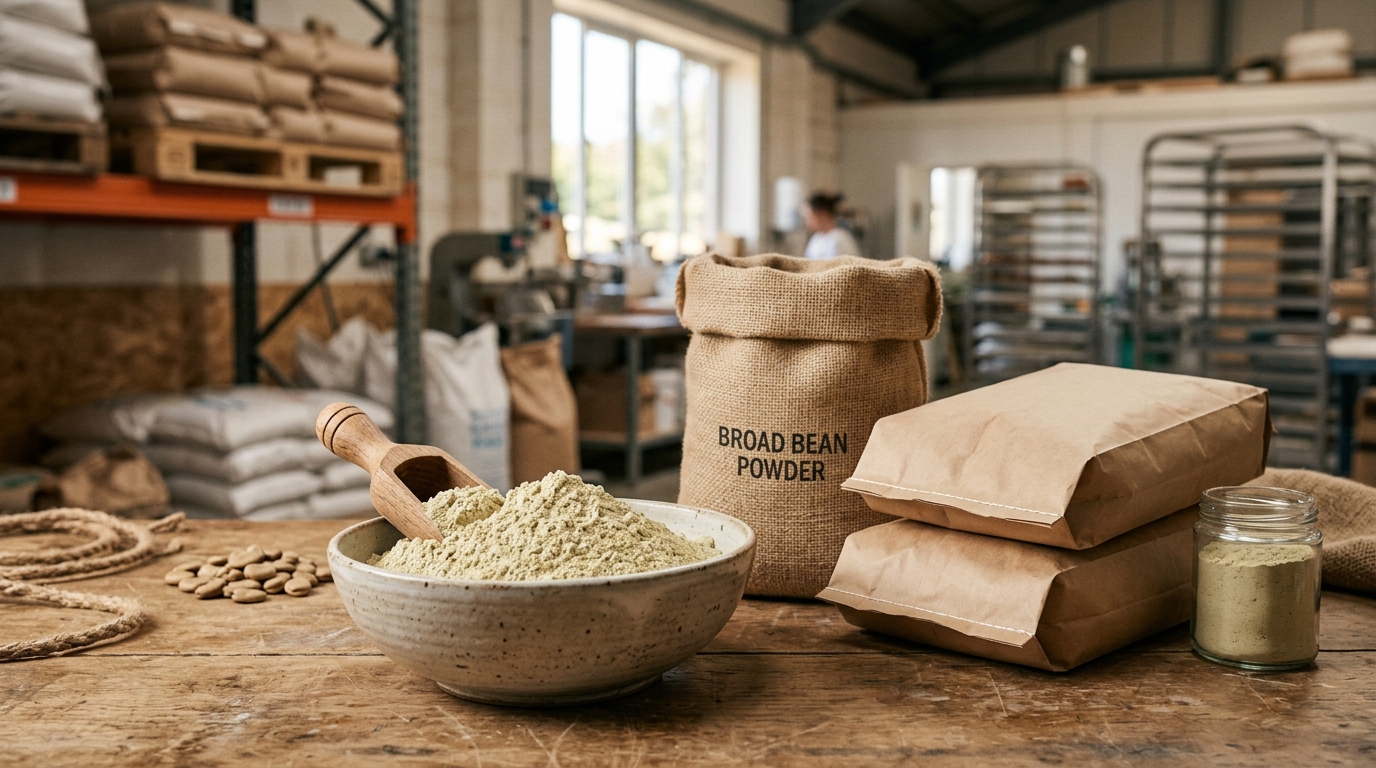
Broad bean powder looks like a simple “dry ingredient,” but for procurement it behaves like a conversion product: value and variability are created (or destroyed) by cleaning losses, dehulling yields, milling/classification settings, and how well the powder is protected from moisture pickup in storage and transit. This guide maps the physical nodes where cost and risk lock in, and translates them into spec, supplier, and contracting decisions a procurement manager can action.
Broad bean powder is not a single commodity flow—it’s a sequence of yield-loss steps (cleaning, dehulling, milling/fractionation) layered with food-grade controls (testing, segregation, packaging integrity). The biggest fixed cost drivers are set early: (1) how much of the incoming bean becomes usable food-grade kernel, (2) how much value is added by particle-size control and protein shifting, and (3) how much cost is required to keep the powder dry, clean, and traceable through long logistics.
Insight: The supply chain is a conversion chain: beans → edible fractions → functional powder, and each conversion step creates both cost and irreversible yield loss.
Data: Typical physical flow is (a) farm + aggregation, (b) cleaning/sorting and grading, (c) dehulling/splitting (optional but common for lighter-color food powders), (d) milling and classification (standard flour vs. protein-enriched via dry fractionation/air classification), (e) food-grade packing + QA release, (f) ambient distribution with moisture/infestation control. [4]
Procurement Impact: Even before any “market” movement, your landed cost and supply robustness are structurally shaped by dehulling yield, milling route (simple grind vs. air classification), and the QA/packaging discipline needed to prevent moisture pickup and foreign matter.

Insight: Broad bean powder economics are governed by a small set of physical variables—cleaning loss, dehulling loss, energy intensity in milling/air handling, and the cost of proving food-grade compliance.
Data: The same bean can end up as (1) standard milled flour/powder, (2) pre-cooked/gelatinized powder, or (3) protein-enriched powder via dry fractionation (air classification); each step increases conversion cost and narrows the qualified supply base. [1]
Procurement Impact: When you compare suppliers, you’re often comparing different conversion routes and different “hidden” yield assumptions—not just different margins.

| Supply Chain Node | Cost Ratio (% of Final Cost) | Notes |
|---|---|---|
| Raw Material Cost (beans) | 45% | Dominant driver; quality grade affects cleaning loss and consistency. |
| Primary Processing (clean/sort/grade) | 8% | Optical sorting intensity drives reject rate and rework. |
| Kernel Preparation (dehull/split) | 10% | Adds yield loss; improves color/flavor and lowers fiber. |
| Secondary Processing (milling/sieving) | 12% | Energy, wear parts, dust control, tight PSD targets. |
| Packaging & QA | 10% | COA/testing, liners, traceability, hold-time cost. |
| Logistics & Distribution | 15% | Moisture/infestation controls and damage risk over distance. |
| Supply Chain Node | Cost Ratio (% of Final Cost) | Notes |
|---|---|---|
| Raw Material Cost (beans) | 38% | Still large, but value shifts to processing intensity. |
| Primary Processing (clean/sort/grade) | 8% | Tight input cleanliness protects classifiers and PSD stability. |
| Kernel Preparation (dehull/split) | 10% | Often required to hit lighter color and reduce hull fiber. |
| Secondary Processing (milling + air classification) | 22% | High energy/air handling; multiple passes; stream management. |
| Packaging & QA | 12% | More functional claims mean tighter release specs and documentation. |
| Logistics & Distribution | 10% | Higher unit value reduces logistics share, but damage risk remains. |
| Supply Chain Node | Cost Ratio (% of Final Cost) | Notes |
|---|---|---|
| Raw Material Cost (beans) | 36% | Input quality still critical; discoloration risk increases with heat. |
| Primary Processing (clean/sort/grade) | 8% | Foreign matter control is essential before thermal steps. |
| Kernel Preparation (dehull/split) | 10% | Improves color and reduces off-notes that heat can amplify. |
| Secondary Processing (cook + dry + mill) | 24% | Steam/thermal energy + drying shrink + added equipment. |
| Packaging & QA | 12% | Moisture spec tighter to prevent caking after thermal treatment. |
| Logistics & Distribution | 10% | Similar dry-chain needs; higher caking sensitivity if moisture rises. |
Insight: The broad bean powder chain has a few “constants” that shape availability, quality consistency, and cost floors regardless of supplier or region.
Data: These constants are rooted in seasonality, conversion yields, and the physics of powder handling.
Procurement Impact: If you don’t explicitly account for these constants in specs and internal expectations, you will misdiagnose root causes (blaming suppliers for what is structurally inevitable).
Insight: Food-grade volume is created by rejection and loss, not by magic.
Insight: Milling route determines functional variability more than most buyers expect.
Insight: The “dry chain” is a first-class technical requirement.
Insight: You can map most downstream issues (cost surprises, inconsistent performance, rejections) to one of three physical levers: conversion yield, processing intensity, or dry-chain integrity.
Data: In practice, the biggest differentiators across suppliers are (1) sorting/dehulling capability and yield control, (2) milling/classification equipment and PSD control, and (3) QA release discipline plus packaging that prevents moisture ingress.
Procurement Impact: When you document a spec, qualify a supplier, or explain variance internally, anchor the conversation on these physical nodes—because that’s where the real constraints live.
The Bottom Line for Your Next Contract: (Analyzed at: Oct, 2026)
Treat broad bean powder as a route-defined ingredient, and contract it that way: require suppliers to declare the exact processing route (whole vs. dehulled; milled-only vs. air-classified; any thermal pre-cook) and to hold a tight, auditable set of release parameters (moisture, PSD, and documented change control). This works because air classification outcomes and functional performance are highly sensitive to milling/classification settings and flour properties, so “protein % only” specs invite expensive line trials and hidden yield loss. With 2026/27 pulse supplies described as comfortable-but-not-burdensome and European weather volatility still in play, the teams that win are the ones that pre-qualify at least one alternate route/origin now—late movers typically pay for it in expediting, QA holds, and avoidable scrap that can easily add mid-single-digit percentage points to landed cost. [3]


