

Broad bean (faba bean) protein concentrate looks like a “short” supply chain, but procurement outcomes are usually decided in two places: (1) food-grade segregation/storage discipline upstream, and (2) processing + QA release discipline at the fractionation site. This guide maps the physical flow, highlights where cost and risk actually accumulate, and shows how to translate specs into more resilient, auditable sourcing decisions.
Broad bean (faba bean) protein concentrate is built on a simple physical flow—beans to flour to air-classified protein-rich fraction—but the economics are shaped by two constraints: (1) food-grade bean segregation and handling, and (2) a relatively small number of industrial fractionation lines that can consistently hit protein, microbiology, and functionality targets at scale. Most “concentrate” in this category is produced via dry fractionation (milling + air classification), which typically lands in the ~55–70% protein range on a dry-matter basis, depending on starting material and process settings. [1]
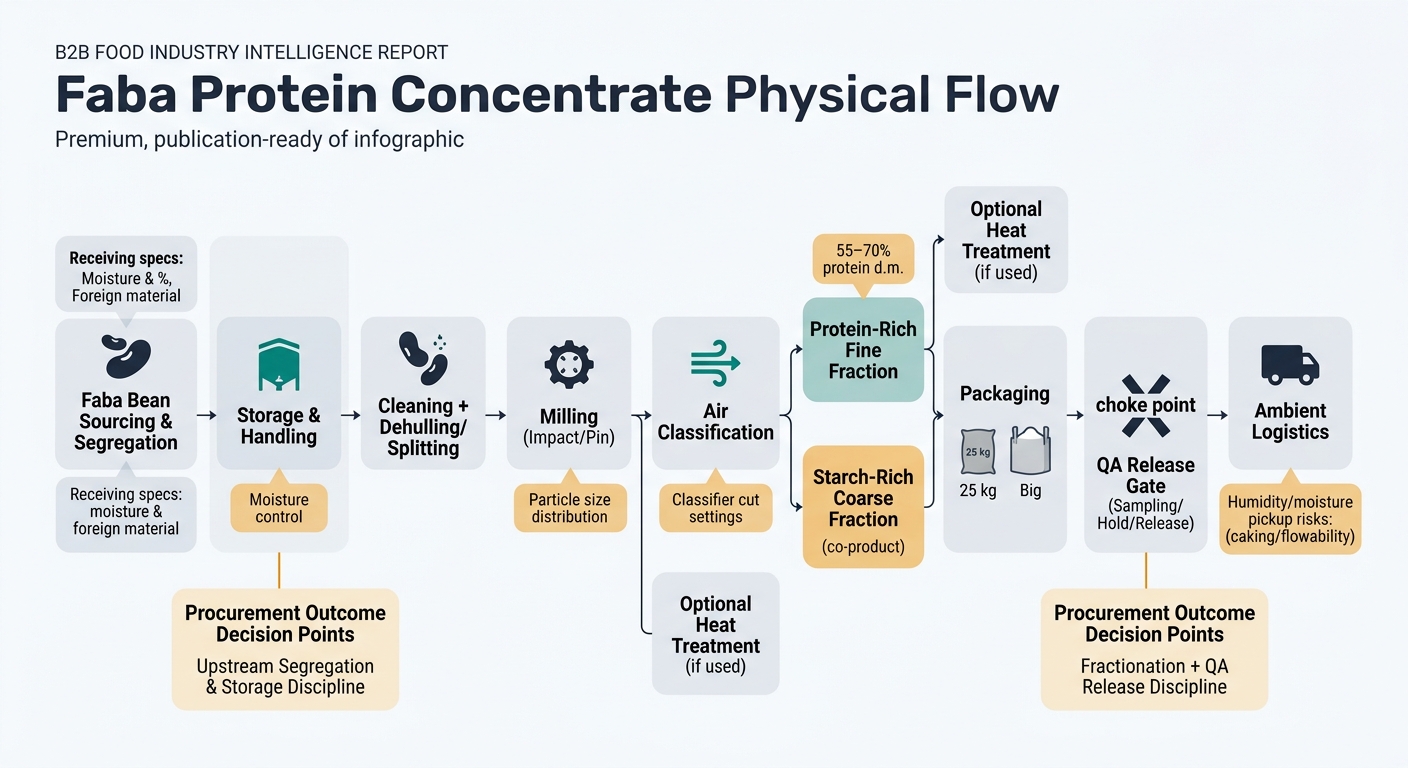
Insight: The chain is physically short, but value-add is concentrated in dehulling/milling precision, air-classification performance (yield), and QA release discipline.
Data: Dry fractionation is commonly described as dehulling/splitting → impact/pin milling → air classification; published reviews and studies show protein enrichment is sensitive to particle size distribution and classifier cut settings, which drives variability across products. [1]
Procurement Impact: Your landed-cost stability is less about “farm count” and more about whether your supply base has redundant processing capacity, consistent QA release, and controlled storage/logistics that prevent moisture pickup and caking.
Insight: Costs accumulate less from “many steps” and more from yield losses, capital intensity, utilities, and rejection risk at the processing/QA nodes.
Data: Dry fractionation avoids solvent and large effluent loads typical of wet extraction, but still depends heavily on milling energy, classifier performance, and tight particle-size control to enrich protein. [4]
Procurement Impact: The same nominal “protein %” can mask very different cost structures depending on yield, rework, and QA hold rates—so physical-node economics matter as much as the delivered price.

| Supply Chain Node | Cost Ratio (% of Final Cost) | Notes |
|---|---|---|
| Raw Material (food-grade beans) | 35% | Cost set by food-grade segregation and usable yield. |
| Primary Processing (dehull + mill) | 12% | Dehulling yield + particle-size control drive efficiency. |
| Secondary Processing (air classification) | 22% | Capital + utilities + yield losses; purity vs throughput trade-off. |
| Packaging & QA release | 8% | Testing, hold time, COA, traceability; rejection/rework risk sits here. |
| Logistics & Distribution | 10% | Humidity protection, inland + ocean, customs handling. |
| Distributor/Processor Margin | 13% | Working capital + inventory risk + service level expectations. |
| Supply Chain Node | Cost Ratio (% of Final Cost) | Notes |
|---|---|---|
| Raw Material (beans) | 25% | Lower share because processing adds more cost. |
| Primary Processing (prep + milling) | 10% | Similar front-end steps; tighter control often needed. |
| Secondary Processing (wet extraction/isoelectric + drying) | 35% | Water/chemicals/energy + drying + effluent handling raise fixed costs. |
| Packaging & QA release | 8% | More intensive analytical controls are common for high-purity specs. |
| Logistics & Distribution | 9% | Similar physical shipping needs; higher value density reduces freight %. |
| Distributor/Processor Margin | 13% | Higher working capital and QA risk premium. |
| Supply Chain Node | Cost Ratio (% of Final Cost) | Notes |
|---|---|---|
| Raw Material (concentrate/flour inputs) | 30% | Input cost depends on concentrate grade and consistency. |
| Primary Processing (milling/blending prep) | 8% | Conditioning and particle-size consistency matter. |
| Secondary Processing (texturization/extrusion + drying) | 28% | Energy + throughput + scrap/rework are key cost levers. |
| Packaging & QA release | 8% | Bulk packs; physical specs (density, hydration) add testing. |
| Logistics & Distribution | 10% | Bulk volume can increase freight sensitivity. |
| Distributor/Processor Margin | 16% | Value-add step often carries higher margin expectations. |
Insight: Three structural realities shape availability, quality consistency, and cost—regardless of market cycle.
Data: Published reviews consistently describe (1) dry fractionation as a milling + air-classification system sensitive to particle size and cut-point settings, (2) concentrate protein levels that vary by process and cut selection, and (3) sensory/off-note management and functionality differences as real differentiators across pulse protein ingredients. [5]
Procurement Impact: If you treat faba protein concentrate as a commodity flour, you will under-budget for qualification time, QA workload, and the cost of managing variability.
Insight: Broad bean protein concentrate cost and risk are physically anchored in yield, utilities, and QA gates—not in a long chain of intermediaries.
Data: Dry fractionation depends on dehulling/milling and air classification; reviews describe faba starting protein around ~28–34% (d.b.) and emphasize that milling/classifier settings drive variability in concentrate purity and performance. [5]
Procurement Impact: When you align Procurement, QA, and R&D on a short list of “must-hold” physical specs (protein basis, moisture control, microbiology, key functionality tests, and flavor thresholds), you reduce the hidden cost of rework, blending, and late-stage rejection.
(Analyzed at: Oct, 2026) Treat faba protein concentrate as a processing-capacity and QA-release risk—then contract accordingly. With 2026 pulse acreage signals pointing to softer supply growth in parts of North America and logistics volatility now a recurring baseline, the teams that win continuity are the ones that lock dual-sourced, spec-locked coverage (same basis: as-is vs dry matter; moisture + micro limits; 1–2 application-relevant functionality tests) and require defined QA release lead times at each site. [3]
If you wait to “see how the crop lands,” you usually pay later in expediting, rework, and line downtime—costs that can easily erase a low-single-digit unit-price gain on the ingredient itself.


