
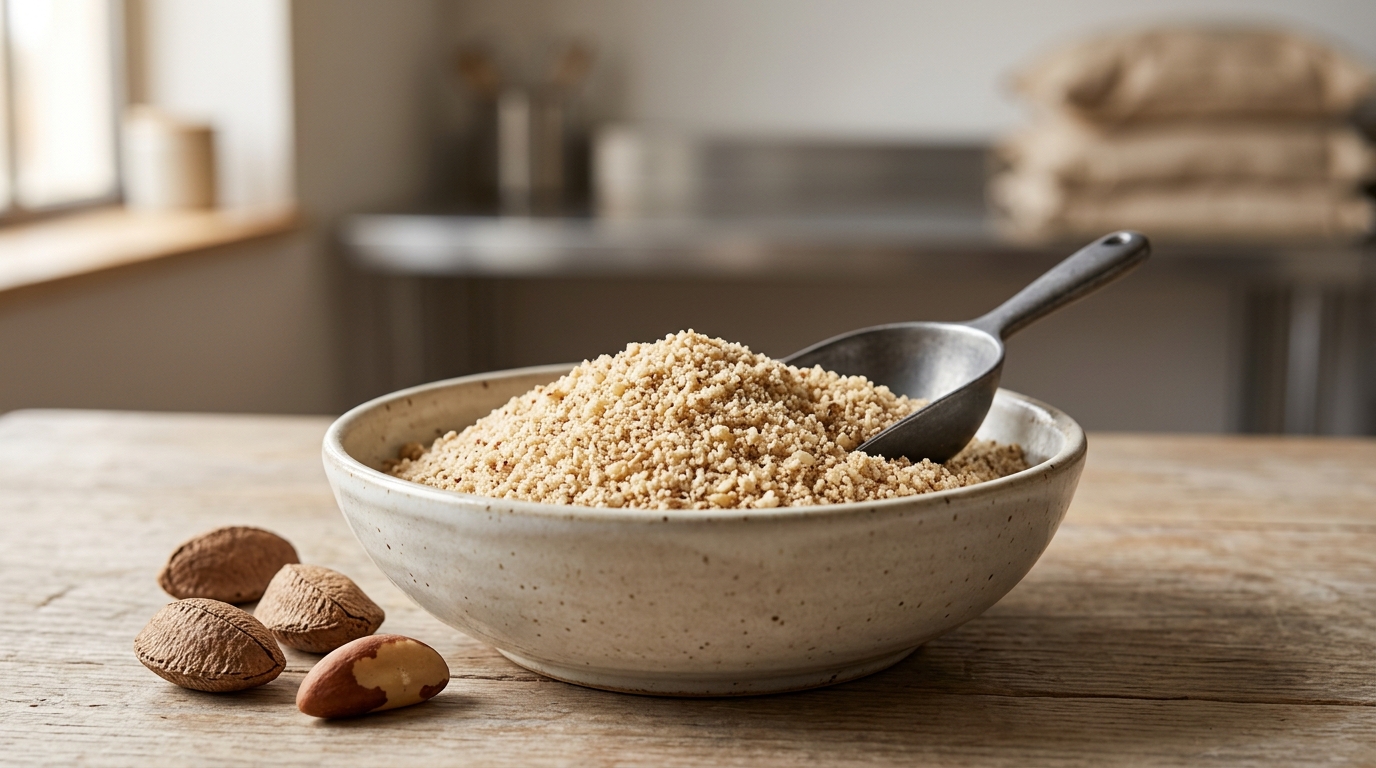
Brazil‑nut meal looks like a straightforward milled ingredient, but procurement outcomes (release time, non‑conformance rate, and disruption exposure) are mostly determined upstream—where wild‑collected nuts are aggregated, dried, and sorted—and downstream—where fat oxidation and moisture pickup can quietly turn an “in‑spec at pack” lot into a claim or hold at receipt.
Brazil-nut meal is a byproduct-driven ingredient: its availability and baseline cost are structurally tied to wild-harvest Brazil nuts and to what happens to kernels (export as edible kernels vs. downgraded to pressing/milling). The physical chain is short on paper, but long in reality because material moves through remote collection networks, labor-heavy shelling/sorting, and then either oil-pressing (cake) or milling (meal/flour), before packaging and long, humidity-sensitive logistics. (FAO describes Brazil nuts as wild-collected across the Amazon Basin and traded in-shell and shelled, with Bolivia/Peru leading in shelled exports—i.e., more transformation capacity.) [1]
Insight: Cost and compliance exposure accumulate earliest at drying/handling and shelling/sorting—because that’s where moisture, mold pressure, and foreign matter are either controlled or “baked in” to the lot.
Data: Brazil nuts are largely wild-collected in the Amazon Basin; upstream handling relies on manual collection, aggregation, and drying infrastructure with limited mechanization, and quality losses (rejections/downgrades) can be material when moisture control is weak. Literature on the Brazil-nut chain links low-technology handling and extended post-collection periods to higher aflatoxin risk, reinforcing drying/handling as a critical control leverage point. [2]
Procurement Impact: The physical map tells you where variability is structural: upstream access + drying + sorting yield determine how much material is available for meal streams and how consistent specs will be downstream.

Insight: Brazil-nut meal cost is not “one process”—it is a stack of (1) remote-origin friction costs, (2) yield loss from sorting/screening, and (3) stabilization/QA/packaging needed to keep a high-fat nut ingredient within oxidation and moisture limits.
Data: The meal stream commonly comes from either (a) milling broken/downgraded kernels or (b) milling press-cake after oil extraction; both routes depend on the economics of kernel grading and the effectiveness of contamination controls.
Procurement Impact: Understanding node-level cost drivers helps QA/procurement align on which specs are truly process-limiting (moisture/oxidation/foreign matter) versus what can be controlled later (granulation via milling/sieving).

| Supply Chain Node | Cost Ratio (% of Final Cost) | Notes |
|---|---|---|
| Upstream raw nuts (collection + aggregation) | 18% | Remote access + drying capability drives baseline cost. |
| Primary processing (shelling/sorting/screening) | 22% | Labor-intensive; yield loss from rejects/downgrades is embedded here. |
| Secondary processing (pressing + cake milling) | 17% | Press capex/energy + handling; fat target more controllable. |
| Packaging & QA release | 10% | Barrier liners + lab testing/COA generation. |
| Logistics & distribution | 18% | Inland + ocean + warehousing; delay raises quality risk. |
| Importer/processor margin & overhead | 15% | Working capital, shrink, compliance overhead, customer servicing. |
| Supply Chain Node | Cost Ratio (% of Final Cost) | Notes |
|---|---|---|
| Upstream raw nuts (collection + aggregation) | 16% | Still driven by remote origin friction and drying. |
| Primary processing (shelling/sorting/screening) | 24% | Higher sensitivity to incoming quality; more sorting loss. |
| Secondary processing (milling + sieving + optional stabilization) | 18% | Fine particle specs add sieving/recirculation; stabilization may add energy. |
| Packaging & QA release | 12% | Higher barrier need due to oxidation sensitivity of full-fat product. |
| Logistics & distribution | 16% | Heat/humidity control matters; faster turns reduce drift. |
| Importer/processor margin & overhead | 14% | Includes quality claims handling and inventory risk. |
| Supply Chain Node | Cost Ratio (% of Final Cost) | Notes |
|---|---|---|
| Brazil-nut meal input (as received) | 35% | Dependent on upstream yield and oxidation state at blending. |
| Other ingredient inputs | 25% | Seeds/nuts/sugars/proteins; varies by formulation. |
| Secondary processing (blending + re-milling) | 12% | Homogeneity, segregation control, metal detection. |
| Packaging & QA release | 10% | Allergen labeling complexity + multi-ingredient COA compilation. |
| Logistics & distribution | 8% | Often shorter lanes if blended near end market. |
| Brand/packer margin & overhead | 10% | Includes traceability admin and recall readiness overhead. |
Insight: Brazil-nut meal is not primarily “grown for meal”—it is structurally downstream of how much kernel volume is processed and how much is downgraded into secondary streams.
Data: Sorting/grading separates export-grade kernels from broken/downgraded kernels; oil pressing can also redirect material into cake streams when kernel outlets are constrained.
Procurement Impact: Meal availability and consistency are structurally sensitive to upstream quality outcomes (moisture/mold/foreign matter) because those outcomes change downgrade volumes and usable fractions.
Insight: Moisture is not just a spec line—it drives mold pressure, sorting loss, and the probability of downstream non-conformance.
Data: Upstream drying constraints in humid Amazon conditions increase variability; moisture pickup can also occur in transit if packaging and container controls are weak. Studies on Brazil’s mycotoxin challenge highlight that inadequate management and extended time windows in the chain favor aflatoxin formation—supporting tighter “time/temperature/moisture” discipline upstream. [2]
Procurement Impact: Moisture drift increases the chance of holds, retesting, and yield loss (clumping, off-odors), which shows up as real operational cost even when unit price looks unchanged.
Insight: The more surface area and residual oil, the faster oxidation can progress—especially with heat, oxygen, and time.
Data: Full-fat meals/flours typically require tighter control of peroxide value/FFA (exact limits are spec-dependent) and more protective packaging to maintain shelf-life. Tree nut commodity specs commonly include PV/FFA and sensory “no rancid odor” requirements, which aligns with the practical failure mode procurement sees at receiving. [3]
Procurement Impact: If you buy high-fat, fine granulation meal, the physical chain forces higher QA intensity and tighter storage/turn requirements to avoid rancidity claims.
(Analyzed at: Aug, 2026)
Treat transit time and humidity exposure as specification variables, not “logistics noise.” With ongoing origin-corridor disruption and shipment timing variability still being reported into mid‑2026, the most defensible move is to contractually tie acceptance to (1) pack date + test date within a defined window, (2) lot‑level moisture plus PV or FFA tested close to ship, and (3) explicit packaging + container controls (barrier liner, sealed inner, desiccant requirement where appropriate). This works because moisture and oxidation drift are predictable failure modes in nut meals, and delays amplify them. Teams that don’t lock this down typically pay for it in holds, rework, and write‑offs that can easily feel like a quiet 3–8% tax on landed cost during volatile lanes. [6]


