INDUSTRY TRENDS

Boudin Supply Chain Map: Where Delivered Cost Really Locks In (and How Procurement Can Control It)

Author
Team Tridge
DATE
July 21, 2026
7 min read
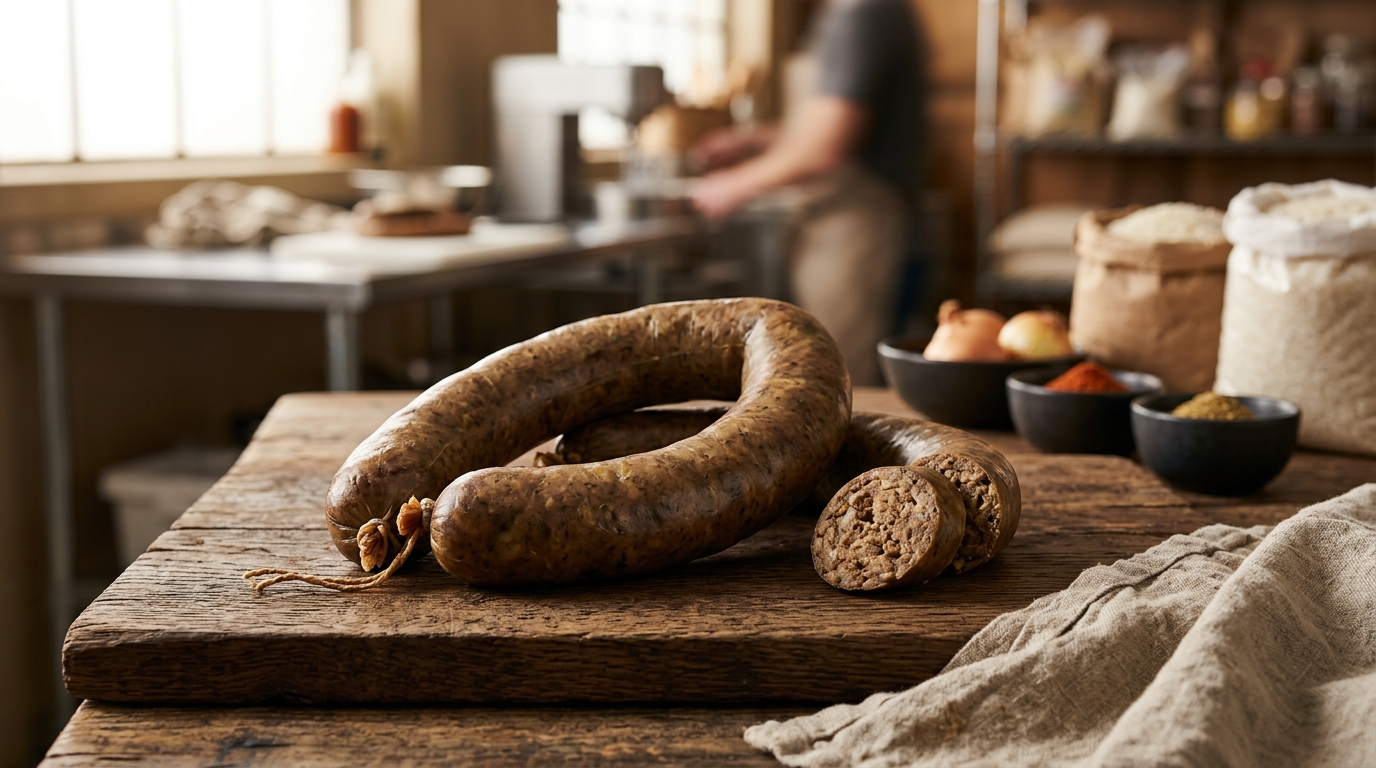
boudin Cover
BoudinHS 160100
Powered by Tridge Eye
🇫🇷 France↑ 2.7%
$7.92/kg
Wholesale reference prices across 133 markets

Boudin sourcing looks deceptively simple because the geography can be regional and the ingredient list is short. In practice, most cost and service outcomes “lock in” at the further-processor due to cook/chill capacity, QA hold-and-release, packaging integrity, and cold-chain time-to-shelf. This guide maps the physical flow so procurement teams can negotiate what actually moves the needle.

Executive Summary

  • Cost and service are primarily constrained by trim standardization, validated lethality + stabilization (cooling), and cold-chain time-to-shelf—not by the recipe.
  • For RTE/par-cooked styles, FSIS Appendix A/B are commonly used as scientific support for validated cooking and cooling; chilling capacity often becomes the true bottleneck.
  • Packaging is shelf-life physics + governance (seal integrity, labeling, metal detection, micro holds), not “just materials.”
  • Refrigerated programs win or lose on dwell time + shrink/returns, while frozen programs trade higher structural logistics cost for resilience.
  • As of Jul 2026, U.S. pork production expectations for 2H 2026 have been pressured by lower hog inventory forecasts; trim markets can tighten seasonally, making index-linked and spec-disciplined contracts more valuable.
A left-to-right supply chain flow showing the physical movement and decision/control points: Upstream Inputs (pork trim, rice/veg, spices, casings) → Primary Meat Processing (fabrication, trim standardization, cold storage) → Secondary Processing (grind/mix/stuff, cook/par-cook, validated lethality, rapid chilling) → Packaging + QA Release (vacuum/MAP, seal integrity, labeling, metal detection, micro testing, hold-and-release) → Cold-Chain Logistics + Distribution (reefer transport, DC dwell time, store delivery) → Customer/Time-to-Shelf. Visually flag the three major constraints as callouts: Trim standardization, Validated lethality + stabilization (cooling), Cold-chain time-to-shelf. Add small icons for bottlenecks (clock for dwell/holds, thermometer for time/temp control, snowflake for chill capacity) without showing any intelligence dashboard UI.

1) How Boudin Physically Moves—and Where Costs Become “Fixed”

Boudin’s supply chain is structurally “short” in geography but dense in cost accumulation: most value (and risk) is created in the further-processing plant, not on the farm. The product’s defining attributes—ground pork + cooked rice/vegetables, high moisture, and (often) a par-cook step—make time/temperature control and sanitation the governing physics of the chain.

Insight: Boudin cost and service outcomes are largely determined by three physical constraints: (1) pork trim standardization, (2) validated lethality + rapid chilling (if par-cooked/RTE), and (3) cold-chain time-to-shelf (especially for refrigerated formats).

Data (validated process controls): For cooked or partially cooked meat products, FSIS “Appendix A/B” guidance is commonly used as scientific support for validated lethality and stabilization (cooling) processes; cooling windows are directly tied to controlling spore-formers (e.g., Clostridium perfringens) during chill-down. [1] [2]

Procurement Impact: Even before you discuss “price,” the physical map tells you what can’t be negotiated away: line time, changeovers, chilling capacity, shelf-life loss from temperature abuse, and QA hold/release time. Those are the structural drivers of delivered cost and fill-rate.

2) Per-Node Cost & Margin Structure (What Each Node Physically Adds)

Insight: Boudin’s value-add stack is dominated by conversion (labor/energy/QA) and cold-chain handling; raw materials matter, but the plant’s capability (cook/chill + sanitation + packaging) is what turns inputs into a compliant, shippable product.

1. Upstream Inputs (Pork Trim, Rice/Veg, Spices, Casings)

  • Insight: The “raw” node is less about farming and more about co-products and standardization: boudin typically starts with pork trim (lean/fat targets), plus rice/veg and spice blends; casing choice sets stuffing yield and breakage.
  • Procurement Impact: Your fixed cost drivers here are (a) trim spec (lean point, freshness, frozen vs chilled), (b) casing caliber/defect rate, and (c) spice blend reproducibility (lot-to-lot). These directly translate into grind texture, stuffability, and yield.

2. Primary Meat Processing (Fabrication + Trim Standardization)

  • Insight: This node converts carcass economics into a repeatable input: trim is sorted/boxed/frozen, and variability is “moved” into lean-point assortments.
  • Data (practical reality): Temperature history and trim form (fresh vs frozen blocks) constrain downstream grind performance; the cold chain starts here and never stops.
  • Procurement Impact: The non-negotiable cost mechanics are: cold storage, trim loss (purge/drip), and variability management. If trim arrives warmer/older, your further-processor pays with higher microbial risk, shorter shelf life, and more QA holds.

3. Secondary Processing (Grinding/Mixing/Stuffing + Cook/Par-Cook)

  • Insight: This is the economic “center of gravity.” Labor, line utilization, and validated lethality/cooling determine both unit cost and whether the product is operationally scalable.
  • Data: FSIS recognizes use of the revised Appendix A (cooking/lethality) and Appendix B (stabilization/cooling) guidelines as scientific support for meeting lethality and stabilization performance standards; Appendix B lays out cooling options and time/temperature expectations. [1] [2]
  • Procurement Impact: Fixed drivers include: changeover time between spice profiles/spec variants, stuffing speed limits (casing handling), cook-step energy/steam, and chilling capacity (blast chill vs spiral vs rack). Any bottleneck here shows up as higher conversion cost and longer lead times.

4. Packaging + QA Release (Vacuum/MAP, Metal Detection, Micro Holds)

  • Insight: Packaging is not just materials—it’s shelf-life physics and food-safety governance. Vacuum packaging removes oxygen but creates anaerobic conditions that change hazard controls and storage expectations.
  • Data: FSIS notes vacuum packaging removes air and can extend refrigerated storage time, but it is not a substitute for safe processing of perishable foods. [3]
  • Procurement Impact: Fixed cost drivers include: film/bag specs (seal integrity, puncture resistance), label compliance, metal detection, and micro testing/hold-and-release time. Seal failures and purge drive rework, returns, and code-date shrink.

5. Cold-Chain Logistics + Distribution (Reefer, Dwell Time, Code-Date Shrink)

  • Insight: For refrigerated boudin, logistics is a “race against time.” Every transfer (plant → DC → store) consumes shelf life; for frozen, the chain is more resilient but adds freezing/storage energy and sometimes texture trade-offs.
  • Procurement Impact: Fixed drivers are reefer capacity, fuel/route density, and dwell time at DCs. The measurable output is shrink: temperature abuse and slow rotation convert “landed cost” into write-offs.
Three 100% stacked bars (one per format) using the article’s cost ratios: Refrigerated Vacuum-Packed Links (Upstream Inputs 45, Primary 8, Secondary 22, Packaging & QA 10, Cold-Chain Logistics 8, Margin 7); Frozen Vacuum-Packed (Upstream 40, Primary 7, Secondary 20, Packaging & QA 9, Freezing+Frozen Storage+Logistics 16, Margin 8); Bulk Foodservice Chilled (Upstream 48, Primary 8, Secondary 24, Packaging & QA 6, Cold-Chain Logistics 9, Distributor Margin 5). Use consistent color coding for shared nodes across all bars; include short annotations highlighting what structurally increases cost (e.g., 'Freezing & storage adds 16% in frozen'). Avoid any product UI or dashboard-like styling; keep it editorial and print-friendly.

Product-Level Cost Breakdown

A) Refrigerated Vacuum-Packed Boudin Links (Regional Distribution)

Supply Chain Node Cost Ratio (% of Final Cost) Notes
Upstream Inputs (trim, rice/veg, spices, casings) 45% Trim + casing quality strongly drive yield and rework.
Primary Processing (trim standardization/cold storage) 8% Cold handling and trim variability management.
Secondary Processing (grind/mix/stuff + cook/chill) 22% Labor + line utilization + chilling capacity dominate.
Packaging & QA Release 10% Vacuum bags/labels + micro/hold-and-release + metal detection.
Cold-Chain Logistics & Distribution 8% Reefer freight + DC handling; shelf-life consumption is the hidden cost.
Wholesale/Retail Margin 7% Lower margin than shelf-stable items due to shrink risk.

B) Frozen Vacuum-Packed Boudin (National Distribution)

Supply Chain Node Cost Ratio (% of Final Cost) Notes
Upstream Inputs 40% Similar BOM; sometimes slightly different fat/rice ratios for freeze/thaw performance.
Primary Processing 7% More frozen trim usage can shift storage needs upstream.
Secondary Processing 20% Comparable conversion; may include different cook profiles.
Packaging & QA Release 9% Packaging must tolerate freezer handling and puncture risk.
Freezing + Frozen Storage + Logistics 16% Blast freezing, storage, and frozen freight add structural cost.
Wholesale/Retail Margin 8% Frozen reduces shrink, enabling broader distribution economics.

C) Bulk Foodservice Boudin (Chilled, High Throughput Packs)

Supply Chain Node Cost Ratio (% of Final Cost) Notes
Upstream Inputs 48% Higher throughput often increases sensitivity to trim consistency.
Primary Processing 8% Similar mechanics; fewer retail-driven specs.
Secondary Processing 24% Labor efficiency matters; large runs reduce changeover burden.
Packaging & QA Release 6% Simpler packaging formats (bulk bags) reduce material cost.
Cold-Chain Logistics & Distribution 9% Delivered in fewer drops; still sensitive to temperature abuse.
Foodservice Distributor Margin 5% Margin depends on service model and returns policy.
Sourcing Window Radar
Boudin — Global Harvest Calendar
VIETNAM SEASON ACTIVE
🇻🇳 Vietnam
JUL — JUL
🇺🇸 United St.
OCT — OCT
🇧🇷 Brazil
JAN — JAN
JanFebMarAprMayJunJulAugSepOctNovDec

3) Structural Facts Every Procurement Manager Needs (Non-Obvious “Constants”)

Insight: Boudin behaves like a refrigerated prepared food with meat regulatory complexity—not like a commodity sausage—because rice + moisture + handling exposure make stabilization and environmental hygiene the governing constraints.

Data: FSIS verification activities and the Listeria regulation framework for post-lethality exposed RTE products drive facility practices like hygienic zoning, sanitation labor, and environmental monitoring intensity; these programs materially affect conversion cost and downtime risk. [4] [5]

Procurement Impact: The “best” plant is often the one with excess chilling capacity, strong EMP (environmental monitoring program), and disciplined hold/release—not the one with the lowest stated conversion rate.

Structural Reality #1 (Chilled boudin is shelf-life-limited by the chain, not the recipe)

  • Insight: Each handoff consumes code-date; distribution design (number of touches) is a structural cost driver.
  • Data: Vacuum packaging may extend refrigerated storage time, but it does not replace validated controls and strict refrigeration. [3]
  • Procurement Impact: Your delivered cost is tightly coupled to shrink/returns policies and DC dwell time—even if the ex-works price is unchanged.

Structural Reality #2 (Casing supply is a quality-and-yield constraint, not just a line item)

  • Insight: Natural casing caliber uniformity and defect rates set stuffing speed and breakage.
  • Data (procurement-grade framing): Treat casing as a performance input: defect rate, calibration consistency, salt content/handling, and documentation (traceability/COAs) are what separate “cheap” from “low total cost.”
  • Procurement Impact: Casing variability shows up downstream as slower line rates, higher rework, and inconsistent link count/net weight compliance.

Structural Reality #3 (Cook/chill capacity is the bottleneck that dictates scalability)

  • Insight: For par-cooked/RTE styles, chilling is frequently the rate limiter.
  • Data: FSIS Appendix B establishes stabilization expectations and cooling options tied to controlling pathogen growth during cooling, reinforcing why chiller design and loading practices matter. [2]
  • Procurement Impact: If a plant is “full,” you don’t just lose volume—you lose the ability to protect shelf life (slower chill = higher risk + more QA holds).

4) The Bottom Line for Your Next Contract

(Analyzed at: Jul, 2026)

Lock your next boudin award around capacity and process governance, not just a $/lb conversion quote: require a product-specific Appendix A/B-based validation package (or equivalent scientific support), an explicit cooling/chill-capacity statement, and a documented hold-and-release timeline as contractual deliverables. This works because the plant’s cook/chill and QA release windows are where your shelf life and fill-rate are actually won or lost—and that’s also where disruptions turn into expedite freight, short-ship penalties, and retail shrink.

With USDA forecasting lower hog inventories into late 2026 (a common precursor to tighter pork availability) and trim markets showing seasonal strength patterns, teams that separate index-driven trim movement from conversion/packaging/logistics leakage typically protect several points of delivered cost versus reactive spot buys and last-minute production slots. [6] [1]

BoudinSupply Chain Intelligence
133 countries tracked
10
Exporters
10
Importers
$962M
Top Export Value
Top Exporters (2024)
🇮🇹
Italy
$962M
🇺🇸
United States
$866M
🇪🇸
Spain
$729M
🇵🇱
Poland
$678M
🇩🇪
Germany
$676M
+128 more
Top Buyers
🇬🇧 United Kingdom $1.00B🇩🇪 Germany $619M🇧🇪 Belgium $372M🇨🇦 Canada $322M🇳🇱 Netherlands $315M

References

  1. fsis.usda.gov
  2. fsis.usda.gov
  3. ask.usda.gov
  4. fsis.usda.gov
  5. ecfr.gov
  6. ers.usda.gov

Related Contents

Subscribe
→
By subscribing you agree to with our Privacy Policy and provide consent to receive updates from our company.
Thank you! Your submission has been received!
Oops! Something went wrong while submitting the form.
Subscribe to receive the latest blog posts, updates, promotions, and announcements from Tridge.
