

Bok choy powder is a leafy-green dehydration chain: most of the final cost is structurally determined before the powder ever reaches a blender or packer, because you are paying to remove water, stabilize color, and control microbiology in a high-moisture raw material. The physical map is short but unforgiving: time-to-dry, dryer energy, and contamination control set the floor on cost and the ceiling on capacity.

Insight: In bok choy powder, margin is earned mainly where water is removed and risk is reduced (dehydration + QA discipline), not where the product is simply moved or re-packed.
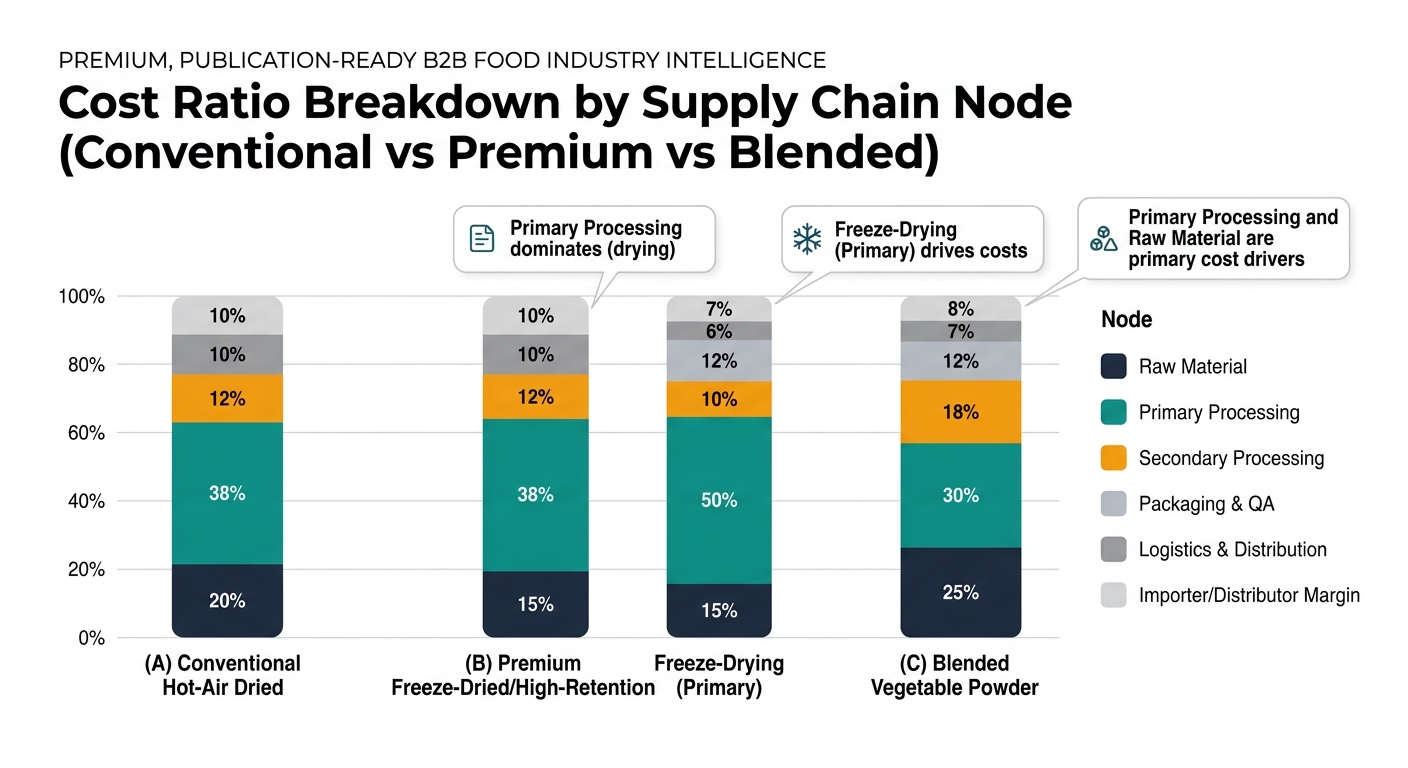
| Supply Chain Node | Cost Ratio (% of Final Cost) | Notes |
|---|---|---|
| Raw Material (fresh bok choy) | 20% | Driven by usable solids and trim/waste; perishability penalizes slow handling. |
| Primary Processing (wash/blanch/dry) | 38% | Dehydration energy + dryer throughput is the structural cost center. |
| Secondary Processing (milling/sieving/controls) | 12% | Mesh control and foreign-matter controls add processing time and yield loss. |
| Packaging & QA | 10% | Barrier liners + moisture/aw + micro testing; documentation costs scale with customer requirements. |
| Logistics & Distribution | 10% | Ocean/ambient lanes plus humidity risk mitigation. |
| Importer/Distributor Margin | 10% | Working capital and inventory holding for long lead times. |
| Supply Chain Node | Cost Ratio (% of Final Cost) | Notes |
|---|---|---|
| Raw Material (fresh bok choy) | 15% | Higher-grade selection, but cost share is diluted by processing intensity. |
| Primary Processing (premium drying) | 50% | Premium drying is the dominant cost driver; energy/capex amortization is higher. |
| Secondary Processing (milling/sieving) | 10% | Often gentler milling to protect color/aroma; tighter in-process controls. |
| Packaging & QA | 12% | Higher barrier needs to protect color/oxidation-sensitive attributes. |
| Logistics & Distribution | 6% | Often smaller lots, faster lanes; still humidity-sensitive. |
| Importer/Distributor Margin | 7% | Higher unit value but sometimes more direct shipment models. |
| Supply Chain Node | Cost Ratio (% of Final Cost) | Notes |
|---|---|---|
| Raw Materials (multi-veg inputs) | 25% | Blend economics depend on the dominant component and its yield. |
| Primary Processing (drying across components) | 30% | Drying cost spreads across multiple SKUs; scheduling affects utilization. |
| Secondary Processing (blending + sieving) | 18% | Blend uniformity and segregation control add handling steps. |
| Packaging & QA | 12% | More complex COA set (multiple raw inputs) and traceability documentation. |
| Logistics & Distribution | 7% | Similar humidity profile; more SKU complexity in warehousing. |
| Importer/Distributor Margin | 8% | Inventory management complexity increases carrying cost. |
Write your next bok choy powder specification so it explicitly controls water activity (aw) and moisture as separate acceptance criteria, and require the supplier to state the drying method and pack-out humidity controls used to achieve them. This works because the chain’s most expensive failure modes—caking, microbial instability, and lot-to-lot performance drift—are physically rooted in dehydration outcomes and moisture pickup, not in downstream handling.
Teams that tighten these two stability controls (without over-tightening sensory preferences) typically reduce rejection/hold events and the hidden cost of rework and disposal that can easily reach high single-digit percentages of annual volume when powders are humidity-exposed. The practical challenge is that aw/moisture performance can vary by origin, season, and process—so maintaining continuity requires current, lot-level visibility into spec performance across suppliers.
Bok choy powder looks like a simple “dry ingredient,” but procurement outcomes are mostly decided upstream—by how fast fresh bok choy gets stabilized, how efficiently water is removed, and how well the powder is protected from humidity after milling. This guide maps the physical chain and highlights the few cost drivers you can realistically influence without breaking the spec.
Write the contract so the supplier must control aw and moisture as separate release criteria and disclose the pack-out humidity controls (not just “foil bag”), then tie remedies to what actually fails in transit: caking/flowability and out-of-spec aw on receipt. This works because low-moisture foods are stable only as long as they don’t pick up water, and aw thresholds around 0.60 are a widely used dividing line in food safety references—so you’re contracting to the physics, not the marketing [8].
With 2026 ocean freight volatility and periodic space constraints, the cost of one moisture-compromised container can easily dwarf a small unit-price concession—think a full lot disposal/rework plus line downtime instead of a 2–4% “win” on price [7].


