
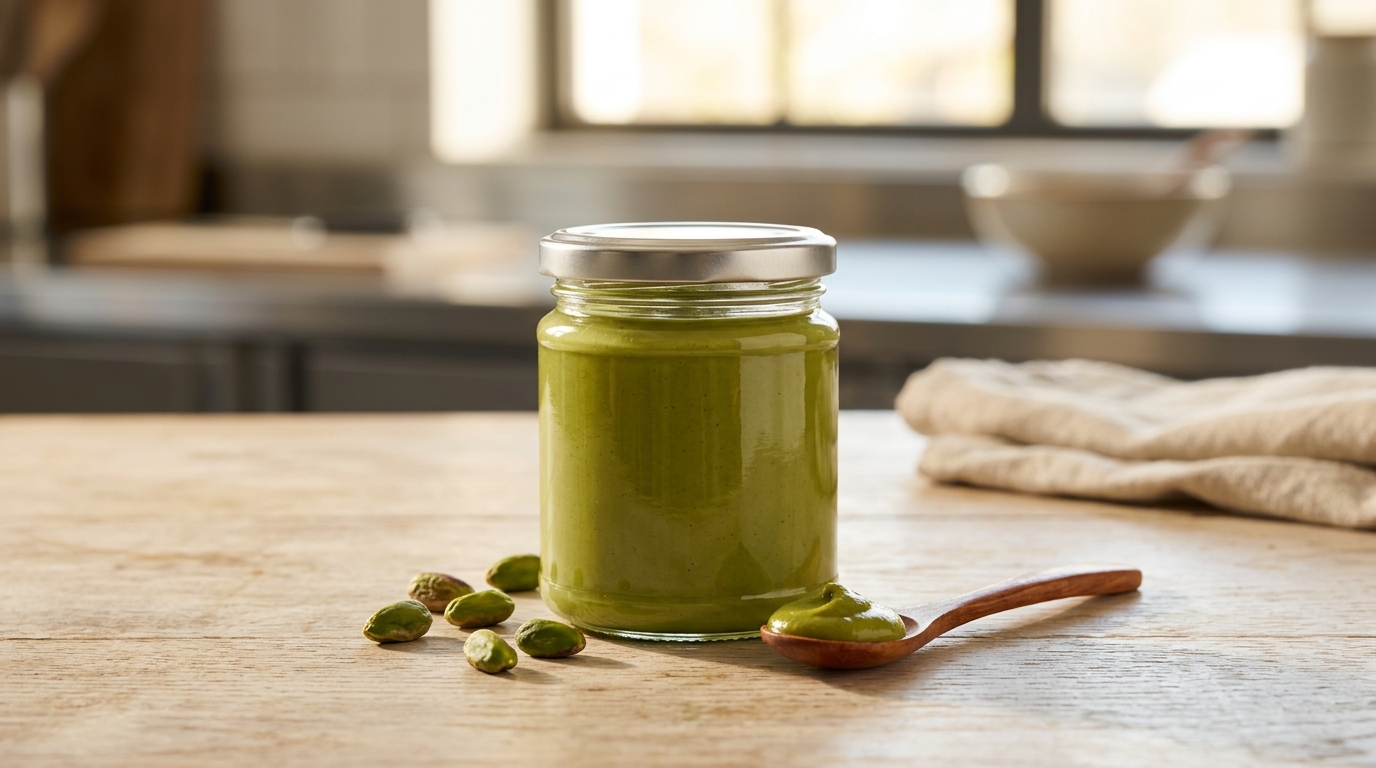
Blanched pistachio paste looks like a single ingredient on a BOM, but procurement outcomes are largely set upstream—by conversion yield losses (sorting, blanching), compliance gates (notably aflatoxins), and how well the chain controls oxidation across a long storage arc after a short harvest.
Blanched pistachio paste is not a single commodity chain—it’s a sequence of yield-loss steps (shelling → defect sorting → blanching → milling) where each conversion narrows usable supply and hardens cost. The “paste” you buy is the end of a kernel-quality and process-control story.
In EU compliance regimes, pistachio-based products can be held to tree-nut aflatoxin maximum levels, so upstream segregation, sampling, and documentation become physical constraints, not paperwork. In particular, Regulation (EU) 2023/915 sets maximum levels for pistachios and states that for processed products consisting at least 80% of the tree nuts concerned, the same maximum levels apply—making this directly relevant to 100% pistachio paste and many high-nut formulations. [1]
Harvest is seasonal (California typically late Aug–Oct), but paste demand is year-round—so storage and oxidation control are structural, not optional. [2]
Your landed cost and continuity risk are largely determined upstream: kernel grade, sorting intensity for “green” color, blanching capacity, and storage/packaging choices that slow oxidation.
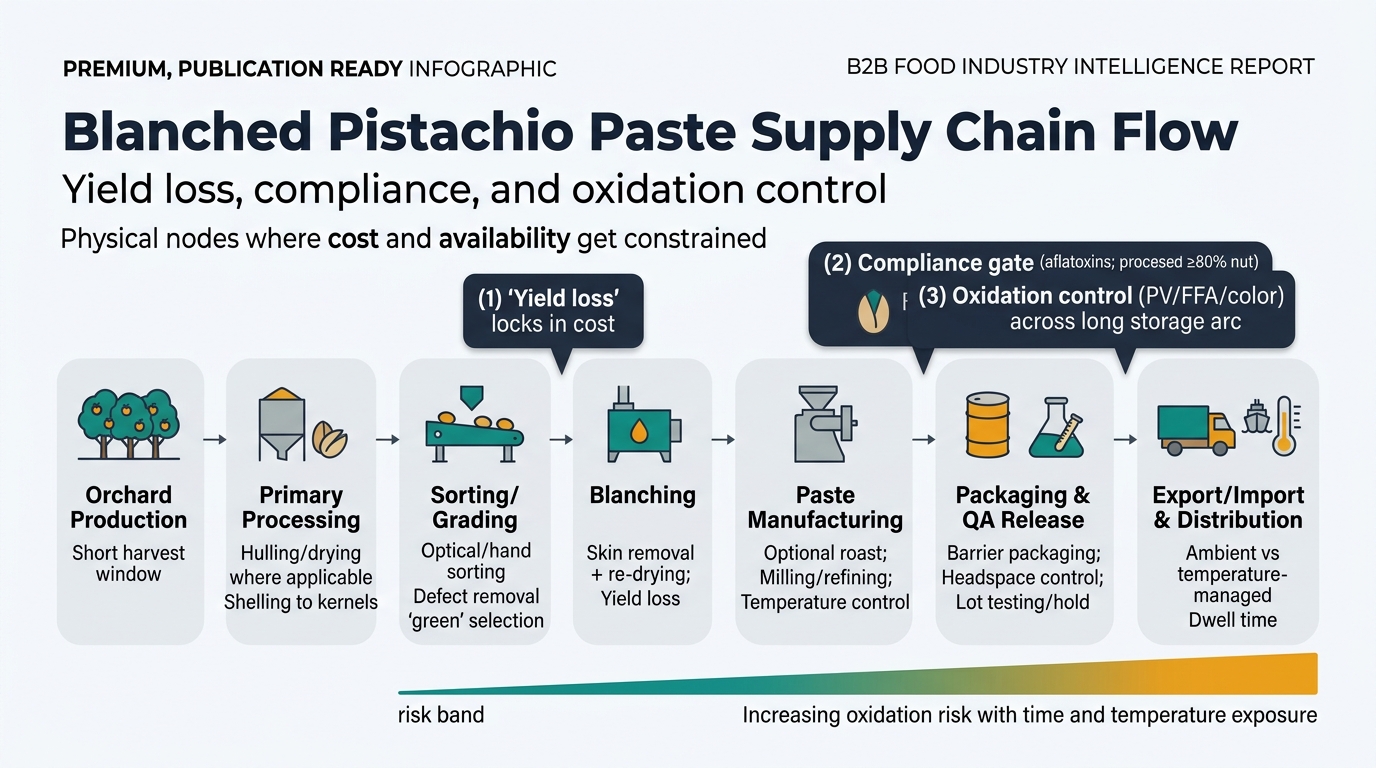
Cost accumulation is dominated by (1) yield loss from removing “non-conforming” kernels, (2) energy/water and throughput limits in blanching and milling, and (3) QA/compliance gating that can stop lots from shipping.
Pistachio paste quality is measurably sensitive to storage and packaging; published work on pistachio paste/spreads and related pistachio paste stability uses oxidation indicators such as peroxide value (PV), free fatty acids (FFA), anisidine value, and color changes across storage conditions. [3]
EU aflatoxin limits are set at the ingredient level for pistachios and can apply to processed products with high nut content (≥80% rule), which is why “documentation” becomes a ship/no-ship constraint. [1]
Even without discussing “how to buy,” the practical implication is that spec choices (color, micro, oxidation limits, particle size, packaging) determine which physical node is the bottleneck—and therefore where supply tightness and cost are structurally created.
The chain’s biggest structural constraint is seasonality: a short harvest window must supply a full year, so drying and storage discipline become part of “raw material cost,” not overhead.
California pistachio harvest typically runs late August through October (often peaking in September). [2] This compresses labor, equipment, and receiving capacity into weeks.
Kernel quality variability (immature, stained, insect-damaged) created here shows up later as higher sort loss, weaker green color, and higher oxidation risk—raising conversion cost per kg of finished paste.
This node is where “usable kernel yield” is manufactured. Optical sorting and defect removal are not cosmetic—they determine paste color, flavor cleanliness, and compliance risk.
U.S. grading standards for shelled pistachios include moisture-related definitions (e.g., “average moisture content”) and a formal quality framework—evidence that condition is treated as a measurable attribute, not a subjective one. [4] In practice, tighter defect tolerances mean more rejects and higher effective raw input cost.
If your paste spec implies low defect tolerance (bright green, low specking), your cost base is structurally tied to sorting intensity and the availability of high-grade kernels.
Blanching is a capacity and yield-loss bottleneck: skins must be removed without “cooking” flavors, and kernels must be re-dried to stabilize moisture—both of which consume energy and time.
Blanching relies on heat and water/steam to loosen skins; downstream quality is sensitive to moisture and subsequent drying. Even small process drifts can shift color and increase browning risk during later roasting.
This node explains why “blanched” paste often carries a structural premium vs. natural-kernel paste: you are paying for conversion losses, utilities, and constrained throughput.
Paste manufacturing cost is driven by particle size targets, temperature control, and throughput limits of mills/refiners; finer textures can require more passes and tighter control.
Published work on pistachio paste/spread production and stability commonly tracks quality outcomes (including oxidation and color) as processing and storage conditions change, reinforcing that process settings matter to measurable outcomes, not just “texture preference.” [3]
“Smooth” vs. “coarse” is not a label—it changes line time, energy use, and sometimes scrap risk (overheating can dull flavor and accelerate oxidation), which then affects cost per kg and batch-to-batch consistency.
For industrial paste, packaging is a functional control system (oxygen/light barrier + headspace management) and QA release is a gating step that can hold inventory.
Pistachio paste quality studies track PV and FFA (and related markers) as oxidation indicators under different storage/packaging conditions, reinforcing that packaging and temperature are measurable drivers of shelf-life behavior. [3]
In the EU, aflatoxin maximum levels are defined for pistachios and can extend to processed products with ≥80% nut content, which is why lot-level test-and-release plus traceability is operationally decisive. [1]
Tighter oxidation and micro specs typically increase testing frequency, hold time, and packaging cost (barrier liners, drums/pails), which becomes a predictable, recurring cost component.
Pistachio paste is oil-rich and oxidation-sensitive; logistics is a quality-preservation step, not just freight.
The category’s quality markers (PV/FFA and related measures) are known to move with storage conditions; temperature excursions and long dwell times accelerate degradation. [3]
Seasonality at origin forces longer storage cycles, increasing dependence on stable transit and warehousing conditions. [2]
The physical choice of shipping mode (ambient vs. managed temperature) directly affects sensory stability and claim risk—especially for “green” paste where color fade is commercially visible.

| Supply Chain Node | Cost Ratio (% of Final Cost) | Notes |
|---|---|---|
| Raw Material (orchard + first handling) | 45–60% | Seasonality + storage discipline; kernel quality drives downstream yield. |
| Primary Processing (shelling + sorting) | 10–18% | Defect removal and optical sorting intensity set usable yield. |
| Blanching (skin removal + re-drying) | 6–12% | Utilities + yield loss + throughput constraints. |
| Secondary Processing (roast + milling) | 6–12% | Particle size targets, heat control, rework/scrap risk. |
| Packaging & QA release | 4–8% | Barrier packaging + test/hold costs; documentation. |
| Logistics & Distribution | 4–10% | Temperature exposure risk; long dwell times increase quality loss probability. |
| Supply Chain Node | Cost Ratio (% of Final Cost) | Notes |
|---|---|---|
| Raw Material (high-grade kernels) | 50–65% | Higher kernel premiums; more sensitivity to crop quality. |
| Primary Processing (sorting) | 12–20% | Higher reject rates to protect color/speck limits. |
| Blanching | 6–12% | Tighter process window; higher scrap risk if color drifts. |
| Secondary Processing | 5–10% | Gentle roasting/low heat load may reduce throughput. |
| Packaging & QA release | 5–10% | More frequent testing; tighter oxidation limits. |
| Logistics & Distribution | 4–10% | Often more conservative temperature management to protect color. |
| Supply Chain Node | Cost Ratio (% of Final Cost) | Notes |
|---|---|---|
| Pistachio input (kernels/paste share) | 25–45% | Lower nut percentage reduces exposure to kernel premiums. |
| Secondary Processing (mixing/refining) | 10–18% | Emulsification/texture control; viscosity targets. |
| Packaging & QA release | 5–10% | Allergen controls still critical; micro targets vary by use. |
| Logistics & Distribution | 5–12% | Often more stable than 100% paste, but still oxidation-aware. |
| Manufacturer/Distributor margin | 15–30% | Formulation value-add + brand/spec management. |
Three structural realities shape availability and quality outcomes regardless of price cycles: harvest compression, conversion yield loss, and regulatory gating.
(1) Harvest timing is concentrated (e.g., California late Aug–Oct), forcing inventory carry and long storage arcs. [2] (2) EU aflatoxin maximum levels apply at the ingredient level for pistachios and explicitly extend to processed products consisting at least 80% pistachios, making compliance a physical constraint on what can ship. [1] (3) Paste quality is measurable and storage-sensitive (PV/FFA/color), so packaging and temperature are structural levers. [3]
Treat packaging format and temperature management as spec items (not logistics preferences) because they directly protect measurable quality attributes over the inventory cycle.
Most “surprises” in blanched pistachio paste come from hidden conversion losses and quality preservation steps that are easy to underweight: sorting yield, blanching throughput, and oxidation control.
Harvest seasonality compresses supply intake into weeks, while quality indicators like peroxide value/free fatty acids (and related oxidation markers) are known to move with storage and packaging conditions. [2] Aflatoxin limits in major markets (e.g., EU) can apply directly to pistachio-rich processed products (≥80%), making upstream segregation and testing consequential. [1]
If you only track “paste price,” you miss the real cost physics: the chain is governed by yield, utilities/throughput, and quality gating—so specs that look minor (color band, particle size, PV/FFA limits, packaging barrier) can materially change who can supply and how stable the product will be in your plant.
Analyzed at: Jul, 2026
With global pistachio markets staying firm into 2026 amid tightening inventories and weather-related production risk signals, your highest-ROI move is to contract quality preservation and release discipline, not just volume: require lot-level aflatoxin compliance evidence aligned to Regulation (EU) 2023/915 (including the ≥80% processed-product rule where relevant) plus a defined oxidation “guardrail” (PV/FFA or equivalent) at ship and receipt, tied to agreed packaging and maximum temperature exposure in transit. [1]
This works because the chain must carry inventory across a compressed harvest, and degradation/holds typically show up as claims, rework, or emergency replacement freight—cost that can easily dwarf a small per‑kg premium when a line is down or a lot is blocked at release.


