INDUSTRY TRENDS

Banana Sourcing Intelligence (U.S. Import Programs): Where Total Landed Cost and Risk Really Sit

Author
Team Tridge
DATE
March 16, 2026
8 min read
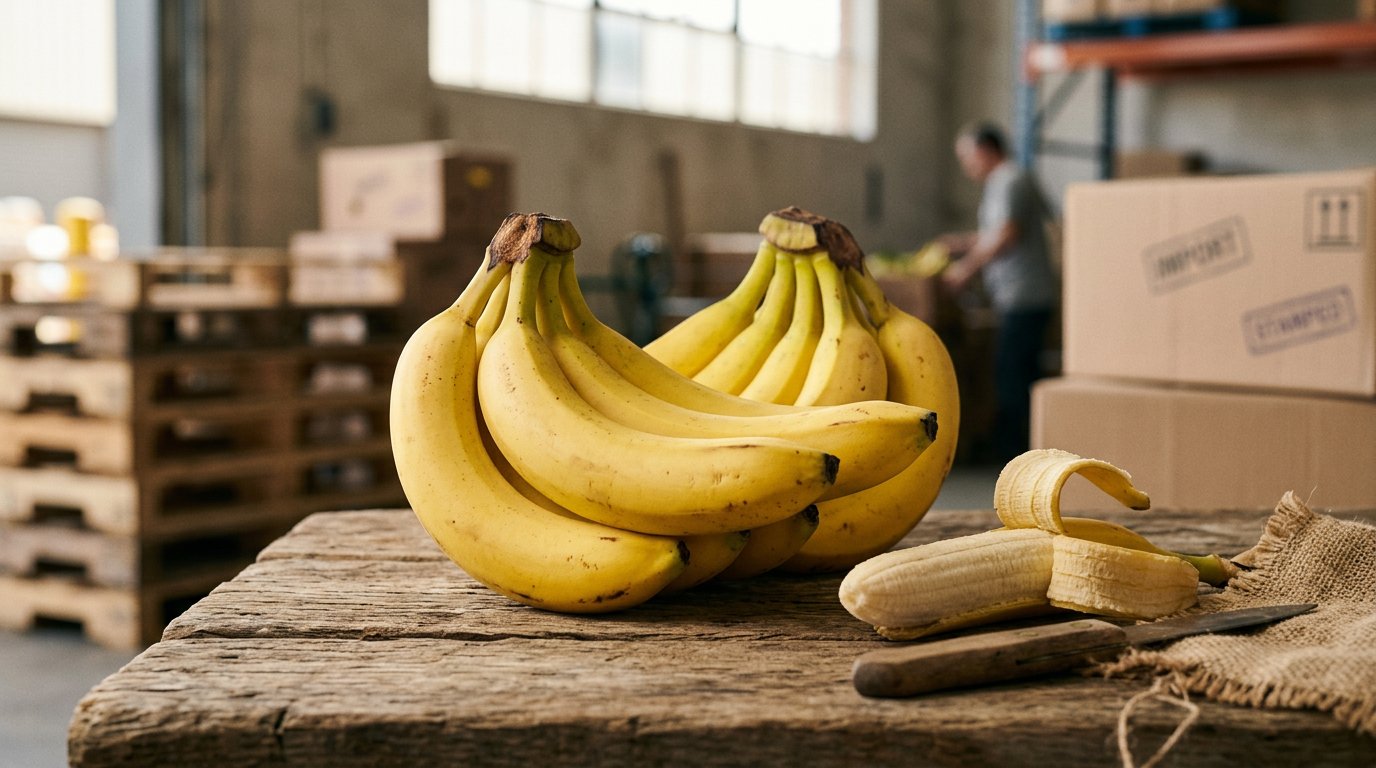
Banana Cover
Tridge Eye Data Intelligence Solution

This report is powered by Tridge Eye Data Intelligence.

Every data point, price signal, and supply risk insight in this analysis comes from the same platform that procurement and sourcing leaders worldwide rely on daily. As you read, consider what this level of market intelligence could do for your sourcing decisions.

Explore Tridge Eye →

Banana sourcing looks simple on an invoice, but it behaves like a tightly timed, temperature-managed manufacturing program. If you’re a procurement leader coming from other categories, the fastest way to get leverage (and avoid avoidable shrink/claims) is to govern the “hidden factories” in the chain: cold chain discipline, vessel schedule reliability, and ripening execution. This guide walks through the real flow, where cost accumulates, and how to turn market/supplier signals into award, contract, and governance decisions.

Executive Summary

  • What you’re actually buying: Mature-green biology + cold chain + ripening capacity delivered inside a narrow quality window.
  • Critical operating set-points (industry guidance): Green banana holding/shipping commonly targets ~13–14°C; ripening commonly uses ~100–150 ppm ethylene in controlled rooms (typical guidance, not a guarantee of outcomes).
  • Cost reality: Unit price is often not the biggest controllable lever; schedule reliability, temperature discipline, and ripening utilization frequently drive the swing in true cost-to-serve through shrink/claims and emergency actions.
  • Structural concentration (U.S. market): USDA ERS reports 2024 U.S. fresh banana imports were mainly from Guatemala (41%), Ecuador (19%), Costa Rica (16%), Honduras (9%)—diversification requires more than adding another exporter name.
  • Governance takeaway: If you don’t measure and manage lane-level OTIF + claims + “days-green / color-stage at delivery” proxies, QBRs become subjective and award decisions become hard to defend.

Key Insights

Analyzed at: Mar, 2026

Banana Infographic
  • Strategy: Hold
  • Reliability: Medium
  • Potential Saving: 3% ~ 8%
  • Insight: For most U.S. import programs, the highest-confidence savings window in 2026 is not chasing headline FOB moves—it’s tightening lane-and-ripening governance:
  • Renegotiate contracts to require temperature/schedule evidence and clearer claim root-cause pathways,
  • Rebalance volume toward lanes with better schedule reliability even if invoice price is slightly higher, and
  • Pre-qualify a contingency bench by origin + port + ripening capacity.
  • These actions typically reduce avoidable shrink/claims and emergency buys (often a mid-single-digit % of delivered cost) without over-rotating your supply base.

1) The banana supply chain “ground truth” (what you’re actually buying)

A left-to-right flowchart showing the U.S. banana import program from plantation harvest through packing, pre-cool and port gate-in, ocean reefer transport (target ~13–14°C), import clearance and inland drayage, ripening rooms (typical ethylene ~100–150 ppm for 24–48 hours with ventilation/CO2 management), and final DC/foodservice/retail delivery, emphasizing the hidden factories of cold chain discipline and ripening execution with risk icons for delays and temperature breaks.

Most procurement teams think they buy “a banana.” In practice, you’re buying a tightly controlled mature-green biology + cold-chain + ripening program that has to arrive inside a narrow quality window.

Typical end-to-end flow (export bananas for U.S. retail & foodservice)

  1. Plantation harvest (mature-green) → harvest maturity and handling discipline drive downstream “green life” and ripening uniformity.
  2. Packing station (wash, grade, box, palletize) → crown condition, latex management, carton build, and reject discipline all show up later as claims.
  3. Pre-cool / staged cooling + port gate-in → temperature and ventilation discipline matter because bananas continue to respire.
  4. Ocean reefer transport → common guidance targets ~13.2–14.0°C for mature-green bananas; colder increases chilling/physiological disorder risk, warmer shortens green life. (Cargo guidelines and postharvest references commonly cite this range.)
  5. Import clearance + inland drayage → delays compress the ripening window and increase “arrive too advanced” risk.
  6. Ripening rooms (ethylene + temperature/RH + ventilation) → common commercial guidance uses ~100–150 ppm ethylene for ~24–48 hours at controlled temperatures to induce uniform ripening; CO2 must be vented/managed to avoid uneven color/texture. [1]
  7. DC / foodservice distribution / retail delivery → service windows are unforgiving; late fruit becomes shrink or credits.

Banana-specific reality that drives procurement outcomes

  • Your “quality” is often determined after ocean transit—during ripening and last-mile handling.
  • A cheap FOB can be overwhelmed by claims, shrink, missed windows, and emergency buys.

2) Where cost and margin accumulate (by node) — and why it matters to buyers

Key insight: In bananas, the unit price is only a portion of the cost story. The largest controllable levers for a buyer are often logistics stability, ripening performance, and claim/shrink leakage, not just upstream economics.

2.1 Upstream / Raw material (plantation & field operations)

What happens here (plain terms):

  • Continuous production in tropical zones; harvest timing/maturity drives ripening success.

Cost drivers:

  • Field labor intensity (bagging, de-leafing, harvest).
  • Disease management (e.g., Sigatoka programs) and systemic threats like Fusarium wilt TR4.

Procurement implication:

  • Agronomy and harvest discipline show up downstream as uniformity (less mixed maturity) and fewer ripening failures.

2.2 Primary processing (packing station: wash/grade/box/pallet)

What happens here:

  • Sorting by size/defects, boxing into export cartons, liner/pad choices, pallet build.

Cost drivers:

  • Packing labor, carton/liner materials, reject rates.

Procurement implication:

  • Packing discipline is a leading indicator for bruise rates, crown issues, carton integrity, and therefore claims.

2.3 Logistics (origin inland → port → ocean reefer)

What happens here:

  • Cold chain is maintained around ~13–14°C for green bananas; temperature excursions are costly because they change ripening speed and shelf-life. [2]

Cost drivers:

  • Reefer ocean freight, fuel/bunker surcharges, port fees, drayage, detention/demurrage exposure.

Procurement implication:

  • Lane reliability often dominates total landed cost variance because delay = shortened green life + higher shrink risk.

2.4 Import-side ripening (the “hidden factory”)

What happens here:

  • Ripening is an industrial control step, not a passive wait. Typical guidance for many commercial cultivars is ~100–150 ppm ethylene for ~24–48 hours at controlled temperature/RH, with ventilation to manage CO2. [1]

Cost drivers:

  • Energy, labor, room utilization, loss from non-uniform ripening, and rework (re-gassing, hold time).

Procurement implication:

  • If your program doesn’t align arrival maturity + ripening capacity, you pay through downgraded color stages, missed windows, and higher credits.

2.5 End-market distribution (DC → store/foodservice)

What happens here:

  • Tight windows; handling damage and temperature breaks create rapid losses.

Cost drivers:

  • DC handling, last-mile, store-level shrink.

Procurement implication:

  • The “best” supplier is frequently the one with the lowest cost-to-serve, not the lowest invoice.
A stacked bar chart with two vertical bars comparing where total landed cost accumulates for (A) green bananas delivered to import DC (pre-ripening) and (B) ripened bananas delivered to retail/foodservice DC, using range bands for modeled cost ratio ranges and including an annotation that biggest controllable swings often come from schedule reliability, temperature discipline, and ripening utilization via shrink/claims and expedites.

2.6 Product-level cost breakdown (illustrative ratios)

These are modeled ranges to show where cost concentrates for procurement decisioning. Actual ratios vary by incoterms, destination, ripening model (in-house vs 3PL), and market conditions.

A) Green export bananas delivered to import DC (pre-ripening)

Supply chain node Cost ratio (% of delivered DC cost) What moves it most
Upstream farming 25–40% labor, inputs, disease pressure, yield
Packing & export prep 10–18% cartons/liners, labor, rejects
Logistics (inland + ocean + port) 25–40% reefer rates, fuel, congestion, delays
Import clearance & inland 3–8% port dwell, drayage, fees
Importer margin/overhead 5–12% financing, risk, programs

Table check: Ranges can sum above 100% because each line is a range; use it as a where-to-look model, not an accounting statement.

B) Ripened bananas delivered to retail/foodservice DC

Supply chain node Cost ratio (% of delivered ripened cost) What moves it most
All costs to import DC (green) 70–85% see above
Ripening operations 5–12% energy, room utilization, rework
Shrink/claims leakage (net) 2–10% temp excursions, maturity mix, handling
Distribution margin/overhead 5–12% service model, delivery frequency

C) Processing-grade diversion (puree/chips/flour feedstock)

Supply chain node Cost ratio (% of delivered ingredient cost) What moves it most
Raw fruit input (often off-grade) 20–45% availability of off-grade and pricing
Conversion yield & processing 25–50% yield loss, energy, labor
Packaging & QA 10–20% aseptic/drums, food safety testing
Logistics & distribution 10–20% weight/volume, shelf-life model

3) One structural fact procurement teams should anchor on

Structural fact: The U.S. banana market is highly dependent on a small set of origins.

  • USDA ERS reports 2024 U.S. fresh banana import volume (highest since 2018) was sourced mainly from Guatemala (41%), Ecuador (19%), Costa Rica (16%), and Honduras (9%). [3]

Why that matters:

  • If your supply base mirrors the market, your “diversification” may be superficial.
  • True resilience comes from diversifying across origins + exporters + ports + ripening capacity, not just adding another exporter name.

4) The critical insight: why banana prices and your real costs disconnect

Banana procurement often experiences a mismatch between:

  • Quoted price (FOB/CIF/program price)
  • True cost-to-serve (shrink + claims + service failures + expedites)

The disconnect happens because bananas are time-sensitive inventory:

  • Ocean delays or temperature excursions can convert a “good buy” into early yellowing, uneven ripening, crown rot/decay exposure, and higher rejection/credits.

Cold chain set-point is non-negotiable (as a governance principle):

  • Common postharvest guidance targets holding/shipping mature-green bananas in the ~13–14°C range. [2]

Category-level biological risk is real (not theoretical):

  • TR4 (Fusarium wilt Tropical Race 4) has been reported in Colombia (2019) and Peru (2021) (and later Venezuela (2023) in the scientific literature), which elevates long-term supply risk management questions for Cavendish-heavy programs. [4]

5) Where procurement teams typically get banana sourcing wrong

  1. Over-weighting the invoice price and under-weighting shrink/claims leakage.
  2. Treating “supplier diversification” as adding exporters, while staying concentrated in the same origin/port corridor.
  3. Not contracting for what actually fails:
  4. temperature discipline evidence (reefer settings, pulp temps where available, exception reporting),
  5. vessel schedule reliability expectations and escalation paths,
  6. ripening performance accountability (what happens when arrivals are advanced/late).
  7. Spec rigidity at the wrong time:
  8. In disruption periods, overly tight cosmetic/size specs can increase rejects and service failures.
  9. Governance gaps:
  10. QBRs become subjective because OTIF and claims are not normalized by lane, seasonality, and maturity profiles.

6) How an intelligence-driven approach changes the outcome (without hype)

Decision being improved:Award / re-award volumes and set contract governance for a banana program (program + contingency bench).

Banana-specific risk to manage (anchor risk):

  • Lane disruption → ripening window failure → shrink and service penalties

Relevant intelligence capability (1–2 only):

  • Supply chain risk monitoring (origin-to-destination) to detect early indicators (weather/port/labor/logistics constraints) and translate them into procurement actions.
  • Supplier benchmarking & portfolio comparison to link lane performance and claims patterns to volume allocation.

How it changes the process (what a procurement leader would actually do):

  1. Set a weekly risk review cadence (15–30 minutes) with ops/quality:
  2. top origin/lane risks,
  3. expected transit reliability shifts,
  4. ripening capacity constraints.
  5. Translate signals into predefined actions (pre-approved playbooks):
  6. activate backup origin for X% volume,
  7. adjust ripening schedule (earlier/later gassing) based on arrival condition,
  8. allow temporary spec flex (size/cosmetic) to protect fill rate.
  9. Run a total landed cost view that includes:
  10. invoice + freight + ripening,
  11. expected shrink/claims by lane/supplier,
  12. expedite probability during disruption windows.
  13. Govern with a scorecard that procurement owns:
  14. lane-level OTIF,
  15. claims rate per million lbs (or per container),
  16. shelf-life at delivery proxy (color stage / days-green),
  17. corrective action closure time.

What changes in negotiations:

  • You stop arguing “your price is high” and start negotiating on measurable cost drivers (reliability, temperature compliance, claim leakage, and contingency readiness).

7) Strategic use cases procurement teams can operationalize

  1. Pre-qualify a contingency bench before disruption
  2. Build a shortlist by origin + lane + certifications + pack formats.
  3. Pre-negotiate activation terms (lead time, minimums, spec flex rules).
  4. KPI: time-to-activate contingency supplier.
  5. Reduce cost volatility without sacrificing service
  6. Track freight and lane reliability signals; adjust program/spot mix.
  7. KPI: landed cost variance vs benchmark and emergency buy frequency.
  8. Link performance to award decisions (make QBRs objective)
  9. Standardize metrics and normalize by lane.
  10. KPI: OTIF, claims rate, shrink %, corrective action closure.
  11. Spec governance that protects availability
  12. Define “normal spec” vs “disruption spec” (pre-approved flex bands).
  13. KPI: fill rate maintained during disruption windows.

8) Why this matters beyond bananas (examples your organization likely buys too)

Bananas are a clean teaching case because the product is simple, but the supply chain is not. The same intelligence logic applies to other procurement categories with “hidden factories” and tight service windows:

  • Avocados: maturity and ripening management drive shrink and customer satisfaction; lane delays change ready-to-eat performance.
  • Table grapes/berries: cold chain breaks rapidly convert into claims; supplier selection should include packhouse discipline and logistics reliability.
  • Fresh-cut salads: food safety and shelf-life risk make supplier governance and audit readiness as important as unit cost.
  • Frozen shrimp: not perishable like bananas, but still exposed to origin compliance risk, port disruptions, and spec/claim leakage.

The transferable lesson: procurement outcomes improve when you govern the drivers of service failure, not only the quoted price.

9) Why this example is powerful for procurement leaders evaluating intelligence

This category forces clarity on four procurement truths:

  1. Total landed cost beats unit price when shrink/claims are material.
  2. Resilience is portfolio design (origins + lanes + ripening capacity), not a second supplier name.
  3. Risk monitoring only matters if it triggers decisions (predefined playbooks and thresholds).
  4. Governance is measurable: when scorecards are lane- and season-aware, award decisions become defensible and repeatable.

Metrics that make the program auditable and board-ready

  • OTIF / fill rate (by lane)
  • Shrink % (DC and store-level)
  • Claims rate & top 3 root causes
  • Landed cost variance vs benchmark
  • Supplier/origin concentration (top-1, top-3 share)
  • Time-to-activate contingency supplier
Tridge Eye Data Intelligence Solution

Make Faster, Data-Driven Sourcing Decisions

The insights in this report are just the starting point. Tridge Eye is the data intelligence solution that gives procurement and sourcing leaders real-time market signals, price benchmarks, and supply risk alerts — so you can act before the market moves.
Explore Tridge Eye →

References

  1. postharvest.ucdavis.edu
  2. cargohandbook.com
  3. ers.usda.gov
  4. pmc.ncbi.nlm.nih.gov
Subscribe
By subscribing you agree to with our Privacy Policy and provide consent to receive updates from our company.
Thank you! Your submission has been received!
Oops! Something went wrong while submitting the form.
Subscribe to receive the latest blog posts, updates, promotions, and announcements from Tridge.