INDUSTRY TRENDS

Avocado Procurement Intelligence That Actually Lowers Shrink-Adjusted Landed Cost Risk

Author
Team Tridge
DATE
March 16, 2026
10 min read
Avocado Cover
Tridge Eye Data Intelligence Solution

This report is powered by Tridge Eye Data Intelligence.

Every data point, price signal, and supply risk insight in this analysis comes from the same platform that procurement and sourcing leaders worldwide rely on daily. As you read, consider what this level of market intelligence could do for your sourcing decisions.

Explore Tridge Eye →

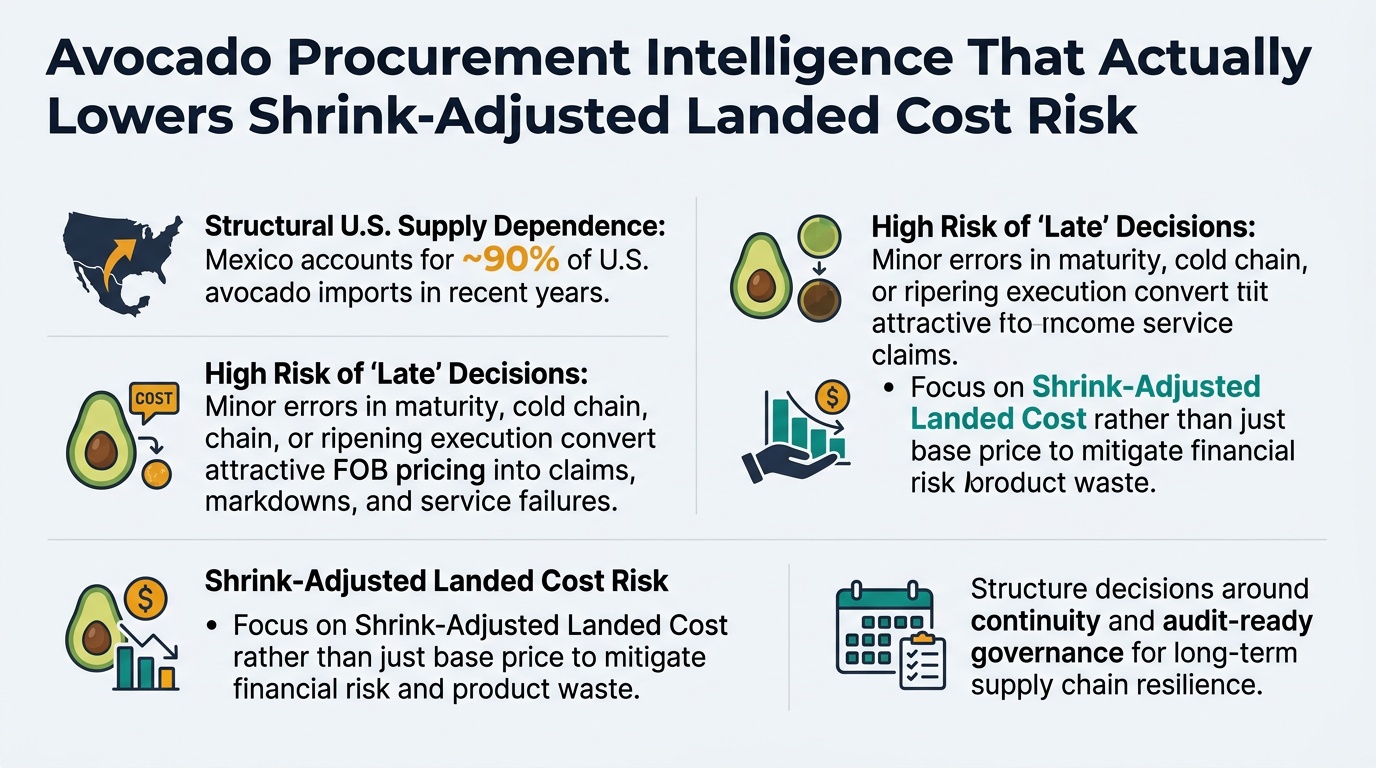
Avocados punish “late” decisions: a small miss in maturity, cold chain, or ripening execution can turn an attractive FOB into claims, markdowns, and service failures a week later. This guide is written for procurement and sourcing managers who are strong category professionals but newer to avocado-specific realities—so you can structure decisions around shrink-adjusted landed cost, continuity, and audit-ready governance.

Executive Summary

  • U.S. supply dependence is structural: Mexico typically accounts for ~90% of U.S. avocado imports/ imported shipments in recent years (varies by year and data series). [1]
  • Per-capita consumption is high and stable: Hass Avocado Board (HAB) reported 8.7 lb per capita in 2023 and 8.6 lb in 2024. [2]
  • Market-scale is approaching a step-change: HAB stated the U.S. market was on track to exceed 3 billion pounds in 2025. [3]
  • Cold chain guidance is well-established: UC Davis notes mature-green ‘Hass’ can be held around 5–7°C (41–45°F) under appropriate conditions; temperature discipline materially affects quality outcomes. [4]
  • Non-agronomic events can halt flows: APHIS inspection pauses in Michoacán (e.g., February 2022; additional actions reported later) show how security/regulatory events can tighten supply quickly. [5]
  • Procurement takeaway: The winning playbook is not “lowest unit price”—it’s risk-adjusted supplier selection + contract performance terms + trigger-based switching to protect OTIF and shrink-adjusted landed cost.

Key Insights

(Analyzed at: Mar, 2026)

Avocado Infographic
  • Strategy: Hold
  • Reliability: Medium
  • Potential Saving: 4% ~ 10%
  • Insight: Maintain Mexico as your base-load, but tighten governance and optionality rather than chasing spot price. Mexico remains ~90% of U.S. import supply in many recent datasets, so “switching away” is rarely feasible at scale; the practical savings opportunity is to reduce shrink and service penalties by (1) locking a higher share of volume under performance-based programs during high-risk windows, (2) pre-qualifying Peru/Colombia/DR as supplemental lanes with clear spec/ripening constraints, and (3) using trigger thresholds (inspection/security events, transit-time slippage, size-curve shifts) to move volume early—before downstream shrink spikes.

1) The Ground Truth: Why Avocados Don’t Behave Like “Normal” Produce

Avocados are a maturity-managed, cold-chain-dependent fruit where value is created (or destroyed) after harvest as much as in the orchard. For procurement leaders, this creates a different reality than many other categories:

  • Supply is origin-switched and highly concentrated: the U.S. market is structurally dependent on Mexico for the majority of imports (often cited around ~90% of imported shipments in recent multi-year summaries; exact share varies by year). [1]
  • Quality risk is often “invisible” at receipt: external appearance can look fine while internal defects (browning, vascular discoloration, rot) show up later—driving claims and shrink.
  • Maturity (dry matter) drives eating quality and shrink: dry matter is widely used as a maturity index; minimums vary by cultivar and program. [4]
  • Cold chain is not optional: mature-green Hass is commonly managed around 5–7°C (41–45°F) under appropriate conditions; too cold increases chilling injury risk, too warm accelerates ripening and decay. [4]
  • A single disruption can reprice the whole market: inspection pauses, security incidents, port delays, or weather can rapidly tighten supply. The 2022 suspension of inspections in Michoacán is a clear example of how a non-agronomic event can halt flows. [5]

Procurement implication: The “best price” supplier is rarely the best outcome if it increases shrink, destabilizes service level, or fails governance requirements.

2) Where Cost Accumulates (and Why Shrink Is a Hidden Tax)

Below is a node-by-node view of cost and margin mechanics across the avocado supply chain. This is written for procurement managers who need a practical mental model—not agronomy depth.

A left-to-right supply chain diagram showing the six nodes described in Section 2 (Orchard/Harvest Lot; Packinghouse sorting/grading/carton build; Ripening & value-added programs; Packaging & QA specs/testing/traceability; Logistics & distribution cold chain/transit/gateways; End markets retail/foodservice/wholesale), with cost pressure and shrink risk bands for each node, plus a logistics temperature callout targeting ~5–7°C (41–45°F) for mature-green Hass and a note that time delays increase effective age.

2.1 Upstream / Raw Material (Orchard & Harvest Lot)

Key insight: In avocados, yield and size distribution (counts per carton) are set upstream, but your P&L pain often shows up downstream as shrink and service failures.

What’s happening operationally

  • Orchard decisions (irrigation, nutrition, pest control) influence fruit size curve, skin condition, and shelf life.
  • Harvest timing is constrained by maturity standards (dry matter); harvesting too early can produce poor ripening and higher claims. [4]

Primary cost drivers

  • Labor (harvest is labor-intensive)
  • Water/irrigation and energy
  • Crop protection and compliance
  • Yield volatility from weather and disease pressure

Procurement “watch-outs”

  • A low FOB can be offset by higher downstream shrink if maturity/handling is weak.
  • Size volatility (more small fruit) changes carton economics and retail/foodservice suitability.

2.2 Primary Processing (Packinghouse: Sorting, Grading, Carton Build)

Key insight: Packinghouse performance drives grade-out, which quietly determines how much “contracted volume” becomes “shippable spec volume.”

What’s happening operationally

  • Sorting by size/count, external defects, and pack style (retail vs foodservice).
  • Pre-cooling and pallet build quality matter for transit outcomes.

Primary cost drivers

  • Labor and throughput constraints (peak weeks)
  • Cartons, pallets, labels, traceability
  • QA sampling and compliance documentation

Procurement “watch-outs”

  • Contract language that only references “volume” without pack-out / grade-out expectations can leave you short during tight supply.

2.3 Secondary Processing (Ripening & Value-Added Programs)

Key insight: Ripening programs convert “green supply risk” into “ready-to-eat service risk.” You’re buying execution capability, not just fruit.

What’s happening operationally

  • Ripening centers use controlled temperature and ethylene; throughput and room capacity become bottlenecks.
  • Small errors in ripening curves can cause uneven firmness, rapid breakdown, and higher DC/store shrink.

Primary cost drivers

  • Ripening-room capex and operating costs
  • Higher handling touches (damage risk)
  • Higher claims exposure (because the product is closer to end-of-life)

Procurement “watch-outs”

  • The “cheapest” ripened program can be the most expensive after shrink.

2.4 Packaging & QA (Specs, Testing, Certifications, Traceability)

Key insight: In avocados, spec clarity is a governance tool and a cost-control tool.

What’s happening operationally

  • Specs cover count sizes, allowable defects, firmness/ripeness windows, and sometimes maturity indices.
  • Dry matter is widely used as a maturity index; minimums vary by cultivar and region. [4]

Primary cost drivers

  • QA labor and inspection
  • Certification compliance (food safety, social, sustainability)
  • Lot-level traceability systems

Procurement “watch-outs”

  • Over-tight specs can increase rejections during tight markets, creating service failures.
  • Over-loose specs can reduce rejections but raise shrink and claims later.

2.5 Logistics & Distribution (Cold Chain, Transit Time, Gateways)

Key insight: Logistics is not just a cost line; it is a quality preservation system.

What’s happening operationally

  • Mature-green Hass is commonly managed at ~5–7°C; deviations can accelerate ripening or increase quality risk depending on variety and condition. [4]
  • Inspection delays, port congestion, and reefer availability can turn “on-time” into “arrived old.”

Primary cost drivers

  • Refrigerated trucking (Mexico–U.S. lanes)
  • Sea freight and reefer surcharges (Peru/Chile/Africa)
  • Demurrage, detention, cold storage
  • Inventory carrying cost (perishable working capital)

Procurement “watch-outs”

  • A 1–2 day delay can be a bigger cost impact than a few cents of FOB.

2.6 End Markets (Retail/Foodservice/Wholesale Margin + Shrink)

Key insight: The final “margin” is often a mix of markup and shrink recovery. When shrink rises, downstream partners push back via claims, rejections, and tighter receiving.

What’s happening operationally

  • Retail demands consistent eating quality and appearance; foodservice demands size consistency and dependable ripened supply.

Primary cost drivers

  • DC handling, store labor, display losses
  • Promotions (volume spikes) and forecast error
  • Chargebacks and claims administration

Illustrative Cost Breakdown by Major Avocado Product Form (Shrink-Adjusted View)

Note: These are modeled, illustrative ratios to show where cost tends to concentrate. Actual ratios vary by origin, week, size curve, freight market, and whether you buy green vs ripened.

A) Green Hass Avocados (Imported, DC-Delivered)

Supply Chain Node Cost Ratio (% of Final DC-Delivered Cost) What typically moves it
Upstream (orchard/harvest) 30% yield, size curve, maturity discipline
Packinghouse (grading/pack) 12% pack-out, materials, labor throughput
Ripening (if none) 0% N/A
Packaging & QA 6% spec enforcement, audits, traceability
Logistics & distribution 27% reefer trucking/sea freight, delays
Importer/wholesale margin + shrink reserve 25% claims, shrink expectations, market tightness

B) Ready-to-Eat / Ripened Hass Program (DC-Delivered)

Supply Chain Node Cost Ratio (% of Final DC-Delivered Cost) What typically moves it
Upstream (orchard/harvest) 26% maturity, fruit condition for ripening
Packinghouse (grading/pack) 10% tighter selection for ripening suitability
Ripening operations 12% room capacity, labor, energy, handling loss
Packaging & QA 7% firmness windows, more QA touches
Logistics & distribution 23% time sensitivity, cold chain precision
Importer/wholesale margin + shrink reserve 22% higher shrink/claim exposure near end-of-life

C) Value-Added (Frozen Pulp / Guacamole Input, Delivered)

Supply Chain Node Cost Ratio (% of Final Delivered Cost) What typically moves it
Upstream (orchard/harvest) 18% raw fruit price, off-grade availability
Primary processing 8% sorting for processing suitability
Secondary processing (manufacturing) 28% equipment, yield loss, food safety, additives
Packaging & QA 12% food-grade packaging, testing
Logistics & distribution 16% frozen chain, storage
Manufacturer/distributor margin 18% capacity utilization, contracts

3) The Structural Fact That Shapes Every Sourcing Plan: U.S. Dependence + Origin Switching

A procurement plan that ignores structural dependence will fail under stress.

  • Mexico is the anchor supplier for the U.S. (often summarized around ~90% of imported shipments in recent multi-year views; exact share varies by year). [1]
  • Secondary origins (Peru, Colombia, Dominican Republic, Chile) matter most as risk relief valves and seasonal supplements, not perfect substitutes.
  • Demand keeps the market tight: HAB reported per-capita consumption around 8.7 lb in 2023 and 8.6 lb in 2024, and indicated the U.S. market was on track to exceed 3 billion pounds in 2025. [2] [3]

Procurement implication: You’re not just buying fruit—you’re managing a portfolio where the “base load” is Mexico and the “stability premium” is diversification + logistics + ripening capability.

4) The Critical Insight: Why Avocado “Price” and “True Cost” Diverge

In many categories, invoice price is a decent proxy for cost. In avocados, it often isn’t.

The disconnect happens because:

  1. Shrink is nonlinear
  2. A small deterioration in maturity discipline or cold chain can cause a disproportionate increase in decay and internal defects.
  3. Time is a cost driver
  4. Avocados are sold on a clock. Delays convert value into waste.
  5. Specs interact with market tightness
  6. When supply tightens, holding specs constant can increase rejections and service failures.
  7. Ripening execution is a capability constraint
  8. If ripening rooms are constrained, “available supply” is not the same as “deliverable RTE supply.”

Practical metric: Track shrink-adjusted landed cost:

  • (FOB + freight + handling + duty/fees) / (received sellable units) + expected claims cost
A waterfall chart bridging invoice/FOB price to shrink-adjusted landed cost by sequentially adding cost-to-serve components (freight/reefer, handling/storage, duties/fees, optional ripening program cost, claims/credits reserve, and shrink/waste cost impact), ending at 'Shrink-Adjusted Landed Cost', with a side annotation defining the formula and callouts showing how small delays or temperature deviations can amplify shrink and claims.

5) Where Procurement Teams Commonly Misstep (and Why It Looks Rational at the Time)

These are typical failure modes when teams apply shelf-stable or less-perishable playbooks to avocados:

  1. Over-optimizing for FOB and under-optimizing for OTIF + shrink
  2. Result: “cheaper” fruit that costs more after claims and waste.
  3. Treating diversification as a crisis action instead of a standing capability
  4. Result: switching late, with spec mismatches and operational friction.
  5. Writing contracts that cover volume but not performance realities
  6. Missing: pack-out expectations, substitution rules, ripening SLAs, dispute protocols.
  7. No trigger-based escalation
  8. Teams notice issues only after store complaints spike—too late for a perishable cycle.
  9. Assuming quality is the QA team’s problem
  10. In avocados, procurement decisions (origin, week, supplier, lane, ripening model) create quality outcomes.

6) What an Intelligence-Driven Approach Changes in Day-to-Day Buying Decisions

This isn’t about “more data.” It’s about making decisions earlier, with clearer trade-offs, and a defensible governance trail.

6.1 Supplier benchmarking becomes risk-adjusted (not price-only)

Compare suppliers by:

  • OTIF reliability by season/window
  • claim/shrink proxies (rejections, credit memos, QC fail rates)
  • spec adherence consistency (size curve stability, defect trends)
  • compliance posture (audit readiness, traceability)

Decision improvement: You can justify paying a premium when it reduces shrink-adjusted cost and protects fill rate.

6.2 Price intelligence becomes “coverage timing,” not weekly guessing

Use seasonal baselines and deviation signals to decide:

  • What % to lock under contract vs leave spot
  • When to activate secondary origins
  • When to change pack formats or size mix

Decision improvement: Fewer emergency buys at peak pricing; smoother transitions.

6.3 Risk monitoring becomes exposure management (by origin, lane, and program)

Monitor disruptions that matter for avocados:

  • inspection pauses/security events (e.g., APHIS inspection suspensions) [5]
  • port/reefer constraints
  • weather anomalies impacting harvest timing and size

Decision improvement: You quantify exposure (e.g., “70% of RTE volume depends on one ripening site + one origin”) and pre-approve mitigations.

6.4 Scenario design becomes operationally realistic

Instead of “switch origin,” scenarios include:

  • lead times and transit risk
  • ripening capacity constraints
  • spec relax/tighten options
  • pack style substitutions (bulk vs bagged, size mix)

Decision improvement: Faster execution during disruption with fewer internal escalations.

6.5 Governance becomes audit-ready

  • Decision logs: what you chose, why, what risks were accepted, what triggers will cause change.

Decision improvement: Better stakeholder alignment (Ops/Quality/Finance) and cleaner post-incident reviews.

7) Strategic Use Cases Procurement Leaders Actually Run in Avocados

Below are repeatable use cases that map directly to measurable outcomes.

  1. Stabilize landed cost without sacrificing fill rate
  2. Inputs: price trend baselines + supplier performance signals
  3. Output: contract coverage plan by month/window
  4. KPIs: shrink-adjusted landed cost, OTIF, emergency buy frequency
  5. Build a “bench” of qualified alternates before the market forces you
  6. Inputs: supplier discovery + pre-qualification checklists
  7. Output: ranked alternates by origin/pack/ripening compatibility
  8. KPIs: time-to-switch, continuity during disruption, concentration risk
  9. Reduce shrink by aligning specs to seasonal realities
  10. Inputs: defect/maturity trend signals by origin/window
  11. Output: spec guardrails + escalation thresholds
  12. KPIs: rejection rate, credit memos, DC/store shrink
  13. Protect ready-to-eat programs with ripening-capacity planning
  14. Inputs: ripening SLA performance + volume forecasts
  15. Output: capacity reservations, backup ripening lanes
  16. KPIs: service level in RTE, firmness compliance, markdowns
  17. Executive-ready risk posture reporting
  18. Inputs: exposure mapping + event monitoring
  19. Output: origin/lane/supplier concentration metrics with mitigation plans
  20. KPIs: % volume in top origin, single-point-of-failure count, mitigation coverage

8) Why This Matters Beyond Avocados (Examples Procurement Teams Will Recognize)

Avocados are an extreme case of a broader procurement truth: in high-variability categories, “unit price” is a weak decision metric.

Examples that often sit near avocados in procurement portfolios:

  • Berries (e.g., blueberries, raspberries): shelf life is short, cold chain failures are catastrophic; supplier performance and lane reliability often beat FOB.
  • Citrus: quality and sizing vary by region/season; promotional demand spikes create service risk; specs need seasonal flexibility.
  • Leafy greens: food safety and traceability governance can dominate supplier selection; disruption risk can be regional and sudden.
  • Mangoes: maturity handling and transit sensitivity create similar “looks fine on arrival, fails later” dynamics.

Transferable lesson: Intelligence-driven procurement doesn’t eliminate risk; it makes risk measurable, comparable, and governable.

9) Why Avocados Are the Best “Proof Category” for Intelligence-Driven Sourcing

Avocados force procurement teams to operate like portfolio and risk managers—because the category punishes late decisions.

  • High concentration + high perishability creates a clear need for diversification and early warning.
  • Maturity and cold chain make quality outcomes dependent on upstream discipline and logistics precision. [4]
  • Market scale and growth mean small improvements in shrink or OTIF translate into meaningful dollars at enterprise volume. [3]

Net outcome for procurement management: better cost control (shrink-adjusted), higher service stability, lower disruption exposure, and a decision trail that stands up in governance reviews.

Tridge Eye Data Intelligence Solution

Make Faster, Data-Driven Sourcing Decisions

The insights in this report are just the starting point. Tridge Eye is the data intelligence solution that gives procurement and sourcing leaders real-time market signals, price benchmarks, and supply risk alerts — so you can act before the market moves.
Explore Tridge Eye →

References

  1. ask.ifas.ufl.edu
  2. hassavocadoboard.com
  3. hassavocadoboard.com
  4. postharvest.ucdavis.edu
  5. apnews.com
Subscribe
By subscribing you agree to with our Privacy Policy and provide consent to receive updates from our company.
Thank you! Your submission has been received!
Oops! Something went wrong while submitting the form.
Subscribe to receive the latest blog posts, updates, promotions, and announcements from Tridge.