INDUSTRY TRENDS

Almond Sourcing Intelligence (2026): How to Control Landed Cost Volatility Without Trading Away Food-Safety and Continuity

Author
Team Tridge
DATE
April 16, 2026
9 min read
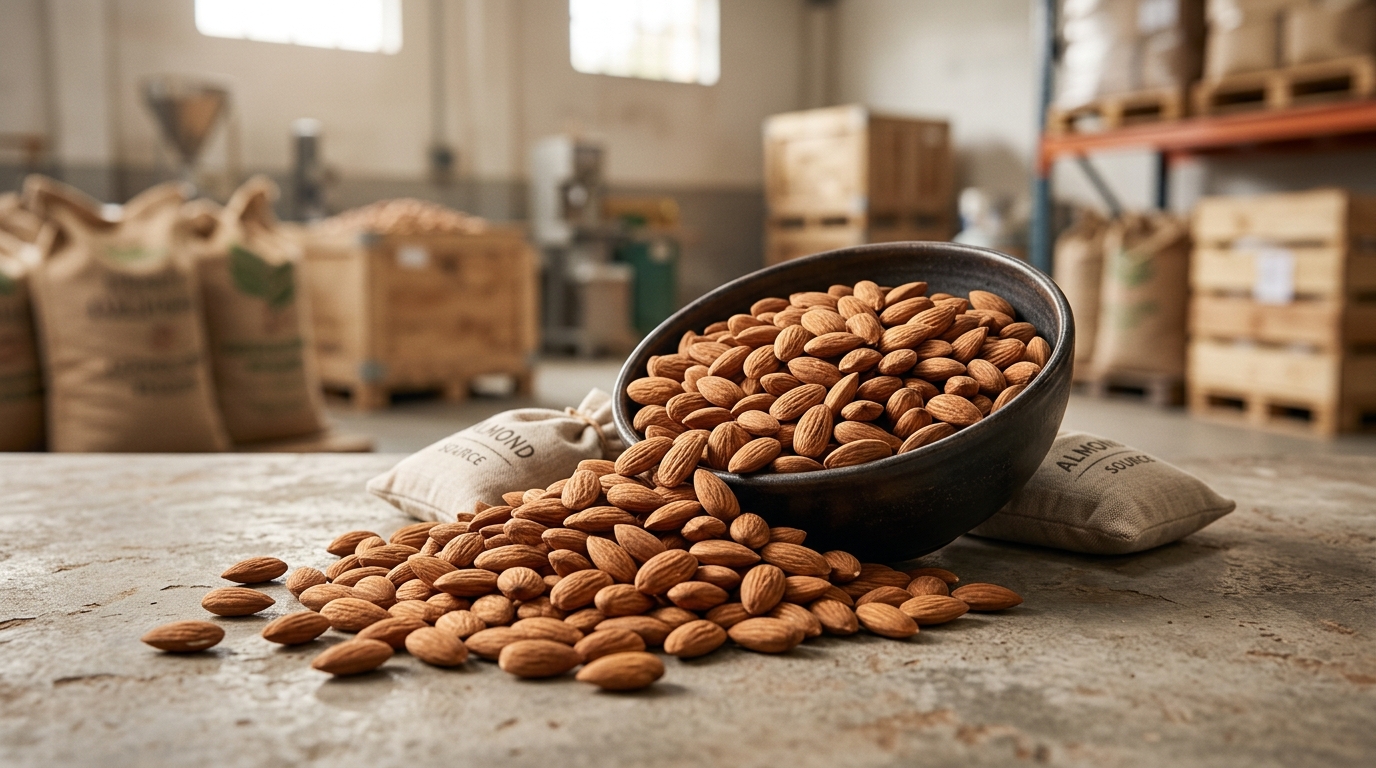
almonds Cover
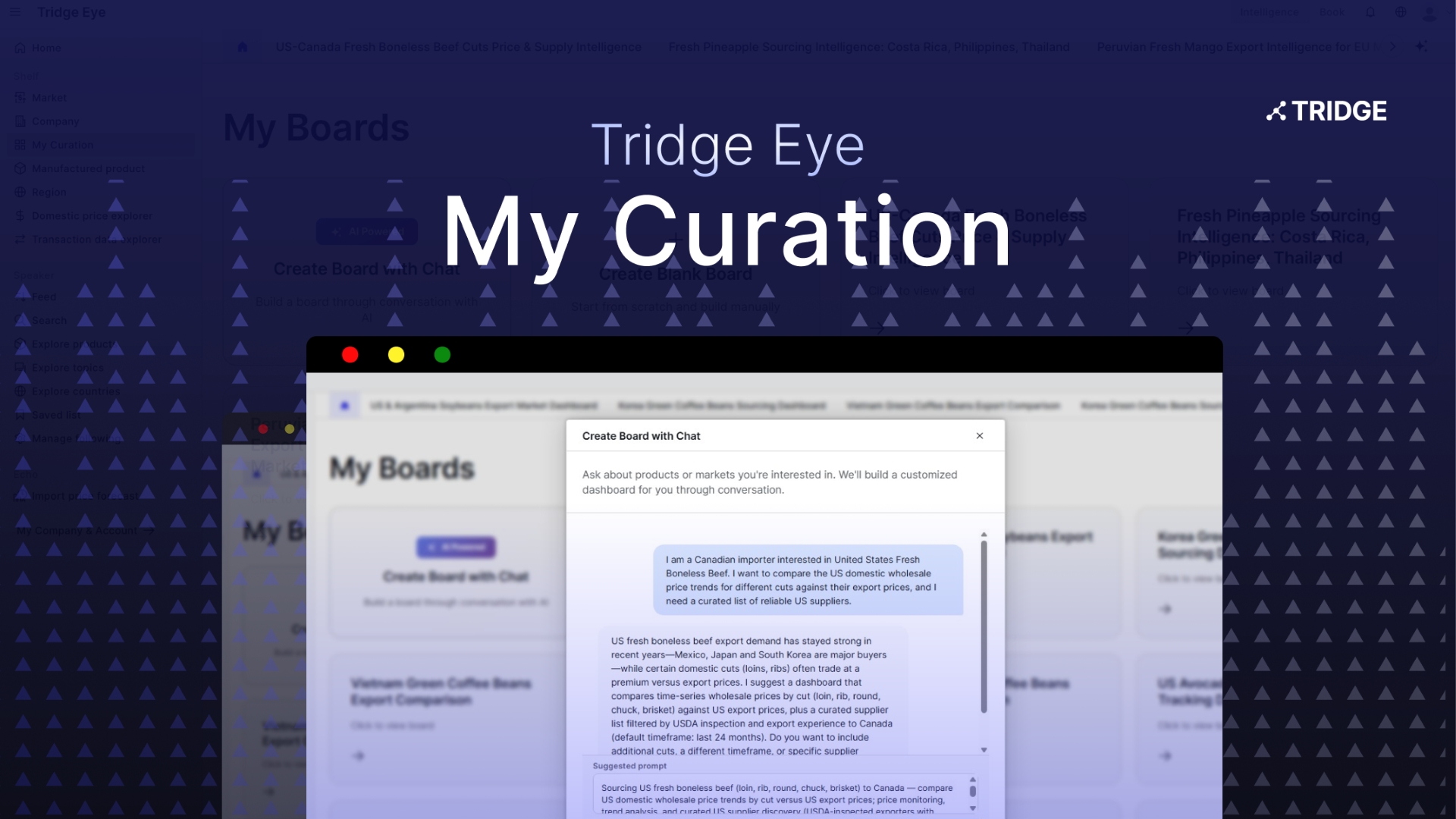
Tridge Eye Data Intelligence Solution

This report is powered by Tridge Eye Data Intelligence.

Every data point, price signal, and supply risk insight in this analysis comes from the same platform that procurement and sourcing leaders worldwide rely on daily. As you read, consider what this level of market intelligence could do for your sourcing decisions.

Explore Tridge Eye →

If you’re a procurement leader who’s strong in industrial categories but newer to almonds, the fastest way to get leverage is to stop treating almonds as “a kernel commodity” and start managing them as a harvest-driven, spec-managed food ingredient. Your outcomes (landed cost variance, continuity, and audit readiness) are usually driven as much by crop-year timing, processing capacity, and food-safety governance as by the headline kernel quote.

Executive Summary

  • Crop-year reality: Almond trade reporting and market rhythm commonly run on an Aug 1 – Jul 31 crop year, not a calendar year—this should anchor your contracting and allocation cadence. [1]
  • Harvest window (California): Harvest is typically August through mid-October, which resets new-crop availability and handler shipment pace. [2]
  • Mandatory Salmonella control (U.S.): The U.S. program under the federal marketing order requires treatment processes that achieve a minimum 4-log reduction of Salmonella, with mandatory compliance historically set at September 1, 2007—so treatment validation and segregation controls are governance-critical, not optional. [3]
  • Coproduct economics are real: A common industry reference point is that almond “tree fruit weight” splits roughly 31% kernels / 49% hulls / 20% shells, meaning coproduct monetization can influence handler economics and behavior. [4]
  • Procurement implication: For value-add forms (blanched/sliced/meal), conversion yield + capacity often explain price moves that don’t track kernel quotes.

Key Insights

Analyzed at: Apr, 2026

  • Strategy: Hold
  • Reliability: Medium
  • Potential Saving: 3% ~ 8%
  • Insight: Use the current window to rebalance contracts around the Aug–Jul crop-year cadence:
  • Keep core volume covered with validated-treatment, high-service suppliers.
  • Competitively bid a defined tranche (e.g., 15–30%) for whole/natural where switching friction is lowest.
  • Lock in or cap pricing earlier for capacity-constrained value-add (sliced/blanched) where conversion yield and line availability can dominate.
  • This typically reduces premium freight/spot buys and improves leverage without creating QA requalification bottlenecks.

1) What You’re Actually Buying: The Real Almond Supply Chain (Ground Truth)

If you’re used to metals, packaging, or industrial ingredients, almonds can look deceptively simple: a commodity kernel in a bag. In reality, almonds are a harvest-driven biological product with quality segmentation, mandatory food-safety treatment expectations (in the U.S. market), and processing capacity constraints that can change your delivered cost and continuity more than “kernel price” alone.

The physical flow (what happens to the product)

A left-to-right (or top-to-bottom) flow diagram showing the end-to-end physical flow: Orchard production → Harvest & field drying (Aug–mid-Oct) → Hulling & shelling (primary processing) → Food-safety treatment / Salmonella control (validated kill step; 4-log reduction requirement callout) → Secondary processing (blanched/sliced/meal/roasted) → Packaging & QA release (COA, moisture/defects/micro/allergen) → Logistics & distribution (ocean container + inland). Includes callout boxes for procurement levers: crop-year timing, processing capacity, and governance/food safety.
  1. Orchard production (California dominates many global industrial supply chains)
  2. Almonds are produced on trees; output is highly sensitive to weather during bloom, summer heat, and water availability.
  3. Harvest + field drying (Aug–mid-Oct in California)
  4. California harvest generally occurs between August and mid-October (variety and microclimate dependent). [2]
  5. Timing matters because new-crop availability, handler inventory, and shipment pace reset around this window.
  6. Hulling & shelling (primary processing)
  7. Hull removed, shell cracked, kernel separated; foreign material removed.
  8. This is where yield (crack-out) and defect sorting start to create commercial differences between suppliers.
  9. Food safety treatment / “pasteurization” (mandatory for many U.S. commercial channels)
  10. In the U.S., almonds under the federal marketing order’s outgoing quality requirements are subject to a mandatory Salmonella-control program requiring processes that achieve a minimum 4-log reduction (often referred to in industry as “pasteurization,” though the technical labeling nuances vary). [3]
  11. Practically: buyers must confirm process validation, lot traceability, and recontamination controls—this is not a paperwork-only step.
  12. Secondary processing (value-add forms)
  13. Blanching (skin removal), slicing/slivering/dicing, roasting, meal/flour, butter/paste.
  14. Each step adds cost and increases quality risk (breakage, oxidation, micro exposure).
  15. Packaging + QA release
  16. Moisture/FFA/rancidity, defect counts, micro specs, allergen controls, aflatoxin where required.
  17. Logistics & distribution
  18. Almonds move heavily via containerized ocean freight; landed cost can swing with freight, port constraints, and timing vs peak shipping windows.

The commercial flow (who holds power)

  • Handlers/processors (often in origin) control conditioning, inventory, and shipment execution.
  • Importers/distributors may add financing and inventory buffering.
  • Industrial end-users (bakery, confectionery, beverage, snacks) often buy by spec, not “almonds in general.”

Key takeaway: Almond procurement is less like buying a uniform commodity and more like buying a spec-managed food ingredient where crop-year timing + processing capacity + food safety governance determine your real risk and cost.

2) Where the Money Accumulates: Cost & Margin by Supply-Chain Node

Below is a practical, procurement-oriented view of where cost builds—iteration by node, with almond-specific cost drivers.

Node 1 — Orchard / Raw Material (on-tree almonds)

Key insight: Your “raw material” cost is dominated by yield volatility and irrigation/pollination intensity, not just acreage.

  • Cost drivers you feel downstream
  • Yield swings (weather during bloom; heat events; pest/disease pressure).
  • Water and energy costs (irrigation pumping, compliance).
  • Pollination services (managed bees) and timing.
  • What procurement should watch
  • Crop outlook updates and objective measurements (because they move seller posture and basis).
  • Regional water/climate stress indicators.

Node 2 — Primary Processing (hulling/shelling/sorting + storage)

Key insight: Primary processing is where yield (crack-out) and defect removal translate into real COGS differences between suppliers.

  • Cost drivers
  • Crack-out % (kernel yield from in-shell).
  • Optical sorting intensity (foreign material, insect damage, chips).
  • Working capital for inventory carry (handlers finance the crop to ship year-round).
  • Almond-specific reality check
  • A commonly cited Almond Board reference point shows the full weight of almond tree fruit as roughly Kernels: 31% / Hulls: 49% / Shells: 20%. [4]
  • This matters because coproduct monetization can partially offset processing economics and influences handler behavior.

Node 3 — Food Safety Treatment (mandatory treatment / pasteurization programs)

Key insight: Food safety treatment is a non-negotiable governance cost in many U.S. channels, and it can create a hidden “quality-of-supply” premium.

  • Cost drivers
  • Validated treatment step, monitoring, documentation.
  • Segregation to prevent recontamination.
  • Testing and audit readiness.
  • Why procurement cares
  • Supplier capability here affects border risk, customer complaint risk, and recall exposure more than it affects invoice price.

Node 4 — Secondary Processing (blanched, sliced, slivered, diced, meal/flour, roasted)

Key insight: Value-add forms are where yield loss and breakage become material, and where capacity bottlenecks show up first.

  • Cost drivers
  • Blanching energy/water and skin-loss yield.
  • Cutting/slicing breakage and tighter defect tolerances.
  • Oxidation control (especially for roasted products).

Node 5 — Packaging & QA release

Key insight: Packaging is not “just packaging” for almonds—barrier properties and QA release discipline directly affect shelf life and claims.

  • Cost drivers
  • Barrier films/cartons, nitrogen flush for some SKUs.
  • QA specs: moisture, defects, micro, allergen controls.
  • Market-specific contaminant requirements.

Node 6 — Logistics & distribution (to your dock)

Key insight: Landed cost variance is often driven by freight + inventory timing rather than kernel price alone.

  • Cost drivers
  • Ocean freight + inland drayage.
  • Port congestion/availability.
  • Inventory carrying cost (especially when buying ahead of crop uncertainty).

Product-level cost build (illustrative, procurement modeling view)

A stacked bar chart with one bar per product form: Raw kernels (natural, whole), Blanched whole kernels, Sliced/slivered almonds, Almond meal/flour, Roasted kernels. Each bar is segmented by cost node: Farm/Raw Material, Primary Processing, Food Safety Treatment, Secondary Processing, Packaging & QA, Logistics & Distribution, using the exact illustrative percentages shown in the table. Includes a footnote label: “Illustrative ratios; actuals vary by origin/spec/terms/freight/crop tightness.”

Assumptions: illustrative ratios to show where cost concentrates by form; actuals vary by origin, spec, contract terms, freight, and crop tightness.

Product Form (Delivered to Industrial Buyer) Farm/Raw Material Primary Processing Food Safety Treatment Secondary Processing Packaging & QA Logistics & Distribution Typical Notes
Raw kernels (natural, whole) 55% 15% 5% 0% 5% 20% Most price-sensitive to crop outlook; freight can dominate landed variance in disruption years.
Blanched whole kernels 45% 12% 4% 18% 6% 15% Blanching adds cost + yield loss; tighter color/skin specs.
Sliced/slivered almonds 40% 10% 4% 25% 6% 15% Cutting yield/breakage + capacity constraints; specs drive premium/penalties.
Almond meal/flour 42% 12% 4% 20% 7% 15% Particle size + fat content specs; higher QA/testing frequency.
Roasted kernels 45% 12% 0% 18% 8% 17% Roasting can function as a kill step in many validated processes; oxidation/shelf-life management becomes key.

3) The Structural Fact Most Procurement Teams Underestimate

Almonds are managed on a crop-year clock, not a calendar-year clock. The Almond Board of California’s position reports follow a crop year of August 1 to July 31, aligned to harvest and shipment cycles. [1]

Why that matters operationally:

  • New crop resets availability, seller leverage, and quality mix.
  • Inventory coverage and shipment pace become “market signals” that change negotiation posture.
  • Contract timing (fix vs float) should be designed around that crop-year rhythm.

4) The Critical Insight: Why “Kernel Price” and Your Delivered Cost Disconnect

Procurement teams often expect a clean pass-through: if kernel prices fall, delivered cost should fall. Almonds break that assumption for four structural reasons:

  1. Form conversion amplifies non-kernel costs
  2. Sliced/blanched/meal pricing is often driven by processing capacity and yield loss, not only kernel input.
  3. Food safety governance creates a capability premium
  4. Suppliers with stronger validated treatment controls and documentation tend to reduce disruption and claims risk (a cost that doesn’t show up in the commodity quote).
  5. Regulatory and border-risk costs are destination-specific
  6. Aflatoxin limits differ by market; the EU framework (e.g., Regulation (EU) 2023/915) is commonly referenced as tighter than U.S. norms, increasing rejection/rework/testing risk for some trade lanes and customer segments. [5]
  7. Freight + timing can dominate landed cost variance
  8. When container availability or port flow is constrained, the “cheapest” origin quote can become the most expensive landed outcome.

Net: Your price model must separate (a) kernel input economics from (b) conversion/capability economics and (c) logistics/timing economics.

5) Where Procurement Teams Typically Get Almonds Wrong (Common Failure Modes)

  1. Treating all suppliers as interchangeable “kernel sellers”
  2. Reality: suppliers differ materially in sorting rigor, lot traceability, treatment validation discipline, and value-add capability.
  3. Over-allocating to the lowest quote without concentration guardrails
  4. California’s dominance means you can be “multi-supplier” but still effectively single-region exposed.
  5. Using last year’s spec as immovable
  6. In tight markets, spec rigidity forces spot buying or premium freight. Strategic spec-flex (pre-approved by QA/R&D) can be cheaper than emergency sourcing.
  7. Scorecarding only price and OTIF
  8. Missing KPIs: defect drift, complaint rate, rework frequency, documentation cycle time, responsiveness during holds.
  9. Waiting for disruption to qualify alternates
  10. For almonds, QA qualification lead times are real; switching under pressure increases food-safety and brand risk.

6) What Changes When You Run Almond Sourcing with Intelligence (Decision-First)

This is where an intelligence-driven service changes outcomes—not by “predicting prices,” but by tightening decisions and governance.

A) If your decision is contracting posture (fix vs float, when to buy)

Use price intelligence & driver tracking to:

  • Tie contracting windows to crop-year signals (Aug–Jul cycle) and shipment pace.
  • Separate raw-kernel exposure from value-add conversion exposure.
  • Reduce ad-hoc spot buys that usually carry hidden costs (freight, rework, higher defect risk).

Outcome metrics: landed cost variance, % spend on spot, premium freight incidence.

B) If your decision is supplier portfolio design (dual sourcing, allocation, contingency)

Use supplier discovery + alternative identification to:

  • Build a ready shortlist by form (natural whole vs blanched vs sliced) and by capability (treatment validation, sorting technology, packaging formats).
  • Design guardrails (e.g., max share per supplier; contingency coverage by SKU).

Outcome metrics: time-to-switch, concentration risk (% top-2 suppliers), continuity incidents.

C) If your decision is governance (QBRs, performance accountability)

Use benchmarking + governance analytics to:

  • Standardize scorecards across plants/brands.
  • Track leading indicators (holds, COA cycle time, defect drift) alongside OTIF.

Outcome metrics: complaint rate, hold/release cycle time, corrective action closure time.

Trade-off to make explicit: diversification increases qualification workload (QA, supplier onboarding). Intelligence helps you target the shortlist so you diversify where it matters (highest-risk forms/specs) without exploding admin burden.

7) Strategic Use Cases Procurement Leaders Actually Run in Almonds

Use case 1 — Reduce cost volatility without increasing continuity risk

  • Situation: leadership wants savings; operations cannot tolerate shortages.
  • Intelligence-led approach:
  • Segment spend by form (whole vs sliced vs blanched).
  • Define contract mix by segment (more fixed for constrained value-add; more flexible for whole kernels if coverage is strong).
  • Benchmark incumbents vs credible alternates on quality drift and service—not just price.
  • Measurable outcomes: lower landed-cost variance, fewer emergency buys, stable service levels.

Use case 2 — Pre-qualify alternates before disruption hits

  • Situation: a supplier outage, port issue, or crop-quality shift forces switching.
  • Intelligence-led approach: maintain an “always-ready” shortlist by SKU/spec with documented QA requirements and lead times.
  • Measurable outcomes: faster switching, lower compliance risk, better leverage in tight markets.

Use case 3 — Strengthen governance and audit readiness

  • Situation: inconsistent supplier management across sites.
  • Intelligence-led approach: unified supplier scorecards + risk monitoring triggers + QBR cadence.
  • Measurable outcomes: fewer surprises, cleaner audits, tighter approved-supplier compliance.

8) Why This Matters Beyond Almonds (For the Categories You Likely Also Buy)

The same intelligence patterns show up in other procurement-relevant food ingredients where biology + processing capability + regulation break simple commodity logic:

  • Cocoa (liquor/butter/powder): processing ratios and origin risk can decouple bean price from delivered ingredient price.
  • Coffee (green vs roasted/ground): conversion yield, freshness, and logistics timing change total cost and service.
  • Dairy powders (skim milk powder, whey): plant capacity, specs, and regulatory constraints can dominate price moves.
  • Spices (paprika, turmeric): contamination/adulteration risk makes supplier governance as important as unit price.

If your organization is building a broader “resilient ingredients” program, almonds are a strong template because they force cross-functional alignment between procurement, QA, operations, and finance.

9) Why Almonds Make a High-Impact Proof Point for Prospective Customers

Almonds are a powerful example because they compress multiple procurement realities into one category:

  • Concentration + seasonality: crop-year timing (Aug–Jul) and harvest window dynamics are explicit. [1]
  • Capability-driven cost: slicing/blanching capacity and yield loss are real cost levers.
  • Governance-critical food safety: validated treatment expectations and documentation discipline materially change risk exposure. [3]
  • Coproduct economics: kernel/hull/shell splits are material to handler economics. [4]

For procurement leadership, that means an intelligence-driven approach can show measurable improvements across:

  • Total landed cost stability (not just price)
  • Supply continuity (time-to-switch, fewer disruptions)
  • Governance and audit readiness (consistent supplier accountability)
Tridge Eye Data Intelligence Solution

Make Faster, Data-Driven Sourcing Decisions

The insights in this report are just the starting point. Tridge Eye is the data intelligence solution that gives procurement and sourcing leaders real-time market signals, price benchmarks, and supply risk alerts — so you can act before the market moves.
Explore Tridge Eye →

References

  1. almonds.org
  2. almonds.org
  3. pmc.ncbi.nlm.nih.gov
  4. almonds.org
  5. bfr.bund.de
Subscribe
By subscribing you agree to with our Privacy Policy and provide consent to receive updates from our company.
Thank you! Your submission has been received!
Oops! Something went wrong while submitting the form.
Subscribe to receive the latest blog posts, updates, promotions, and announcements from Tridge.