Açaí powder sourcing looks deceptively simple until you map where perishability, water removal, and documentation controls actually “lock in” cost and risk. This guide walks procurement and sourcing managers through the physical chain (berry → pulp → powder), the two structural choke points (frozen pulp and drying capacity), and how to write specs and contracts that prevent avoidable rejects, expediting, and supply interruptions.
Açaí powder is not a simple “fruit-in, powder-out” chain. It is a two-step stabilization problem: first you must convert ultra-perishable berries into pulp fast enough to avoid fermentation and oxidation; then you must remove water (dehydration) without destroying color and key bioactives. Those two stabilization steps—pulping/freezing and drying—are where the largest fixed cost drivers sit.
Insight: The physical chain is designed to beat time, water, and oxygen—because berries spoil quickly, pulp is mostly water, and pigments oxidize.
Data: Published literature commonly reports that the edible pulp is a small fraction of fruit weight and that the seed/residue is the dominant mass fraction (often cited around ~60–85% depending on definition and maturity), constraining edible yield and forcing high-throughput pulping to make the economics work.
Procurement Impact: Even before “powder” exists, cost and quality are largely determined upstream by (1) time-to-pulping, (2) freezing reliability, and (3) the chosen drying route (freeze-dry vs spray-dry with carriers).
Quick Win: When mapping risk and cost, treat frozen pulp and drying capacity as the two “choke points”—they dictate how quickly the chain can recover from any upstream disruption.
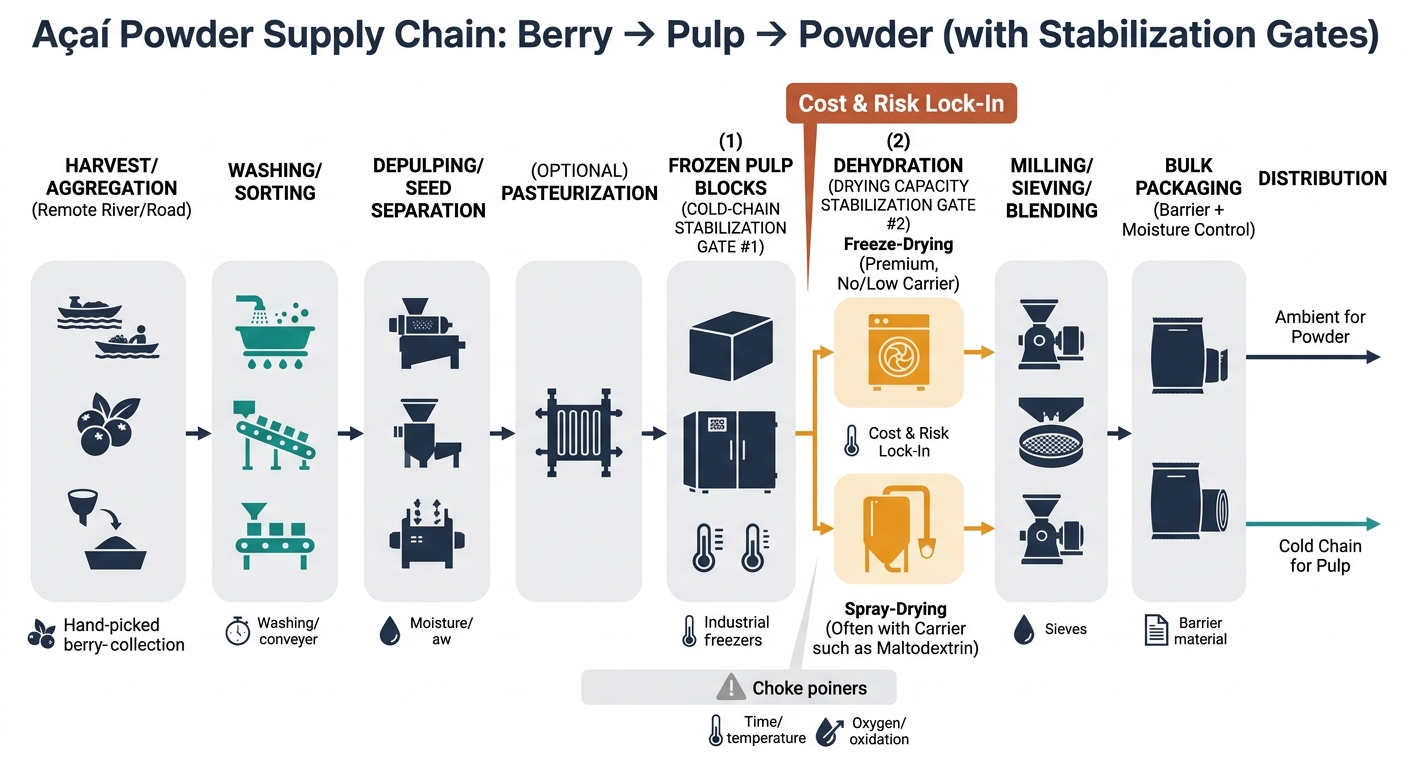
Insight: Açaí powder’s landed cost is the sum of many small frictions (remote logistics, yield loss, energy, QA), but two nodes dominate structurally: cold-chain pulp stabilization and dehydration energy/capex.
Data: Açaí pulp is high-moisture, so every kg of finished powder represents a large mass of water removed plus tight control to prevent quality loss; academic studies on açaí pulp drying report low final powder moisture targets (often <5%) and show freeze drying can preserve pigments better than higher-heat methods.
Procurement Impact: The supply chain naturally creates a two-tier product market: premium freeze-dried powders (higher cost, better color retention) vs spray-dried powders (lower cost, often with carriers like maltodextrin).
Insight: Upstream economics are constrained by biology and geography: berries are highly perishable and harvested in dispersed Amazon river systems.
Data: Açaí fruit contains a very high seed fraction (commonly reported as the majority of fruit mass), limiting pulp yield and increasing the amount of fruit that must be moved and processed per kg of powder.
Procurement Impact: This node structurally embeds (a) high handling intensity, (b) spoilage loss risk, and (c) variability in incoming raw material—showing up downstream as color and flavor variance lot-to-lot.
Insight: This is the first “stabilization gate.” If pulp isn’t produced and frozen fast and cleanly, downstream drying cannot “fix” oxidation, microbial load, or off-notes.
Data: Industrial and academic sources describe depulping as generating a large seed/residue stream because the seed is the dominant fraction of the fruit.
Procurement Impact: Primary processing is where hidden costs accumulate: sanitation, water treatment, freezing energy, cold storage, and yield loss. Failures here typically surface later as COA non-conformance or shelf-life complaints.
Insight: Drying is the dominant transformation cost because it is energy-intensive and determines the powder’s functional “identity” (color, aroma, solubility, carrier content).
Data: Spray-drying açaí commonly uses carrier solids (e.g., maltodextrin) to improve powder recovery and reduce stickiness; published spray-drying studies explicitly evaluate carrier proportion effects on moisture, water activity, yield, and solubility.
Procurement Impact: The drying route structurally sets what you must control in specs and QA: freeze-dried powders tend to preserve premium attributes but at higher capex/energy; spray-dried powders often trade “potency per kg” for cost and flowability (and may include declared carriers).
Insight: Finished powder quality is often “made” here through particle size control, blending to hit color/potency targets, and moisture protection.
Data: Across fruit powders, moisture content and water activity are repeatedly managed outcomes because they drive caking and stability; drying/carrier choices measurably shift these parameters.
Procurement Impact: This node drives the practical differences buyers experience: flowability, dusting, dispersibility, and shelf-life. Packaging design (barrier films, liners, desiccants, nitrogen flush) is not cosmetic—it is a stability control.
Insight: Powder can ship ambient, but it is humidity-sensitive; pulp requires cold chain and is exposed to reefer availability and power continuity.
Data: Food safety guidance for produce supply chains consistently emphasizes time/temperature control principles; for high-moisture intermediates (like pulp), temperature excursions are a predictable driver of quality and micro risk.
Procurement Impact: Logistics costs are not just freight: they include quality preservation (humidity control, container desiccants), insurance, and the cost of longer lead times (working capital tied up in inventory).

| Supply Chain Node | Cost Ratio (% of Final Cost) | Notes |
|---|---|---|
| Upstream Harvest & Aggregation | 18% | Labor + first-mile logistics; yield loss risk due to perishability and seed-heavy fruit. |
| Primary Processing (Pulping + Freezing) | 20% | Sanitation, extraction yield, freezing energy, cold storage reliability. |
| Secondary Processing (Freeze-Drying) | 32% | Highest energy + capex intensity; long cycle time drives structural cost. |
| Finishing (Milling/Blending) + Packaging & QA | 15% | Particle size control, lab testing, high-barrier packaging to protect pigments. |
| Logistics & Distribution | 15% | Ambient shipping but humidity control; longer lead times and inventory carrying costs. |
| Supply Chain Node | Cost Ratio (% of Final Cost) | Notes |
|---|---|---|
| Upstream Harvest & Aggregation | 16% | Similar upstream constraints; some buffering possible via blending and solids basis. |
| Primary Processing (Pulping + Freezing) | 18% | Still a major stabilization gate; pulp quality dictates powder outcomes. |
| Secondary Processing (Spray-Drying + Carrier) | 24% | Higher throughput than freeze-dry; carrier cost + process controls for stickiness and recovery. |
| Finishing + Packaging & QA | 17% | Flowability and moisture control are central; label/claim management if carrier used. |
| Logistics & Distribution | 25% | Higher share when shipping longer distances and managing moisture exposure; claims and QA release can add dwell time. |
| Supply Chain Node | Cost Ratio (% of Final Cost) | Notes |
|---|---|---|
| Upstream Harvest & Aggregation | 22% | Perishability and first-mile constraints dominate. |
| Primary Processing (Pulping + Freezing) | 38% | Freezing + cold storage are the core value-add and cost center. |
| Packaging & QA | 10% | Food-contact packaging, seal integrity, micro testing, traceability documentation. |
| Cold-Chain Logistics & Distribution | 30% | Reefer freight, port dwell risk, temperature excursions, higher insurance. |
Insight: Açaí powder’s variability is not primarily a supplier discipline issue—it is rooted in biology (seed-heavy fruit), geography (remote collection), and physics (water removal + oxidation).
Data: (1) Many technical sources describe seeds/residue as the dominant fraction of the fruit by weight, structurally constraining pulp yield. (2) USDA FAS (Mar 13, 2026) reports that ~90% of harvest occurs in the “100-day season,” typically beginning Aug/Sep and lasting to Nov/Dec.
Procurement Impact: Specs, QA plans, and packaging requirements should be built to absorb predictable variance (seasonal, moisture-driven, oxidation-driven), not just to police it.
Quick Win: In your internal material master data, separate SKUs by drying method + carrier presence (even if marketing names are similar). It prevents downstream confusion in QA release and formulation performance.
(Analyzed at: Apr, 2026)
Write your next açaí powder contract as if you’re buying a process-defined material, not a generic fruit powder: lock the drying method, explicitly cap/declare carrier type and %, and set moisture + water activity limits with packaging requirements that prevent humidity pickup in transit. This works because USDA FAS still describes a highly concentrated “100‑day season” (Aug/Sep–Nov/Dec) that pushes suppliers to allocate and blend aggressively, and because the seed-heavy fruit economics mean upstream variability can’t be “QA’d out” later. Teams that tighten identity-and-stability controls typically avoid the expensive failures—blocked receipts, rework, and expedited replacements—that can easily add mid-single-digit percentages to annual açaí spend even when the unit price looks unchanged.